Air Temperatures – The following maximum temperatures were recorded across the state of Hawaii Thursday:
Lihue, Kauai – 85
Honolulu airport, Oahu – 87 (record for Thursday – 92 in 1987)
Kaneohe, Oahu – 79
Molokai airport – 83
Kahului airport, Maui – 85
Kona airport 86
Hilo airport, Hawaii – 81
Air Temperatures ranged between these warmest and coolest spots near sea level – and on the highest mountain tops…as of 5pm Thursday evening:
Barking Sands, Kauai – 85
Hilo, Hawaii – 79
Haleakala Crater – 46 (near 10,000 feet on Maui)
Mauna Kea Summit – 43 (over 13,500 feet on the Big Island)
Here are the 24-hour precipitation totals (inches) for each of the islands as of Thursday afternoon:
0.15 Mount Waialeale, Kauai
0.08 Manoa Lyon Arboretum, Oahu
0.00 Molokai
0.00 Lanai
0.00 Kahoolawe
0.12 West Wailuaiki, Maui
0.12 Hilo airport, Big Island
Marine Winds – Here’s the latest (automatically updated) weather map showing a 1034 millibar high pressure system far to the northeast of our islands. Our local trade winds will remain active through Saturday.
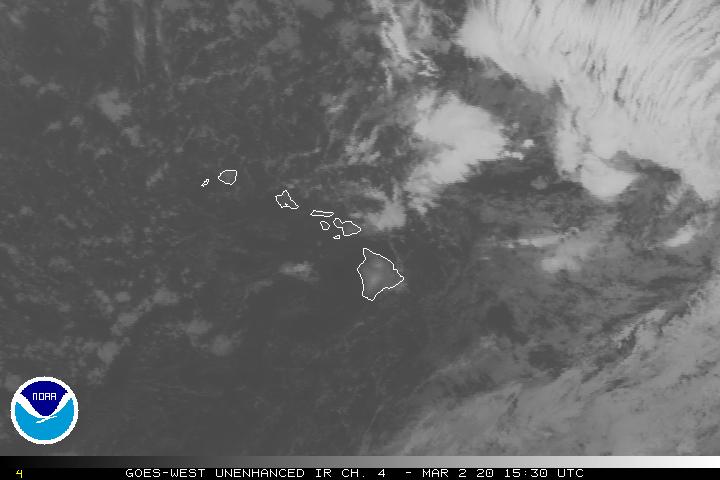
Satellite and Radar Images: To view the cloud conditions we have here in Hawaii, please use the following satellite links, starting off with this Infrared Satellite Image of the islands to see all the clouds around during the day and night. This next image is one that gives close images of the islands only during the daytime hours, and is referred to as a Close-up visible image. Finally, here's a Looping IR satellite image, making viewable the clouds around the islands 24 hours a day. To help you keep track of where any showers may be around the islands, here’s the latest animated radar image.
Hawaii’s Mountains – Here’s a link to the live web cam on the summit of near 13,500 foot Mauna Kea on the Big Island of Hawaii. The tallest peak on the island of Maui is the Haleakala Crater, which is near 10,000 feet in elevation. These two web cams are available during the daylight hours here in the islands…and when there’s a big moon shining down during the night at times. Plus, during the nights you will be able to see stars, and the sunrise and sunset too…depending upon weather conditions.
Tropical Cyclone activity in the eastern and central Pacific – Here’s the latest weather information coming out of the National Hurricane Center, covering the eastern north Pacific. You can find the latest tropical cyclone information for the central north Pacific (where Hawaii is located) by clicking on this link to the Central Pacific Hurricane Center. A satellite image, which shows the entire ocean area between Hawaii and the Mexican coast…can be found here. Here's a tropical cyclone tracking map for the eastern and central Pacific.
Aloha Paragraphs

Increasing showers locally into Friday, with returning nice
trade wind weather pattern later Saturday into Sunday…
onwards into next week.
The trade winds will remain moderately strong Thursday, easing up some Friday…then increasing again into the upcoming weekend and beyond. Glancing at this weather map, we find a 1034 millibar high pressure system, located far to the north-northeast of our islands Thursday night. This map also shows the short dashed red line…which is the approaching trough of low pressure. We have a small craft wind advisory active between Maui and the Big Island, in the Alenuihaha Channel, also for Maalaea Bay, Maui…and the channel between Molokai and Maui too.
Our trade winds will remain active…the following numbers represent the strongest gusts (mph), along with directions Thursday evening:
30 Port Allen, Kauai – ENE
28 Honolulu, Oahu – NE
27 Molokai – NE
21 Kahoolawe – NE
23 Kapalua, Maui – NE
25 Lanai – NE
30 South Point, Big Island – NE
We can use the following links to see what’s going on in our area of the north central Pacific Ocean Thursday night. Looking at this NOAA satellite picture we find low level clouds, which are generally out over the ocean, although stretching over the windward sides of the islands more frequently now. We can see a larger cloud clump to the northeast of the Big Island, and to the east of Maui. We can use this looping satellite image to see lower level clouds being carried along in the low level wind flow. A random thunderstorm was evident to the west-northwest of Kauai…over the ocean well offshore. Checking out this looping radar image we see increasing showers being carried along in the wind flow, bringing moisture to the windward sides.
Sunset Commentary: A trough of low pressure is located just to our east, which will be riding in over us on the trades this evening, into the night and on into Friday. This trough can be seen on this satellite image, not too far to the northeast of the Big Island and Maui at the time of this writing. If we put this satellite picture into the looping mode, we can see what looks like some deepening cumulus clouds around the center of this large cloudy area.
We can see cloud plumes coming off the leeward sides of Maui County and the Big Island too. At the same time, we see a northwest drift of this showery area of clouds. This larger clump may give some nice showers to the central islands, and then on to Kauai with time. There is a tail to this clump that looks like it will come into the Big Island as well. The bottom line here is that we could use the precipitation, given the fact that we’re pushing through our dry season of the year. At the time of this writing, the animated radar image is starting to show more showers arriving now, which will continue tonight and Friday too…we will be seeing the radar screen light up with rain showers more often now
As this trough of low pressure swings by, likely by later this coming weekend, we’re expected to shift right back into weather that's more typical of our summer season. This of course means the normal trade wind weather pattern wording. We all know the drill: moderately strong trade winds, passing windward showers, with a few making it over to the leeward sides at times…especially during the night and early morning hours. This typical early August weather regime will continue into next week, and unless another upper level low pressure system, or a surface trough of low pressure moves over us, we’re looking good well into the future.
Here in Kihei, Maui, at around 530pm HST Thursday evening, skies were partly cloudy. The trade winds were stronger than normal for this time of day, as the wind direction is more northeasterly. The approaching trough of low pressure is enhancing our local trade wind speeds as well. It will be interesting to see what influence that this trough of low pressure has on our local weather. It is expected to increase our showers, and we could use them in most areas of the state. We'll know more by the morning just how things are going in this regard, and how much rainfall has impacted our islands. I'll be back early Friday morning with your next new weather narrative, I hope you have a great Thursday night until then! Aloha for now…Glenn.
Interesting: An exceptional wildfire in northern Alaska in 2007 put as much carbon into the air as the entire Arctic tundra absorbs in a year, scientists say. The Anaktuvuk River fire burned across more than 400 square miles, doubling the extent of Alaskan tundra visited by fire since 1950. With the Arctic warming fast, the team suggests in the journal Nature that fires could become more common.
If that happens, it could create a new climate feedback, they say. Fires in the tundra are uncommon because the ground is covered in snow and ice for large periods of the year. “Melting can lead to other huge changes… releasing carbon that's been frozen since the Pleistocene” Temperatures are low even in summer, and the ground can also remain wet after the ice has melted.
But 2007 saw unusually warm and dry conditions across much of the Arctic – resulting, among other things, in spectacularly fast melting of Arctic sea ice. This created conditions more conducive to fire, and when lightning struck the tundra in July, the Anaktuvuk River fire ignited.
"Most tundra fires have been very small – this was an order of magnitude larger than the historical size," said Michelle Mack from the University of Florida in Gainesville, who led the research team on the Nature paper and is currently conducting further field studies in Alaska.
"In 2007, we had a hot, dry summer, there was no rain for a long period of time. "So the tundra must have been highly flammable, with just the right conditions for fire to spread until the snow in October finally stopped it." According to the team's calculations, the statistics of the fire are remarkable. It is the largest on record, doubling the cumulative area burned since 1950.
It put carbon into the atmosphere about 100 times faster than it usually escapes from the ground in the Arctic summer, and released more than 2 million tons. Although a small contribution to global emissions, this is about the same amount as the entire swathe of tundra around the Arctic absorbs in a single year. There is some vegetation on the summer lands, which did burn; but the main fuel is carbon in the ground itself.
The Anaktuvuk fire burned down to a maximum depth of 15cm (6in), and was burning carbon sequestered away over the last 50 years. What this implies for the future is uncertain. Climate models generally predict warmer temperatures across the Arctic, which could increase the frequency of fires and so a net loss of carbon into the atmosphere – reinforcing global warming.
On the other hand, plant life could flourish under these conditions, potentially increasing absorption and sequestering of carbon from the atmosphere. In a news story published well before the Nature paper came out, another of the US research team, Gaius Shaver from the Marine Biological Laboratory in Woods Hole, said the northern region of Alaska could become "vastly different from the frozen, treeless tundra of today. "And it's one that may feedback positively to global climate change."
On reflection …
Another impact of the fire that has yet to be fully assessed is that the blackened soil absorbs more solar energy than normally vegetated tundra. This abets melting of the permafrost layer below. "Once permafrost melts beyond a certain depth on a slope, then all of the organic layer slides down the slope like a landslide," Dr Mack told BBC News.
"This whole issue of melting can lead to other huge changes in drainage, in areas of wetlands – releasing carbon that's been frozen since the Pleistocene [Epoch, which ended more than 10,000 years ago]." The latest data on Arctic sea ice, meanwhile, reveals that 2011 could well see a melting season that will beat the 2007 record.
Currently, about the same area of sea is covered in ice as at the same point in 2007, which the US National Snow and Ice Data Center (NSIDC) ascribes to "persistent above-average temperatures and an early start to [the] melt".
Interesting2: Researchers believe that several of the largest volcanic eruptions in Earth's history were fueled by magma from a primitive reservoir in the mantle that has remained unchanged for 4.5 billion years, a remnant of the material that formed the early Earth. Punctuating the last 250 million years, these staggering eruptions sometimes lasted several million years and were so large that a single event could double the total amount of magma on the Earth's surface.
The most recent of the resulting formations (called flood basalts) is found on Baffin Island in Canada and West Greenland, created by eruptions 62 million years ago. Samples from here gave researchers the first indication that the ancient mantle reservoir existed.
In a report published last year, researchers found unexpected element concentrations and isotope ratios that matched what is predicted for the primitive mantle — the homogeneous matter that surrounded the Earth's newly-formed metal core before the mantle cooled enough to separate the crust from the modern mantle.
In the new report, published Wednesday in Nature, the researchers find that world's other largest eruptions tapped this same reservoir.
"We decided to look at other flood basalts." said Matthew Jackson of Boston University who authored the new study with Richard Carlson of the Carnegie Institution of Washington.
They started with the biggest one, the Ontong Java plateau, a Pacific Ocean, undersea plateau the size of Alaska, 20 miles thick and as big as the other flood basalts combined. They studied its isotope ratios and element concentrations, as with the previous case.
"It had a lot of the same characteristics as the Baffin Island ones that we looked at last year" he said. They looked at four others around the world, with similar results.
Taken together, "The world's largest volcanic events in the last 250 million years all seem to have compositions that are consistent with sampling an early Earth reservoir," Jackson said.
The findings make sense, he notes, because the undisturbed, never-melted primitive mantle material would have retained high concentrations of radioactive elements to provide a lot of heat, as well as relatively high levels of easily melted materials, compared to already-depleted mantle reservoirs.
"Together these are the perfect recipe for generating enormous quantities of melt," Jackson said.
Recent work by others indicates that the largest volcanic events all erupted over one of two "superplumes" in the mantle, one under Africa and one in the South Pacific. It may be that these represent the locations of primitive mantle reservoirs, Jackson noted.
The findings also raise questions about what the Earth is made of, Jackson said. "We've always thought that Earth's primitive mantle would be the same as chondrites," carbon-containing meteorites thought to contain material formed in the early solar system. "People always thought the earth was just an agglomeration of chondrites."
But the new findings suggest Earth's early mantle does not have a chondritic origin. "If the Earth is not chondritic, we developed a very specific hypothesis for what its composition would be. Isotope compositions in Baffin Island lavas perfectly match that composition."
"If it is true, it is going to be a big paradigm shift," said Mukul Sharma of Dartmouth College in Hanover, NH. "All textbooks in geochemistry will have to be revised," Still, he added, other types of evidence need to be found before this can be confirmed.
Interesting3: A swell of modern humans outnumbered Neanderthals in Europe by nearly 10 to one, forcing their extinction 40,000 years ago, a study of French archeology sites suggests. Scientists have long debated what caused the Neanderthals to die off rather suddenly, making way for the thriving population of more advanced Homo sapiens who likely moved in from Africa.
The latest theory, published in the journal Science today, is based on a statistical analysis of artifacts and evidence from the Perigord region of southern France, where the largest concentration of Neanderthal and early modern human sites in Europe can be found.
Researchers at the University of Cambridge found more sites where modern humans settled, larger settlement areas, greater densities of tools and bigger amounts of animal and food remains, suggesting Neanderthals were crowded out. Homo sapiens also likely had more elaborate social networks and possibly sharper brains, as evidenced by the stone tools, jewellery and artwork they left behind which was much more advanced than Neanderthal creations.
Their arrival in such large numbers likely forced Neanderthals from their habitual settlements and into places where food and shelter were harder to find, said lead author Paul Mellars of Cambridge University. "It was clearly this range of new technological and behavioural innovations which allowed the modern human populations to invade and survive in much larger population numbers than those of the preceding Neanderthals across the whole of the European continent," he said.
"Faced with this kind of competition, the Neanderthals seem to have retreated initially into more marginal and less attractive regions of the continent." The last traces of Neanderthals, who had survived on the continent for some 300,000 years, have been uncovered in caves in modern-day Spain and Gibraltar. Mr Mellars suggested a final death blow may have been delivered by a harsh cold snap, a theory that has been debated in the scientific community for many years. The Neanderthals' extinction may have been "accelerated further by sudden climatic deterioration across the continent around 40,000 years ago", he said.
 Email Glenn James: