











April 21-22, 2010
Air Temperatures – The following maximum temperatures were recorded across the state of Hawaii Wednesday afternoon:
Lihue, Kauai – 76
Honolulu, Oahu – 83
Kaneohe, Oahu – 78
Kaunakakai, Molokai – 77
Kahului, Maui – 84
Hilo, Hawaii – 83
Kailua-kona – 81
Air Temperatures ranged between these warmest and coolest spots near sea level around the state – and on the highest mountains…at 4pm Wednesday afternoon:
Barking Sands, Kauai – 80F
Molokai airport, Maui – 72
Haleakala Crater – 46 (near 10,000 feet on Maui)
Mauna Kea summit – 41 (near 14,000 feet on the Big Island)
Precipitation Totals – The following numbers represent the largest precipitation totals (inches) during the last 24 hours on each of the major islands, as of Wednesday afternoon:
2.28 Mount Waialaele, Kauai
0.53 Oahu Forest NWR, Oahu
0.11 Molokai
0.00 Lanai
0.00 Kahoolawe
0.50 West Wailuaiki, Maui
1.27 Kawainui Stream, Big Island
Marine Winds – Here’s the latest (automatically updated) weather map showing a 1036 millibar high pressure system far to the northeast of the islands. This pressure configuration will keep our moderate to locally strong and gusty trade winds blowing Thursday…lighter Friday.
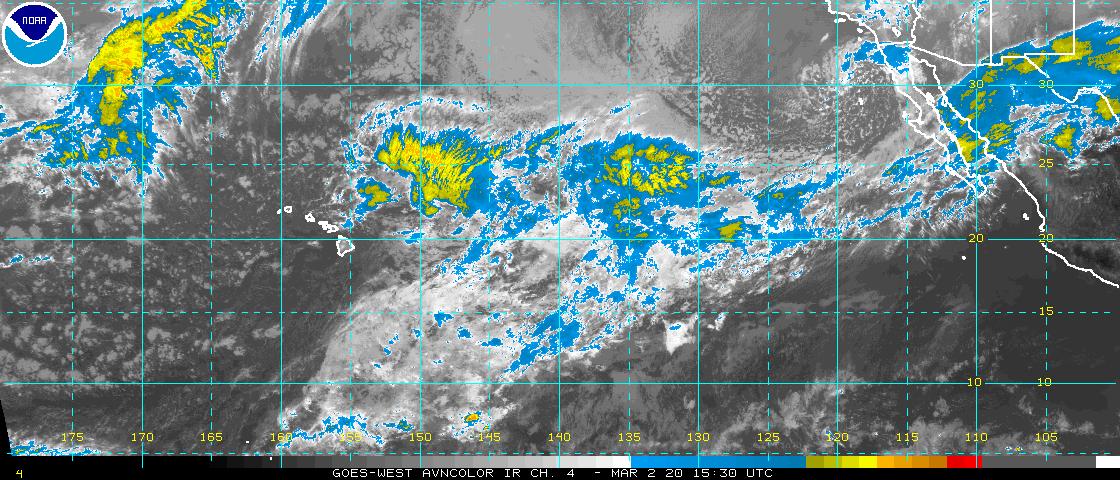
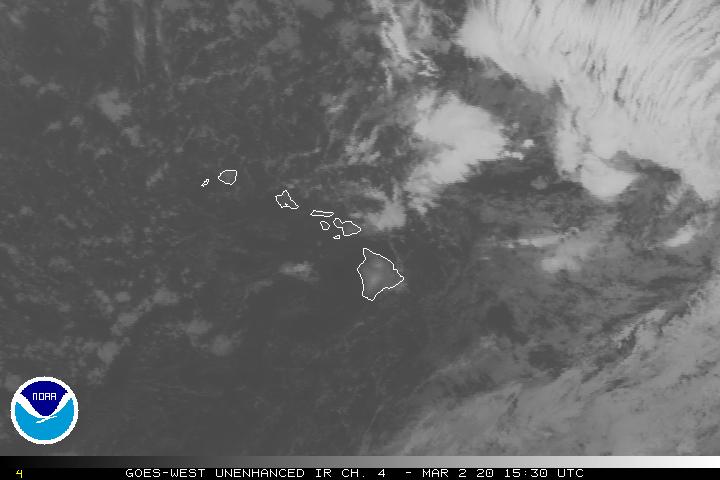
Satellite and Radar Images: To view the cloud conditions we have here in Hawaii, please use the following satellite links, starting off with this Infrared Satellite Image of the islands to see all the clouds around the state during the day and night. This next image is one that gives close images of the islands only during the daytime hours, and is referred to as a Close-up visible image. This next image shows a larger view of the Pacific…giving perspective to the wider ranging cloud patterns in the Pacific Ocean. Finally, here’s a Looping IR satellite image, making viewable the clouds around the islands 24 hours a day. To help you keep track of where any showers may be around the islands, here’s the latest animated radar image.
Hawaii’s Mountains – Here’s a link to the live webcam on the summit of near 14,000 foot Mauna Kea on the Big Island of Hawaii. The tallest peak on the island of Maui is the Haleakala Crater, which is near 10,000 feet in elevation. These two webcams are available during the daylight hours here in the islands…and when there’s a big moon rising just after sunset for an hour or two! Plus, during the nights and early mornings you will be able to see stars, and the sunrise too…depending upon weather conditions.
Tropical Cyclone activity in the eastern and central Pacific – Here’s the latest weather information coming out of the National Hurricane Center, covering the eastern north Pacific. You can find the latest tropical cyclone information for the central north Pacific (where Hawaii is located) by clicking on this link to the Central Pacific Hurricane Center. Here’s a tracking map covering both the eastern and central Pacific Ocean. A satellite image, which shows the entire ocean area between Hawaii and the Mexican coast…can be found here. Of course, as we know, our hurricane season won’t begin again until June 1st here in the central Pacific.
Aloha Paragraphs

Artistic Hawaiian Rain Forest…Barbara Freeland
The trade winds will continue to be on the breezy side Thursday, before easing off Friday into the weekend. We could have called the trade winds moderately strong today, with some blustery gusts locally…which will continue into Thursday. As we move into Friday and the weekend, and perhaps right into early next week too, our local winds will prevail in what we could call the light to moderately strong realms. The NWS forecast office has small craft wind advisories active across just those windiest coasts and channels around Maui and the
So, besides the trade winds, and their mild pull back in strength Friday, the other primary change we’ll see is…an increase in showers. This is already happening, especially along our windward sides
It’s Wednesday evening as I begin writing this last section of this morning’s narrative. The shower band moving through the state now, as noted above, will keep those windward sides moist. It appears that there are lots more showery clouds upstream of the islands too, which will serve to keep our showery weather happening into Friday. The computer models have been seeing this coming for quite a long time, attesting to their accurate forecasts. The winds are still rather gusty at this time, and as they are so strong, some of these showery clouds will cruise over into the leeward sides on the smaller islands. I notice that the NWS forecast office in Honolulu has just issued a high surf advisory for the north and west facing beaches too, which is active from Kauai down through Maui, skipping the Big Island at this time. ~~~ Here in Kihei, Maui, just before I take the drive back upcountry to Kula, it was quite cloudy, although warm of course. If anything unusual catches my eye on the way up there, I’ll come back online and let you know, otherwise I’ll meet you back here early Thursday morning, and hope you have a good night! Aloha for now…Glenn.
Interesting: Children race out of their classrooms onto green, fluffy grass playing fields. They tumble and slide, roll around and laugh. Their pants turn green from grass stains. They rub their eyes and faces. They drop water bottles and snacks onto the lawn. The lush grass helps to protect their knees from scrapes and guards them against serious injury. But the grass also could make them sick, according to environmental advocates and numerous scientific studies.
Many schools in the state use pesticides on their athletic fields to kill bugs, pests and weeds. A number of scientific studies have shown that exposure to pesticides can increase children’s risk for cancer, exacerbate asthma and trigger seizures. Environmental advocates are lobbying state lawmakers to ban pesticides, herbicides and fungicides on playgrounds and athletic fields in public and private schools and at day care centers.
The Legislature is expected to debate the bill today as part of a package of Earth Day legislation. It’s not clear if it will pass. It has died in the state Senate nine times before. Chemical companies are pressing lawmakers to vote against the bill. They say pesticides are highly regulated and safe to use. Children are especially susceptible to pesticides because of their small size and still-developing organs, according to the U.S. Environmental Protection Agency.
Rather than a purely chemical approach, the agency recommends schools use Integrated Pest Management, which combines several more organic and less toxic techniques to manage pests and weeds, such as over seeding, mowing grass taller, watering less and applying "compost tea," a liquefied form of compost.
"Put simply, IPM is a safer, and usually less costly option for effective pest management in a school community," EPA regulators said. A 2000 study by the state attorney general’s office, the most recent available, found that 87 percent of schools in New York use pesticides, with almost 65 percent using pesticides outdoors.
Interesting2: Most of the airspace across Europe has reopened after a six-day shutdown due to an Icelandic volcano eruption, and it appears the threat to aviation is over for now. The volcano has reentered a quieter stage currently, after a calm phase on March 20 and a violent-eruptive stage occurring on April 12. A plume of ash, dust and steam is seen coming from a volcano erupting beneath Iceland’s Eyjafjallajokull glacier, Wednesday, April 21, 2010 in Eyjafjallajokull, Iceland.
"It’s gone through three phases where we think it is going to stop, and the events have mitigated around the volcano," said Peter La Femina, Associate Professor of Geosciences at the Pennsylvania State University. However, scientists note that Eyjafjallajokull could keep erupting, but a time frame for cessation is relatively unknown.
"Currently, the seismicity shows that there’s still magma migrating through the system," said La Femina. "It could go on for a year; it could stop tomorrow. We just don’t know." La Femina explained that it is not uncommon for volcanoes to erupt for years, and the Icelandic volcano is of no exception.
"During the last eruption of Eyjafjnallajokull in 1821, the eruption actually lasted from 1821 to 1823," he said. While the London Volcanic Ash Advisory Center announced in its latest warning that there is "eruption continuing" from Eyjafjallajokull, volcanologists in Iceland said the volcano’s ash output has decreased by 80 percent since April 14.
Icelandic scientists also report that any ash content spewing for the volcano is "insignificant," which could have caused aviation officials to resume flights Wednesday. Aviation officials report that as many as 95,000 flights have been canceled since Thursday, when much of Europe’s airspace was initially closed.
Why Did the Icelandic Volcano Wreak Havoc on Aviation?
In light of the recent Icelandic volcano eruption that is responsible for one of the most costly and widespread aviation crises on record, how was this volcano able to cause such a travel nightmare? Eyjafjallajokull’s ash plume stalled aviation over Europe for more than five days because of the interaction between ice and lava during the eruption, as well as the lava composition, which is unique and influenced by the country’s glacial nature.
Eyjafjallajokull is a subglacial volcano, meaning the eruption occurs beneath the surface of an ice sheet. The heat of the lava from these volcanoes has the power to melt overlying ice, making lava flow much more easily. "The eruption did migrate to be subglacial, and that interaction with the glacial ice has been more explosive through fragmentation of the lavas," explained La Femina.
The volcano erupted in separate phases, with the first relatively calm phase taking place on March 20. However, the eruptions within the second phase occurring on April 12 were much more violent and spewed a much different type of lava than the previous phase did.
This dramatic change in eruption was possible because volcanoes emit lava of different consistencies, but predicting what type of consistency will result from an eruption is difficult. The interaction between the lava and the surrounding ice gives off steam, which propels ash more explosively than the slow-moving, shallow eruptions exhibited by Hawaiian volcanoes.
Steam-powered explosions can propel ash thousands of feet into the Earth’s atmosphere, and in Eyjafjallajokull’s case, ash clouds were spewed up to 30,000 feet into the air. These powerful steam-powered eruptions shatter the magma into very fine ash, and those ash particles are easily dispersed both upwards and outwards in the atmosphere and can remain airborne for long periods of time.
The atmospheric winds also enabled ash dispersion, carrying the fine particles from Eyjafjallajokull and extending across much of Europe. However, La Femina said it is very difficult to predict ash dispersion levels after individual eruptions. The uncertainty of the direction of the ash plume combined with the dangerous nature of ash itself were contributing factors to the closure of European airspace.
"When you have a volcanic eruption, especially when it’s so highly explosive, you’re fragmenting the lava down to individual glass shards," explained La Femina. The problem arises when the particulate material interacts with modern jet engines. "The temperatures within the jets can actually melt that glass and fuse it to the turbines," he said. "It basically causes the engines to stall."
Although eruptions are easier to forecast through the use of seismic equipment, it is inaccurate to assume the concentration of lava spewing from a volcano will be of a particular consistency. Ultimately, scientists cannot predict whether or not the same very fine ash will continue to spew from Eyjafjallajokull, or if only a steam cloud including no particulate matter and no risk to aviation will erupt.
Interesting3: The world’s combined global land and ocean surface temperature made last month the warmest March on record, according to NOAA. Taken separately, average ocean temperatures were the warmest for any March and the global land surface was the fourth warmest for any March on record. Additionally, the planet has seen the fourth warmest January — March period on record.
The monthly National Climatic Data Center analysis, which is based on records going back to 1880, is part of the suite of climate services NOAA provides government, business and community leaders so they can make informed decisions.
• The combined global land and ocean average surface temperature for March 2010 was the warmest on record at 56.3°F, which is 1.39°F above the 20th century average of 54.9°F.
• The worldwide ocean surface temperature was the highest for any March on record –1.01°F above the 20th century average of 60.7°F.
• Separately, the global land surface temperature was 2.45°F above the 20th century average of 40.8°F — the fourth warmest on record. Warmer-than-normal conditions dominated the globe, especially in northern Africa, South Asia and Canada. Cooler-than-normal regions included Mongolia and eastern Russia, northern and western Europe, Mexico, northern Australia, western Alaska and the southeastern United States.
• El Niño weakened to moderate strength in March, but it contributed significantly to the warmth in the tropical belt and the overall ocean temperature. According to NOAA’s Climate Prediction Center, El Niño is expected to continue its influence in the Northern Hemisphere at least through the spring.
• For the year-to-date, the combined global land- and ocean-surface temperature of 55.3°F was the fourth warmest for a January-March period. This value is 1.19°F above the 20th century average.
• According to the Beijing Climate Center, Tibet experienced its second warmest March since historical records began in 1951. Delhi, India also had its second warmest March since records began in 1901, according to the India Meteorological Department.
Other Highlights
• Arctic sea ice covered an average of 5.8 million square miles during March. This is 4.1 percent below the 1979-2000 average expanse, and the fifth-smallest March coverage since records began in 1979. Ice coverage traditionally reaches its maximum in March, and this was the 17th consecutive March with below-average Arctic sea ice coverage. This year the Arctic sea ice reached its maximum size on March 31st, the latest date for the maximum Arctic sea ice extent since satellite records began in 1979.
• Antarctic sea ice expanse in March was 6.9 percent below the 1979-2000 average, resulting in the eighth smallest March ice coverage on record.
• In China, the Xinjiang province had its wettest March since records began in 1951, while Jilin and Shanghai had their second wettest March on record. Meanwhile, Guangxi and Hainan provinces in southern China experienced their driest March on record, according to the Beijing Climate Center.
• Many locations across Ontario, Canada received no snow, or traces of snow, in March, which set new low snowfall records, according to Environment Canada.
Scientists, researchers, and leaders in government and industry use NOAA’s monthly reports to help track trends and other changes in the world’s climate. This climate service has a wide range of practical uses, from helping farmers know what and when to plant, to guiding resource managers with critical decisions about water, energy and other vital assets.
Interesting4: An earthquake measuring 6.2 on the Richter scale has struck in the South Pacific Ocean off the Samoa Islands early Thursday, according to the U.S. Geological Survey. The USGS said that the moderate quake struck at about 6:20am local time, with its epicenter located 123 miles off the Samoa islands at a depth of 19 miles.
There were no immediate reports of casualties or damages, and the Pacific Tsunami Warning Center in Hawaii did not issue any tsunami warning following the quake. Earthquakes and accompanying tsunamis are frequent in the region as it is located on the so-called Pacific "Ring of Fire," where several tectonic plates collide.
The latest quake comes after a destructive tsunami generated by a powerful 7.9 magnitude earthquake on 29th September 2009 left over 170 dead in Samoa, American Samoa and Tonga.
 Email Glenn James: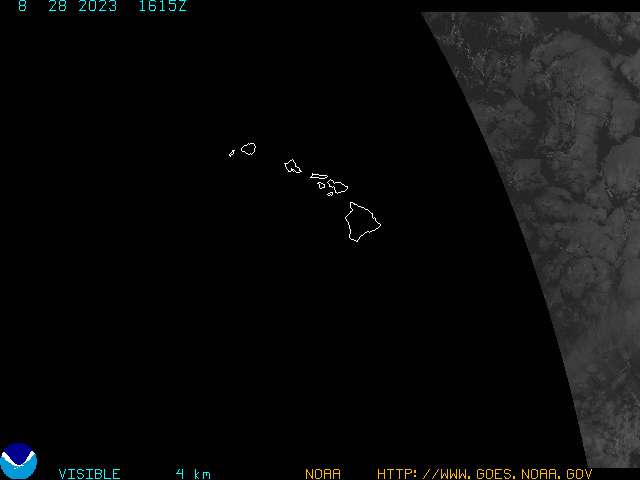



Roz Says:
Glenn – I have so enjoyed reading your wonderful narratives. We are coming to visit next week 4/29 (our first time to Maui) for 9 days and wish it could be much longer. Have a great day. ~~~Hi Roz, thanks very much for letting me know that you got value by visiting my website! I know you will have a marvelous vacation here on Maui, as everyone does! Aloha, Glenn