April 14-15, 2010
Air Temperatures – The following maximum temperatures were recorded across the state of Hawaii Wednesday afternoon:
Lihue, Kauai – 77
Honolulu, Oahu – 79
Kaneohe, Oahu – 77
Kaunakakai, Molokai – 74
Kahului, Maui – 78
Hilo, Hawaii – 69
Kailua-kona – 80
Air Temperatures ranged between these warmest and coolest spots near sea level around the state – and on the highest mountains…at 4pm Wednesday afternoon:
Port Allen, Kauai – 79F
Hilo, Hawaii – 67
Haleakala Crater – 45 (near 10,000 feet on Maui)
Mauna Kea summit – 37 (near 14,000 feet on the Big Island)
Precipitation Totals – The following numbers represent the largest precipitation totals (inches) during the last 24 hours on each of the major islands, as of Wednesday afternoon:
0.03 Wainiha, Kauai
0.01 Kahuku, Oahu
0.04 Molokai
0.00 Lanai
0.01 Kahoolawe
1.30 West Wailuaiki, Maui
1.68 Kawainui Stream, Big Island
Marine Winds – Here’s the latest (automatically updated) weather map showing high pressure systems located far to the northwest and north-northeast, and east-northeast of the islands. At the same time, we have a 1010 millibar low to our northeast…moving eastward. This pressure configuration will keep our winds north to northeast into Friday.
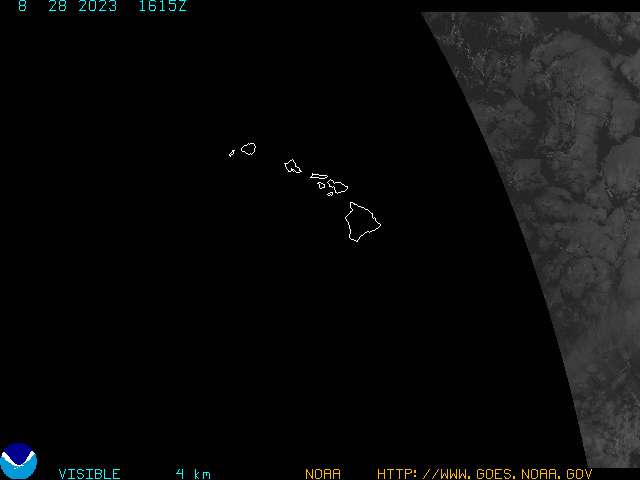
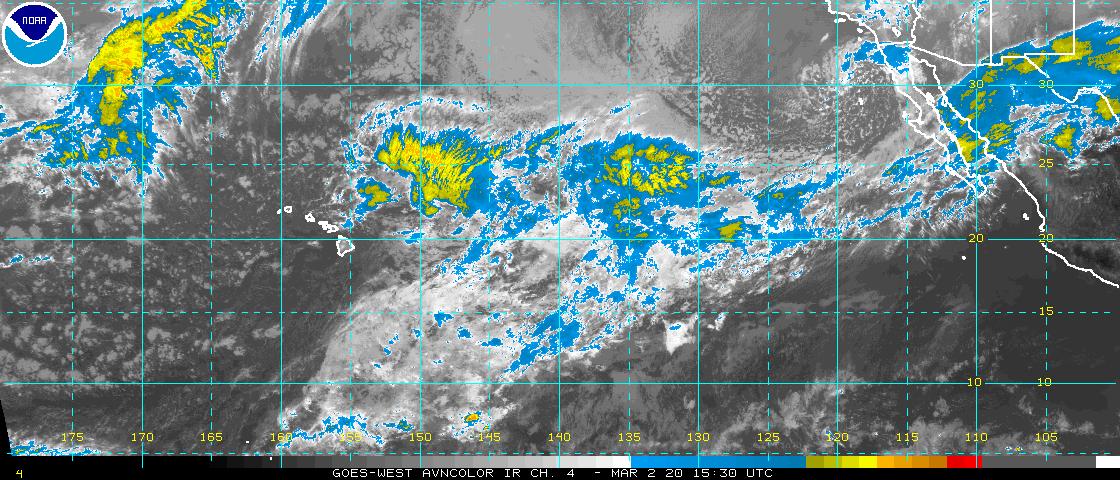
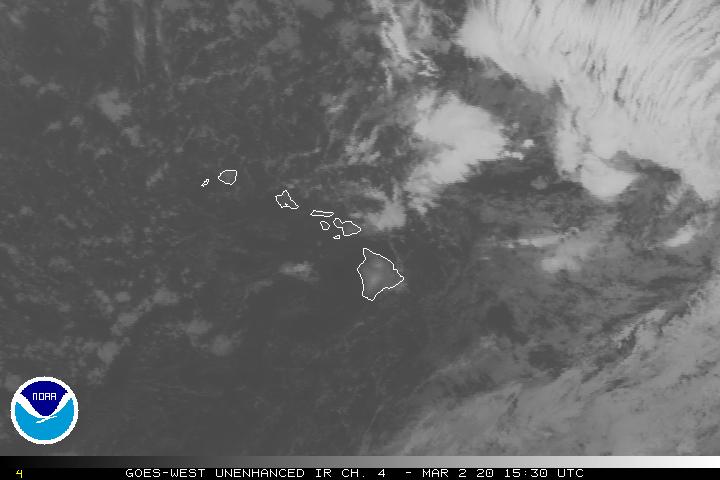
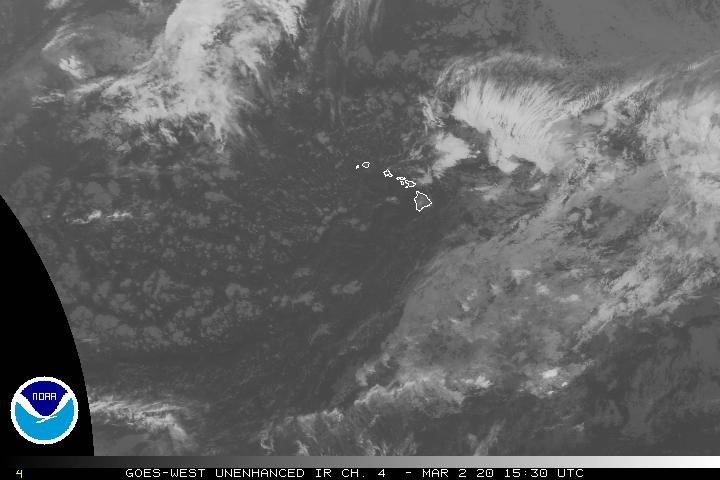
Satellite and Radar Images: To view the cloud conditions we have here in Hawaii, please use the following satellite links, starting off with this Infrared Satellite Image of the islands to see all the clouds around the state during the day and night. This next image is one that gives close images of the islands only during the daytime hours, and is referred to as a Close-up visible image. This next image shows a larger view of the Pacific…giving perspective to the wider ranging cloud patterns in the Pacific Ocean. Finally, here’s a Looping IR satellite image, making viewable the clouds around the islands 24 hours a day. To help you keep track of where any showers may be around the islands, here’s the latest animated radar image.
Hawaii’s Mountains – Here’s a link to the live webcam on the summit of near 14,000 foot Mauna Kea on the Big Island of Hawaii. The tallest peak on the island of Maui is the Haleakala Crater, which is near 10,000 feet in elevation. These two webcams are available during the daylight hours here in the islands…and when there’s a big moon rising just after sunset for an hour or two! Plus, during the nights and early mornings you will be able to see stars, and the sunrise too…depending upon weather conditions.
Tropical Cyclone activity in the eastern and central Pacific – Here’s the latest weather information coming out of the National Hurricane Center, covering the eastern north Pacific. You can find the latest tropical cyclone information for the central north Pacific (where Hawaii is located) by clicking on this link to the Central Pacific Hurricane Center. Here’s a tracking map covering both the eastern and central Pacific Ocean. A satellite image, which shows the entire ocean area between Hawaii and the Mexican coast…can be found here.
Aloha Paragraphs

It’s warmer under the water…than above!
A chilly weather pattern will persist through the remainder of this work week, gradually moderating this weekend…with warmer weather continuing on into next week. Air temperatures were all in the 70F’s Wednesday, with just one place, Kailua-kona on the Big Island…able to barely reach 80 degrees
We find several high pressure systems located in various places to our northwest through east-northeast…providing these breezy winds. The 1010 millibar low pressure system is located to the northeast of Hawaii Wednesday evening…moving eastward. This low is blocking our islands from the brunt of the strongest winds. The low is also veering our winds around its western flank, firing them into our area from the north and northeast…thus the cooler than normal temperatures. The latest computer models show the more common, although breezy trade winds returning this weekend, continuing into next week…bringing warmer conditions back with them.
Our overlying atmosphere is relatively stable and dry now…able to bring us just a few showers…along our windward sides. This IR satellite image shows that’s it’s difficult to see whatever showers are heading our way from the north and northeast…due to the area of high cirrus clouds coming into the state. Under these circumstances we can switch over to this looping radar image to get an idea of the nature of the incoming precipitation. We see that as expected, the rainfall has backed-off quite a bit.
As the winds are so strong and gusty, at least locally, there will be a few showers falling at times…the bulk of which will occur along the windward sides. We’re expecting to find fairly modest periods of clouds and showers Thursday and Friday, with a fast moving cold front pushing through the state on Friday. The models go on to suggest drier weather everywhere this weekend into early next week, although with the blustery trade winds blowing…there ought to be some passing shower activity along the windward sides at times.
It’s Wednesday evening as I begin writing this last section of today’s narrative. The weather today was quite similar to Tuesday, although with way fewer showers falling everywhere. The winds are still up, and on the cool side too, along with those high cirrus clouds noted above. Here’s a broader perspective, with this satellite image showing the extent of those icy clouds at higher altitudes of our atmosphere. It shows that this wide swath of cirrus seems to be thinning as we head into Wednesday night…although should provide some nice colors for sunset. Again, it was cool today, case in point, the Hilo airport down on the Big Island, could only reach 69F degrees for its maximum temperature today! Looking back in the record book, that broke the old record low high temperature for the date (of 73F degrees, set back in 1989) by four degrees!
It will remain cooler than normal Thursday and Friday, with a few passing showers, perhaps most notably on Friday, as a rapidly moving cold front swings through the island chain. ~~~ Here in Kula, Maui, it was a cool day too, with my high temperature reaching only 65F degrees, at this 3,100 foot elevation on the slopes of the Haleakala Crater. My wind chimes have been going crazy, as the winds are very gusty when they are coming in from the north and northeast! At around 7pm, the air temperature was a cool 56.1 degrees. I just back from my walk, and watching the sunset together, and they were both great. I definitely needed my wind breaker, as it is freezing out there…what with the wind chill factor and all! I hope you have a great Wednesday night, with that extra blanket on you, and that you can join me here again on Thursday! I’ll be back at the drawing boards early in the morning, and should have your next weather narrative available right around 630am HST. Aloha for now…Glenn.
Interesting: For those in the American Northeast last winter was rugged and fairly cold. Yet what is the world picture? The World Meteorological Organization’s latest report demonstrates that 2000-2009 is the warmest decade since modern measurements began recording temperatures around 1850. In its annual report, “WMO Statement on the Status of the Global Climate,” the WMO also found that 2009 is nominally ranked as the fifth warmest on record. According to WMO, the year 2009 is likely to rank in the top 10 warmest on record since the beginning of instrumental climate records in 1850.
The global combined sea surface and land surface air temperature for 2009 (January—October) is currently estimated at 0.79°F ± 0.20°F above the 1961—1990 annual average of 57.2°F. The current nominal ranking of 2009, which does not account for uncertainties in the annual averages, places it as the fifth-warmest year. The decade of the 2000s (2000—2009) was warmer than the decade spanning the 1990s (1990—1999), which in turn was warmer than the 1980s (1980—1989). More complete data for the remainder of the year 2009 will be analyzed at the beginning of 2010 to update the current assessment.
The year started with a mild January in northern Europe and large parts of Asia, while western and central Europe were colder than normal. Russia and the Great Lakes region in Canada experienced colder than average temperatures in February and January, respectively. Spring was very warm in Europe and Asia; April in particular was extremely warm in central Europe. Germany, the Czech Republic and Austria reported temperature anomalies of more than +5°C, breaking the previous records for the month in several locations.
The European summer was also warmer than the long term average, particularly over the southern regions. Spain had the third warmest summer, with hotter summers reported only in 2003 and 2005. Italy recorded a strong heat wave in July, with maximum temperatures above 40°C, and some local temperatures reaching 45°C. A heat wave at the beginning of July affected the United Kingdom, France, Belgium and Germany, and some stations in Norway experienced new maximum temperature records.
India had an extreme heat wave event during May, which caused 150 deaths. A heat wave hit northern China during June, with daily maximum temperatures above 40°C; historical maximum temperature records were broken for the summer in some locations. In late July many cities across Canada recorded their warmest daily temperatures. Vancouver and Victoria set new records, reaching 34.4°C and 35.0°C, respectively. Alaska also had the second-warmest July on record.
Conversely, October was a very cold month across large parts of the United States. For the nation as a whole, it was the third coolest October on record, with an average temperature anomaly of -2.2°C. Similarly, a very cold October was reported in Scandinavia, with mean temperature anomalies ranging from -2°C to -4°C. This year above normal temperatures were recorded in most parts of the continents. Only North America (United States and Canada) experienced conditions that were cooler than average.
Given the current figures, large parts of southern Asia and central Africa are likely to have the warmest year on record. This preliminary information for 2009 is based on climate data from networks of land based weather and climate stations, ships and buoys, as well as satellites. The data are continuously collected and disseminated by the National Meteorological and Hydrological Services of the 189 Members of WMO and several collaborating research institutions.
The National Oceanic and Atmospheric Administration recently reported the following global trends: The combined global land and ocean surface temperature for February 2010 was the sixth warmest on record, at 1.08 degrees F above the 20th century average of 53.9 degrees F. The global land surface temperature for February 2010 was 1.35 degrees F above the 20th century average of 37.8 degrees F — tying with 1992 as the 14th warmest February on record.
Anomalously cool conditions were widespread across the contiguous United States, Mexico, Europe and Russia. Overall, the United Kingdom had its coolest February since 1991, and the Irish Republic, its coolest February since 1986. Warmer than average temperatures enveloped much of the rest of the world’s land areas, with the warmest temperature anomalies occurring across Alaska, Canada and across the Middle East and northern Africa. The Goddard Institute for Space Studies is also analyzing global temperatures and in a preliminary report have come to the same rising temperature scenario for 2009. Global temperatures are still rising despite local trends and situations.
Interesting2: Allergies have become widespread in developed countries: hay fever, eczema, hives and asthma are all increasingly prevalent. The reason? Excessive cleanliness is to blame according to Dr. Guy Delespesse, a professor at the Université de Montréal Faculty of Medicine. Allergies can be caused by family history, air pollution, processed foods, stress, tobacco use, etc. Yet our limited exposure to bacteria concerns Dr. Delespesse, who is also director of the Laboratory for Allergy Research at the Centre hospitalier de l’Université de Montréal.
"There is an inverse relationship between the level of hygiene and the incidence of allergies and autoimmune diseases," says Dr. Delespesse. "The more sterile the environment a child lives in, the higher the risk he or she will develop allergies or an immune problem in their lifetime." In 1980, 10 percent of the Western population suffered from allergies. Today, it is 30 percent. In 2010, one out of 10 children is said to be asthmatic and the mortality rate resulting from this affliction increased 28 percent between 1980 and 1994.
"It’s not just the prevalence but the gravity of the cases," says Dr. Delespesse. "Regions in which the sanitary conditions have remained stable have also maintained a constant level of allergies and inflammatory diseases." "Allergies and other autoimmune diseases such as Type 1 diabetes and multiple sclerosis are the result of our immune system turning against us," says Dr. Delespesse. Why does this happen?
"The bacteria in our digestive system are essential to digestion and also serve to educate our immune system. They teach it how to react to strange substances. This remains a key in the development of a child’s immune system." Although hygiene does reduce our exposure to harmful bacteria it also limits our exposure to beneficial microorganisms. As a result, the bacterial flora of our digestive system isn’t as rich and diversified as it used to be.
 Email Glenn James: