











April 9-10, 2010
Air Temperatures – The following maximum temperatures were recorded across the state of Hawaii Friday afternoon:
Lihue, Kauai – 79
Honolulu, Oahu – 83
Kaneohe, Oahu – 79
Kaunakakai, Molokai – 80
Kahului, Maui – 83
Hilo, Hawaii – 80
Kailua-kona – 80
Air Temperatures ranged between these warmest and coolest spots near sea level around the state – and on the highest mountains…at 4pm Friday afternoon:
Port Allen, Kauai – 81F
Kapalua, Maui – 73
Haleakala Crater – 43 (near 10,000 feet on Maui)
Mauna Kea summit – 33 (near 14,000 feet on the Big Island)
Precipitation Totals – The following numbers represent the largest precipitation totals (inches) during the last 24 hours on each of the major islands, as of Friday afternoon:
1.81 Mount Waialaele, Kauai
0.43 Waianae Boat Harbor, Oahu
0.14 Molokai
0.00 Lanai
0.00 Kahoolawe
0.74 West Wailuaiki, Maui
2.47 Keahole Airport , Big Island
Marine Winds – Here’s the latest (automatically updated) weather map showing a high pressure system located to the north of the islands. Our local trade wind speeds will weaken slightly this weekend.
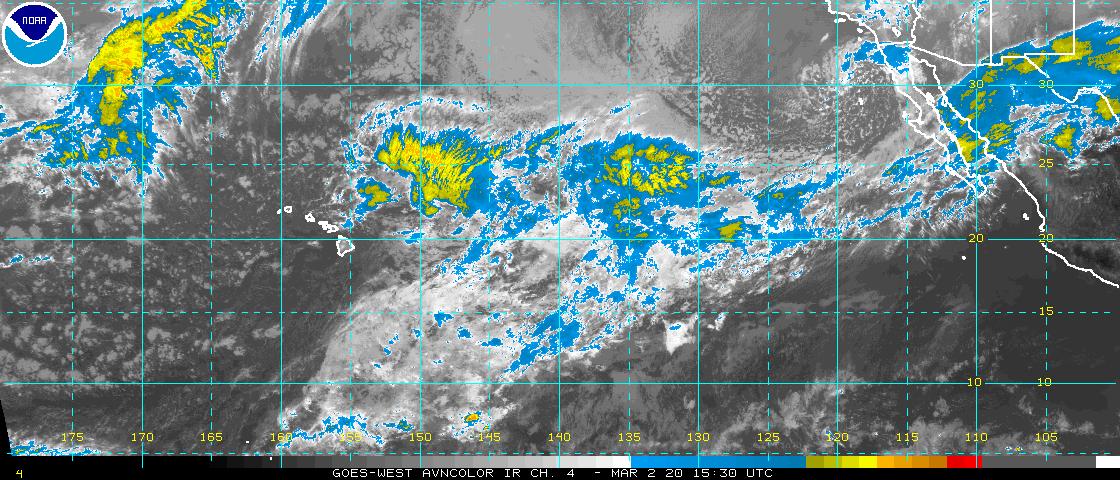
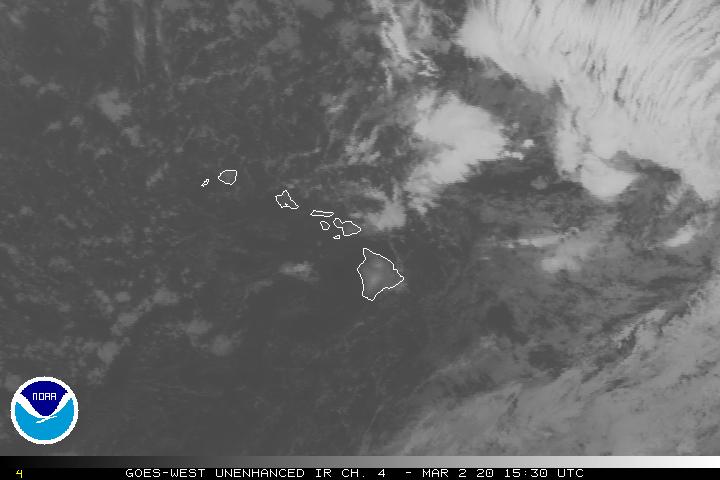
Satellite and Radar Images: To view the cloud conditions we have here in Hawaii, please use the following satellite links, starting off with this Infrared Satellite Image of the islands to see all the clouds around the state during the day and night. This next image is one that gives close images of the islands only during the daytime hours, and is referred to as a Close-up visible image. This next image shows a larger view of the Pacific…giving perspective to the wider ranging cloud patterns in the Pacific Ocean. Finally, here’s a Looping IR satellite image, making viewable the clouds around the islands 24 hours a day. To help you keep track of where any showers may be around the islands, here’s the latest animated radar image.
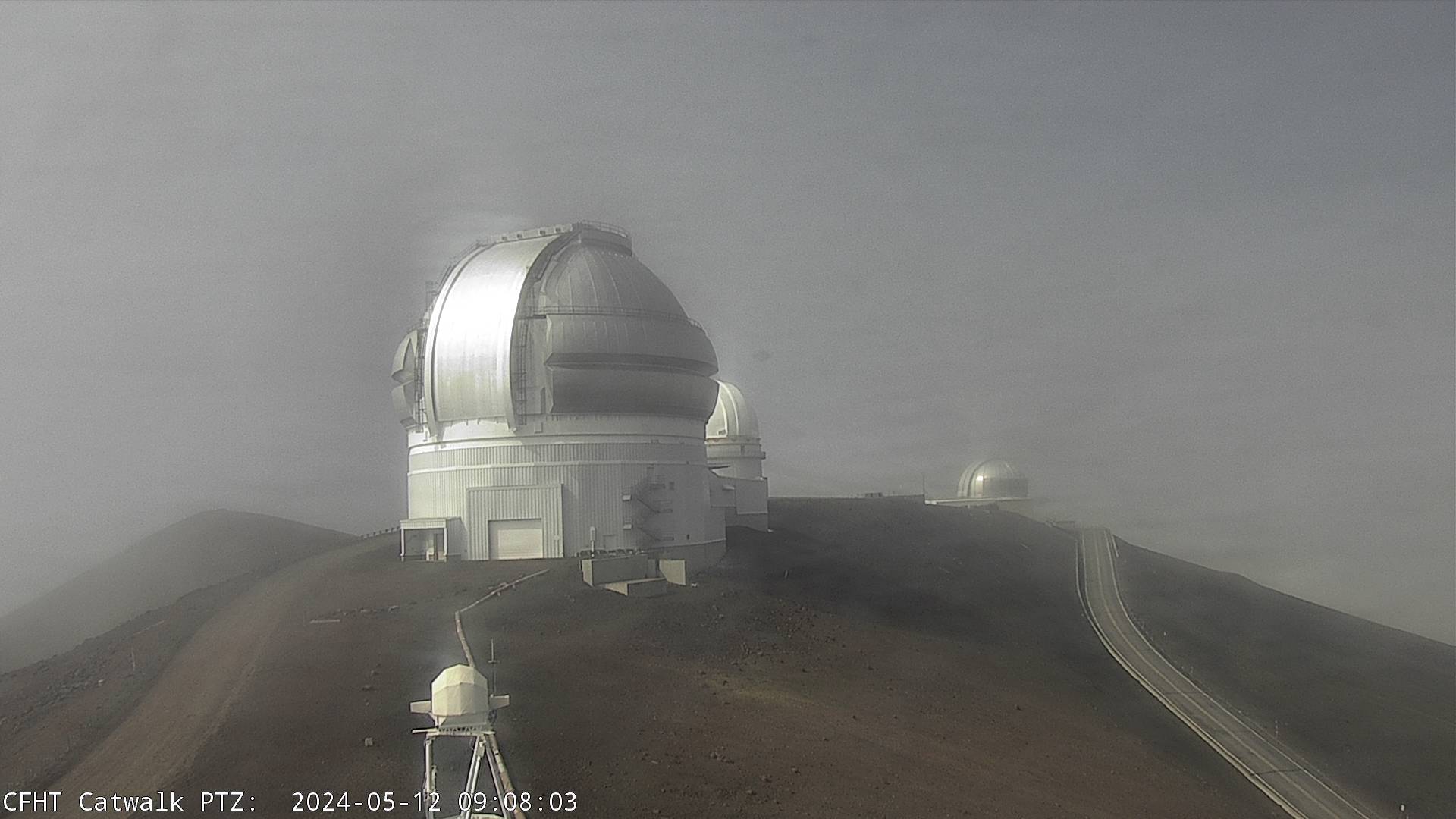
Hawaii’s Mountains – Here’s a link to the live webcam on the summit of near 14,000 foot Mauna Kea on the Big Island of Hawaii. The tallest peak on the island of Maui is the Haleakala Crater, which is near 10,000 feet in elevation. These two webcams are available during the daylight hours here in the islands…and when there’s a big moon rising just after sunset for an hour or two! Plus, during the nights and early mornings you will be able to see stars, and the sunrise too…depending upon weather conditions.
Tropical Cyclone activity in the eastern and central Pacific – Here’s the latest weather information coming out of the National Hurricane Center, covering the eastern north Pacific. You can find the latest tropical cyclone information for the central north Pacific (where Hawaii is located) by clicking on this link to the Central Pacific Hurricane Center. Here’s a tracking map covering both the eastern and central Pacific Ocean. A satellite image, which shows the entire ocean area between Hawaii and the Mexican coast…can be found here.
Aloha Paragraphs

The Hana coast…east Maui
The overlying atmosphere remains somewhat unstable and moist, with still the threat of a few localized heavier showers today. Our air mass is still ripe for these showers today, although as we move into the weekend, these conditions will fade into the new work week ahead. Taking a quick look at this IR satellite image, we see a new large area of high cirrus clouds moving overhead from the west-southwest. At lower levels of the atmosphere, we’ll find whatever few showers that around, taking aim on our windward coasts and slopes, carried our way on the trade wind breezes. There may still be some localized heavy downpours around in places as well. The NWS forecast office is keeping a small craft wind advisory in force in those windier areas around Maui and the
The trade winds will remain breezy today, then wind down a little Saturday and Sunday, before picking up again during the new week…probably. As this weather map shows, we see high pressure systems far to the north and northeast of our islands Friday afternoon. These high pressure cells will keep trade winds through the next week…although becoming lighter Saturday and Sunday. The computer forecast models, or at least most of them, show these trade winds continuing on well into the future, through all of the next week as a matter of fact. There is at least one model however, that deviates from the rest, showing a low pressure system forming to our north, and moving southeast. If this were to occur, our trade winds could remain light after the weekend for a few days.
It’s Friday afternoon as I begin writing this last section of today’s narrative. Our weather here in the islands should be pretty good for the most part going forward. We actually some some localized heavy showers around in places, especially on the Big Island. There’s still some question whether the trade winds remain light going into the new week ahead, and whether we get some added showers Monday and Tuesday. We’ll have to see about these things, and in the interim, I’d say generally that fairly normal trade wind weather will continue…stay tuned. ~~~ Here in Kihei late in the day, we saw some showers falling, as well as upcountry in Kula too. The cloud cover is quite heavy at the time of this writing. I’ll be heading up to Kula as soon as I have this dermatological procedure done here in Kihei. I must admit I’m somewhat anxious about this, although at the same time, I’m very much looking forward to having it behind me. I’ll be hunkered inside the house this weekend, hiding from the sun, although will be back in the morning with your next new weather narrative. I hope you have a great Friday night until then! Aloha for now…Glenn.
Extra: A winter weather warning is in effect over the Big Island summits until Friday evening at 7pm. We can see a little freezing rain or snow on the ground…perhaps a bit of ice on the camer lens at times, by checking out this Mauna Kea webcam.
Interesting: With Haiti still ravaged from the 7.0-magnitude earthquake that shook the nation on January 12, the normal rainy season will begin to drop potentially devastating and heavy flood-inducing rainfall next week. "Conditions are favorable for significant rainfall to last throughout the entirety of next week." A 7.0-magnitude earthquake hit Haiti on Jan. 12, killing and injuring thousands and leaving more than a million people living in makeshift camps.
What meteorologists are forecasting for Haiti isn’t out of the ordinary, but it doesn’t mean they are prepared to handle flooding rain and mudslides after near-devastation from the January quake. This shouldn’t be an extreme event, but a natural occurrence that happens every year. Millions have been displaced to outdoor shelters in low-lying areas. The relief shelters are poorly made, with the majority of displaced Haitians living under bed sheets and tarps held up by sticks.
Flash flooding could cause dangerous sliding debris. Haiti’s rainy season, which does not usually begin until May, may have arrived earlier than anticipated. This Caribbean island nation usually averages about 3 inches of rain in March, and this amount doubles to 6 inches by the end of April. By May that average traditionally triples to 9 inches.
Interesting2: NASA has successfully completed the first science flight of the Global Hawk unpiloted aircraft system over the Pacific Ocean. The flight was the first of five scheduled for this month’s Global Hawk Pacific, or GloPac, mission to study atmospheric science over the Pacific and Arctic oceans. The Global Hawk is a robotic plane that can fly autonomously to altitudes above 18,288 meters (60,000 feet) — roughly twice as high as a commercial airliner — and as far as 20,372 kilometers (11,000 nautical miles), which is half the circumference of Earth.
Operators pre-program a flight path, then the plane flies itself for as long as 30 hours, staying in contact through satellite and line-of-site communications links to a ground control station at NASA’s Dryden Flight Research Center in California’s Mojave Desert. "The Global Hawk is a revolutionary aircraft for science because of its enormous range and endurance," said Paul Newman, co-mission scientist for GloPac and an atmospheric scientist from NASA’s Goddard Space Flight Center in Greenbelt, Md.
"No other science platform provides the range and time to sample rapidly evolving atmospheric phenomena. This mission is our first opportunity to demonstrate the unique capabilities of this plane, while gathering atmospheric data in a region that is poorly sampled." GloPac researchers plan to directly measure and sample greenhouse gases, ozone-depleting substances, aerosols and constituents of air quality in the upper troposphere and lower stratosphere.
GloPac’s measurements will cover longer time periods and greater geographic distances than any other science aircraft. During Wednesday’s flight, the plane flew approximately 8,334 kilometers (4,500 nautical miles) along a flight path that took it to 150.3 degrees West longitude, and 54.6 degrees North latitude, just south of Alaska’s Kodiak Island. The flight lasted just over 14 hours and flew up to 18,562 meters (60,900 feet). The mission is a joint project with the National Oceanic and Atmospheric Administration, or NOAA.
The plane carries 11 instruments to sample the chemical composition of the troposphere and stratosphere, including two from NASA’s Jet Propulsion Laboratory, Pasadena, Calif.. The instruments profile the dynamics and meteorology of both layers and observe the distribution of clouds and aerosol particles. Project scientists expect to take observations from the equator north to the Arctic Circle and west of Hawaii.
Although the plane is designed to fly on its own, pilots can change its course or altitude based on interesting atmospheric phenomena ahead. Researchers have the ability via communications links to control their instruments from the ground. "The Global Hawk is a fantastic platform because it gives us expanded access to the atmosphere beyond what we have with piloted aircraft," said David Fahey, co-mission scientist and a research physicist at NOAA’s Earth System Research Laboratory in Boulder, Colo.
"We can go to regions we couldn’t reach or go to previously explored regions and study them for extended periods that are impossible with conventional planes." The timing of GloPac flights should allow scientists to observe the breakup of the polar vortex. The vortex is a large-scale cyclone in the upper troposphere and lower stratosphere that dominates winter weather patterns around the Arctic and is particularly important for understanding ozone depletion in the Northern Hemisphere. Scientists also expect to gather high-altitude data between 13,716 and 19,812 meters (45,000 and 65,000 feet), where many greenhouse gases and ozone-depleting substances are destroyed. They will measure dust, smoke and pollution that cross the Pacific from Asia and Siberia and affect U.S. air quality.
Interesting3: For the first time, scientists have detected clear signs of recent lava flows on the surface of Venus. The observations reveal that volcanoes on Venus appeared to erupt between a few hundred years to 2.5 million years ago. This suggests the planet may still be geologically active, making Venus one of the few worlds in our solar system that has been volcanically active within the last 3 million years.
The evidence comes from the European Space Agency’s Venus Express mission, which has been in orbit around the planet since April 2006. The science results were laid over topographic data from NASA’s Magellan spacecraft. Magellan radar-mapped 98 percent of the surface and collected high-resolution gravity data while orbiting Venus from 1990 to 1994. Scientists see compositional differences compared to the surrounding landscape in three volcanic regions.
Relatively young lava flows have been identified by the way they emit infrared radiation. These observations suggest Venus is still capable of volcanic eruptions. The findings appear in the April 8 edition of the journal Science. "The geological history of Venus has long been a mystery," said Sue Smrekar, a scientist at NASA’s Jet Propulsion Laboratory in Pasadena, Calif., and lead author of the paper describing the work. "Previous spacecraft gave us hints of volcanic activity, but we didn’t know how long ago that occurred.
Now we have strong evidence right at the surface for recent eruptions." The volcanic provinces, or hotspots, on which Smrekar and her team focused are geologically similar to Hawaii. Scientists previously detected plumes of hot rising material deep under Venus’ surface. Those plumes are thought to have produced significant volcanic eruptions. Other data from the planet suggest that volatile gases commonly spewed from volcanoes were breaking down in its atmosphere.
The rate of volcanism will help scientists determine how the interior of the planet works and how gases emitted during eruptions affect climate. Something is smoothing Venus’ surface, because the planet has only about 1,000 craters, a relatively small amount compared to other bodies in our solar system. Scientists think it may be the result of volcanic activity and want to know if it happens quickly or slowly. The Venus Express results suggest a gradual sequence of smaller volcanic eruptions as opposed to a cataclysmic volcanic episode that resurfaces the entire planet with lava.
 Email Glenn James: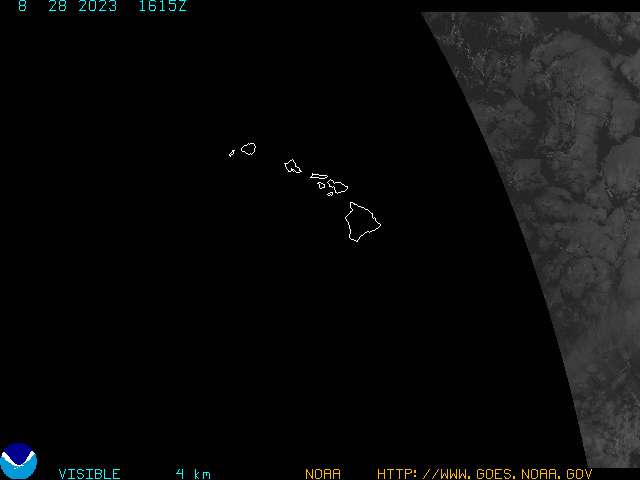


jack weber Says:
Plenty of rain here and a bit on the chilly side. Rain coming in from the north-northeast tonight, so it looks like…hope your derm. appt. was smooth… J*~~~Hi Jack, good to hear of cool rain, good for the vegetation, way better than hot and dry. Dermatological procedure went off, now into the healing process. Thanks for your note, Aloha, Glenn
Helen Says:
Hi Glenn,
Wishing you a quick and pain- free recovery . Drink lots of liquids as well.
Aloha , Helen~~~Thanks Helen, will follow your advice. Aloha, Glenn
Calvin Says:
Aloha Glenn, good luck with the dermatological procedure. Wish you a speedy recovery so you can get back out in the sunshine…Calvin~~~Thanks Calvin, appreciate your well wishes. Aloha, Glenn
Sandra J Says:
I wish you a speedy recovery Glenn.~~~Thank you Sandra, it is a process called Photodynamic Therapy…addressing pre-cancerous conditions. I appreciate your speedy recover note. Aloha, Glenn