











April 6-7, 2010
Air Temperatures – The following maximum temperatures were recorded across the state of Hawaii Tuesday afternoon:
Lihue, Kauai – 80
Honolulu, Oahu – 82
Kaneohe, Oahu – 79
Kaunakakai, Molokai – 82
Kahului, Maui – 86
Hilo, Hawaii – 76
Kailua-kona – 80
Air Temperatures ranged between these warmest and coolest spots near sea level around the state – and on the highest mountains…at 4pm Tuesday afternoon:
Kahului, Maui – 81F
Hilo, Hawaii – 69
Haleakala Crater – 50 (near 10,000 feet on Maui)
Mauna Kea summit – 41 (near 14,000 feet on the Big Island)
Precipitation Totals – The following numbers represent the largest precipitation totals (inches) during the last 24 hours on each of the major islands, as of Tuesday afternoon:
3.08 Mount Waialaele, Kauai
1.79 Manoa Valley, Oahu
0.36 Molokai
0.00 Lanai
0.00 Kahoolawe
1.67 West Wailuaiki, Maui
1.99 Glenwood , Big Island
Marine Winds – Here’s the latest (automatically updated) weather map showing a 1033 millibar high pressure system located far to the northeast of the islands. This pressure configuration will keep trade winds blowing Wednesday…increasing into Thursday.
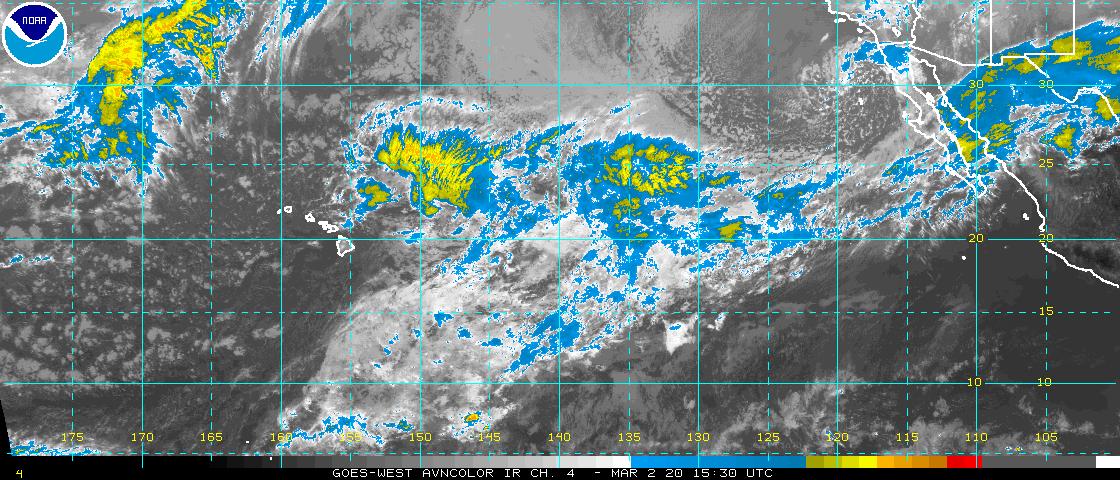
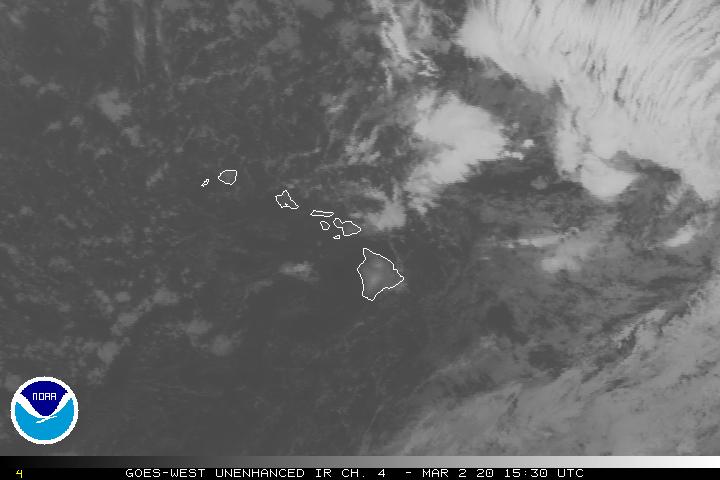
Satellite and Radar Images: To view the cloud conditions we have here in Hawaii, please use the following satellite links, starting off with this Infrared Satellite Image of the islands to see all the clouds around the state during the day and night. This next image is one that gives close images of the islands only during the daytime hours, and is referred to as a Close-up visible image. This next image shows a larger view of the Pacific…giving perspective to the wider ranging cloud patterns in the Pacific Ocean. Finally, here’s a Looping IR satellite image, making viewable the clouds around the islands 24 hours a day. To help you keep track of where any showers may be around the islands, here’s the latest animated radar image.
Hawaii’s Mountains – Here’s a link to the live webcam on the summit of near 14,000 foot Mauna Kea on the Big Island of Hawaii. The tallest peak on the island of Maui is the Haleakala Crater, which is near 10,000 feet in elevation. These two webcams are available during the daylight hours here in the islands…and when there’s a big moon rising just after sunset for an hour or two! Plus, during the nights and early mornings you will be able to see stars, and the sunrise too…depending upon weather conditions.
Tropical Cyclone activity in the eastern and central Pacific – Here’s the latest weather information coming out of the National Hurricane Center, covering the eastern north Pacific. You can find the latest tropical cyclone information for the central north Pacific (where Hawaii is located) by clicking on this link to the Central Pacific Hurricane Center. Here’s a tracking map covering both the eastern and central Pacific Ocean. A satellite image, which shows the entire ocean area between Hawaii and the Mexican coast…can be found here.
Aloha Paragraphs

Increasing trades…some locally heavy showers
Trade winds turned quite light Tuesday, although are expected to ramp up a notch later Wednesday…then increase further Thursday into the upcoming weekend. Looking at this weather map, we find that our trade wind producing high pressure system is now located to the northeast of Hawaii. As this high pressure cell is so far away, it allowed a notable reduction in our wind speeds today. Late Tuesday the winds had veered towards the east-southeast, or even southeast, blocking the smaller islands from Maui to Kauai from the strongest part of the wind flow. This lighter wind condition won’t last long though, as already by Wednesday, the winds will be on the rise, remaining active through the rest of this week.
A moist and unstable air mass made for numerous showers today…the heaviest of which fell from Kauai and Oahu. An upper level low pressure system, with its cold air aloft, has edged into our area from the west. Thus, we will see showers falling at times along our windward sides, as the trade winds continue to blow…carrying moisture our way. The Big Island’s windward side caught the lions share of these showers Tuesday. At the same time, with the lighter trade winds, coupled with the daytime heating, and unstable and moist atmosphere, we saw afternoon towering cumulus clouds dropping showers in places as well. This destabilized air mass will keep the chance of localized heavier showers around through the next several days.
It’s Tuesday evening as I begin writing this last section of today’s narrative. Right on schedule, we saw the introduction of heavier showers Tuesday afternoon, with some good old fashioned downpours on some of the islands. The island of Maui missed most of these heavy ones, but there’s still the chance for all the islands to receive a good soaking, at least at times over the next couple of days. This satellite image shows the big clumps of clouds around the islands now…largely offshore at the time of this writing. While we’re looking at images, let’s check out this looping radar image, as we’ll want to refer to it periodically over the next several days…due to the increased chance of precipitation. As we head towards sunset, the island of Oahu had the most active shower clouds overhead. ~~~ Here in Kihei, Maui, before I leave for the drive back upcountry, I see lots of clouds hanging around in our local skies. Radar shows showers falling in places along the east slopes of the Haleakala Crater, and over the West Maui Mountains too. The heavy stuff at the moment, seemed to be up towards Kauai and Oahu. I’ll check things out on the way home, and if anything catches my eye to write more about, I’ll come back online from Kula. Otherwise, I’ll catch up with you again early Wednesday morning, when I’ll be up early to prepare your next new weather narrative from paradise. Aloha for now…Glenn.
Interesting: The energy needs of the entire human population could potentially be met by converting wind energy to electricity. While offshore wind power resources are abundant, wind turbines are currently unable to provide steady power due to natural fluctuations in wind direction and strength.
Offshore wind power output can be made more consistent by choosing project development locations that take advantage of regional weather patterns and by connecting wind power generators with a shared power line, according to a paper by researchers from the University of Delaware and Stony Brook University published in the April 5 issue of the Proceedings of the National Academy of Sciences.
"Making wind-generated electricity more steady will enable wind power to become a much larger fraction of our electric sources," said the paper’s lead author Willett Kempton, UD professor of marine policy in the College of Earth, Ocean, and Environment and director of its Center for Carbon-free Power Integration.
The research team — which also included UD alumnus Felipe Pimenta, UD research faculty member Dana Veron, and Brian Colle, associate professor in the School of Marine and Atmospheric Sciences at Stony Brook University — demonstrated thoughtful design of offshore wind power projects can minimize the impacts of local weather on power fluctuations.
The researchers analyzed five years of wind observations from 11 monitoring stations along the U.S. East Coast from Florida to Maine. Based on wind speeds at each location, they estimated electrical power output from a hypothetical five-megawatt offshore turbine. After analyzing the patterns of wind energy among the stations along the coast, the team explored the seasonal effects on power output.
"Our analysis shows that when transmission systems will carry power from renewable sources, such as wind, they should be designed to consider large-scale meteorology, including the prevailing movement of high- and low-pressure systems," Kempton said. Colle explained the ideal configuration.
"A north-south transmission geometry fits nicely with the storm track that shifts northward or southward along the U.S. East Coast on a weekly or seasonal time scale," he said. "Because then at any one time a high or low pressure system is likely to be producing wind (and thus power) somewhere along the coast."
The researchers found each hypothetical power generation site exhibited the expected ups and downs, but when they simulated a power line connecting them, the overall power output was smoothed so that maximum or minimum output was rare. In the particular five-year period studied, the power output of the simulated grid never completely stopped.
No wind turbines are presently located in U.S. waters, although projects have been proposed off the coasts of several Atlantic states. This research could prove useful as project sites are selected and developed.
Reducing the severity of wind power fluctuations would allow sufficient time for power suppliers to ramp up or down power production from other energy sources as needed. Solutions that reduce power fluctuations also are important if wind is to displace significant amounts of carbon-emitting energy sources, the researchers said.
Interesting2: The number of sea turtles inadvertently snared by commercial fishing gear over the past 20 years may reach into the millions, according to the first peer-reviewed study to compile sea turtle bycatch data from gillnet, trawl and longline fisheries worldwide. The study, which was published online April 6 in the journal Conservation Letters, analyzed data compiled from peer-reviewed papers, government reports, technical reports, and symposia proceedings published between 1990 and 2008.
All data were based on direct onboard observations or interviews with fishermen. The study did not include data from recreational fishing. Six of the world’s seven species of sea turtles are currently listed as vulnerable, endangered or critically endangered on the IUCN Red List of Threatened Species. "Direct onboard observations and interviews with fishermen indicate that about 85,000 turtles were caught between 1990 and 2008.
But because these reports cover less than one percent of all fleets, with little or no information from small-scale fisheries around the world, we conservatively estimate that the true total is at least two orders of magnitude higher," said Bryan Wallace, lead author of the new paper. Wallace is the science advisor for the Sea Turtle Flagship Program at Conservation International and an adjunct assistant professor at Duke University’s Nicholas School of the Environment.
Most of his co-authors are researchers at Duke’s Center for Marine Conservation. Their global data review revealed that the highest reported bycatch rates for longline fisheries occurred off Mexico’s Baja California peninsula, the highest rates for gillnet fishing took place in the North Adriatic region of the Mediterranean and the highest rates for trawls occurred off the coast of Uruguay.
When bycatch rates and amounts of observed fishing activity for all three gear types were combined and ranked across regions, four regions emerged as the overall most urgent conservation priorities: the East Pacific, the Mediterranean, the Southwest Atlantic, and the Northwest Atlantic. "Although our numbers are estimates, they highlight clearly the importance of guidelines for fishing equipment and practices to help reduce these losses," Wallace said.
Effective measures to reduce turtle bycatch include the use of circle hooks and fish bait in longline fisheries, and Turtle Excluder Devices (TEDs) in trawling. Many of the most effective types of gear modifications, Wallace noted, have been developed by fishermen themselves. Wallace said the Hawaiian longline fishery and the Australian prawn fishery have significantly reduced bycatch through close working relationships between fishermen and government managers, use of onboard observers, mandatory gear modifications and innovative technologies.
TurtleWatch, a real-time database that provides daily updates on water temperatures and other conditions indicating where turtles might be found, has guided fishermen to avoid setting their gear in those areas. Other approaches, such as the creation of marine protected areas and use of catch shares, also reduce bycatch, preserve marine biodiversity and promote healthy fish stocks in some cases, he said.
"Fisheries bycatch is the most acute threat to worldwide sea turtle populations today. Many animals die or are injured as a result of these interactions," Wallace said. "But our message is that it’s not a lost cause. Managers and fishers have tools they can use to reduce bycatch, preserve marine biodiversity and promote healthy fish stocks, so that everyone wins, including turtles."
Interesting3: Farmers in the developing world have long struggled with the vagaries of weather, battling droughts, floods, storms and pest invasions brought on by changing conditions. In many ways, "climate change to us is nothing new," says Peter Hartmann, head of the International Institute of Tropical Agriculture, based in Ibadan, Nigeria. But what terrifies the longtime Nigerian researcher is how fast the changes are now coming.
As the planet warms, he said, bands of heat, plant diseases and pests are moving much more rapidly than before, presenting a huge challenge to researchers trying to help farmers adapt. "Preparing for the changes in those belts scares the heck out of me," he admitted at an international conference in France this week on reforming agricultural research to spur development.
Helping farmers survive and perhaps even prosper in coming years, experts said at the conference, will require helping them build greater resilience to uncertainty. That may mean putting pioneering crop insurance programs in place in one area, introducing more resilient crops in others and in some places persuading farmers to switch staple crops altogether. Climate models suggest that rain-fed maize – the staple in southern Africa – may no longer be a viable crop there by mid-century, as droughts in the region worsen.
But in other regions, the models are still unclear about whether warming conditions will bring more or less rainfall, wet-weather viruses or drought-driven pests. Deciding what to prepare for on a national basis requires "downscaling" climate models, which can magnify modeling errors, particularly in areas where the results are less certain, researchers said. India’s monsoon, for example, is becoming more irregular as a result of climate pressures, but no one is entirely sure whether it will ultimately bring more or less rain to any one area of India.
And while models agree that both northern and southern Africa will become dryer in years ahead, there is great uncertainty about what will happen in the central part of the continent, or in places like the Amazon. "People say, ‘What should we do in Rwanda?’ We don’t know what to do. We don’t know if it’s going to get wetter or dryer," said Sir Gordon Conway, an agricultural ecologist and former president of the UK Royal Geographic Society. Preparing for the worsening extreme weather events that climate change is likely to bring will be another challenge, he said.
"You can breed (crops) for hotter, dryer, wetter or rising sea levels," Conway said. "But for a lot of the world, that isn’t what’s happening. It’s more extreme events – more sudden floods, more sea surges, more drought." One of the biggest coping strategies for farmers in the years ahead, researcher said, will be diversifying crop varieties – planting a field with a mix of flood-resistant rice and regular high-yield rice, for instance, to ensure at least one species survives and that harvests are as large as possible.
Another will be strengthening ties to urban areas, where family members can turn for jobs and support in times of hardship on the farm, or for help in selling their produce and getting a better price for it in good years. "The biggest resilience strategy is diversity," Conway said. The good news is "poor people have developed resilience strategies anyway.
They have had years of living in difficult situations," he said. The question now is whether those strategies – and new ones being prepared by agricultural researchers and others – will be sufficient to deal with the coming pressures, said K.P. Singh, president of the National Institute for Agriculture in India, and a regional head of the International Federation of Agricultural Producers.
 Email Glenn James: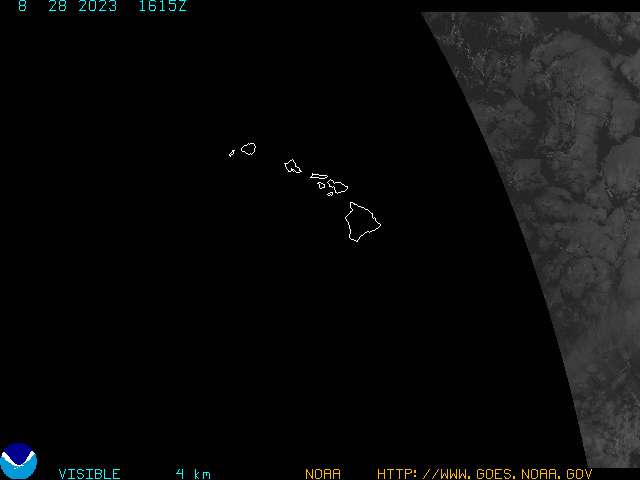



Eliza Says:
Aloha Glenn – I truly wish that the Kailua-Kona side of the Big Island would get some lovely rains. They are so very crispy over there, it is not funny. When I woke in the TVR to the smell of lighter fluid for a charcoal fire at 330am, I was concerned that someone was going to set a fire. Then it drifted away on the ocean breezes and I went back to sleep. Phew… Anyway I am very happy to be home on Maui. Thanks for the updates. Eliza~~~Hi Eliza, welcome back home, yes, Maui is such a comforting place to live. It’s so easy to take it for granted, although when you leave, and its different in so many ways other places…its a big old sigh of relief to be back to this soft and safe place. Aloha, Glenn