











April 2-3, 2010
Air Temperatures – The following maximum temperatures were recorded across the state of Hawaii Friday afternoon:
Lihue, Kauai – 78
Honolulu, Oahu – 83
Kaneohe, Oahu – 79
Kaunakakai, Molokai – 79
Kahului, Maui – 84
Hilo, Hawaii – 81
Kailua-kona – 79
Air Temperatures ranged between these warmest and coolest spots near sea level around the state – and on the highest mountains…at 5pm Friday evening:
Honolulu, Oahu – 80F
Lihue, Kauai – 71
Haleakala Crater – 57 (near 10,000 feet on Maui)
Mauna Kea summit – 43 (near 14,000 feet on the Big Island)
Precipitation Totals – The following numbers represent the largest precipitation totals (inches) during the last 24 hours on each of the major islands, as of Friday afternoon:
2.21 Mount Waialaele, Kauai
0.28 Oahu Forest NWR, Oahu
0.14 Molokai
0.00 Lanai
0.00 Kahoolawe
0.46 Puu Kukui, Maui
0.47 Saddle Quarry, Big Island
Marine Winds – Here’s the latest (automatically updated) weather map showing a strong 1041 millibar high pressure system located far to the northwest of the islands….with a ridge of high pressure north and northeast of the islands. This pressure configuration will bring back around round of strong and gusty trade winds this weekend.
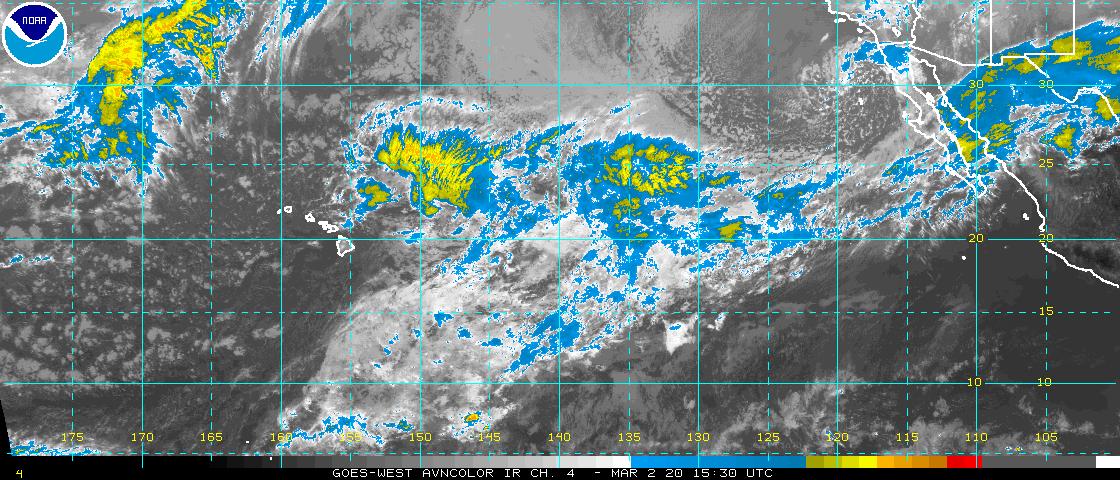
Satellite and Radar Images: To view the cloud conditions we have here in Hawaii, please use the following satellite links, starting off with this Infrared Satellite Image of the islands to see all the clouds around the state during the day and night. This next image is one that gives close images of the islands only during the daytime hours, and is referred to as a Close-up visible image. This next image shows a larger view of the Pacific…giving perspective to the wider ranging cloud patterns in the Pacific Ocean. Finally, here’s a Looping IR satellite image, making viewable the clouds around the islands 24 hours a day. To help you keep track of where any showers may be around the islands, here’s the latest animated radar image.
Hawaii’s Mountains – Here’s a link to the live webcam on the summit of near 14,000 foot Mauna Kea on the Big Island of Hawaii. The tallest peak on the island of Maui is the Haleakala Crater, which is near 10,000 feet in elevation. These two webcams are available during the daylight hours here in the islands…and when there’s a big moon rising just after sunset for an hour or two! Plus, during the nights and early mornings you will be able to see stars, and the sunrise too…depending upon weather conditions.
Tropical Cyclone activity in the eastern and central Pacific – Here’s the latest weather information coming out of the National Hurricane Center, covering the eastern north Pacific. You can find the latest tropical cyclone information for the central north Pacific (where Hawaii is located) by clicking on this link to the Central Pacific Hurricane Center. Here’s a tracking map covering both the eastern and central Pacific Ocean. A satellite image, which shows the entire ocean area between Hawaii and the Mexican coast…can be found here.
Aloha Paragraphs
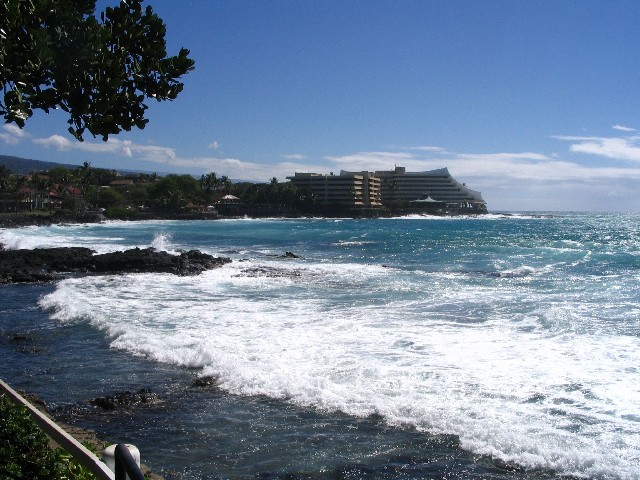
Gonna get windy again this weekend
The trade winds will be gaining strength again Saturday and Sunday. Looking at this weather map, we find that a new, very strong 1041 millibar high pressure system has moved into the area far northwest of the state Friday evening. As this high pressure cell moves into the area north of our islands this weekend, winds will become strong and gusty once again. We will see small craft wind advisories stretching across the entire state…with possible gale warnings once again around Maui and the Big Island by Saturday evening into Sunday.
The trade winds will taper off a little Monday and Tuesday…although then rebound once again towards the middle of the new week. This series of high pressure systems will continue to bring bouts of strong trade winds. The periods between these strongest blustery episodes, will even remain on the gusty side. There really isn’t an end to to this prolonged trade wind pattern, which isn’t too unusual this time of year. As suppose we should just begin to getting used to the brisk trade wind flow here in the islands.
There will finally be some showers arriving, with the windward sides getting the most, although some light showers may get carried over into the leeward sides on the smaller islands. This increase in showers may continue into the first part of the new week ahead, and has helped to cause the discontinuance of the recent wild fire threat. Towards the middle to end of the new work week, we may finally see some more significant rainfall arriving. There will be more news on this potentially wetter period over the next few days.
It’s Friday evening as I begin writing this last section of today’s narrative. As mentioned above, the trade winds are about ready to surge again. Looking at the strongest gusts around the state at around 5pm, these were the strongest on each of the islands:
31 mph on Kauai
36 mph on Oahu
30 mph on Molokai
32 mph on Lanai
36 mph on Kahoolawe
38 mph on Maui
29 mph on the Big Island
As the numbers above show, our winds have begun to pick up again this evening. This is the time of the day when they are often quite gusty, although this is more likely the leading edge of what will become stronger trade winds this weekend. As a new high pressure system moves into place to our north, we will see higher gusts reaching into our island chain. As we get into the second half of the Easter weekend, we may see gale warnings going up in the channels around Maui and the Big Island again. There’s even the chance that we may see a few areas having a wind advisory being issued by the NWS again then too.
~~~ Thursday evening I went to see the new Alice in Wonderland film (2010) starring Johnny Depp and Helena Bonham Carter, Mia Wasikowska, and Anne Hathaway…among others. Director Tim Burton takes on the whimsical world of Alice, a 19-year-old who returns to the world she first encountered as a young girl, reuniting with her childhood friends: the White Rabbit, Tweedledee and Tweedledum, the Dormouse, the Caterpillar, the Cheshire Cat, and of course, the Mad Hatter. Alice embarks on a fantastical journey to find her true destiny and end the Red Queen’s reign of terror. This film was in 3D, and made for a very fun experience. I felt myself kind of duck a few times, when it seemed like things were going to hit me coming off the screen! I thoroughly enjoyed this film, it was very entertaining, and deserves a B+ grade in my opinion. Here’s the trailer for this film…which captures very well the look and feel of this old favorite!
~~~ Today was such a great day, a Good Friday kind of day. I had the day off from work, and honestly didn’t do much other than visit with my neighbors some, did the updating on this website, took a long walk, and had a good breakfast. I never even got around to making lunch, and even had a nap during a period of reading during the afternoon. It was one of those do nothing kinds of days that feel so refreshing after a week at work. The weather was nice, with some increasing clouds during the day, along with the gradually increasing winds too. My wind chimes here in Kula have been sounding off, which tells me that the winds have a bit more north in them, than the regular easterly trade winds. I’ll take another walk after I finish this last little bit of my sunset commentary. I’ll likely come back and sit out on my deck for the sunset viewing after that. I hope you had a good day too, from wherever you happened to be spending it! I’ll be back in the morning with your next new weather narrative, likely concentrating again on the windier weather just up ahead. Aloha for now…Glenn.
Extra: Orangutan and the Hound Dog video…National Geographic
Interesting: No fooling, the DOT and EPA, in response to one of the Obama Administration’s top priorities, have jointly established aggressive new federal rules that will significantly increase the fuel economy of all passenger cars and light trucks sold in the United States. They have also established new federal rules that would for the first time ever, set national greenhouse gas (GHG) emissions standards for these vehicles. The new rules are forecast to save the average buyer of a 2016 model year car $3,000 over the lifetime of the vehicle.
EPA estimates that nationally, it has the potential to conserve about 1.8 billion barrels of oil and reduce nearly a billion tons of GHG emissions over the lives of the vehicles. The new rules also simplify the old system because they establish one clear standard for all automakers, instead of the three separate standards used prior: DOT, EPA, and a state standard. Fuel economy standards are increased under the Corporate Average Fuel Economy (CAFE) program which is a part of the DOT’s National Highway Traffic Safety Administration (NHTSA).
Greenhouse gas (GHG) emissions standards are established under the Clean Air Act. Today’s final rules will apply to vehicles produced from 2012 through 2016. "This is a significant step towards cleaner air and energy efficiency, and an important example of how our economic and environmental priorities go hand-in-hand," said EPA Administrator Lisa P. Jackson. ”By working together with industry and capitalizing on our capacity for innovation, we’ve developed a clean cars program that is a win for automakers and drivers, a win for innovators and entrepreneurs, and a win for our planet."
Transportation Secretary, Ray LaHood said "These historic new standards set ambitious, but achievable, fuel economy requirements for the automotive industry that will also encourage new and emerging technologies. We will be helping American motorists save money at the pump, while putting less pollution in the air." The new standards take effect for 2012 model year vehicles, requiring automakers to improve fleet-wide fuel economy each year up to 34.1 mpg by 2016, and reduce fleet-wide GHG emissions by about 5% each year.
The EPA standards require that by 2016, automakers must achieve a combined average vehicle emission of 250 grams of CO2 per mile. If all reductions came from fuel economy improvements, it would be equivalent to 35.5 mpg. Automakers can use air-conditioning improvements to partially meet the new standard. The EPA estimates a reduction in CO2 emissions by about 960 million metric tons over the lifetime of the vehicles, or the equivalent of taking 50 million cars and light trucks off the road in 2030.
This joint regulation achieves a top goal set by the Obama Administration to develop a National Program to establish federal standards that also meet the standards of the states including California. The effort was first announce by the President last May with the broad support of automakers, the United Auto Workers, States, and environmental advocates. The efficiencies demanded by the new rules can be largely met by more widespread adoption of conventional technologies such as more efficient engines, tires, transmissions, aerodynamics, air conditioning, and materials.
In addition, smaller or lighter vehicles are likely. However, the EPA and NHTSA expect automakers to choose to pursue more advanced technologies such as hybrid, plug-in electric hybrid, and electric vehicles, as well as clean diesel engines. Canada, along with the United States, is also announcing GHG emissions regulations today for light duty vehicles. Environment Canada has worked closely with the US EPA and NHTSA to ensure a common North American approach.
In the United States, passenger vehicles and light trucks account for almost 60% of all US transportation-related GHG emissions. The announcement of the new federal regulations does not come as a complete surprise, and it is encouraging to see. It marks a very positive step in the effort to make the United States more energy-independent, decrease fuel costs, clean the air, and address climate change.
Interesting2: If everyone became vegan and so ate only fruit and vegetables, then the reduction in greenhouse emissions for the whole of food consumption would be a mere 7%. The widespread adoption of vegetarianism would have even less impact, while organic food production actually leads to a net increase in greenhouse gas emissions. Those are the conclusions of a research paper published in the journal Progress in Industrial Ecology.
Helmi Risku-Norja and Sirpa Kurppa of MTT Agrifood Research Finland, working with Juha Helenius of the Department of Agricultural Sciences, University of Helsinki, have determined that the cultivation of soil for whatever purpose, whether growing crops or raising livestock is the primary source of greenhouse gas emissions in food production, not fertilizer production, animal husbandry, nor agricultural energy requirements.
The team explains that for current average food consumption, in Finland, emissions from soil represent 62% of the total emissions. Greenhouses gases released by cows and sheep account for 24%, and energy consumption and fertilizer manufacture about 8% each. The greenhouse emissions performance for extensive organic production is poor, they explain, despite this approach to farming being considered the "green" option, the lower efficiency requires the cultivation of greater areas of soil, which counteracts many of the benefits.
Reducing greenhouse gas emissions through food consumption would require large-scale changes among the entire population, the team points out. They suggest that rather than stressing the impact of an individual citizen’s dietary choices, we should be paying more attention to social learning and to the notion of working towards food sustainability and security. In general, sustainable consumption might be possible by introducing services to substitute for material consumption.
Although food itself cannot be substituted, a lot can be done at the household level to improve sustainability of food provisioning and reduce food wastage. "There is a pressing need to design effective policy measures," says Risku-Norja. "Consumer information is important from the viewpoint of food and sustainability education, leading eventually to adopting more sustainable lifestyles in the coming generations," the team concludes.
Interesting3: People who are unhappy in life are unlikely to find satisfaction at work. This is the finding of a study published online April 1, 2010, in the Journal of Occupational and Organizational Psychology. Assistant Professor Nathan Bowling of Wright State University, USA, and colleagues Kevin Eschleman and Qiang Wang undertook a meta-analysis on the results of 223 studies carried out between 1967 and 2008.
All of the studies had investigated some combination of job satisfaction and life satisfaction (or subjective well-being). Assistant Professor Nathan Bowling said: "We used studies that assessed these factors at two time points so that we could better understand the causal links between job satisfaction and life satisfaction. If people are satisfied at work, does this mean they will be more satisfied and happier in life overall?
Or is the causal effect the opposite way around?" The causal link between subjective well-being and subsequent levels of job satisfaction was found to be stronger than the link between job satisfaction and subsequent levels of subjective well-being.
"These results suggest that if people are, or are predisposed to be, happy and satisfied in life generally, then they will be likely to be happy and satisfied in their work," said Nathan Bowling. "However, the flipside of this finding could be that those people who are dissatisfied generally and who seek happiness through their work, may not find job satisfaction. Nor might they increase their levels of overall happiness by pursuing it."
 Email Glenn James: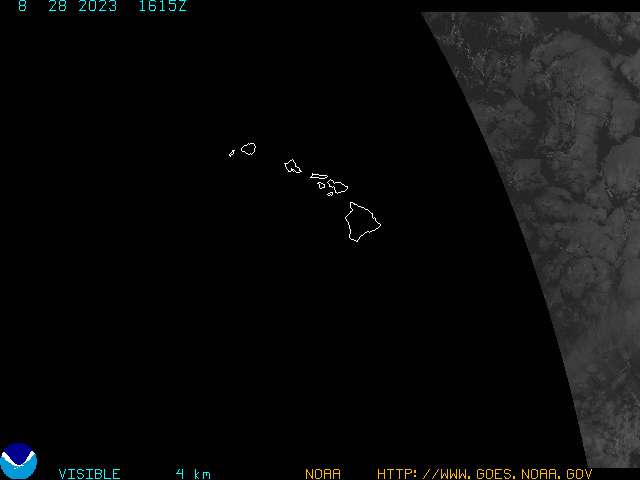



Max Says:
Hey Glenn. Heres the footage I filmed of the winds on the big Island on March 30th. It was pretty wild! I’d say gusts up to 70mph. http://www.youtube.com/watch?v=ETn0hE2DJWM ~~~ Hi Max, wow, that is a great example of the extremely windy conditions that we saw in many areas of the state, especially around Kaupo Gap here on Maui, and your area there on the Big Island! Good quality footage, thanks for sending it along to us! Aloha, Glenn