











March 29-30, 2010
Air Temperatures – The following maximum temperatures were recorded across the state of Hawaii Monday afternoon:
Lihue, Kauai – 78
Honolulu, Oahu – 79
Kaneohe, Oahu – 78
Kaunakakai, Molokai – 79
Kahului, Maui – 82
Hilo, Hawaii – 79
Kailua-kona – 81
Air Temperatures ranged between these warmest and coolest spots near sea level around the state – and on the highest mountains…at 5pm Monday evening:
Barking Sands, Kauai – 81F
Lihue, Kauai – 71
Haleakala Crater – 48 (near 10,000 feet on Maui)
Mauna Kea summit – 39 (near 14,000 feet on the Big Island)
Precipitation Totals – The following numbers represent the largest precipitation totals (inches) during the last 24 hours on each of the major islands, as of Monday afternoon:
0.82 Mount Waialaele, Kauai
0.31 South Fork Kaukonahua, Oahu
0.02 Molokai
0.00 Lanai
0.00 Kahoolawe
1.23 Puu Kukui, Maui
0.59 Kawainui Stream, Big Island
Marine Winds – Here’s the latest (automatically updated) weather map showing a 1031 millibar high pressure system located to the north of the islands. This pressure configuration will cause increasingly strong trade wind speeds Tuesday into mid-week.
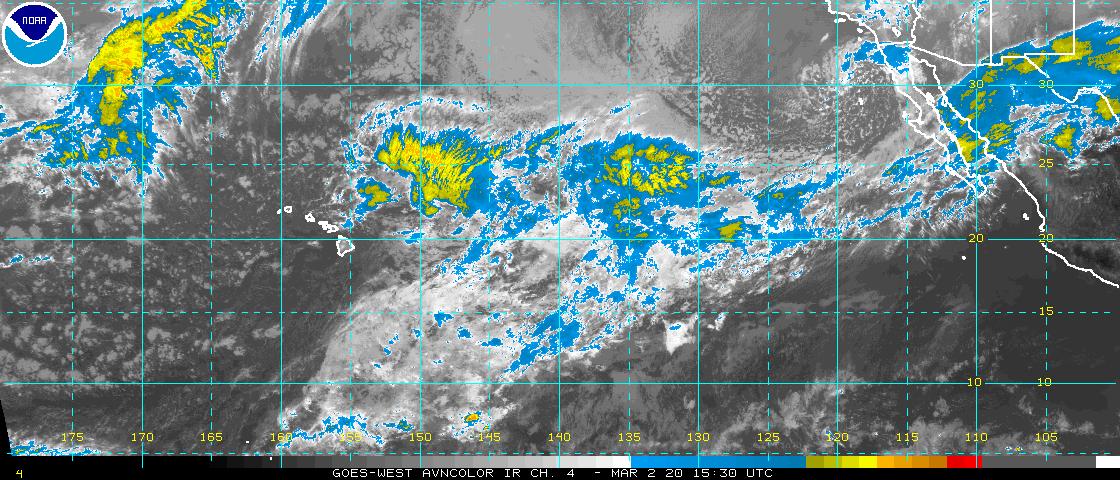
Satellite and Radar Images: To view the cloud conditions we have here in Hawaii, please use the following satellite links, starting off with this Infrared Satellite Image of the islands to see all the clouds around the state during the day and night. This next image is one that gives close images of the islands only during the daytime hours, and is referred to as a Close-up visible image. This next image shows a larger view of the Pacific…giving perspective to the wider ranging cloud patterns in the Pacific Ocean. Finally, here’s a Looping IR satellite image, making viewable the clouds around the islands 24 hours a day. To help you keep track of where any showers may be around the islands, here’s the latest animated radar image.
Hawaii’s Mountains – Here’s a link to the live webcam on the summit of near 14,000 foot Mauna Kea on the Big Island of Hawaii. The tallest peak on the island of Maui is the Haleakala Crater, which is near 10,000 feet in elevation. These two webcams are available during the daylight hours here in the islands…and when there’s a big moon rising just after sunset for an hour or two! Plus, during the nights and early mornings you will be able to see stars, and the sunrise too…depending upon weather conditions.
Tropical Cyclone activity in the eastern and central Pacific – Here’s the latest weather information coming out of the National Hurricane Center, covering the eastern north Pacific. You can find the latest tropical cyclone information for the central north Pacific (where Hawaii is located) by clicking on this link to the Central Pacific Hurricane Center. Here’s a tracking map covering both the eastern and central Pacific Ocean. A satellite image, which shows the entire ocean area between Hawaii and the Mexican coast…can be found here.
Aloha Paragraphs

Exceptionally windy in many areas now
The primary influence in the
Small craft wind advisories are up across the entire state now, at least in those coastal waters going into Monday night. As the winds have increased today, we now have gale warnings across the windy channels around Maui and the
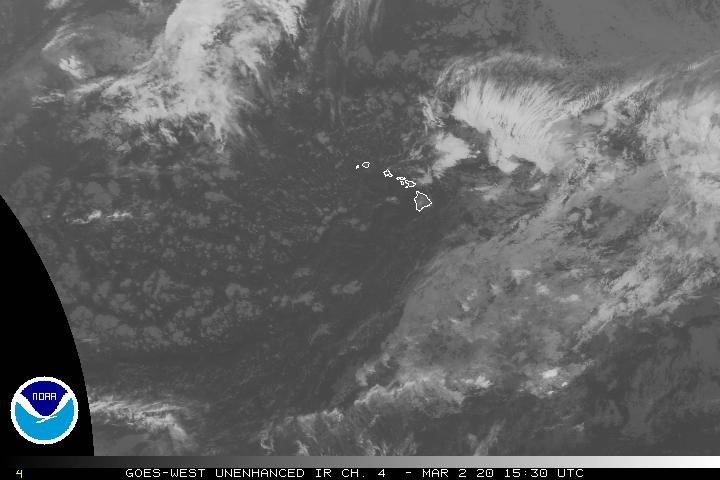
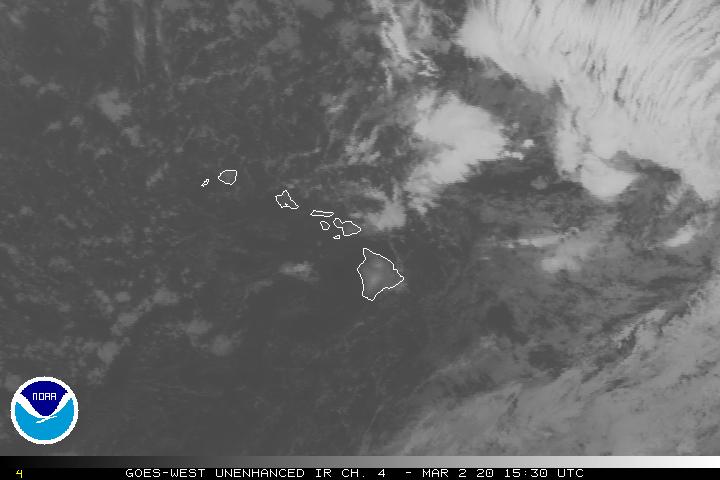
As far as rainfall goes, most of it will be deposited by the trade winds along the windward coasts and slopes, with a few showers perhaps flying over the lower mountains on the smaller islands…into the leeward sides. Typically, showers are quite abundant during such gusty trade wind episodes. This time around though, there should be somewhat limited precipitation, although passing showers at times nonetheless. Meanwhile, this satellite image shows a rather extensive amount of high cirrus clouds just to the west of the islands. This area has been nearly stationary for the last several days. It looks like it is getting ready to move closer on the upper winds aloft. The lower level clouds, as seen on this closer IR satellite picture…shows just scattered clouds upstream. By the way, a fire weather watch is now in effect through Wednesday evening, due to the gusty winds, low relative humidity, and ample dry fuel…on the leeward sides.
It’s Monday evening as I begin writing this last section of today’s narrative. Trade winds remain active across the islands now. Looking at the strongest gusts around the state at near 5pm, these were the highest on each of the islands:
32 mph at Lihue, Kauai
48 mph at Oahu Forest NWR
38 mph on Molokai
42 mph on Lanai
50 mph on Kahoolawe
46 mph at Kaupo Gap, Maui
44 mph at Waikola, Big Island
As we can see, these gusts are all at 30 mph or over…and actually are mostly over 40 mph later in the day Monday. I would expect these strongest gusts to top 50 mph as we move into Tuesday and potentially Wednesday too. As noted in the paragraph above, these strong winds, coupled with the relatively dry relative humidities, and lots of bone dry fuel along the windward sides, spell the danger from brush fires – thus the current fire weather watch. This windy episode will be the main feature in our Hawaiian Island weather picture through this week, and right on into next week as well. The spring months here in the islands are well known to be filled with trade winds. All this rushing air, as it passes over the ocean surface, will cause millions of white caps. Thus, we expect rough and choppy ocean conditions, be careful when heading out to sea under these circumstances. The surf will be large enough over the next day or two, that we now have high surf advisory flags having gone up along our east facing shores, and our northwest shores too. ~~~ It’s about 530pm here in Kihei, Maui, as I get ready to head back upcountry to Kula. By the way, have you been noticing the large near full moon lately? You’ll be able to see it Monday night into Tuesday morning, when it will be at its fullest aspect, I’ll sure be checking it out with you! Looking up towards the Haleakala Crater before I take the drive back home, its mostly clear, with just a few minor clouds. It wouldn’t surprise me to see some color in our sky at sunset, what with those high cirrus clouds over the ocean to our west. I’ll catch up with you again early Tuesday morning, when I’ll be back with your next new weather narrative from windy Hawaii! Aloha for now…Glenn.
Interesting: Starved and emaciated, sea lion pups are beaching themselves along the Pacific Coast. A strong El Nino tropical weather pattern is to blame. Unusually warm sea surface temperatures in the western Pacific are moving east, forcing the sea lions’ natural food sources — squid, hake, herring and anchovies — to seek out cooler waters.
Adult sea lions have enough fat stored up to survive the resulting food shortage, but their pups aren’t so well-equipped. Richard Evans, medical director of the Pacific Marine Mammal Center in Laguna Beach, Calif., tells NPR’s Guy Raz that by the time the animals get to his team, they’re in the third stage of starvation.
"We stage starvation in humans and animals: one, two, three. Three is when you’ve gone so bad that you start digesting your muscle as a source of protein." The Pacific Marine Mammal Center rescues and nurses starving sea lions back to health, and then releases them back into the sea. Scientists at the center started seeing an increase in starving sea lion pups last spring.
The center sees sick animals all the time, but not usually this severe. The pups began coming in so sick that it took much longer to nurse them back to health — up to six months instead of the usual two or three. Officials at the center soon learned that there had been an El Nino in the Pacific beginning in April. "It had taken its toll on the breeding colonies," Evans says. In addition to the food shortage, some sea lion mothers may have decided to stop nursing their pups in order to survive themselves.
Interesting2: A severe winter has left 4.5 million dead animals in stockyards across the Mongolian steppes, and many poor herders face the loss of all their property just before the important breeding season. About a tenth of Mongolia’s livestock may have perished, as deep snows cut off access to grazing and fodder. The damage to the rural economy could increase demands on Mongolia’s already-stretched national budget, which relies on mining revenues to meet spending commitments.
The Red Cross launched an emergency appeal for 1 million Swiss francs to assist Mongolian herders, after it estimated that 4.5 million livestock have died in the country since December. "The numbers of livestock that have perished have gone up very, very quickly and dramatically now to about 4 million which is roughly a tenth of the whole livestock population," Francis Markus, communications director for the Red Cross’ East Asia delegation, said in Beijing after returning from Mongolia.
"This means that thousands of families, mostly coming from the poorest and most vulnerable layers of the herder population, have lost their entire flocks of animals and have been left in a very, very distraught and very, very desperate state." Roughly one-quarter of Mongolia’s 3 million people are nomads, while others also raise livestock in fixed settlements.
Many go deeply in debt to buy and raise their herds, in hopes of making the money back by selling wool, meat and skins. A similar combination of a summer drought, followed by heavy snow and low winter temperatures, which is known in Mongolian as a ‘zud’, caused widespread hardship in Mongolia a decade ago. As a result, impoverished herder families flocked to the slums outside the capital, Ulan Bator, straining the city’s ability to provide basic services.
Interesting3: Once upon a time a trip around the world made major headlines. Nowadays it is common place and a convenient way to measure air quality around the world by plane. A plane outfitted to measure greenhouse gases has taken off from Colorado on the first leg of a 24 day mission that will take it back and forth across the Pacific Ocean from the Arctic to the Antarctic.
The mission is part of a three year project designed to determine when and where the gases enter and leave the atmosphere. That in turn could help policymakers as well as scientists on how to handle and measure climate change. The scientific questions that this study is focused on are (1) understanding the global sources and sinks for CO2, CH4, and other carbon cycle gases, and more broadly (2) determining large scale rates of tracer transport in the atmosphere.
In other words what are the seasonal ups and downs of these gases and where do they increase (sources) and where do they decrease (sinks). The largest known carbon dioxide sink is the ocean where about a quarter of the world supply of this gas is absorbed. Sources are both biological (animal) and fossil fuels. The three year campaign relies on the powerful capabilities of a specially equipped Gulfstream V aircraft.
The jet, known as the High performance Instrumented Airborne Platform for Environmental Research (HIAPER), has a range of about 7,000 miles, which allows scientists to traverse large regions of the Pacific Ocean without refueling, gathering air samples along the way. Researchers will take the jet from an altitude of 1,000 feet above Earth’s surface up to as high as 47,000 feet into the lower stratosphere. How carbon dioxide and methane gases vary by altitude will be determined.
Mapping air quality has been done before but not on a world level. For example NASA has funded maps on Carbon Dioxide air emissions are available of the US on a state by state level. Satellites have also been used to get a general range of some pollutants such as Nitrogen Dioxide in the troposphere as measured by SCIAMACHY Envisat. It can also measured with numerous ground based instruments and the data correlated and combined.
This is done by EPA for Ozone and Hazardous Air Pollutants such as Benzene for evaluating regional air quality. The present air borne study (the third of five) recently started from Anchorage, it will fly over the northern polar region, then to Hawaii, Fiji, New Zealand and the southern polar region before retracing its path to Alaska and returning to Colorado in mid-April.
"Previous experiments only can do like one fixed station, and with the aircraft you can actually fly and do vertical profiles of the gases you are measuring," said Vidal Salazar, project manager. "It’s the best and the latest." The missions are scheduled for different seasons to cover a range of conditions. Previous missions were in January and October 2009. The plane carries a 10 person research team along with cameras and instruments attached to the underside of each wing.
Interesting4: The economic growth in much of Asia has been quite remarkable in the last few decades. Unfortunately, along with growth comes intense pollution and atmospheric degradation. Pollutants from the region are being carried upward into the stratosphere during the monsoon season. Findings from a new study conducted by scientists at the National Center for Atmospheric Research (NCAR) provide evidence of the global nature of this atmospheric phenomenon.
The study was published Thursday, March 25, 2010 in Science Express, and was funded by the National Science Foundation with help from NASA and the Canadian Space Agency. Satellite observations and data modeling were used to determine the circulation properties associated with the Asian monsoon season.
"The monsoon is one of the most powerful atmospheric circulation systems on the planet, and it happens to form right over a heavily polluted region," says the lead author of the study, NCAR scientist William Randel. During the monsoon, air is transported upward into the stratosphere, about 20-25 miles above sea level.
This rapid movement of air provides a pathway for pollutants such as black carbon, sulfur dioxide (SO2), nitrogen oxides (NOx), and many others. Once at that level, the pollutants can circulate the globe for several years before returning to lower levels or breaking apart. It is difficult to predict the future of this global pollutant transport system. Increased industrial activity in Asia would increase the stratospheric damage. Also climate change has the potential to alter the monsoon season.
However, whether it would increase or decrease the upward flow of air remains uncertain. The effects of industrial pollutants in the stratosphere warrants further research. Sulfur-dioxide is known to affect the ozone layer by converting into compounds known as aerosols. Other chemicals may affect global climate by altering the amount of solar heat that reaches the planet surface.
Interesting5: The severe epidemic of plague known as the "Black Death" caused the death of a third of the European population in the 14th century. It is probable that the climatic conditions of the time were a contributory factor towards the disaster. "The late Middle Ages were unique from the point of view of climate," explains Dr Ulf Büntgen of the Swiss Federal Institute for Forest, Snow and Landscape Research (WSL) in Birmensdorf, Switzerland.
"Significantly, there were distinct phases in which summers were wetter than they are today." What exactly took place at the time can be reconstructed today by studying the annual growth rings of old oak trees. "Annual growth rings provide us with an accurate indication of summer droughts for each individual year, dating back to late medieval times," adds Professor Dr Jan Esper of the Johannes Gutenberg University Mainz.
Together with colleagues at the universities of Bonn, Gießen, and Göttingen, Büntgen and Esser managed, with the aid of the information provided by tree growth rings, to identify for the first time the summer drought periods over extensive areas of Germany in the last 1000 years. Their results have been published in the leading specialist journal Quaternary Science Reviews.
Using dendrochronology, the researchers have been able to demonstrate, for example, that a ridge beam in an old timber-framed house in the city of Kassel must have come from a tree felled in 1439. In this technique, the pattern of annual growth rings is compared with those in already dated wood samples. "We can thus determine the exact age of every beam," says Büntgen, describing the process. The ridge beam can also provide information on whether past summers in Kassel were wet or dry.
"If a summer tended to be wet, the trees generally grew faster, thus resulting in wider growth rings," Esper explains. However, the information available from one beam is not enough to allow reliable conclusions about the climate in Kassel in 1439 to be reached. A large number of wood samples are required. For their survey the researchers analyzed 953 different pieces of oak. To obtain information on the more recent past, they took wood from living trees.
They also took samples from wooden construction elements of old timber-framed houses, castles, and churches, thus roughly covering the period of the last 1000 years. All construction wood samples were obtained in the north of the German state of Hesse and the south of Lower Saxony, while the living wood came from the region of the Kellerwald-Edersee National Park. "Oak trees in this area are particularly sensitive to climate change," states Büntgen, explaining why these sites were selected.
The oldest wood sample used in this survey dates back to the year 996 A.D., a time when the Holy Roman Empire was just coming into being. A total of 135,000 individual growth rings were measured to obtain a detailed overview of the history of rainfall in Germany, covering major eras ranging from the optimal Medieval climate (warm and humid) through the Little Ice Age (dry and cold) to that of the Industrial Climate Change (dry and warm).
 Email Glenn James: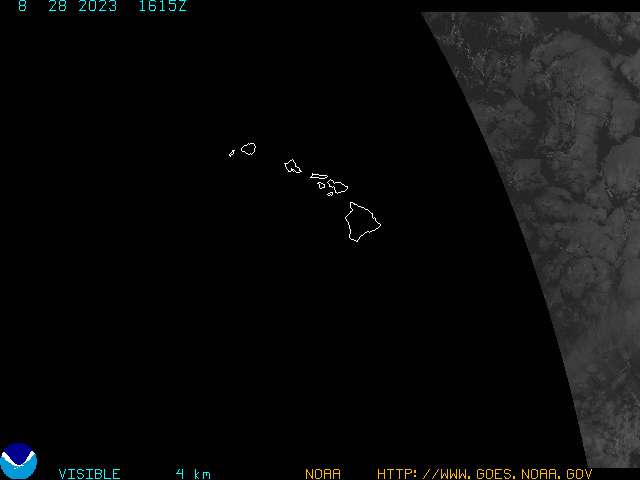


Willy Bennett Says:
Aloha Glenn,
The weather to day was predicted to be very windy in Kihei but was calm most of the day. I think it is because of the easterly direction causing the wind to be calm in the morning due to the blocking effect of Haleakala. Could you ask the Honolulu weather office to put that in their prediction? The time of day graphs don’t show it.
Mahalo,
Willy~~~Hi Willy, exactly, the direction of the winds make all the difference in how windy it gets in Kihei. North and NE winds funnel across the central valley, and make for windy weather along the south coast. Easterly winds are blocked by the bulk of Haleakala. Aloha, Glenn
Frank Parrino Says:
Aloha Glenn….
Forecasts missing once again. Can you help?
West Molokai here.~~~Hi Frank, I’m aware of that, as many folks are letting me know. I’ve let my webmaster know in turn, and am waiting to see what they can do. I’m sorry about these missing forecasts, hopefully they will be back again soon! Aloha, Glenn
WILL MCTHEWSON Says:
Hi Glen,
Many thanks to you for keeping such a great web site going without charge.
I use the Maui map you have fairly often, always trying to figure out if the southern direction is going to make it to my favorite point break (McGreggors) or get snuffed by island blocking. I sure would like to see the other islands added to the Maui map, it might improve my guessing abilities!
Aloha
Will~~~Hi Will, glad to be of service. As for for free usage, that’s very true. There’s always that option to click on a google ad when you visit, it helps out. Best of luck in figuring out about that island blocking. This week should be rather weak at that surf break…better luck next week. Aloha, Glenn