











Air Temperatures – The following maximum temperatures were recorded across the state of Hawaii Tuesday:
Lihue, Kauai – 80
Honolulu airport, Oahu – 84
Kaneohe, Oahu – 80
Molokai airport – m
Kahului airport, Maui – 88 (record for Tuesday – 94 in 1953)
Kona airport 83
Hilo airport, Hawaii – 80
Air Temperatures ranged between these warmest and coolest spots near sea level – and on the highest mountain tops…as of 5pm Tuesday evening:
Honolulu, Oahu – 82
Hilo, Hawaii – 77
Haleakala Crater – 52 (near 10,000 feet on Maui)
Mauna Kea summit – 36 (over 13,500 feet on the Big Island)
Here are the 24-hour precipitation totals (inches) for each of the islands as of Tuesday evening:
0.33 Hanalei River, Kauai
0.67 Moanalua RG, Oahu
0.16 Molokai
0.01 Lanai
0.46 Kahoolawe
0.70 Oheo Gulch, Maui
0.68 Kawainui Stream, Big Island
Marine Winds – Here’s the latest (automatically updated) weather map showing a 1034 millibar high pressure system…far to the north-northeast of our islands. Our local winds will be gradually picking up Wednesday into Thursday.
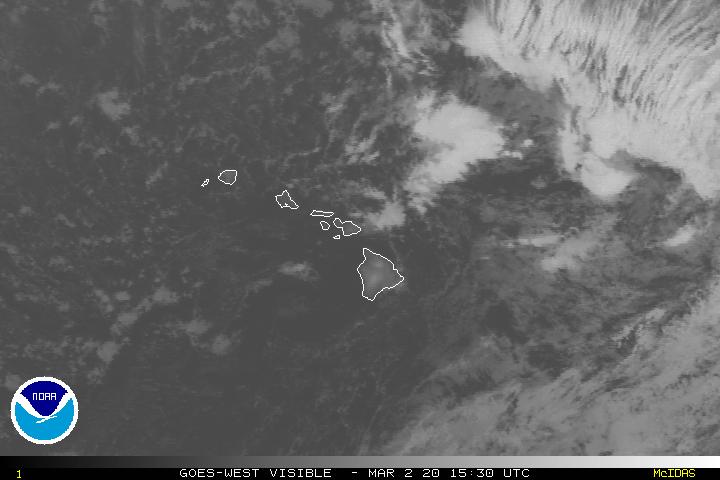
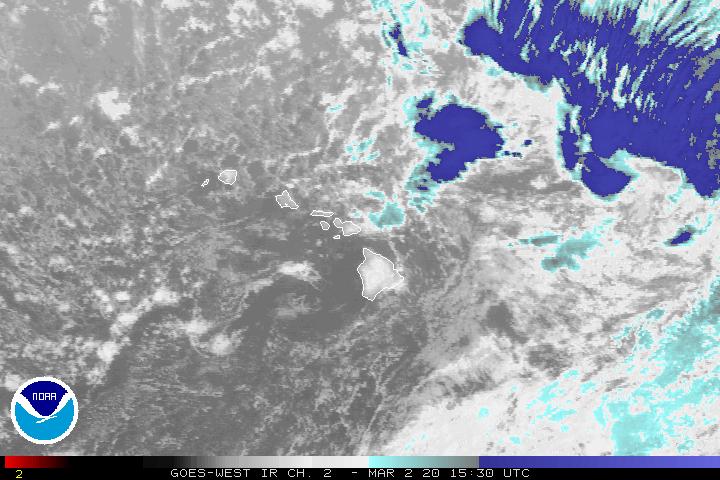
Satellite and Radar Images: To view the cloud conditions we have here in Hawaii, please use the following satellite links, starting off with this Infrared Satellite Image of the islands to see all the clouds around during the day and night. This next image is one that gives close images of the islands only during the daytime hours, and is referred to as a Close-up visible image. Finally, here's a Looping IR satellite image, making viewable the clouds around the islands 24 hours a day. To help you keep track of where any showers may be around the islands, here’s the latest animated radar image.
Hawaii’s Mountains – Here’s a link to the live web cam on the summit of near 13,500 foot Mauna Kea on the Big Island of Hawaii. The tallest peak on the island of Maui is the Haleakala Crater, which is near 10,000 feet in elevation. These two web cams are available during the daylight hours here in the islands…and when there’s a big moon shining down during the night at times. Plus, during the nights you will be able to see stars, and the sunrise and sunset too…depending upon weather conditions.
Tropical Cyclone activity in the eastern and central Pacific – Here’s the latest weather information coming out of the National Hurricane Center, covering the eastern north Pacific. You can find the latest tropical cyclone information for the central north Pacific (where Hawaii is located) by clicking on this link to the Central Pacific Hurricane Center. A satellite image, which shows the entire ocean area between Hawaii and the Mexican coast…can be found here.
Aloha Paragraphs

Increasing trades, high and middle level clouds…showers too
The trade winds blowing across the islands will gradually become rather strong and gusty Wednesday through Saturday…backing off some Sunday into early next week. Glancing at this weather map, we find a 1034 millibar high pressure system located far to our northeast. This high pressure cell has an elongated ridge of high pressure draping southwest, putting it to the north of our islands. As this high moves southward closer to Hawaii, our trade winds will increase a notch Wednesday…and then another Thursday into Saturday. I would appear likely that these stiff trade wind breezes, with their robust gusts, would trigger NWS issued small craft wind advisories. The most common locations for these advisories would be through those windiest channels, and some coasts too, around Maui County and the Big Island. The computer forecast models suggest that by later this weekend, into next week, our trades would ease up enough to be called normal by then.
Our trade winds will be strengthening…the following numbers represent the strongest gusts, along with directions Tuesday evening:
10 Lihue, Kauai – NE
24 Honolulu, Oahu – ENE
24 Molokai – NE
27 Kahoolawe – ESE
27 Kapalua, Maui – SE
14 Lanai
25 South Point, Big Island – NE
We can use the following links to see what’s going on in our area of the north central Pacific Ocean Tuesday night. Looking at this NOAA satellite picture we see those high and middle level clouds to our northeast through southwest, associated with an approaching upper level low pressure system. We can use this looping satellite image to see areas of high and middle level clouds far east of the Big Island. We can also see the clouds associated with this low pressure system…which are moving through the islands now. Checking out this looping radar image we see that showers are falling generally over the ocean, especially near Kauai and Oahu at the time of this writing.
Sunset Commentary: First things first, the trade winds are blowing, and will stick around as far into the future as the computer forecast models can see. Climatology points out that the month of June here in the islands will have these balmy tropical breezes blowing 91% of the time.
There will be the usual day-to-day fluctuations in strength, although will they reach their peak at some point between Wednesday and Saturday. There is a good chance of finding the NWS forecast office in Honolulu issuing small craft wind advisories during at least part of this time frame…if not all.
Late season cold fronts moving by to the north of the state, up in the mid-latitudes of the central Pacific, will weaken our trade wind producing high pressure system…starting later this coming weekend into early next week. Now that we’re pushing steadily towards the start of our summer season however, it would be difficult to slow these trades down very much.
Meanwhile, the cloud band that was to our northeast yesterday at the time of this writing, moved into the state…bringing generally windward biased showers. This satellite image shows what’s left of it early this evening. Actually, it’s difficult to see it, at least for me. Shifting to this shortwave IR satellite picture, we can see the light blue tinge to the high and middle level clouds pushing down towards the islands from the northwest. They have already reached Kauai and Oahu, and will be traveling eastward over the rest of the state during the night.
These clouds, besides dimming and filtering our daytime sunshine will color up our sunsets and sunrises…if these clouds don’t get too thick. Speaking of clouds a bit more, we have yet another upper level low pressure system, associated with the high and middle level clouds moving overhead now. The air temperatures aloft aren’t expected to be as cold as we saw this past weekend.
This cold air, although not as chilly as it was several days ago, will be pretty cold for this time of year. It may be cold enough in fact to trigger a few more of those thunderstorms that brought locally heavy rains to the parts of the state recently. The latest thought is that there’s a “slight” chance of these thunder bumpers by later Wednesday into the Saturday time frame.
This really catches my attention here! There’s been an extraordinary number of thunderstorms this year, in fact more than I can ever remember in the 36 years that I’ve lived here in the islands. The windward sides will be on the receiving end of most of these enhanced showers otherwise. Although with that said, we need to remember that the gusty trade winds may carry some showers over into the leeward sides at times too. Finally, the upcountry sections on both Maui and the Big Island may end up getting some generous showers during the afternoons too.
Here in Kihei, Maui at 550pm Tuesday evening, skies are generally clear, with some clouds around the edges. As noted above, the winds will be on the rise, along with more clouds passing across our skies…at high, middle and lower levels of the atmosphere. Showers will be gradually increasing through the next several days as well, especially along the windward sides…although elsewhere too at times. Right now I'm going to jump in the car and head back upcountry to Kula. I'll be up very early again on Wednesday, in time to post your next new weather narrative from paradise, I hope you have a great Tuesday night until then! Aloha for now…Glenn.
Extra: There's still snow atop Mauna Kea on the Big Island Tuesday evening!
Interesting: Dried fruit is fruit where the majority of the original water content has been removed either naturally, through sun drying, or through the use of specialized dryers or dehydrators. Dried fruit has a long tradition of use dating back to the fourth millennium BC in Mesopotamia. Internationally recognized health researchers presented their views at the 30th World Nut & Dried Fruit Congress on May 21, 2011, recommending that food policy makers consider dried fruits equivalent to fresh fruits in dietary recommendations.
The presentations recommended that traditional dried fruits such as dried apricots, dried apples, dates, dried figs, raisins and sultanas, and prunes should be included side by side with fresh fruit recommendations. Dried fruits have the advantage of being easy to store and distribute, available year round, they are readily incorporated into other foods and recipes, relatively low cost and present a healthy alternative to sugary snacks.
The scientific basis for recommending higher fruit intake is the epidemiological evidence that individuals who regularly eat generous amounts of these foods have lower rates of cardiovascular disease, obesity, several cancers, diabetes and other chronic disease. Traditional dried fruit such as raisins, figs, dates, apricots and apples have been a staple of Mediterranean diets for millennia.
This is due partly to their early cultivation in the Middle Eastern region known as the Fertile Crescent, made up by parts of modern Iraq, Iran and Syria, southwest Turkey and northern Egypt. Drying or dehydration also happened to be the earliest form of food preservation: grapes, dates and figs that fell from the tree or vine would dry in the hot desert sand.
Early hunter-gatherers observed that these fallen fruit took on an edible form, and valued them for their stability as well as their concentrated sweetness. Figs were also prized in early Mesopotamia, Israel and Egypt where their daily use was probably greater than or equal to that of dates. As well as appearing in wall paintings, many specimens have been found in Egyptian tombs as funerary offerings.
In Greece and Crete, figs grew very readily and they were the staple of poor and rich alike, particularly in their dried form. Dried fruits meet dietary guidelines for daily fruit servings and address barriers to fruit intake. The greatest benefit of including dried fruits regularly in the diet is that it is a means to expand overall consumption of fruit and the critical nutrients they contain.
Dried fruits have the advantage of being very easy to store and distribute, they are readily incorporated into other foods and recipes, relatively low cost and present a healthy alternative to sugary snacks. There is considerable research supporting the role of dried fruit particularly in regulating bowel function and maintaining a healthy digestive system.
Recently published research shows that dried plums are more effective than psyllium for the treatment of mild to moderate constipation, and should be considered as a first line therapy. Contrary to the popular perception that dried fruit promote cavities, recent studies indicate that they may actually promote oral health.
Bioactive compounds found in raisins and dried plums appear to have antimicrobial properties that inhibit the growth of bacteria that cause cavities and gum disease. Dried fruits are excellent sources of phenolic compounds in the diet. These make up the largest group of plant bioactive compounds or phytochemicals in the diet and they appear to be, at least in part, responsible for the health benefit associated with the consumption of diets abundant in fruits and vegetables.
Phenolic compounds contribute the most antioxidant capacity of fruits and vegetables and have a multitude of functional capabilities, which may have a beneficial effect on health. Western diets are characterized by intake of excessive amounts of sodium, solid fats, and added sugars that replace nutrient dense food, making it difficult for people to achieve recommended nutrient intake and control caloric value of the diet.
Like fresh fruit, traditional dried fruits are free of fat, trans fats, saturated fat and cholesterol. Dried fruits also have very low sodium content.
Interesting2: Whales are Earth's largest creatures, yet they are incredibly hard to study in the open ocean. For decades scientists have used boats, aircraft and even high cliffs to conduct visual surveys and gather data on whale and dolphin populations. Today, these live surveys form the basis of our knowledge of these marine mammals — what species live where in the world, which ones tend to live together and how abundantly they are represented.
Now, recent work by paleobiologist Nick Pyenson of the Smithsonian's National Museum of Natural History, has revealed a second, equally valuable resource for information on cetaceans — the record of dead whales and dolphins stranded and washed ashore on beaches around the world "Some 30 years ago scientists got serious about the conservation of cetaceans, and began keeping records of strandings," Pyenson says.
Stranding networks were set up around the world and information — such as species type, sex, age, size, cause of death — have been carefully collected, recorded and archived. By compiling and comparing long-term data from stranding records and visual sighting records, both taken from nearly every ocean basin in the world, Pyenson verified that stranding records "faithfully reflect the number of species and the relative abundance" found in live surveys.
In fact, Pyenson says, the stranding data in many parts of the world "almost always provides better diversity information about existing cetacean communities than the live surveys. A lot of rare species show up in stranding records that never appear in the live surveys," Pyenson adds. The stranding record also faithfully reflects the structure of cetacean communities.
"There is a strong and significant correlation in relative abundance of species at nearly all taxonomic levels in both the live data and the stranding data." Pyenson's study, which he refers to as "spreadsheet taphonomy," is the first time the cetacean stranding record has been verified as a viable reflection of the living community, across the globe.
The live sighting and stranding data used in his research came from the coastlines of Australia, the Galapagos Islands (Ecuador), Greece and the Greek Archipelago, Ireland, The Netherlands, New Zealand and the United States. Pyenson based his approach on a study published last year, in the journal Paleobiology, which examined the stranding record of California, Oregon and Washington State.
Pyenson's current paper, which appeared in a recent edition of the Proceedings of The Royal Society B, implies that other scientists seeking taxonomic data on living cetaceans for a specific region "should consult the archived stranding data rather than conduct a survey," Pyenson says. "The best results come from bodies of water adjacent to long coastlines where data have been collected for more than 10 years."
"The results of this live-dead comparison show that key aspects of cetacean community diversity is actually preserved in the stranding record, which is important if you want some baseline for understanding their diversity in the fossil record," Pyenson adds. Strandings have more in common with natural traps, like the Rancho La Brea tar pits, which provide snapshots of diversity in restricted areas, than they do with live surveys. It is possible, Pyenson says, that fossils from certain geologic strata may even hold clues to the structure and abundance of extinct cetacean communities.
Interesting3: Stanford sophomores studying ants in a summer course discovered that the local ants were using poison to kill invading Argentine ants. The discovery provides new insight into the war between the local "winter ants" and the South American invaders who have shown up everywhere from California to South Africa. Argentine ants are taking over the world — or at least the nice temperate parts.
They've spread into Mediterranean and subtropical climates across the globe in sugar shipments from Argentina, and no native ant species has been known to withstand their onslaught — until now. A group of Stanford University undergraduate students working on a class project have discovered that a native species, the plucky winter ant, has been using chemical warfare to combat the Argentine tide.
The winter ants — named for their unusual ability to function in cold weather, rather than grind to a halt like most insects — manufacture a poison in a gland in their abdomen that they dispense when under extreme duress. One tiny drop applied to an Argentine ant is enough to put an end to it. In laboratory testing, the poison had a 79 percent kill rate.
"This is the first well-documented case where a native species is successfully resisting the Argentine ant," said Deborah M. Gordon, a biology professor at Stanford who specializes in studying ants and taught the three-week summer class in which the students first saw the winter ants wielding their poison. "I did not believe it at first," she said.
"This is a group of ants that does not have a sting and you don't see them acting aggressively, but the students were able to show very clearly not just that the winter ants are using poison, but when they use it, how they use it and what the impact is." Gordon and her students presented their findings in a paper published earlier this year in PLoS ONE, a journal published by the Public Library of Science. Argentine ant invasion
The Argentine ants are happy anyplace that has cool, rainy winters and hot, dry summers. They have conquered the entire coastline around the Mediterranean Sea, parts of South Africa, Hawaii, Japan and Australia, as well as the full length of the California coastline. "If you live in a Mediterranean climate, the Argentine ant is the ant in your kitchen," Gordon said.
"These ants, wherever they become established, wipe out all the native ants." Leah Kuritzky marks the trail of some of the winter ants she and her fellow student researchers studied on the Stanford campus. The extermination of native ants sets off a ripple effect through an ecosystem. Some native ant species that eat seeds have coevolved with certain native grasses and other plants to become a crucial part of the plant's propagation by carrying the seeds to new areas.
Without the native ant species to spread their seeds, the grasses can't flourish. Any significant impact on the plants would also likely affect creatures that feed on or nest in the plants. Argentine ants have been declared agricultural pests in California because of the damage they do to citrus crops. The invaders are partial to areas where the ground has been disturbed, such as plowed fields and construction sites.
They also spread through plants sold by nurseries. The invaders are agriculturalists after a fashion themselves, tending "herds" of aphids and other scale insects that attach to plants and suck out the sugary sap. The ants, in turn, feed on the sugar-rich liquid that the aphids excrete, "quaintly called honeydew," Gordon said. By protecting the aphids from predators, the Argentines enable the insects to spread.
That yummy honeydew is what brings the Argentine invaders and the winter ants into conflict, as winter ants also tend aphids. The Stanford students began observing the native ants as part of a 2008 short summer class for sophomores called Ecology of Invasions, taught by Gordon. At a variety of locations on the Stanford campus, they started out simply observing and recording ant behavior while visiting each site at the same time every day.
"We were looking at the nest openings of the winter ants and one day it was just winter ants going about their business foraging for food and making trails — just typical ant behavior," said Leah Kuritzky, a student in the class and one of the coauthors of the PLoS ONE paper. An ant 'massacre' "The next day we came back and the ground was littered with Argentine ants. There were dead ants all around and there was a lot of fighting around the nest entrances."
In earlier observations, the students had noticed the winter ants occasionally secreting a whitish fluid from their abdomens and, by prodding a few with a paperclip, had figured out that the ants tended to secrete when hassled. "They would curl their abdomens around and deposit the white secretion on the paper clip used to prod them," said Trevor Sorrells, then a junior who was a teaching assistant for the class.
Watching the combat, the students saw the winter ants use their lethal secretions against the invaders. Intrigued, the group decided to continue the research after the class ended. Kuritzky did a chemical analysis of the secretion, using gas chromatography and mass spectrometry. She determined that part of the secretion consisted of a type of hydrocarbon, which many social insects use to carry a colony-specific odor that helps them identify friend from foe.
But what substance gives the secretion is lethal punch still has to be determined. "Whatever it is, it is clearly very toxic," Gordon said. To assess the lethality of the secretion — and how freely the winter ants wielded it — Sorrells and the other students ran a series of "trials by combat" in palm-sized shallow glass petri dishes in the lab.
He organized some group rumbles with 20 ants per dish, varying the ratio of winter ants to Argentine ants to see if that had an effect. He also ran some one-on-one gladiatorial combat in a one-centimeter square "ring." "It turns out the winter ants use the secretion only when they are really overwhelmed, so it is probably energetically very expensive for the winter ant to manufacture and use this stuff," Gordon said.
In the great outdoors, without petri dish arenas in which to settle their disputes, the winter ants tend to use their secretion either when vastly outnumbered or in the immediate defense of queen and colony. Gordon has been conducting ant population studies in Stanford's Jasper Ridge Biological Preserve for 18 years, during which she has seen territory change hands as the invaders pushed into the preserve and displaced the winter ants.
But several years ago, the winter ants began gaining the upper hand. "It looks like the Argentine ants are getting pushed back tree by tree," Gordon said. The winter ants are showing up in trees where the Argentine ants had been. "It seems the winter ants let the Argentine ants find the aphids and then they take over.
Over time, the winter ants may be starving the Argentine ants out," she said. The recent shift in the balance of power may be in part a result of cooler weather, which favors the winter ants, and low rainfall, which inhibits the Argentine ants, Gordon suggested. So in a natural habitat, without warm buildings in which the Argentine ants can gather around the kitchen hearth, the winter ants can hold the invaders back.
But continued development, which creates the disturbed ground and toasty homes that the Argentine ants favor, may well trump the winter ants' chemical weapon in the long run. Already, Gordon said, the Argentine ants in California far outnumber the native winter ants.
 Email Glenn James:
Miriam Says:
Hi Glenn, Hope you are well. I was wondering what is the latest date that there has been snow up on Mauna Kea? I see there is still snow this morning, and just wondered if there had ever been a year that there was snow all year round.
Aloha Miriam~~~Hi Miriam, good to hear from you again! Good question, and there is still snow atop Mauna Kea this evening. There has absolutely never been a year that snow has stuck around through the summer, as a matter of fact…this is very late in the year for that white stuff up there! I wonder if at some point between Wednesday and early this coming weekend, that we might see a few more flakes up there? Please keep in touch. Aloha, Glenn
Kimberly Says:
Sometimes when it looks like vog it is sugar cane burning smoke. You can call this number to check and see when and where they are burning. They normally give information for two days at a time.
877-6963
Site for more information on sugar cane burning:
http://www.mauibrand.com/CaneBurningQA.pdf~~~Thanks Kimberly! Aloha, Glenn
Helen Says:
Hi Glenn,
Mahalo for all the weather updates. Hope you are doing well.
Just wondering could there be any vog around still or is it just my imagination?
Mahalo .. ~~~ Hi Helen, thanks for your positive feedback. You know, someone else asked me that same question yesterday, and I said no I didn’t think so. I’ve been stuck in an office so much since Monday however that I can’t be positive. Although looking out the window here in Kihei just now (850am), I didn’t see anything that looked hazy to me. Aloha, Glenn