March 24-25, 2010
Air Temperatures – The following maximum temperatures were recorded across the state of Hawaii Wednesday afternoon:
Lihue, Kauai – 79
Honolulu, Oahu – 83
Kaneohe, Oahu – 79
Kaunakakai, Molokai – 79
Kahului, Maui – 82
Hilo, Hawaii – 79
Kailua-kona – 79
Air Temperatures ranged between these warmest and coolest spots near sea level around the state – and on the highest mountains…at 6pm Wednesday evening:
Barking Sands, Kauai – 81F
Molokai airport – 72
Haleakala Crater – 52 (near 10,000 feet on Maui)
Mauna Kea summit – 39 (near 14,000 feet on the Big Island)
Precipitation Totals – The following numbers represent the largest precipitation totals (inches) during the last 24 hours on each of the major islands, as of Wednesday afternoon:
1.30 Mount Waialaele, Kauai
0.34 Dillingham, Oahu
0.03 Molokai
0.00 Lanai
0.10 Kahoolawe
0.25 Ulupalakua, Maui
0.40 Pahoa, Big Island
Marine Winds – Here’s the latest (automatically updated) weather map showing high pressure systems to the north and northeast. This pressure configuration will keep gusty trade winds blowing Thursday…somewhat lighter Friday.
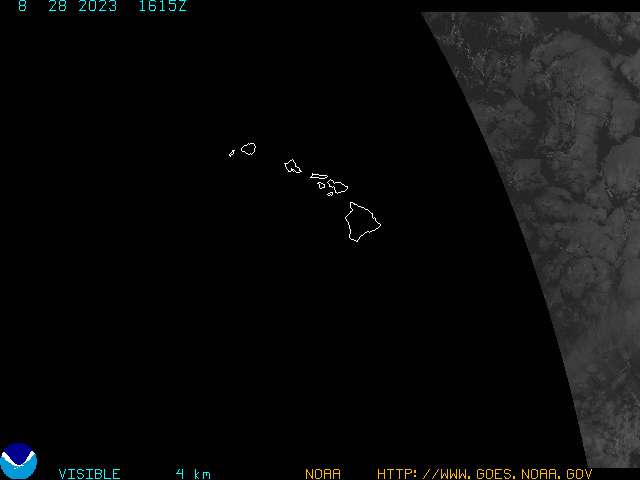
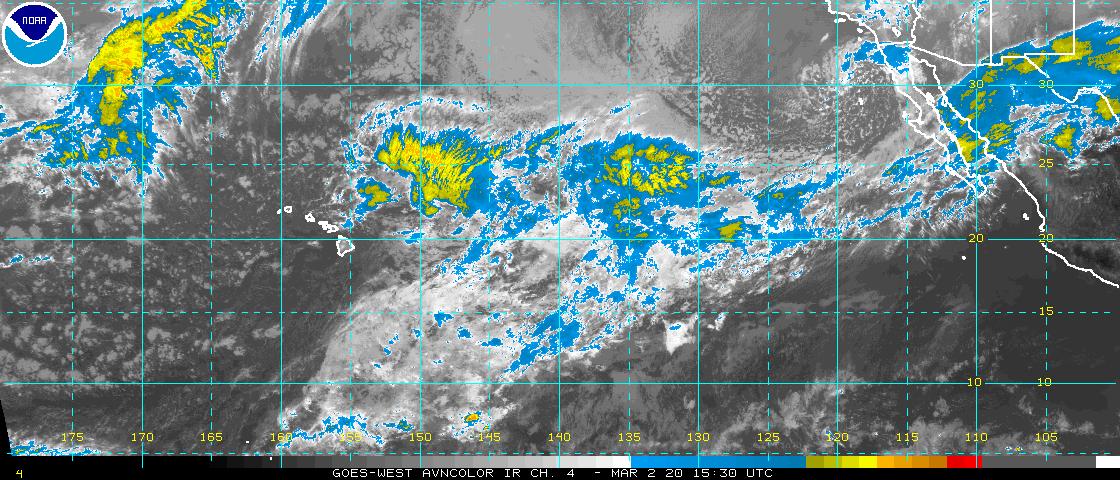
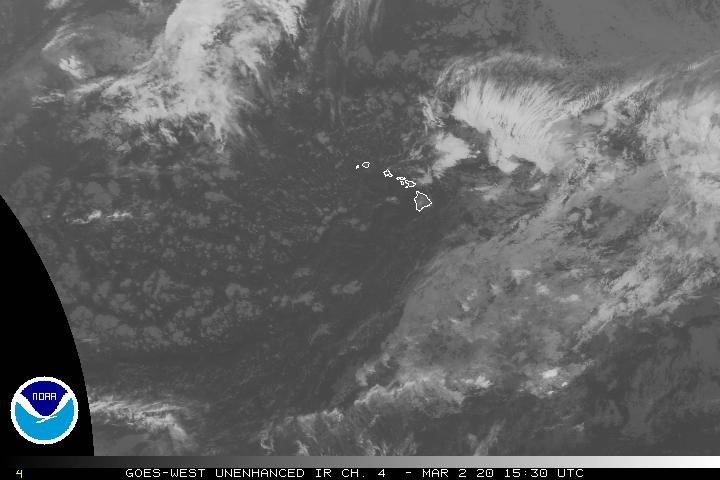
Satellite and Radar Images: To view the cloud conditions we have here in Hawaii, please use the following satellite links, starting off with this Infrared Satellite Image of the islands to see all the clouds around the state during the day and night. This next image is one that gives close images of the islands only during the daytime hours, and is referred to as a Close-up visible image. This next image shows a larger view of the Pacific…giving perspective to the wider ranging cloud patterns in the Pacific Ocean. Finally, here’s a Looping IR satellite image, making viewable the clouds around the islands 24 hours a day. To help you keep track of where any showers may be around the islands, here’s the latest animated radar image.
Hawaii’s Mountains – Here’s a link to the live webcam on the summit of near 14,000 foot Mauna Kea on the Big Island of Hawaii. The tallest peak on the island of Maui is the Haleakala Crater, which is near 10,000 feet in elevation. These two webcams are available during the daylight hours here in the islands…and when there’s a big moon rising just after sunset for an hour or two! Plus, during the nights and early mornings you will be able to see stars, and the sunrise too…depending upon weather conditions.
Tropical Cyclone activity in the eastern and central Pacific – Here’s the latest weather information coming out of the National Hurricane Center, covering the eastern north Pacific. You can find the latest tropical cyclone information for the central north Pacific (where Hawaii is located) by clicking on this link to the Central Pacific Hurricane Center. Here’s a tracking map covering both the eastern and central Pacific Ocean. A satellite image, which shows the entire ocean area between Hawaii and the Mexican coast…can be found here.
Aloha Paragraphs

Sunny leeward, some showers windward
Now that the upper low pressure trough, along with it’s associated surface reflection have vacated our area…weather conditions have settled down quite a bit. The departure of these low pressure systems has also opened the gates to the trade winds, after a couple of days of light breezes. We have drier air, and a stabilized atmosphere overhead Wednesday, with the threat of heavy showers completely out of the weather picture now. Meanwhile, those sun dimming and filtering high cirrus clouds have moved off to the east as well. This puts us into a nice looking trade wind weather pattern, with little change expected through the next week. There will be those times when the trade winds increase or decrease a notch, although overall, will blow at the moderately strong levels generally. At mid-week, these trade winds are strong enough to have necessitated a small craft wind advisory over all the major channels between the islands statewide.
In the precipitation department, an overhead ridge of high pressure will limit showers from falling…especially along the leeward sides. As usual, with the trade winds on the brisk side, the bulk of the showers that do fall however, will land on the windward coasts and slopes. Looking at satellite imagery, it doesn’t appear that there’s all that many rainy clouds out to the east of the state. There’s another wave of high clouds far to the southwest of the state, although it may or may not continue to fly in our direction aloft. This looping radar image shows too, that rainfall certainly isn’t overbearing at the moment locally…with the
It’s Wednesday evening as I begin writing the last section of today’s narrative. The weather here in Hawaii has straightened itself out now, although this doesn’t mean it won’t be locally windy, with windward showers too. The leeward sides will be the best place to catch those all important sun rays, especially during the morning hours…when the least amount of clouds and wind will be around. As I menitoned above, I think I did at least, we should have generally fair weather conditions through the next week. As the winds calm down some this weekend, we may begin to see a bit more upcountry afternoon shower activity. This will depend upon just how light the winds become of course. There will be off and on showers along the windward sides, a bit less or a bit more, depending upon the amount of cloudiness that the trade winds carry our way on any particular day. ~~~ This week is a busy one for this Maui weatherman, after a long visit with my friend Bob, who was here from California for 10 days. Tuesday I had some dermatological surgery, although even with the stitches in two different places on my body, it wasn’t all that big a deal. Then today, I gave a talk to a group of students here from the Windward Community College. The Maui News called after that, and wanted to interview me on our local weather conditions for the paper Thursday. This interview was on the cell phone while I was driving upcountry to Makawao, for my annual tax preparation meeting. As soon as I got home, I went with one of my neighbors for a quick walk, before rememebering that I hadn’t written anything here! Tomorrow at work in Kihei, I have meetings all morning into the early afternoon, as I’m the lead person on a hurricane exercise that the Pacific Disaster Center, my day job, participates in later this spring. So, it’s a busy time, and I must admit, very stimulating in a positive way. ~~~ I’ll be back after meditating early Thursday morning, with your next new update of this page. I hope you have a great Wednesday night until then! Aloha for now…Glenn.
Interesting: A pandemic flu virus from 1918 is markedly similar to last year’s H1N1 strain, according to a study published Wednesday, which scientists said could help in the creation of new vaccines. The research was published in the online journal Science Translational Medicine said. "This study defines an unexpected similarity between two pandemic-causing strains of influenza," said Anthony Fauci, the director of the National Institute of Allergy and Infectious Diseases (NIAID).
"It gives us a new understanding of how pandemic viruses evolve into seasonal strains, and, importantly, provides direction for developing vaccines to slow or prevent that transformation," Fauci said. Researchers at the NIAID and the US Centers for Disease Control and Prevention (CDC) injected mice with a vaccine made from inactivated 1918 influenza virus, then exposed them to high levels of the 2009 H1N1 virus.
All of the vaccinated mice survived. The scientists then repeated the experiment, this time vaccinating the mice with inactivated 2009 H1N1 virus and exposing them to high concentrations of the 1918 virus. Again, the mice survived. The "surprising" finding is that either pandemic virus could be used to create a vaccine that caused the mice to produce antibodies capable of neutralizing the other.
"This is a surprising result," said NIAID scientist Gary Nabel, who led the research. "We wouldn’t have expected that cross-reactive antibodies would be generated against viruses separated by so many years," he said.
Interesting2: Increasing access to energy is critical to ensuring socioeconomic development in the world’s poorest countries. An estimated 1.5 billion people in developing countries have no access to electricity, with more than 80 per cent of these living in sub-Saharan Africa or South Asia. The problem is most acute in remote areas: 89 per cent of people in rural sub-Saharan Africa live without electricity, which is more than twice the proportion (46 per cent) in urban areas.
For these people, even access to a small amount of electricity could lead to life-saving improvements in agricultural productivity, health, education, communications and access to clean water. Options for expanding access to electricity in developing countries tend to focus on increasing centralized energy from fossil fuels such as oil, gas and coal, by expanding grid electricity.
But this approach has little benefit for the rural poor. Grid extension in these areas is either impractical or too expensive. Neither does this strategy help tackle climate change. Power already accounts for 26 per cent of global greenhouse gas emissions and while most of this comes from the developed world, by 2030 developing countries are predicted to use 70 per cent more total annual energy than developed nations. There is therefore a clear need for pro-poor, low-carbon ways to improve access to electricity in the developing world — solar power could be one such solution.
Interesting3: As you stroll down restaurant row and catch the wonderful aroma of food — steaks, burgers, and grilled veggies — keep this in mind: You may be in an air pollution zone. Scientists in Minnesota are reporting that commercial cooking is a surprisingly large source of a range of air pollutants that could pose risks to human health and the environment. They discussed the topic here today at the 239th National Meeting of the American Chemical Society.
Deborah Gross, Ph.D., pointed out that commercial food cooking is a known source of air pollutants, including gases and tiny solid particles — as is cooking in the home. "While that mouth-watering smell may whet our appetites, it comes from the emission of smoke from the cooking process into the air that we breathe," Gross said.
Research conducted in the U.S. during the past decade has shown that cooking is by far the largest source of respirable particles generated in the home, as well. "Exposure to high concentrations of these particles is common." Gross, who is with Carleton College in Northfield, Minn., has been working with colleagues Tom Kuehn, Bernard Olson, and Dabrina Dutcher of the University of Minnesota to define the specific contribution that commercial cooking makes to air pollution.
The project, also involving Carleton undergraduate student Lisa Wang, already has resulted in two air quality management districts in California implementing restrictions on commercial cooking emissions. They are the South Coast and Bay Area Air Quality Management Districts. Much of the Los Angeles Basin now requires the use of catalytic converters to minimize the release of aerosol particles from char broiler grates.
Interesting4: Following months of grueling tests and trials, scientists now reveal the World’s strongest insect to be a species of dung beetle called Onthophagus taurus. In an experiment to find out why animals vary so much in strength and endurance, Dr Rob Knell from Queen Mary, University of London and Professor Leigh Simmons from the University of Western Australia found the strongest beetle could pull an astonishing 1,141 times its own body weight — the equivalent of a 70kg person lifting 80 tons (the same as six full double-decker buses).
Writing in the journal Proceedings of the Royal Society B, the scientists also found these insect athletes need to pay just as much attention to their diet as human athletes. Even the strongest beetles were reduced to feeble weaklings when put on a poor diet for a few days. "Insects are well known for being able to perform amazing feats of strength," explained Dr Knell from Queen Mary’s School of Biological and Chemical Sciences, "and it’s all on account of their curious sex lives.
Female beetles of this species dig tunnels under a dung pat, where males mate with them. If a male enters a tunnel that is already occupied by a rival, they fight by locking horns and try to push each other out." Knell and Simmons tested the beetles’ ability to resist a rival by measuring how much weight was needed to pull him out of his hole. "Interestingly, some male dung beetles don’t fight over females," said Dr Knell. "They are smaller, weaker and don’t have horns like the larger males.
Even when we fed them up they didn’t grow stronger, so we know it’s not because they have a poorer diet. "They did, however, develop substantially bigger testicles for their body size. This suggests they sneak behind the back of the other male, waiting until he’s looking the other way for a chance to mate with the female. Instead of growing super strength to fight for a female, they grow lots more sperm to increase their chances of fertilizing her eggs and fathering the next generation."
 Email Glenn James: