











March 16-17, 2010
Air Temperatures – The following maximum temperatures were recorded across the state of Hawaii Tuesday afternoon:
Lihue, Kauai – 79
Honolulu, Oahu – 81
Kaneohe, Oahu – 79
Kaunakakai, Molokai – 82
Kahului, Maui – 85
Hilo, Hawaii – 80
Kailua-kona – 81
Air Temperatures ranged between these warmest and coolest spots near sea level around the state – and on the highest mountains…at 4pm Tuesday afternoon:
Kahului, Maui – 82F
Lihue, Kauai – 74
Haleakala Crater – 39 (near 10,000 feet on Maui)
Mauna Kea summit – 37 (near 14,000 feet on the Big Island)
Precipitation Totals – The following numbers represent the largest precipitation totals (inches) during the last 24 hours on each of the major islands, as of Tuesday afternoon:
9.74 Mount Waialaele, Kauai
2.05 Oahu Forest NWR, Oahu
0.28 Molokai
0.03 Lanai
0.01 Kahoolawe
1.92 Oheo Gulch, Maui
0.82 Kawainui Stream, Big Island
Marine Winds – Here’s the latest (automatically updated) weather map showing a 1030 millibar high pressure system to the northeast of Hawaii…moving away into the area far northeast of Hawaii. At the same time we have a new cold front approaching from the northwest. The winds will gradually strengthen from the north to northeast later Wednesday into Thursday.
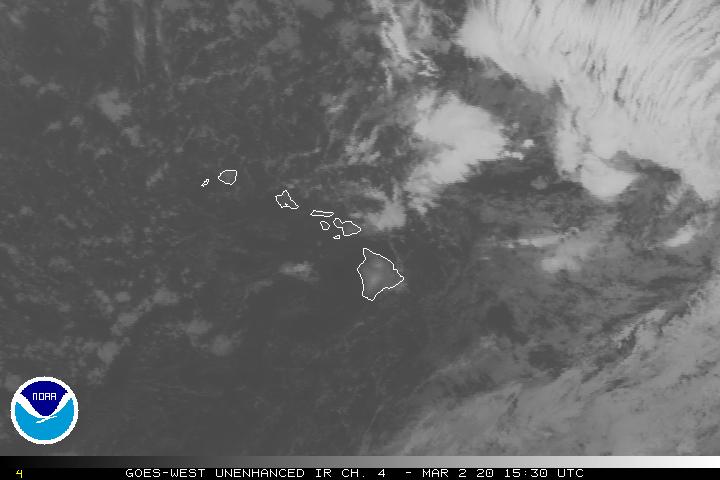
Satellite and Radar Images: To view the cloud conditions we have here in Hawaii, please use the following satellite links, starting off with this Infrared Satellite Image of the islands to see all the clouds around the state during the day and night. This next image is one that gives close images of the islands only during the daytime hours, and is referred to as a Close-up visible image. This next image shows a larger view of the Pacific…giving perspective to the wider ranging cloud patterns in the Pacific Ocean. Finally, here’s a Looping IR satellite image, making viewable the clouds around the islands 24 hours a day. To help you keep track of where any showers may be around the islands, here’s the latest animated radar image.
Hawaii’s Mountains – Here’s a link to the live webcam on the summit of near 14,000 foot Mauna Kea on the Big Island of Hawaii. The tallest peak on the island of Maui is the Haleakala Crater, which is near 10,000 feet in elevation. These two webcams are available during the daylight hours here in the islands…and when there’s a big moon rising just after sunset for an hour or two! Plus, during the nights and early mornings you will be able to see stars, and the sunrise too…depending upon weather conditions.
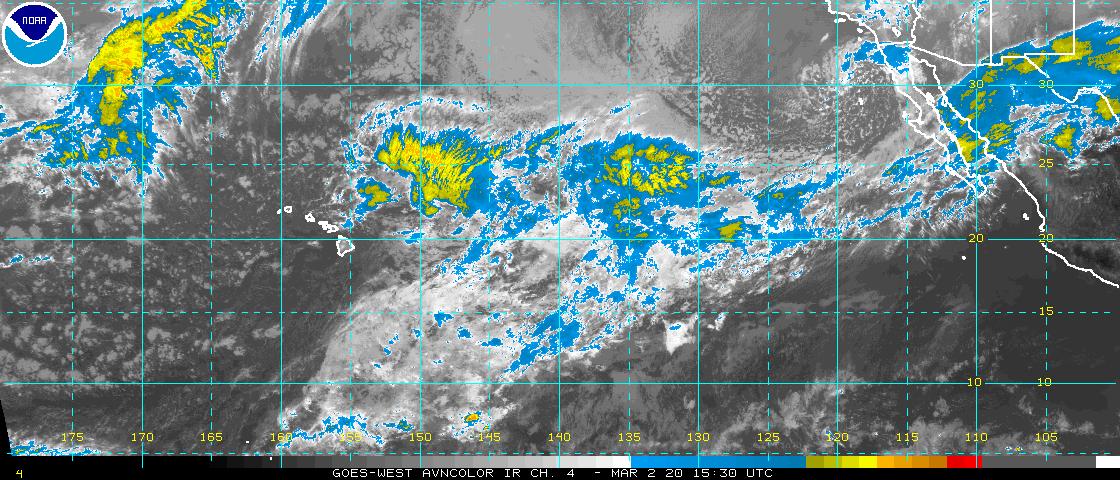
Tropical Cyclone activity in the eastern and central Pacific – Here’s the latest weather information coming out of the National Hurricane Center, covering the eastern north Pacific. You can find the latest tropical cyclone information for the central north Pacific (where Hawaii is located) by clicking on this link to the Central Pacific Hurricane Center. Here’s a tracking map covering both the eastern and central Pacific Ocean. A satellite image, which shows the entire ocean area between Hawaii and the Mexican coast…can be found here.
Aloha Paragraphs
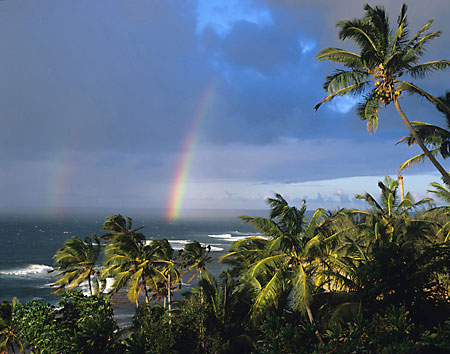
Heavy rain on Kauai…10.09"
The overlying atmosphere remains quite unstable, along with more than the ordinary amount of available moisture for showers. At least part of this moisture has been provided thanks to the recent cold front, which got hung up over
So Tuesday had a reasonably nice morning, with those afternoon clouds dumping locally heavy showers. We can check out this looping radar image, in order to see the wind direction, and where there are showers falling too. There seem to be considerably less showers falling over the ocean than we’ve seen the last several days. At the same time, we see generally southeast winds blowing. Checking out these winds a little more closely early Tuesday evening, it was still a bit gusty over Kahoolawe, and down at South Point on the Big Island too. Otherwise, the winds are noticeably lighter now, although the small craft wind advisory remains in force over all the coastal waters, probably more for the surf than the winds at this point.
We are about to get into some different kinds of weather soon, as the next cold front continues to push in our direction from the northwest. This front was still over 600 miles away early Tuesday evening, and moving southeast towards the
As this cold front arrives, it will usher in another of those tropical cool snaps, with chilly north to northeast winds blowing in behind the frontal boundary. The source of this wind will be the 1031 millibar high pressure system moving in behind the front, currently located near the International Dateline to our west. Again, we can glance at that weather map above, to see this new high pressure cell. The winds will remain cool Thursday, although as the high progresses eastward, our winds will take on a more easterly direction, with warmer trade winds continuing into the weekend. These winds trailing the cold front may contain quite a bit of moisture, so that wet trade winds may continue for several days along the windward sides, blowing perhaps even into the leeward sides at times. The computer models are now showing yet another cold front will approach, bringing our local wind speeds down a notch or two after the weekend.
It’s Tuesday evening, as I begin writing the last section of today’s narrative.
As noted above, heavy rainfall collected over and around the mountains on Kauai, and on the other islands during the second half of the day Tuesday. One particularly wet spot on Kauai, Mount Waialaele, picked up an amazing 10.09" of precipitation during the last 24 hours! There were several 5.00"+ amounts on Kauai as well, with some good totals on the other islands too. This looping radar image again shows the nature of the precipitation falling over the state Tuesday evening. ~~~ Looking a bit further ahead, another cold front will arrive Wednesday evening or night, into Thursday. This will keep the prospect of showery weather in the forecast into Friday. This doesn’t mean that it will be raining all the time by any means. The leeward sides will have less rainfall, and see more sunshine than the windward sides. The chilly north winds coming in behind the next cold front, will bring another one of those tropical cool snaps for a day or two. The warmer trade winds will arrive by Friday, and remain in place through the upcoming weekend. ~~~ I would imagine that much of the afternoon and early evening rainfall will slow down, and probably stop during the night. The one exception may be for Kauai, as some prefrontal clouds and showers may arrive before the actual cold front on Wednesday. Here in Kihei, its raining quite heavily before I take the drive back upcountry to Kula, where it was raining too. My friend Bob, whose visiting from California, went kayaking and snorkeling today, and then drove over to Lahaina during the afternoon, where it was raining too. I’ll be back early Wednesday morning with more weather reporting from Hawaii, I hope you have a great Tuesday night until then! Aloha for now…Glenn.
Interesting: Shrimp are swimming crustaceans found widely around the world in both fresh and salt water. Shrimp are an important food source for larger animals from fish to whales. Shrimp are small creatures but definitely larger than microscopic microbes. Technically, the "shrimp" is not a shrimp but a Lyssianasid amphipod, which is distantly related to shrimp. A finding of such a creature implies other larger organisms that feed off shrimp.
There is also another problem though. Under the glacier it is very cold and dark. Both conditions are quite forbidding for any life. So how can it be? "We were operating on the presumption that nothing’s there," said NASA ice scientist Robert Bindschadler, who will be presenting the initial findings and a video at an American Geophysical Union this month. "It was a shrimp you’d enjoy having on your plate." "We were just gaga over it," he said of the 3 inch long, orange critter starring in their two minute video.
The video is likely to inspire experts to rethink what they know about life in harsh environments. And it has scientists musing that if shrimp like creatures can be found below 600 feet of Antarctic ice in subfreezing dark water, what about other hostile places? What about Europa, a frozen moon of Jupiter? Many have speculated that under its thick surface ice layer lies a vast and frigid ocean. If the Antarctic shrimp can survive under a glacier perhaps its distant cousins can too.
Most planetary scientists believe that a layer of liquid water exists beneath Europa’s surface, kept warm by tidally-generated heat. Surface temperature average about −260 °F at the equator and only −370 °F at the poles, keeping Europa’s icy crust very hard. The first hints of a subsurface ocean came from theoretical considerations of tidal heating (a consequence of Europa’s slightly eccentric orbit and orbital resonance with the other Galilean moons).
In Antarctica: "They are looking at the equivalent of a drop of water in a swimming pool that you would expect nothing to be living in and they found not one animal but two," said biologist Stacy Kim of the Moss Landing Marine Laboratories in California, who joined the NASA team later. "We have no idea what’s going on down there." "This is a first for the sub glacial environment with that level of sophistication," microbiologist Ellis-Evans of the British Antarctic Survey said.
He said there have been findings somewhat similar, showing complex life in retreating ice shelves, but nothing quite directly under the ice like this. A retreating glacier is warmer and is more exposed to sunlight. Ellis-Evans said it’s possible the creatures swam in from far away and don’t live there permanently. But Kim, who is a co-author of the study, doubts it. The site in West Antarctica is at least 12 miles from the open seas. Bindschadler drilled an 8 inch wide hole and was looking at a tiny amount of water.
That means it’s unlikely that that two creatures swam from great distances and were captured randomly in that small of an area, she said. Yet scientists were puzzled at what the food source would be for these critters. While some microbes can make their own food out of chemicals in the ocean and sunlight, complex life like the amphipod can not do so. So what do they eat? And what eats them?
Interesting2: Enkidu, a man raised by wild animals in the classic Sumerian poem Epic of Gilgamesh, knew nothing of beer until a prostitute guided him to a shepherd’s camp. Upon finishing seven full cups, "his soul became free and cheerful, his heart rejoiced, his face glowed…. He became human." Beer was so popular throughout ancient Mesopotamia that some historians argue it inspired the earliest farmers to domesticate grain.
Beer is the third most popular drink in the world, after water and tea. Per-capita annual consumption is highest in the Czech Republic, at 157 liters per person, followed by Ireland (131) and Germany (116). World beer consumption has risen almost every year for the past two decades. The world average in 2005 was 23 liters per person. Conventional beer is made with malted grains (often barley or wheat), hops, yeast, and water.
The hops act as preservatives and add to some beers’ characteristic bitter flavor. Yeast is added after the grains are cooked from a few days to several months. The yeast combines with the mashed grains’ sugary compounds to form alcohol. The brew is then fermented again, filtered, and cooled. One liter of beer traditionally requires between four and six liters of water and four or five kilograms of grain.
Energy consumption – mostly from refrigeration and transportation – is also significant. But the greatest environmental impact is created by beer containers, overwhelmingly single-serving glass bottles or aluminum cans. One ton of glass embodies as much energy as is contained in 135 liters of oil and creates 845 kilograms of mining waste.
Interesting3: China’s international science influence is still weak, even though its investment in science has rapidly increased in recent years, a report has found. The Institute of Scientific and Technical Information of China (ISTIC) evaluated the changing ‘science power’ and global influence of 19 major countries — including China, India, the United Kingdom and the United States — since 2002.
The number of science papers, patents, citations and science awards, amongst other indices, were used to evaluate a country’s science power — a country’s continued investment in basic and applied research, and the results generated. China’s science power ranked fourth in 2006, up from seventh place in 2002. And in terms of investment in research China ranked third (after the United States and Japan).
But the country’s global science influence — measured by criteria including the number of citations in international journals, leading international awards, and membership of prestigious science academies — has not matched its science power, researchers found. China was ranked just thirteenth out of the 19 countries.
Interesting4: Levels of the main greenhouse gas in the atmosphere have risen to new highs in 2010 despite an economic slowdown in many nations that braked industrial output, data showed on Monday. Carbon dioxide, measured at Norway’s Zeppelin station on the Arctic Svalbard archipelago, rose to a median 393.71 parts per million of the atmosphere in the first two weeks of March from 393.17 in the same period of 2009, extending years of gains.
"Looking back at the data we have from Zeppelin since the end of the 1980s it seems like the increase is accelerating" Johan Stroem, of the Norwegian Polar Institute, said of the data compiled with Stockholm University. The rise in concentrations, close to an annual peak before carbon-absorbing plants start to grow in the northern hemisphere spring, was below the average gain over the year of around 2 parts per million.
"It still confirms the rise," Stroem said of the data from the first two weeks of March supplied to Reuters. Concentrations vary from week to week depending on the source of Arctic winds. Carbon concentrations have risen by more than a third since the Industrial Revolution ushered in wider use of fossil fuels.
A 2009 study of the ocean off Africa indicated carbon levels in the atmosphere were at their highest in 2.1 million years. Recession in 2009 in many nations has not apparently affected gains. The International Energy Agency estimated in September that emissions of carbon dioxide would fall about 2.6 percent in 2009 because of a decline in industrial activity.
 Email Glenn James:


jack weber Says:
“Each of the islands got locally soaked, athough Oahu had enough to warrant a flood advisory.”
Not this Big Island! 🙁
J*~~~Hi Jack, well…perhaps not soaked, but at least some rainfall. You are right though, your island did once again get the short end of the stick again! I’m hoping this next cold front will push down your way by Thursday. I’m pretty sure that you will get into some rainfall Friday into the weekend as well…hope so! Aloha, Glenn