











March 15-16, 2010
Air Temperatures – The following maximum temperatures were recorded across the state of Hawaii Monday afternoon:
Lihue, Kauai – 73
Honolulu, Oahu – 81
Kaneohe, Oahu – 77
Kaunakakai, Molokai – 78
Kahului, Maui – 81
Hilo, Hawaii – 77
Kailua-kona – 78
Air Temperatures ranged between these warmest and coolest spots near sea level around the state – and on the highest mountains…at 4pm Monday afternoon:
Honolulu, Oahu – 79F
Lihue, Kauai – 71
Haleakala Crater – 41 (near 10,000 feet on Maui)
Mauna Kea summit – 37 (near 14,000 feet on the Big Island)
Precipitation Totals – The following numbers represent the largest precipitation totals (inches) during the last 24 hours on each of the major islands, as of Monday afternoon:
3.52 Mount Waialaele, Kauai
0.99 Oahu Forest NWR, Oahu
1.80 Molokai
0.10 Lanai
0.00 Kahoolawe
2.69 Puu Kukui, Maui
0.85 Waiakea Uka, Big Island
Marine Winds – Here’s the latest (automatically updated) weather map showing a 1031 millibar high pressure system to the north-northwest of Hawaii…moving eastward into the area north and northeast of Hawaii. At the same time we have a weakening cloud band push down into the state. The winds will be increasing from the northeast Monday…then lighter gradually becoming Tuesday and Wednesday.
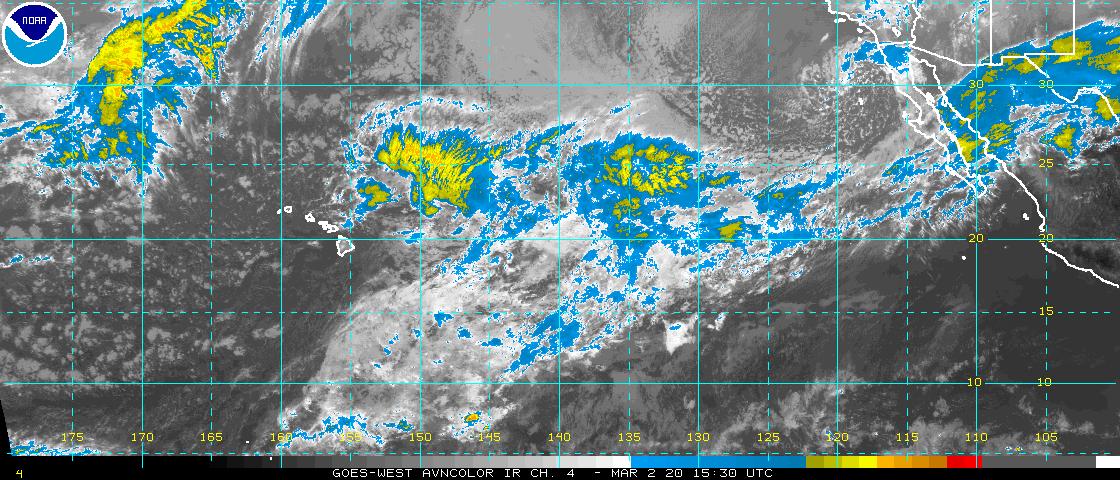
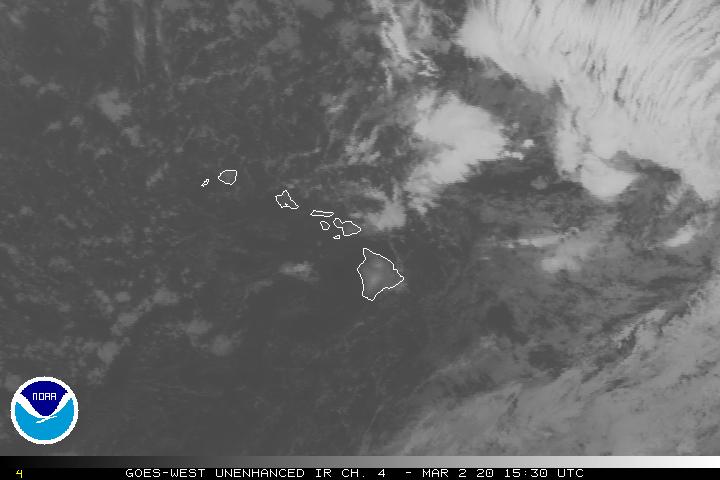
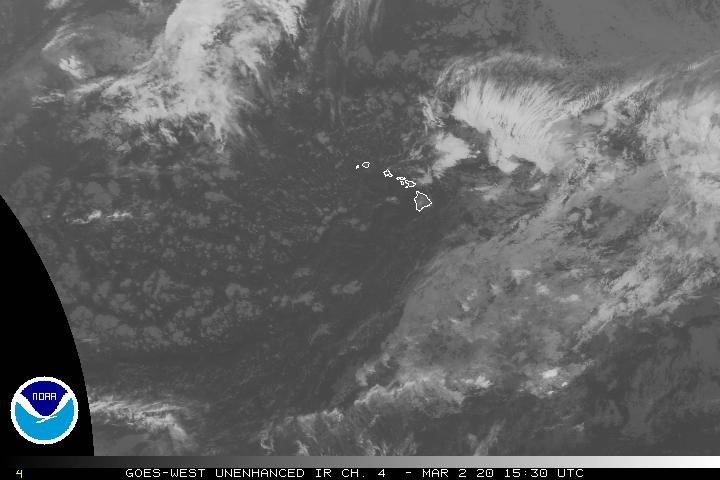
Satellite and Radar Images: To view the cloud conditions we have here in Hawaii, please use the following satellite links, starting off with this Infrared Satellite Image of the islands to see all the clouds around the state during the day and night. This next image is one that gives close images of the islands only during the daytime hours, and is referred to as a Close-up visible image. This next image shows a larger view of the Pacific…giving perspective to the wider ranging cloud patterns in the Pacific Ocean. Finally, here’s a Looping IR satellite image, making viewable the clouds around the islands 24 hours a day. To help you keep track of where any showers may be around the islands, here’s the latest animated radar image.
Hawaii’s Mountains – Here’s a link to the live webcam on the summit of near 14,000 foot Mauna Kea on the Big Island of Hawaii. The tallest peak on the island of Maui is the Haleakala Crater, which is near 10,000 feet in elevation. These two webcams are available during the daylight hours here in the islands…and when there’s a big moon rising just after sunset for an hour or two! Plus, during the nights and early mornings you will be able to see stars, and the sunrise too…depending upon weather conditions.
Tropical Cyclone activity in the eastern and central Pacific – Here’s the latest weather information coming out of the National Hurricane Center, covering the eastern north Pacific. You can find the latest tropical cyclone information for the central north Pacific (where Hawaii is located) by clicking on this link to the Central Pacific Hurricane Center. Here’s a tracking map covering both the eastern and central Pacific Ocean. A satellite image, which shows the entire ocean area between Hawaii and the Mexican coast…can be found here.
Aloha Paragraphs

Sunset Beach…Oahu
A high pressure system moving by to our north has increased our local winds Monday…which will gradually become lighter late Tuesday into Wednesday morning. As a result of these increasing wind speeds, the NWS office in Honolulu is keeping the small craft wind advisory active across all of Hawaii’s marine coastal waters. A high surf advisory remains up along the north and west shores of all the islands as well. As this weather map shows, we have a moderately strong 1031 millibar high pressure system to the north, moving eastward. These locally breezy northeast to east-northeast winds will gradually become lighter later Tuesday and Wednesday. Winds will then pick up again from the north to northeast behind the next cold front Wednesday night into Thursday.
A cold front seems to be holding firm near Kauai Monday evening, which is bringing showers to that island. Some of the showers have been rather generous along the windward coasts and slopes, with 1.00 to 3.00"+ amounts. Here’s an IR satellite image showing the clouds being brought into the state Monday evening…especially near Kauai. Using this larger satellite picture, we can make out the rather diffuse cloud band coming in from the northeast. Meanwhile, down in the deeper tropics, far to our south, we see those bright high cirrus clouds. Glancing at this looping radar image, we see quite a few showers riding in on the northeast wind flow. As the winds remain gusty Monday night, there will be a few showers flying over into the leeward sides on the smaller islands.
It’s Monday evening, as I begin writing the last section of today’s narrative.
As noted above, a weakened cold front has moved into the state, bringing showers with it. The mountains on Kauai picked up 3.52" of the wet stuff, with 1 to 2+ inch amounts on Oahu, Molokai and Maui…at least in those wettest mountainous areas. This looping radar image again most effectively shows the nature of the precipitation moving through now. The overlying atmosphere is quite wet and unstable, so that just about anywhere could end up with some showers falling. This shower prone air mass will stick around through the next couple of days. Looking a bit further ahead, another cold front will arrive during the second half of this work week. The computer models suggest that it will bring showers, then stall somewhere around Maui County. This will keep the prospect of showery weather in the forecast through much of the rest of this week. This doesn’t mean that it will be raining all the time by any means. The leeward sides will often be quite clear and dry during the week, especially during the morning hours. ~~~ I’m just about ready to be leaving Kihei for the drive back upcountry to Kula, Maui. Looking out the window before I leave, it looks like some showers are falling up that way. I’m going to meet my visiting friend Bob, who will join me on my usual evening walk. Then we’ll have dinner together, before I head upstairs to read and sleep. He’ll enjoy his reading downstairs, and crash on the couch…which he finds very comfortable. He mentioned that he had a great time at the beach here in Kihei, as I’m sure many folks did. I’ll be back early Tuesday morning with your next new weather narrative from paradise. I expect Tuesday will be a reasonably decent day, and I’ll look forward to meeting you again here then! Aloha for now…Glenn.
Interesting: A new paper suggests that wind turbines, installed broadly, might actually change the climate themselves just by disrupting the normal flow of the wind. In a paper published online Feb. 22 in Atmospheric Chemistry and Physics, [the MIT researchers] Wang and Prinn suggest that using wind turbines to meet 10 percent of global energy demand in 2100 could cause temperatures to rise by one degree Celsius in the regions on land where the wind farms are installed, including a smaller increase in areas beyond those regions.
Their analysis indicates the opposite result for wind turbines installed in water: a drop in temperatures by one degree Celsius over those regions….In the analysis, the wind turbines on land reduced wind speed, particularly on the downwind side of the wind farms, which reduced the strength of the turbulent motion and horizontal heat transport processes that move heat away from the Earth’s surface.
This resulted in less heat being transported to the upper parts of the atmosphere, as well as to other regions farther away from the wind farms. The effect is similar to being at the beach on a windy summer day: If the wind weakened or disappeared, it would get warmer.
Interesting2: A vast network of under-sea volcanoes pumping out nutrient-rich water in the Southern Ocean plays a key role in soaking up large amounts of carbon dioxide, acting as a brake on climate change, scientists say. A group of Australian and French scientists have shown for the first time that the volcanoes are a major source of iron that single-celled plants called phytoplankton need to bloom and in the process soak up CO2, the main greenhouse gas.
Oceans absorb about a quarter of mankind’s CO2 from burning fossil fuels and deforestation, with the Southern Ocean between Australia and Antarctica among the largest ocean "carbon sinks." Phytoplankton underpin the ocean’s food chain. When they die or are eaten, they carry large amounts of carbon that they absorb to the bottom of the ocean, locking up the carbon for centuries.
There have been a number of studies showing iron is released from deep-sea volcanoes, said Andrew Bowie, a senior research scientist with the Antarctic Climate & Ecosystems Cooperative Research Center in Hobart, Tasmania. "But no study has considered that on a global level and considered its importance on Southern Ocean carbon storage," Bowie, one of the authors, told Reuters.
The volcanoes are dotted along deep ocean ridges that mark major plate boundaries of the earth’s crust and the study is based in part on measurements of how much iron there is in the Southern Ocean at depths of up to four kilometers (nearly three miles).
Interesting3: New York environmental regulators this week released a plan to protect aquatic life in the state’s rivers that could cost power generators billions to upgrade their facilities. The plan, which still needs final approval, would affect most of the state’s six nuclear power plants and several facilities powered by fossil fuels that use water for cooling.
The state Department of Environmental Conservation (DEC) wants the facilities to recycle and reuse the water in a closed-cycle cooling system rather than discharging the heated water into rivers.
One of the first plants to face the proposed regulations would be Entergy Corp’s 1,910-MW Indian Point, located about 45 miles north of New York City where it draws water from the Hudson River. Entergy has already asked the DEC for a new water permit and requested that the federal government renew the license for both of its reactors.
The DEC, which is accepting comment on its proposal through May 9, said it would require closed-cycle systems — like cooling towers — unless "an operator can demonstrate that closed-cycle cooling technology cannot physically be implemented at a particular location."
In February, Entergy filed a report with the DEC that found it would be better to add new underwater screens to the plant’s existing cooling water intake system rather than install expensive cooling towers. The state however wants plants to use closed-cycle systems, which recirculate the water instead of discharging it after one use. The DEC said closed-cycle systems reduce the impact on aquatic life by more than 90 percent.
Interesting4: In response to a 2004 petition and two lawsuits from the Center for Biological Diversity, the U.S. Fish and Wildlife Service announced today that it is finalizing listing for 48 species from the island of Kauai with designation of critical habitat. Most of the species are plants, and many have been waiting decades for protection.
Two birds, Akekee (Kauai akepa) and Akikiki (Kauai creeper), were also included. "Protection for these 48 species is long overdue," said Tierra Curry, conservation biologist at the Center for Biological Diversity. "These 48 highly endangered species now have a shot at survival and recovery."
Interesting5: In the far northern reaches of the Arctic, day versus night often doesn’t mean a whole lot. During parts of the year, the sun does not set; at other times, it’s just the opposite. A new study reported online on March 11th in Current Biology, a Cell Press publication, shows that Arctic reindeer have come up with a solution to living under those extreme conditions: They’ve abandoned use of the internal clock that drives the daily biological rhythms in other organisms.
"Our findings imply that evolution has come up with a means of switching off the cellular clockwork," said Andrew Loudon of the University of Manchester. "Such daily clocks may be positively a hindrance in environments where there is no reliable light-dark cycle for much of the year." Light-dark cycles drive hormone rhythms via a circuit that involves the eye and nervous system projections to structures involved in regulating hormone rhythms, in particular melatonin, Loudon explained.
In most mammals, this wiring circuit also involves an internal clock that drives hormone levels in a rhythmic 24-hour fashion, even when there is no light-dark cycle. "In reindeer, it is this clock element that seems to be missing," Loudon said. The reindeer show no natural internal rhythm of melatonin secretion at all. Instead, hormone levels rise and fall in direct response to light and dark. The researchers show that melatonin levels remain at or below detectable levels during daylight hours.
Those hormone concentrations spike almost as soon as the light goes out, only to dive again when it switches back on. Further studies by Loudon and his colleague Karl-Arne Stokkan of the University of Tromsø in Norway using reindeer skin cells showed that two well-known clock genes don’t oscillate the way they do in other organisms as a way of keeping time. "We suspect that they have the full range of normal clock genes, but these are regulated in a different way in reindeer," Loudon said.
The researchers say that the findings initially came as a surprise, but they now suspect that similar patterns will be uncovered in other Arctic animals. "Synchronization of seasonal cycles in mammals is a prominent feature of physiological adaptation in northern temperate and Arctic species," Loudon and Stokkan write.
"Studies of seasonal sheep reveal that melatonin signals need only be present for a few weeks of the year to entrain an annual reproductive cycle. It is attractive to speculate that in reindeer, informative melatonin signals associated with equinoxes directly entrain a ‘circannual clock’ that, at least in reindeer, may not involve circadian mechanisms."
 Email Glenn James: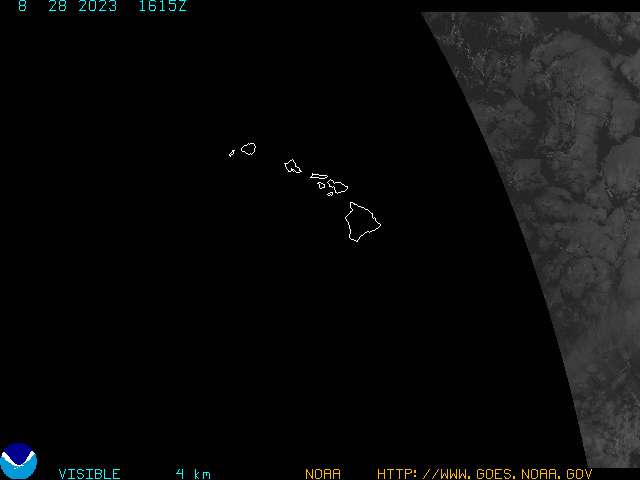


Gail Says:
I check your report each morning and most evenings and I send the link to your webpage to all of my arriving guests.
If your friend, Bob, is planning to be in Kihei on Thursday while you are at work, perhaps he would enjoy a paddle in outrigger canoes with Kihei Canoe Club. Sign in is 7am on Tu and Th mornings and most everyone loves the opportunity to be on the water in this traditional Hawaiian craft. No experience needed!
Gail~~~Hi Gail, thanks for that great suggestion. I’ll pass on the information to Bob, and see what he has planned for Thursday morning. Aloha, Glenn
Butch Says:
Aloha Glen, Many mahalo’s for the fantastic service you provide the community !!!KUDOS TO YOU GLEN !!!! I’m a sailor in Maui for some 30 yrs now,and always appreciate your forecasts! I’ve always wondered where the Puu Kukui weather station is as I notice it usually gets rain ? Again, Mahalo Glen. Aloha, Butch~~~Hi Butch, thanks for your very positive response, much appreciated! Puu Kukui is the rain gauge atop the West Maui Mountains. Aloha, Glenn
David Hume Says:
Glenn, the strangest thing happened here last night, water fell from the sky for over an hour??? I have a distant recollection of this happening a long time ago but can’t remember what it was called. Aloha, David.~~~Hi David, sounds to me like you are saying it hasn’t rained for a very long time at your place there in Kona…and that you appreciated it a lot!! Always appreciate these on the spot reports, thanks. Aloha, Glenn
Eliza Says:
Aloha Glenn –
Good morning – the rains got me up a while ago. Now (715am) the increase in volume in this downpour is quite something to hear. All is lovely and green over here in upper Ha`iku with yesterday’s great! I was in Haiku Saturday afternoon/evening…it was lovely. Rains Thursday, looks likely now. Thanks for your note! Aloha, Glenn