











March 10-11, 2010
Air Temperatures – The following maximum temperatures were recorded across the state of Hawaii Wednesday afternoon:
Lihue, Kauai – 78
Honolulu, Oahu – 81
Kaneohe, Oahu – 78
Kaunakakai, Molokai – 78
Kahului, Maui – 77
Hilo, Hawaii – 76
Kailua-kona – 81
Air Temperatures ranged between these warmest and coolest spots near sea level around the state – and on the highest mountains…at 5pm Wednesday evening:
Barking Sands, Kauai – 81F
Hilo, Hawaii – 70
Haleakala Crater – 41 (near 10,000 feet on Maui)
Mauna Kea summit – 32 (near 14,000 feet on the Big Island)
Precipitation Totals – The following numbers represent the largest precipitation totals (inches) during the last 24 hours on each of the major islands, as of Wednesday afternoon:
1.45 Mount Waialaele, Kauai
0.92 South Fork Kaukonahua, Oahu
0.10 Molokai
0.00 Lanai
0.00 Kahoolawe
2.99 Kaupo Gad, Maui
2.06 Glenwood, Big Island
Marine Winds – Here’s the latest (automatically updated) weather map showing high pressure systems to the northwest through northeast of Hawaii. The winds will be strong and gusty…gradually losing some strength.
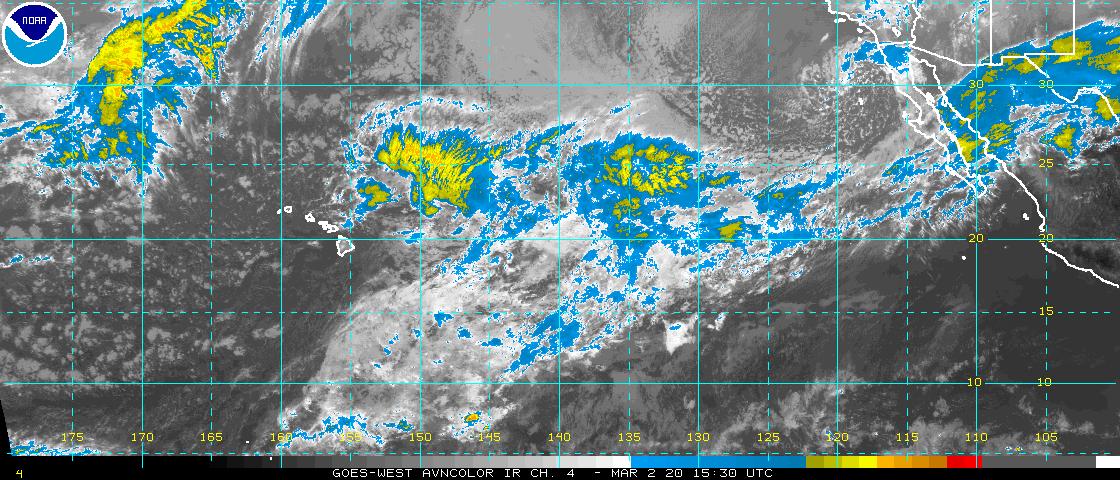
Satellite and Radar Images: To view the cloud conditions we have here in Hawaii, please use the following satellite links, starting off with this Infrared Satellite Image of the islands to see all the clouds around the state during the day and night. This next image is one that gives close images of the islands only during the daytime hours, and is referred to as a Close-up visible image. This next image shows a larger view of the Pacific…giving perspective to the wider ranging cloud patterns in the Pacific Ocean. Finally, here’s a Looping IR satellite image, making viewable the clouds around the islands 24 hours a day. To help you keep track of where any showers may be around the islands, here’s the latest animated radar image.
Hawaii’s Mountains – Here’s a link to the live webcam on the summit of near 14,000 foot Mauna Kea on the Big Island of Hawaii. The tallest peak on the island of Maui is the Haleakala Crater, which is near 10,000 feet in elevation. These two webcams are available during the daylight hours here in the islands…and when there’s a big moon rising just after sunset for an hour or two! Plus, during the nights and early mornings you will be able to see stars, and the sunrise too…depending upon weather conditions.
Tropical Cyclone activity in the eastern and central Pacific – Here’s the latest weather information coming out of the National Hurricane Center, covering the eastern north Pacific. You can find the latest tropical cyclone information for the central north Pacific (where Hawaii is located) by clicking on this link to the Central Pacific Hurricane Center. Here’s a tracking map covering both the eastern and central Pacific Ocean. A satellite image, which shows the entire ocean area between Hawaii and the Mexican coast…can be found here.
Aloha Paragraphs

Still windy for a while yet
We’ve moved through the most intense part of this latest windy episode, although the winds are still remarkably strong and gusty on each of the individual islands at mid-week. These winds are still up in the 30, 40 and 50 mph range…at least in terms of gusts. I say past the peak, which is referring to some of the gusts that were up around 60 mph over the last day or two! The source of these unusually blustery winds continues to be the steep pressure gradient between high pressure cells to our northwest through northeast…and low pressure down near the equator. This weather map shows this well, including the nearly straight east to west orientation of the winds streaming across our island chain now.
We have some changes up ahead, as our trade winds finally begin to ease up…as we move into the weekend. This slowing down of the trade winds, and their associated veering, will be prompted by the approach of a cold front…forecast to arrive later in the day Sunday. The computer models suggest that our winds will swing around to the southeast. Winds from this direction, puts most of the state in a wind shadow, at least the smaller islands downwind from the blocking
The computer models then go on to show a new high pressure system moving into range to our northwest…in the wake of the cold frontal passage (fropa). This new high pressure cell will bring a temporary bout of cooler north to northeast winds. Temporary…because shortly thereafter, another cold front begins to push in our direction. The computer models show quite a bit of moisture getting hung-up along the windward sides after the cold front. This means that there’s a good chance of lots of windward showers, which is a good thing in terms of the dry weather we’ve had this winter. We’ve actually had quite a bit of good showers along the windward sides lately however, and if the cold front does what it’s suppose to do, followed by more showers…this would be a very good turn of events! More and more showers, that’s a good thing now, pushing the drought back several steps in its tracks.
It’s Wednesday evening, as I begin writing the last section of today’s narrative. The trade winds have blown all day, and continue to rush through the Aloha state as we push into the night Wednesday. Here’s the strongest gusts, this time at around 5pm Wednesday evening – 35 mph on Kauai; 37 mph on Oahu; 42 mph on Molokai; 43 mph on Lanai; 46 Kahoolawe; 36 mph on Maui; and 40 mph at South Point on the Big Island. As we move into Thursday onward, the winds will begin to slow down, due to the weakening of our high pressure systems to the north. As we get into the weekend, our winds will become even lighter from the southeast. This may bring some volcanic haze up from the Big Island vents to Maui County, perhaps further up the island chain. Due to the extended drought conditions, I’m getting more excited about the prospect of a cold front bringing generous showers Sunday into early next week. The following chilly north to northeast winds may keep showers falling along the north and northeast coasts and slopes for several days thereafter. By the way, another cold front may approach the islands around the middle of next week, more about that soon. ~~~ As you might have seen at the bottom of this page, where folks leave reponses to me, to us, there was a note from Shawn, who wrote in saying that there had been 50-67 mph gusts in Launiupoko…which is on west Maui, not far from typically light winded Lahaina town! As I wrote in my response to her – Wow! I’m heading out in a few minutes for the drive back upcountry to Kula, Maui. Looking out the window here in Kihei, it’s not totally calm, at least where I am in upper Kihei, but just a gentle breeze at most. I’ll be back here early Thursday morning with your next new weather narrative, I hope you have a great Wednesday night until then! Aloha for now…Glenn.
Extra: incredible music video
Interesting: China and India joined almost all other major greenhouse gas emitters Tuesday in signing up to the climate accord struck in Copenhagen, boosting a deal strongly favored by the United States. More than 100 nations have now endorsed the Copenhagen Accord, a non-binding agreement reached after two weeks of tortuous wrangling at a 194-nation summit in December.
The accord plans $100 billion a year in climate aid for developing nations from 2020 and seeks to limit global warming to below 2 degrees Celsius (3.6F) above pre-industrial times, but produced no timetable of emission limits to reach that goal. Indian Environment Minister Jairam Ramesh told parliament that India would also let its name join the list of "associated" countries on the three-page document.
"This will strengthen our negotiating position on climate change," Ramesh said. Chinese negotiator Su Wei wrote a one-sentence letter to the U.N. Climate Change Secretariat in Bonn saying that it could "proceed to include China in the list." China, the United States, the European Union, Russia and India are the main emitters of the greenhouse gases that are blamed for global warming — mostly carbon dioxide from burning fossil fuels.
Only Russia has yet to associate with the deal. The endorsements are a small boost for the Accord, which environmentalists say was a bare-minimum outcome from a summit that many nations hoped would end with a broad, legally binding pact to fight climate change.
But they offer little indication of how, or when, rich and poor nations might agree on a binding mechanism for combating climate changes that scientists say will multiply droughts, floods, storms and heat waves, and dramatically raise sea levels. China and India have preferred since Copenhagen to stress the supremacy of the 1992 U.N. Climate Convention, agreed in Kyoto, which puts the emphasis on rich nations cutting emissions.
Interesting2: The sensitivity of Amazon rain forests to dry season droughts is still poorly understood, with reports of enhanced tree mortality and forest fires on one hand, and excessive forest greening on the other. In a current story there is a report that previous conclusions of large scale greening of the Amazon as a result of drought are not reproducible. Approximately 11%-12% of the drought stricken forests display greening, while, 28%-20% show browning or no change, and for the rest, the data are not of sufficient quality to characterize any changes.
These changes are also not unique; approximately similar changes are observed in non-drought years as well. The Amazon drought of 2005 was the worst ever recorded in the Amazon. The drought has turned rivers into grassy mud flats, killed tens of millions of fish, stranded hundreds of communities, and brought disease and economic despair to the region.
There have been other droughts such as in 1926, 1983, and 1998. These other droughts can be more linked to El Nino effects. Scientists are not certain as to the cause of the 2005 drought, although warmer water temperatures in the Atlantic Ocean are the leading suspect. Wet tropical forests are the most species rich biome, and tropical forests in the Americas such as along the Amazon River are consistently more species rich than the wet forests in Africa and Asia.
As the largest tract of tropical rain forest in the Americas, the Amazonian rain forests have unparalleled biodiversity. However extensive deforestation has occurred in the last few decades and the 2005 drought did not help. There had been earlier claims that the 2005 drought caused a "greening" of the Amazon. Tied to this thought was that available sunlight increased in this area.
In the March Geophysical Letters an article was published by several authors entitled: "Amazon Forests Did Not Green-up in the 2005 Drought". The authors included Arindam Samanta and Ranga B. Myneni. In this the authors concluded that only about 10% of the affected area increased in greenness and about three times this area became browner. The majority of the affected areas could not be determined.
At the same time sunlight (in the wavelengths most useful for plant life) decreased rather than decreased in most areas. There was no co-relation between drought severity and greenness changes, which is contrary to the idea of drought induced greening. Finally the study concluded that the spatial patterns of Enhanced Vegetation Index changes seen in drought year 2005 are not unique in comparison to non” drought years.
Interesting3: Two billion people worldwide do their cooking on open fires, producing sooty pollution that shortens millions of lives and exacerbates global warming. If widely adopted, a new generation of inexpensive, durable cook stoves could go a long way toward alleviating this problem. With a single, concerted initiative, says Lakshman Guruswami, the world could save millions of people in poor nations from respiratory ailments and early death, while dealing a big blow to global warming — and all at a surprisingly small cost.
"If we could supply cheap, clean-burning cook stoves to the large portion of the world that burns biomass," says Guruswami, a Sri Lankan-born professor of international law at the University of Colorado, "we could address a significant international public health problem, and at the same stroke cut a major source of warming." Sooty, indoor air pollution from open wood or other biomass fires has long been linked to health problems and deaths.
More recently, scientists have been surprised to learn that black carbon — not only from biomass fires but from dirty diesel engines and other sources — is a far larger contributor to global warming than previously suspected: The dark particles absorb and retain heat close to the Earth’s surface that might otherwise be reflected. Some two billion people around the world, Guruswami notes, do most or all of their cooking and heating with fires from simple biomass — dried dung, wood, brush, or crop residues.
In India alone, the ratio is much higher — about three-fourths. "Think about that," says Guruswami, who directs his university’s Center for Energy and Environmental Security. "Two billion people, one-third of the people on Earth, are caught in a time warp, with no access to modern energy. They got energy from Prometheus a long time ago, and that was it."
Interesting4: Consider this T-shirt: It can monitor your heart rate and breathing, analyze your sweat and even cool you off on a hot summer’s day. What about a pillow that monitors your brain waves, or a solar-powered dress that can charge your MP3 player? This is not science fiction — this is cotton in 2010.
Now, the laboratory of Juan Hinestroza, assistant professor of Fiber Science and Apparel Design, has developed cotton threads that can conduct electric current as well as a metal wire can, yet remain light and comfortable enough to give a whole new meaning to multi-use garments.
This technology works so well that simple knots in such specially treated thread can complete a circuit — and solar-powered dress with this technology literally woven into its fabric will be featured at the annual Cornell Design League Fashion Show on Saturday, March 13 at Cornell University’s Barton Hall.
Using multidisciplinary nanotechnology developed at Cornell in collaboration with the universities at Bologna and Cagliari, Italy, Hinestroza and his colleagues developed a technique to permanently coat cotton fibers with electrically conductive nanoparticles. "We can definitively have sections of a traditional cotton fabric becoming conductive, hence a great myriad of applications can be achieved," Hinestroza said.
"The technology developed by us and our collaborators allows cotton to remain flexible, light and comfortable while being electronically conductive," Hinestroza said. "Previous technologies have achieved conductivity but the resulting fiber becomes rigid and heavy. Our new techniques make our yarns friendly to further processing such as weaving, sewing and knitting." This technology is beyond the theory stage.
Hinestroza’s student, Abbey Liebman, was inspired by the technology enough to design a dress that actually uses flexible solar cells to power small electronics from a USB charger located in the waist. The charger can power a smartphone or an MP3 player. "Instead of conventional wires, we are using our conductive cotton to transmit the electricity — so our conductive yarns become part of the dress," Hinestroza said. "Cotton used to be called the ‘fabric of our lives’ but based on these results, we can now call it ‘The fabric of our lights.’"
 Email Glenn James: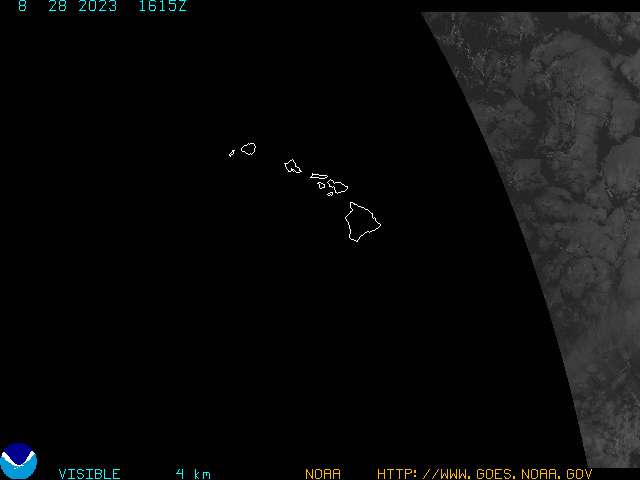


jack weber Says:
Great news with the weather report; hope it all pans out…great Interesting comments too! Thanks…J*~~~Hi Jack, who lives down on the Big Island, glad you are getting some rain, or have been lately. Aloha, Glenn
Glenn Says:
Hi everyone, I really enjoy it when you write in and let me know, us know…what’s happening in your area of the islands…or anywhere else for that matter! Please feel free to do so, and I’ll always give some response back. Aloha, Glenn
Shawn Says:
Glenn,
Launiupoko (shredded coconut leaf) has winds that nobody can beat.
Last nights high gust, 67mph. Today, winds shredded our trees at 50 -60 mph.
Any challangers?
Dorothy and Toto~~~HI, those numbers sound like they could be the very top gusts anywhere in the state of Hawaii…by about 6 or 7 mph! Thanks so much for the on the spot report, about all I can say is: WOW! Aloha, Glenn
Janet Says:
Sorry two Ns!~~~Janet, no problem…it happens all the time! Aloha, Glenn
Janet Says:
Hey Glen, Thanks for this link. When using the sunrise/sunset times, if we’re in Kihei, are the sunrise times listed the time the sky gets light or the time the sun breaks over Haleakala? Janet~~~Hi Janet, I think it depends on what time of year it is, although probably, not living in Kihei myself, it would come up over the flank of the Haleakala Crater…with the sky getting lighter as the sun comes up over the ocean on the Hana side of Maui. Aloha, Glenn