











March 5-6, 2010
Air Temperatures – The following maximum temperatures were recorded across the state of Hawaii Friday afternoon:
Lihue, Kauai – 78
Honolulu, Oahu – 81
Kaneohe, Oahu – 78
Kaunakakai, Molokai – 79
Kahului, Maui – 79
Hilo, Hawaii – 77
Kailua-kona – 79
Air Temperatures ranged between these warmest and coolest spots near sea level around the state – and on the highest mountains…at 5pm Friday evening:
Barking Sands, Kauai – 82F
Hilo, Big Island – 67
Haleakala Crater – 37 (near 10,000 feet on Maui)
Mauna Kea summit – 36 (near 14,000 feet on the Big Island)
Precipitation Totals – The following numbers represent the largest precipitation totals (inches) during the last 24 hours on each of the major islands, as of Friday afternoon:
0.74 Mount Waialeale, Kauai
2.02 South Fork Kaukonahua, Oahu
0.40 Molokai
0.02 Lanai
0.00 Kahoolawe
3.53 Puu Kukui, Maui
1.11 Kawainui Stream, Big Island
Marine Winds – Here’s the latest (automatically updated) weather map showing a large 1034 millibar high pressure system to the north-northeast of Hawaii. This high pressure system, and its associated ridges, will keep slightly lighter trades blowing through Sunday.
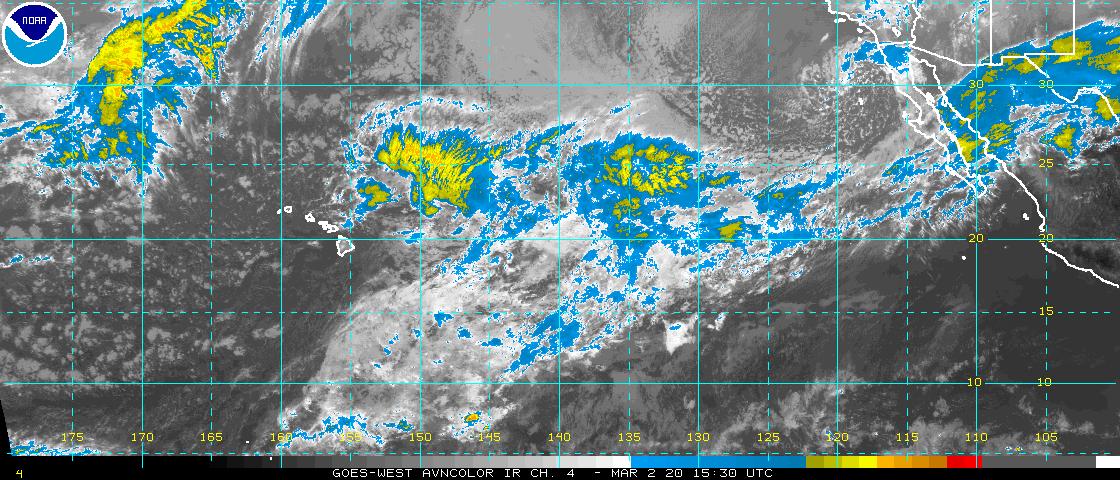
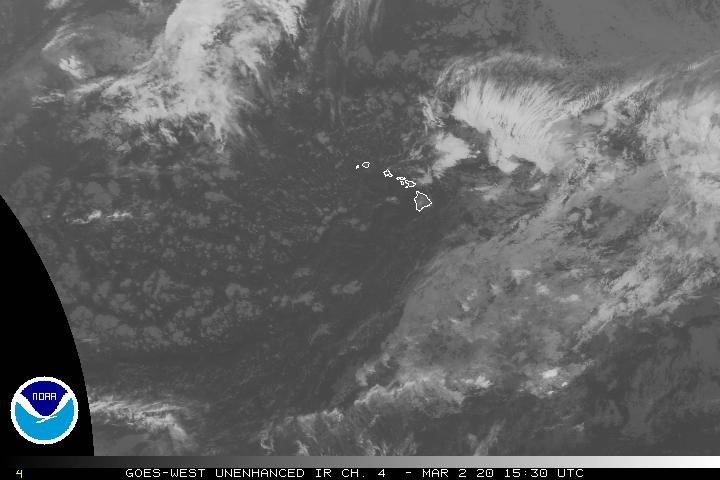
Satellite and Radar Images: To view the cloud conditions we have here in Hawaii, please use the following satellite links, starting off with this Infrared Satellite Image of the islands to see all the clouds around the state during the day and night. This next image is one that gives close images of the islands only during the daytime hours, and is referred to as a Close-up visible image. This next image shows a larger view of the Pacific…giving perspective to the wider ranging cloud patterns in the Pacific Ocean. Finally, here’s a Looping IR satellite image, making viewable the clouds around the islands 24 hours a day. To help you keep track of where any showers may be around the islands, here’s the latest animated radar image.
Hawaii’s Mountains – Here’s a link to the live webcam on the summit of near 14,000 foot Mauna Kea on the Big Island of Hawaii. The tallest peak on the island of Maui is the Haleakala Crater, which is near 10,000 feet in elevation. These two webcams are available during the daylight hours here in the islands…and when there’s a big moon rising just after sunset for an hour or two! Plus, during the nights and early mornings you will be able to see stars, and the sunrise too…depending upon weather conditions.
Tropical Cyclone activity in the eastern and central Pacific – Here’s the latest weather information coming out of the National Hurricane Center, covering the eastern north Pacific. You can find the latest tropical cyclone information for the central north Pacific (where Hawaii is located) by clicking on this link to the Central Pacific Hurricane Center. Here’s a tracking map covering both the eastern and central Pacific Ocean. A satellite image, which shows the entire ocean area between Hawaii and the Mexican coast…can be found here.
Aloha Paragraphs

One of our lovely sandy beaches…on Kauai
Wind speeds are down only very slightly today, and will falter a little more as we move into the weekend. It should be pointed out though, that those windiest locales around the state, especially around Maui and the
As far as the clouds and shower aspect of our local weather goes, there are a few wet ones…generally along the windward sides though. The trade winds remain strong enough though, that some showers will be able to move over from the windward sides…into the leeward sides locally. This satellite image shows no lack of cloudiness in any direction…out from the
It’s Friday evening, as I begin writing this last section of today’s narrative. As noted in the paragraphs above, it will remain windy, despite a modest softening into the weekend. To give you an idea about how strong the trade winds were early Friday evening…here’s the strongest wind gusts at around 5pm – 32 mph on Kauai; 36 mph on Oahu; 36 mph on Molokai; 42 mph on Lanai; 50 mph on Kahoolawe; 35 mph on Maui; and 42 mph at Kealakomo on the Big Island. So much for the slowing down of our trade wind speeds today…even in modest terms! I still expect some minor reductions this weekend, but don’t plan on any major changes. ~~~ The showers will continue to arrive along our windward sides, in an off and on manner. The two defining parameters in this regard, will be the amount of available moisture being carried our way…and whether there will be any upper air troughs around, which often enhance shower production. We’ll have to keep an eye on whether these two things…join forces as we move forward, helping to increase the showers. ~~~ I’m going to see a new film this evening, called Brooklyn’s Finest (2010), starring Wesley Snipes, Ethan Hawke, Don Cheadle, and Richard Gere…among others. A long synopsis of them film: Burned out veteran Eddie Dugan is just one week away from his pension and a fishing cabin in Connecticut. Narcotics officer Sal Procida has discovered there’s no line he won’t cross to provide a better life for his long-suffering wife and seven children. And Clarence "Tango" Butler has been undercover so long his loyalties have started to shift from his fellow police officers to his prison buddy Caz, one of Brooklyn’s most infamous drug dealers. With personal and work pressures bearing down on them, each man faces daily tests of judgment and honor in one of the world’s most difficult jobs. When NYPD’s Operation Clean Up targets the notoriously drug-ridden BK housing project, all three officers find themselves swept away by the violence and corruption of Brooklyn’s gritty 65th Precinct and its most treacherous criminals. During seven fateful days, Eddie, Sal and Tango find themselves hurtling inextricably toward the same fatal crime scene and a shattering collision with destiny. The critics are giving this film a C grade, which isn’t great by any means. I want to go see Alice in Wonderland (2010), but I’m afraid it will still be too crowded, so I’ll wait perhaps until next week. Here’s a trailer of this what looks like will be a pretty heavy duty film, which I’ll give my own review on in the morning. ~~~ Anyway, I’ll be back Saturday morning with your next new weather narrative, I hope you have a great Friday night until then! Aloha for now…Glenn.
Interesting: In a new study conducted by the U.S. Geological Survey (USGS), every single fish tested from 291 freshwater streams across the United States was found to be contaminated with mercury. "This study shows just how widespread mercury pollution has become in our air, watersheds and many of our fish in freshwater streams," said Interior Secretary Ken Salazar. Mercury is a potent neurotoxin that builds up in the food chain at ever higher concentrations in predators such as large fish and humans.
It is especially damaging to the developing nervous systems of fetuses and children, but can have severe effects on adults, as well. The pollutant enters the environment almost wholly as atmospheric emissions from industrial processes, primarily the burning of coal for electricity.
It then spreads across the plant and settles back to the surface, eventually concentrating in rivers, lakes and oceans, where it enters the aquatic food chain. The number one cause of human mercury poisoning in the United States is the consumption of fish and shellfish. Researchers tested the water, sediment and fish of the 291 streams between 1998 and 2005. Fish tested were mostly larger species near the top of the food chain, such as largemouth bass.
Interesting2: The recent earthquake in Chile was one of the biggest the world has felt in the past century – so why was the tsunami that spread across the Pacific smaller than originally feared? The magnitude-8.8 earthquake was devastating, claiming at least 700 lives. Large tsunami waves were reported along parts of Chile’s coastline: reports suggest the town of Constitución was worst affected by the wave. Yet locations further afield were more or less spared by the tsunami.
Waves smaller than 1.5 meters struck Hawaii and Japan, for example, causing very little damage. By contrast, a magnitude-9.5 earthquake in 1960 spawned a tsunami that claimed over 200 lives in Japan, Hawaii and the Philippines. Tim Henstock of the National Oceanography Center at the University of Southampton, UK, speculates that the reason might be that Saturday’s earthquake ruptured a relatively small segment of fault – around 350 kilometers.
The length of fault rupture determines the distance at which a tsunami begins to lose energy. By comparison, the magnitude-9.1 earthquake that generated the 2004 Indian ocean tsunami ruptured around 1600 kilometers of fault. Chile’s recent tsunami was also highly focused. "It was quite a directed tsunami, rather than a ‘stone in a pool’ type propagation," explains Simon Haslett of the University of Wales, Newport.
The tsunami was severe at the coast nearest the epicenter, and westward at the Juan Fernandez Islands, but the energy and height were lost quickly in other directions, he says. Furthermore, the relatively deep origin of the earthquake – 35 kilometers – may have minimized the uplift on the sea floor that displaced the water. "The Chile quake was smaller and deeper than the Indian Ocean quake of 2004, so less energy was released and, most importantly, less of this reached the surface," says Bill McGuire of University College London.
Interesting3: Scientists at the University of Rochester have discovered that the Earth’s magnetic field 3.5 billion years ago was only half as strong as it is today, and that this weakness, coupled with a strong wind of energetic particles from the young Sun, likely stripped water from the early Earth’s atmosphere. The findings, presented in Science, suggest that the magnetopause — the boundary where the Earth’s magnetic field successfully deflects the Sun’s incoming solar wind — was only half the distance from Earth it is today.
"With a weak magnetosphere and a rapid-rotating young Sun, the Earth was likely receiving as many solar protons on an average day as we get today during a severe solar storm," says John Tarduno, a geophysicist at the University of Rochester and lead author of the study. "That means the particles streaming out of the Sun were much more likely to reach Earth.
It’s very likely the solar wind was removing volatile molecules, like hydrogen, from the atmosphere at a much greater rate than we’re losing them today." Tarduno says the loss of hydrogen implies a loss of water as well, meaning there may be much less water on Earth today than in its infancy. To find the strength of the ancient magnetic field, Tarduno and his colleagues from the University of KwaZulu-Natal visited sites in Africa that were known to contain rocks in excess of 3 billion years of age.
Not just any rocks of that age would do, however. Certain igneous rocks called dacites contain small millimeter-sized quartz crystals, which in turn have tiny nanometer-sized magnetic inclusions. The magnetization of these inclusions act as minute compasses, locking in a record of the Earth’s magnetic field as the dacite cooled from molten magma to hard rock.
Simply finding rocks of this age is difficult enough, but such rocks have also witnessed billions of years of geological activity that could have reheated them and possibly changed their initial magnetic record. To reduce the chance of this contamination, Tarduno picked out the best preserved grains of feldspar and quartz out of 3.5 billion-year-old dacite outcroppings in South Africa.
Complicating the search for the right rocks further, the effect of the solar wind interacting with the atmosphere can induce a magnetic field of its own, so even if Tarduno did find a rock that had not been altered in 3.5 billion years, he had to make sure the magnetic record it contained was generated by the Earth’s core and not induced by the solar wind.
Interesting4: An infrared space telescope has spotted several very dark asteroids that have been lurking unseen near Earth’s orbit. Their obscurity and tilted orbits have kept them hidden from surveys designed to detect things that might hit our planet. Called the Wide-Field Infrared Survey Explorer (WISE), the new NASA telescope launched on 14 December on a mission to map the entire sky at infrared wavelengths. It began its survey in mid-January.
In its first six weeks of observations, it has discovered 16 previously unknown asteroids with orbits close to Earth’s. Of these, 55 per cent reflect less than one-tenth of the sunlight that falls on them, which makes them difficult to spot with visible-light telescopes. One of these objects is as dark as fresh asphalt, reflecting less than 5 per cent of the light it receives.
Many of these dark asteroids have orbits that are steeply tilted relative to the plane in which all the planets and most asteroids orbit. This means telescopes surveying for asteroids may be missing many other objects with tilted orbits, because they spend most of their time looking in this plane. Fortunately, the new objects are bright in infrared radiation, because they absorb a lot of sunlight and heat up.
This makes them relatively easy for WISE to spot. "It’s really good at finding the darkest asteroids and comets," said mission team member Amy Mainzer of NASA’s Jet Propulsion Laboratory in Pasadena, California, at the Lunar and Planetary Science Conference in Houston, Texas, on Thursday. WISE is expected to discover as many as 1000 near-Earth objects – but astronomers estimate that the number of unknown objects with masses great enough to cause ground damage in an impact runs into the tens of thousands.
Interesting5: Your cell phone need never again run out of juice while you’re on the go. So says Nokia of Finland, which filed a US patent last week for a handset that recharges itself by harvesting energy from the owner’s motion. Nokia envisages a phone in which the heavier components, such as the radio transmitter circuit and battery, are supported on a sturdy frame.
This frame can move along two sets of rails, one allows it travel up and down, the other side to side. Strips of piezoelectric crystals sit at the end of each rail and generate a current when compressed by the frame. So as the user walks, or otherwise moves the phone, the motion generates electricity. This charges a capacitor which in turn trickles charge into the battery, keeping it topped up.
Interesting6: Geologists have found evidence that sea ice extended to the equator 716.5 million years ago, bringing new precision to a "snowball Earth" event long suspected to have taken place around that time. Led by scientists at Harvard University, the team reports on its work in the journal Science. The new findings — based on an analysis of ancient tropical rocks that are now found in remote northwestern Canada — bolster the theory that our planet has, at times in the past, been ice-covered at all latitudes.
"This is the first time that the Sturtian glaciation has been shown to have occurred at tropical latitudes, providing direct evidence that this particular glaciation was a ‘snowball Earth’ event," says lead author Francis A. Macdonald, an assistant professor in the Department of Earth and Planetary Sciences at Harvard. "Our data also suggests that the Sturtian glaciation lasted a minimum of 5 million years."
The survival of eukaryotic life throughout this period indicates sunlight and surface water remained available somewhere on the surface of Earth. The earliest animals arose at roughly the same time, following a major proliferation of eukaryotes. Even in a snowball Earth, Macdonald says, there would be temperature gradients on Earth and it is likely that ice would be dynamic: flowing, thinning, and forming local patches of open water, providing refuge for life.
"The fossil record suggests that all of the major eukaryotic groups, with the possible exception of animals, existed before the Sturtian glaciation," Macdonald says. "The questions that arise from this are: If a snowball Earth existed, how did these eukaryotes survive? Moreover, did the Sturtian snowball Earth stimulate evolution and the origin of animals?" "From an evolutionary perspective," he adds, "it’s not always a bad thing for life on Earth to face severe stress."
The rocks Macdonald and his colleagues analyzed in Canada’s Yukon Territory showed glacial deposits and other signs of glaciation, such as striated clasts, ice rafted debris, and deformation of soft sediments. The scientists were able to determine, based on the magnetism and composition of these rocks, that 716.5 million years ago they were located at sea level in the tropics, at about 10 degrees latitude.
"Because of the high albedo of ice, climate modeling has long predicted that if sea ice were ever to develop within 30 degrees latitude of the equator, the whole ocean would rapidly freeze over," Macdonald says. "So our result implies quite strongly that ice would have been found at all latitudes during the Sturtian glaciation."
Scientists don’t know exactly what caused this glaciation or what ended it, but Macdonald says its age of 716.5 million years closely matches the age of a large igneous province stretching more than 932 miles from Alaska to Ellesmere Island in far northeastern Canada. This coincidence could mean the glaciation was either precipitated or terminated by volcanic activity.
 Email Glenn James: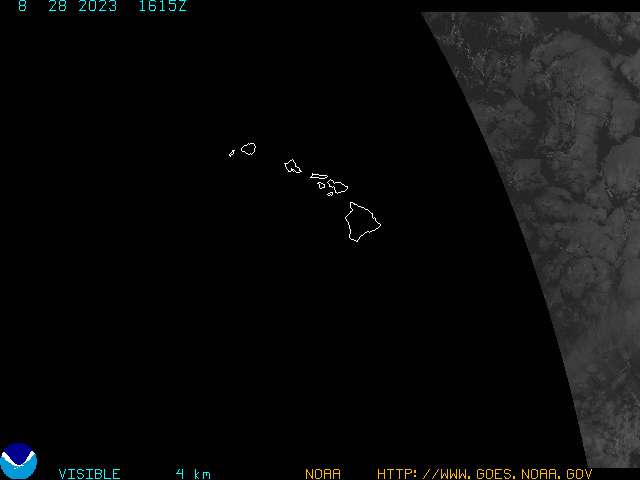


jeff mcconnel Says:
Glenn are you following the sumatra earthquake?
http://twitter.com/earthquake
Hi Jeff, yes I am, here’s a short piece of information:
“Indonsia says no tsunami alert after Sumatra quake strong earthquake struck off West Sumatra in Indonesia on Friday, but there was no tsunami alert issued or immediate reports of casualties or damage, officials at the country’s quake agency said.
The epicentre of the 6.5 magnitude quake was 102.5 miles west of Bengkulu at a depth of 22 km, the U.S. Geological Survey said on its website”. – Aloha, Glenn