











March 4-5, 2010
Air Temperatures – The following maximum temperatures were recorded across the state of Hawaii Thursday afternoon:
Lihue, Kauai – 76
Honolulu, Oahu – 80
Kaneohe, Oahu – 78
Kaunakakai, Molokai – 78
Kahului, Maui – 80
Hilo, Hawaii – 72
Kailua-kona – 81
Air Temperatures ranged between these warmest and coolest spots near sea level around the state – and on the highest mountains…at 5pm Thursday evening:
Barking Sands, Kauai – 79F
Hilo, Big Island – 69
Haleakala Crater – 45 (near 10,000 feet on Maui)
Mauna Kea summit – 37 (near 14,000 feet on the Big Island)
Precipitation Totals – The following numbers represent the largest precipitation totals (inches) during the last 24 hours on each of the major islands, as of Thursday afternoon:
1.01 Mount Waialeale, Kauai
2.10 South Fork Kaukonahua, Oahu
0.30 Molokai
0.00 Lanai
0.11 Kahoolawe
2.08 Puu Kukui, Maui
0.90 Kamuela Upper, Big Island
Marine Winds – Here’s the latest (automatically updated) weather map showing a large 1034 millibar high pressure system to the north of Hawaii…moving east. This high pressure system, and its associated ridge, will keep locally strong and gusty winds blowing Friday…slightly lighter Saturday.
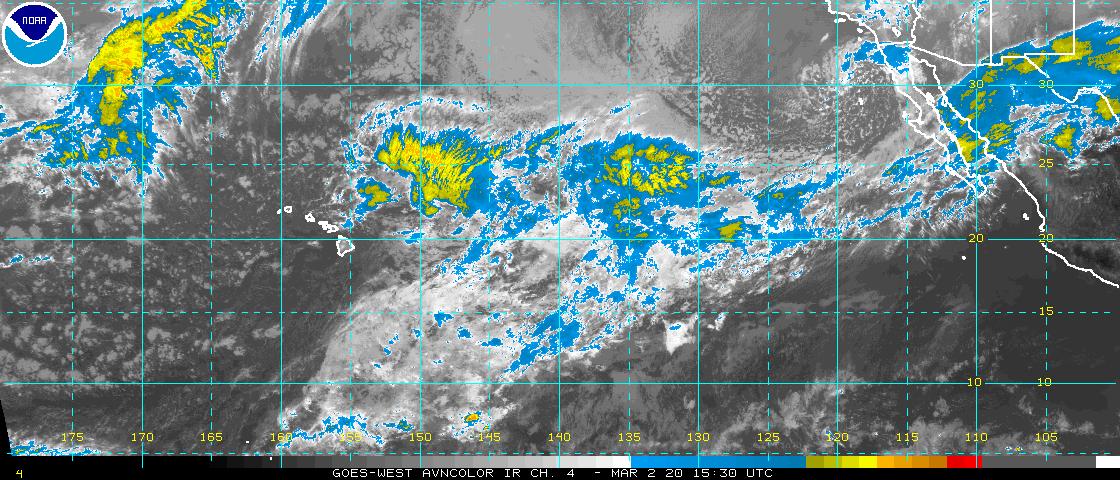
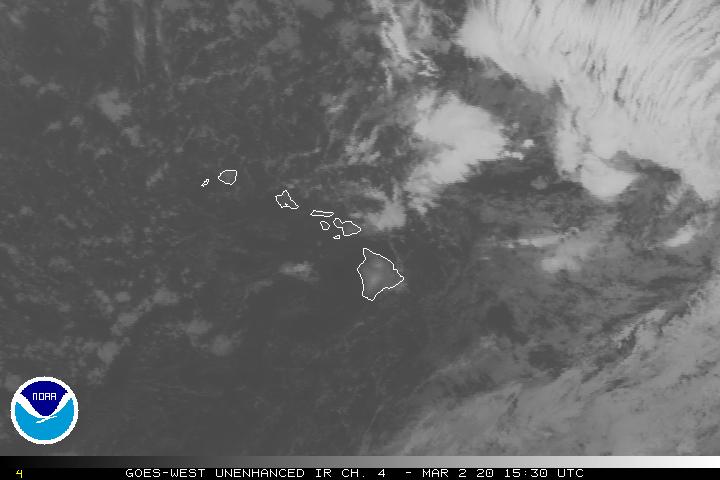
Satellite and Radar Images: To view the cloud conditions we have here in Hawaii, please use the following satellite links, starting off with this Infrared Satellite Image of the islands to see all the clouds around the state during the day and night. This next image is one that gives close images of the islands only during the daytime hours, and is referred to as a Close-up visible image. This next image shows a larger view of the Pacific…giving perspective to the wider ranging cloud patterns in the Pacific Ocean. Finally, here’s a Looping IR satellite image, making viewable the clouds around the islands 24 hours a day. To help you keep track of where any showers may be around the islands, here’s the latest animated radar image.
Hawaii’s Mountains – Here’s a link to the live webcam on the summit of near 14,000 foot Mauna Kea on the Big Island of Hawaii. The tallest peak on the island of Maui is the Haleakala Crater, which is near 10,000 feet in elevation. These two webcams are available during the daylight hours here in the islands…and when there’s a big moon rising just after sunset for an hour or two! Plus, during the nights and early mornings you will be able to see stars, and the sunrise too…depending upon weather conditions.
Tropical Cyclone activity in the eastern and central Pacific – Here’s the latest weather information coming out of the National Hurricane Center, covering the eastern north Pacific. You can find the latest tropical cyclone information for the central north Pacific (where Hawaii is located) by clicking on this link to the Central Pacific Hurricane Center. Here’s a tracking map covering both the eastern and central Pacific Ocean. A satellite image, which shows the entire ocean area between Hawaii and the Mexican coast…can be found here.
Aloha Paragraphs

Hair blowin’ around weather here in Hawaii
These late winter springtime-like trade winds continue to blow over the islands, generating white caps and large incoming swells along our eastern coasts Thursday. The source of all this windiness is coming straight out of a moderately strong high pressure system, now located several hundred miles directly to the north of the
All this rushing air isn’t necessarily setting any records, in terms of wind speed…although has caught the attention of most of our small boaters around the Aloha state. The NWS forecast office in
Moisture being carried along in the trade winds will concentrate along the windward sides…with generally dry and sunny to partly sunny conditions along the leeward sides in contrast. The majority of whatever showers that do fall will occur along the windward sides during the cooler night and early morning hours. There’s always that chance that a few showers may get carried over into the leeward sides, at least on the smaller islands…as long as the trade winds are blowing so strongly. If we check out this IR satellite image, showing relatively close in views, we see clouds stretched across the length of the island chain. If we check out this large satellite image, we see that there is no lack of cloudiness in any direction of
As per the NWS forecast office in
In the South Kohala and leeward North Kohala areas of the
Conditions over the northeast slopes of
For the rest of the state…extreme drought conditions persist over the southern sections of the
Oahu remains as the only major island in the state without any areas under a drought classification.
Thus…more than three-quarters of the state is under at least moderate drought and is the only state in the country with locally severe conditions as of March 4, 2010.
It’s Thursday evening, as I begin writing this last section of today’s narrative. As noted in the paragraphs above, it’s still windy, windy, and more windy. I have been adding lately, as it gives good reference to the nature of our atmosphere…here’s the strongest wind gusts as of around 5pm Thursday evening – 30 mph on Kauai; 38 mph on Oahu; 32 mph on Molokai; 38 mph on Lanai; 42 on Kahoolawe; 39 mph on Maui; and 44 mph at Kohala Ranch on the Big Island. ~~~ Showers will increase a tad overnight into early Friday morning, which is often the case during a trade wind weather pattern such as this. This nocturnal increase, and diurnal decrease will continue on through Sunday. The computer models however continue to suggest, that as the trade winds increase early in the new week ahead, so will our incoming showers. We’ll talk more about this over the weekend, and point out where those showers will likely end up, although here’s a hint…windward. ~~~ I’m just about on my way up to Kula, Maui, as I think of what to write in way of ending this work day. The first thing that comes to mind in the moment, is this: I love my work, and feel so fortunate to be able to have it to do! Part of that of course is what you end up reading here each day. It adds so much to the quality of my life. See you early Friday. Aloha for now…Glenn.
Interesting: The Earth is angry. Or at least it seems that way, with three significant earthquakes in the past week: A 7.0 magnitude quake near Japan last Friday, the huge 8.8 quake near Chile on Saturday, and a 6.4 near Taiwan earlier today. And, of course, there was the devastating 7.0 quake in January in Haiti that killed more than 200,000 people.
So, is there any connection among all the quakes? "No, not that we can see," says Paul Caruso, a geophysicist with the U.S. Geological Survey in Golden, Colo. "We’ve had quite a few quakes in the past two months, but not more than average." What has made the recent earthquakes newsworthy is that the earthquakes have hit near populated areas, says Caruso. Another 6.4 quake this morning rattled the tiny Pacific island nation of Vanuatu, but no injuries have been reported.
In an average year, the geological survey estimates that several million earthquakes occur around the world. However, many go undetected because they hit remote areas or have very small magnitudes. According to long-term records (which exist since about 1900), the U.S.G.S. expects that about 17 major earthquakes (magnitude 7.0 – 7.9) and one great earthquake (8.0 or above) will affect the world in any given year.
Caruso says the three recent Pacific quakes are all related to the so-called "ring of fire," a seismically active region that surrounds the ocean. However, the distances between the quakes are far too great for there to be any relationship between them.
Interesting2: Scientists at Columbia’s Lamont-Doherty Earth Observatory have found evidence of hydrothermal vents on the seafloor near Antarctica, formerly a blank spot on the map for researchers wanting to learn more about seafloor formation and the bizarre life forms drawn to these extreme environments. Hydrothermal vents spew volcanically heated seawater from the planet’s underwater mountain ranges — the vast mid-ocean ridge system, where lava erupts and new crust forms. Chemicals dissolved in those vents influence ocean chemistry and sustain a complex web of organisms, much as sunlight does on land.
In recent decades more than 220 vents have been discovered worldwide, but so far no one has looked for them in the rough and frigid waters off Antarctica. From her lab in Palisades, N.Y., geochemist Gisela Winckler recently took up the search. By analyzing thousands of oceanographic measurements, she and her Lamont colleagues pinpointed six spots on the remote Pacific Antarctic Ridge, about 2,000 miles from New Zealand, the closest inhabited country, and 1,000 miles from the west coast of Antarctica, where they think vents are likely to be found.
The sites are described in a paper published in the journal Geophysical Research Letters. "Most of the deep ocean is like a desert, but these vents are oases of life and weirdness," said Winckler. "The Pacific Antarctic ridge is one of the ridges we know least about. It would be fantastic if researchers were to dive to the seafloor to study the vents we believe are there." Two important facts helped the scientists isolate the hidden vents.
First, the ocean is stratified with layers of lighter water sitting on top of layers of denser water. Second, when a seafloor vent erupts, it spews gases rich in rare helium-3, an isotope found in earth’s mantle and in the magma bubbling below the vent. As helium-3 disperses through the ocean, it mixes into a density layer and stays there, forming a plume that can stretch over thousands of kilometers.
The Lamont scientists were analyzing ocean-helium measurements to study how the deep ocean exchanges dissolved gases with the atmosphere when they came across a helium plume that looked out of place. It was in a southern portion of the Pacific Ocean, below a large and well-known helium plume coming off the East Pacific Rise, one of the best-studied vent regions on earth. But this mystery plume appeared too deep to have the same source.
Suspecting that it was coming from the Pacific Antarctic Ridge instead, the researchers compiled a detailed map of ocean-density layers in that region, using some 25,000 salinity, temperature and depth measurements. After locating the helium plume along a single density layer, they compared the layer to topographic maps of the Pacific Antarctic Ridge to figure out where the plume would intersect.
The sites they identified cover 340 miles of ridge line–the approximate distance between Manhattan and Richmond, Va.–or about 7 percent of the total 4,300 mile-ridge. This chain of volcanic mountains lies about three miles below the ocean surface, and its mile-high peaks are cut by steep canyons and fracture zones created as the sea floor spreads apart. It is a cold and lonely stretch of ocean, far from land or commercial shipping lanes.
"They haven’t found vents, but they’ve narrowed the places to look by quite a bit," said Edward Baker, a vent expert at the National Oceanic and Atmospheric Administration. Of course, finding vents in polar waters is not easy, even with a rough idea where to look. In 2007, Woods Hole Oceanographic Institution geophysicist Rob Reves-Sohn led a team of scientists to the Gakkel Ridge between Greenland and Siberia to look for vents detected six years earlier.
Although they discovered regions where warm fluids appeared to be seeping from the seafloor, they failed to find the high-temperature, black smoker vents they had come for. In a pending paper, Sohn now says he has narrowed down the search to a 400-kilometer-square area where he expects to find seven new vents, including at least one black smoker.
Interesting3: With concern over mercury contamination of tuna on the rise and growing information about the health effects of eating contaminated fish, scientists would like to know exactly where the pollutant is coming from and how it’s getting into open-ocean fish species. A new study published in the journal Environmental Science & Technology uses chemical signatures of nitrogen, carbon and mercury to get at the question. The work also paves the way to new means of tracking sources of mercury poisoning in people.
The study, by researchers at the University of Michigan, Harvard School of Public Health, the Louisiana Universities Marine Consortium and the National Institute of Nutrition and Seafood Research in Norway, appears in the journal’s March 1, 2010 issue. Mercury is a naturally occurring element, but some 2,000 tons of it enter the global environment each year from human-generated sources such as coal-burning power plants, incinerators and chlorine-producing plants.
Deposited onto land or into water, mercury is picked up by microorganisms, which convert some of it to methylmercury, a highly toxic form that builds up in fish and the animals — and people — that eat them. The primary way people in the United States are exposed to methylmercury is by eating fish and shellfish. Health effects include damage to the central nervous system, heart and immune system, and the developing brains of young and unborn children are especially vulnerable.
In the current study, the researchers wanted to know if tuna and other open-ocean fish pick up methylmercury by eating contaminated fish that live closer to shore or by some other means. They studied 11 species of fish, including red snapper, speckled trout, Spanish mackerel and two species of tuna. Seven of the species studied live in the shallow, coastal waters of the Gulf of Mexico; the two tuna species live far out in the ocean and are highly migratory; the remaining two species spend parts of their lives in both habitats.
It’s no mystery how the coastal fish acquire methylmercury, said Joel Blum, who is the John D. MacArthur Professor of Geological Sciences at U-M. "We know that there’s a lot of mercury pollution in the coastal zone. A large amount of mercury comes down the Mississippi River, and there’s also air pollution and deposition of mercury from the highly industrialized coastal Gulf region." In this environment, methylation occurs in the low-oxygen conditions of the lower water column and sediments, and the methylmercury wends its way up the food web, becoming more concentrated at each step along the way.
"It’s much less clear how methylmercury gets into open-ocean fish species, some of which don’t come anywhere close to shore but can still have very high levels," said the study’s lead author, David Senn, formerly of the Harvard School of Public Health, and now a senior researcher at the Swiss Federal Institute of Aquatic Science and Technology. Scientists have proposed three possibilities.
One is that open-ocean fish visit coastal areas to feed, picking up methylmercury from the coastal food web. Another possibility is that small organisms that acquire methylmercury in coastal regions are washed out to sea, where they enter the open-ocean food web. In the third scenario, mercury is directly deposited into the open ocean, where it undergoes methylation.
By looking at three chemical signatures in the fish — nitrogen isotopes, carbon isotopes and mercury isotopes — Senn, Blum and colleagues learned that coastal fish and open-ocean fish are feeding from two separate food webs. "That rules out the first explanation, that these tuna were getting their methylmercury by feeding off coastal fish," Senn said.
"We think it’s unlikely that the mercury is being methylated in coastal sediments and then washed out to the open ocean, so the most likely alternative is that there is deposition and methylation of mercury in the open ocean," Blum said. The finding runs counter to the long-held view that the open ocean is too oxygen-rich to support methylation, but it is consistent with recent studies suggesting more methylation may be occurring in that environment than was previously thought.
"It turns out there are probably low-oxygen microenvironments on tiny particles of organic matter, where methylation may be able to occur," Blum said. One of the biggest differences the researchers found between coastal and open-ocean fish was in their mercury "fingerprint." The fingerprint is the result of a natural phenomenon called isotopic fractionation, in which different isotopes of mercury react to form new compounds at slightly different rates.
In one type of isotopic fractionation, mass-dependent fractionation (MDF), the differing rates depend on the masses of the isotopes. In mass-independent fractionation (MIF), the behavior of the isotopes depends not on their absolute masses but on whether their masses are odd or even. The researchers found that open-ocean fish have a much stronger MIF fingerprint than do coastal fish, a discovery that opens the door to new ways of analyzing human exposure to mercury.
Interesting4: The Cretaceous-Tertiary mass extinction, which wiped out the dinosaurs and more than half of species on Earth, was caused by an asteroid colliding with Earth and not massive volcanic activity, according to a comprehensive review of all the available evidence, published in the journal Science. A panel of 41 international experts, including UK researchers from Imperial College London, the University of Cambridge, University College London and the Open University, reviewed 20 years’ worth of research to determine the cause of the Cretaceous-Tertiary (KT) extinction, which happened around 65 million years ago.
The extinction wiped out more than half of all species on the planet, including the dinosaurs, bird-like pterosaurs and large marine reptiles, clearing the way for mammals to become the dominant species on Earth. The new review of the evidence shows that the extinction was caused by a massive asteroid slamming into Earth at Chicxulub (pronounced chick-shoo-loob) in Mexico. The asteroid, which was around 15 kilometers wide, is believed to have hit Earth with a force one billion times more powerful than the atomic bomb at Hiroshima.
It would have blasted material at high velocity into the atmosphere, triggering a chain of events that caused a global winter, wiping out much of life on Earth in a matter of days. Scientists have previously argued about whether the extinction was caused by the asteroid or by volcanic activity in the Deccan Traps in India, where there were a series of super volcanic eruptions that lasted approximately 1.5 million years.
These eruptions spewed 1,100,000 km3 of basalt lava across the Deccan Traps, which would have been enough to fill the Black Sea twice, and were thought to have caused a cooling of the atmosphere and acid rain on a global scale. In the new study, scientists analyzed the work of palaeontologists, geochemists, climate modellers, geophysicists and sedimentologists who have been collecting evidence about the KT extinction over the last 20 years.
Geological records show that the event that triggered the extinction destroyed marine and land ecosystems rapidly, according to the researchers, who conclude that the Chicxulub asteroid impact is the only plausible explanation for this. Despite evidence for relatively active volcanism in Deccan Traps at the time, marine and land ecosystems showed only minor changes within the 500,000 years before the time of the KT extinction.
Furthermore, computer models and observational data suggest that the release of gases such as sulphur into the atmosphere after each volcanic eruption in the Deccan Traps would have had a short lived effect on the planet. These would not cause enough damage to create a rapid mass extinction of land and marine species. Dr Joanna Morgan, co-author of the review from the Department of Earth Science and Engineering at Imperial College London, said: "We now have great confidence that an asteroid was the cause of the KT extinction.
This triggered large-scale fires, earthquakes measuring more than 10 on the Richter scale, and continental landslides, which created tsunamis. However, the final nail in the coffin for the dinosaurs happened when blasted material was ejected at high velocity into the atmosphere. This shrouded the planet in darkness and caused a global winter, killing off many species that couldn’t adapt to this hellish environment."
Dr Gareth Collins, Natural Environment Research Council Fellow and another co-author from the Department of Earth Science and Engineering at Imperial College London, added: "The asteroid was about the size of the Isle of Wight and hit Earth 20 times faster than a speeding bullet. The explosion of hot rock and gas would have looked like a huge ball of fire on the horizon, grilling any living creature in the immediate vicinity that couldn’t find shelter.
Ironically, while this hellish day signaled the end of the 160 million year reign of the dinosaurs, it turned out to be a great day for mammals, who had lived in the shadow of the dinosaurs prior to this event. The KT extinction was a pivotal moment in Earth’s history, which ultimately paved the way for humans to become the dominant species on Earth." In the review, the panel sifted through past studies to analyze the evidence that linked the asteroid impact and volcanic activity with the KT extinction.
One key piece of evidence was the abundance of iridium in geological samples around the world from the time of the extinction. Iridium is very rare in Earth’s crust and very common in asteroids. Immediately after the iridium layer, there is a dramatic decline in fossil abundance and species, indicating that the KT extinction followed very soon after the asteroid hit.
Another direct link between the asteroid impact and the extinction is evidence of ‘shocked’ quartz in geological records. Quartz is shocked when hit very quickly by a massive force and these minerals are only found at nuclear explosion sites and at meteorite impacts sites. The team say that an abundance of shocked quartz in rock layers all around the world at the KT boundary lends further weight to their conclusions that a massive meteorite impact happened at the time of the mass extinction.
 Email Glenn James: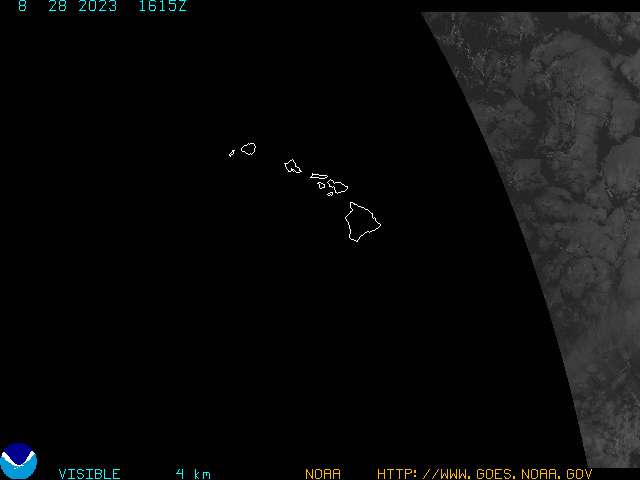


Max Says:
What a great ending to yout entry, Glenn!
I have a question – do you think the trade winds will be stronger with this coming High pressure system than they were this past Monday and Tuesday?~~~That is a very good question! I like this question! The answer may have to wait until Saturday however, and I will write about this possibility on this page then. It will however, whether it attains this past Monday and Tuesday’s big numbers…have big trades. Aloha, Glenn