











March 3-4, 2010
Air Temperatures – The following maximum temperatures were recorded across the state of Hawaii Wednesday afternoon:
Lihue, Kauai – missing
Honolulu, Oahu – 79
Kaneohe, Oahu – missing
Kaunakakai, Molokai – 77
Kahului, Maui – 79
Hilo, Hawaii – 81
Kailua-kona – 81
Air Temperatures ranged between these warmest and coolest spots near sea level around the state – and on the highest mountains…at 4pm Wednesday afternoon:
Kailua-kona – 79F
Princeville, Kauai – 66
Haleakala Crater – 55 (near 10,000 feet on Maui)
Mauna Kea summit – 39 (near 14,000 feet on the Big Island)
Precipitation Totals – The following numbers represent the largest precipitation totals (inches) during the last 24 hours on each of the major islands, as of Wednesday afternoon:
0.21 Mount Waialaele, Kauai
0.18 Manoa Valley, Oahu
0.00 Molokai
0.00 Lanai
0.00 Kahoolawe
0.89 Puu Kukui, Maui
1.48 Kawainui Stream, Big Island
Marine Winds – Here’s the latest (automatically updated) weather map showing a 1035 millibar high pressure system to the north of Hawaii…moving east. This high pressure system, and its associated ridge, will keep strong and gusty winds in place through Thursday.
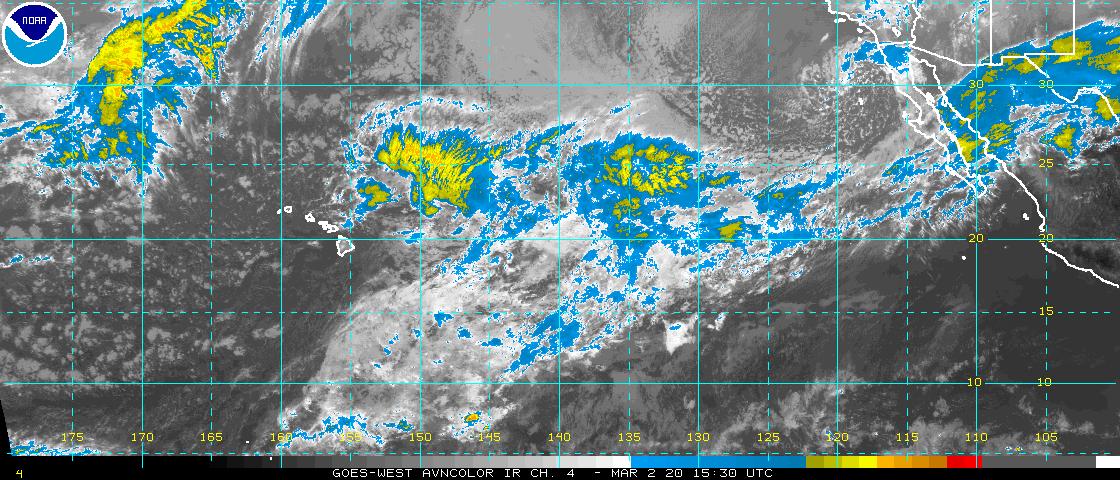
Satellite and Radar Images: To view the cloud conditions we have here in Hawaii, please use the following satellite links, starting off with this Infrared Satellite Image of the islands to see all the clouds around the state during the day and night. This next image is one that gives close images of the islands only during the daytime hours, and is referred to as a Close-up visible image. This next image shows a larger view of the Pacific…giving perspective to the wider ranging cloud patterns in the Pacific Ocean. Finally, here’s a Looping IR satellite image, making viewable the clouds around the islands 24 hours a day. To help you keep track of where any showers may be around the islands, here’s the latest animated radar image.
Hawaii’s Mountains – Here’s a link to the live webcam on the summit of near 14,000 foot Mauna Kea on the Big Island of Hawaii. The tallest peak on the island of Maui is the Haleakala Crater, which is near 10,000 feet in elevation. These two webcams are available during the daylight hours here in the islands…and when there’s a big moon rising just after sunset for an hour or two! Plus, during the nights and early mornings you will be able to see stars, and the sunrise too…depending upon weather conditions.
Tropical Cyclone activity in the eastern and central Pacific – Here’s the latest weather information coming out of the National Hurricane Center, covering the eastern north Pacific. You can find the latest tropical cyclone information for the central north Pacific (where Hawaii is located) by clicking on this link to the Central Pacific Hurricane Center. Here’s a tracking map covering both the eastern and central Pacific Ocean. A satellite image, which shows the entire ocean area between Hawaii and the Mexican coast…can be found here.
Aloha Paragraphs

Napali coast…Kauai
The strong and gusty trade winds remain gnarly, with rough and choppy sea surface conditions…and harbor surges coming into the Kahului harbor. This rushing air flow has remained active all this week, and although the winds may get a little softer this weekend briefly, are expected to increase as we move into next week. We have a 1035 millibar high pressure system located directly to the north of the islands, as shown on this latest weather map. This exceptionally large high pressure area sprawls from the International Dateline to our west…all the way across the central and eastern Pacific into
The windward sides of the islands will have showers, while the leeward sides will see less in the way of moisture. This looping satellite image shows that the stratocumulus and cumulus clouds that are riding along in the blustery trade wind flow, increased again overnight. Despite their rather threatening appearance after dark, the overlying atmosphere is on the dry side, limiting their ability to drop lots of rain. The majority of whatever showers that do fall will occur along the windward sides during those cooler night and early morning hours. There’s always that chance that a few showers may get carried over into the leeward sides, at least on the smaller islands…as long as the trade winds are on the strong side. The animated satellite picture also shows some fairly minor amounts of high cirrus clouds scooting along in the winds aloft over the state. The computer models want to increase our windward biased showers a bit early Thursday and perhaps into Friday…only to take them away again, as we move into the weekend. If we check out this large satellite image, we can track the cold front coming out of the southern
It’s Wednesday evening, as I begin writing this last section of today’s narrative. As noted in the paragraphs above, our winds are still up there, in terms of gustiness! As I’ve been doing the last several days, here’s the top gusts at around 5pm Monday – 33 mph on Kauai; 33 mph on Oahu; 31 mph on Molokai; 37 mph on Lanai; 39 on Kahoolawe; 39 on Maui; and 38 mph at South Point on the Big Island. These are big numbers, although not quite as impressive as what’ve seen the last several days. As I was mentioning this morning, I believe that we’ve moved past the strongest winds of this windy event…which took place Monday and Tuesday. ~~~ It looks like we might pick up a few additional showers later tonight into Thursday, although the lion’s share will be deposited along the north and east facing windward coasts and slopes. I expect that the winds will be with us again Thursday, then a little lighter Friday, perhaps bottoming-out in strength at some point this weekend. As pointed out in the paragraph below the picture above, the trade winds will be right back on us again as we push into next week. ~~~ I’m just about out the door here in Kihei, ready for the 40 minute drive back upcountry to Kula. It looks cloudy up on the western slope of the Haleakala Crater, although as the winds are more easterly now…it will likely be near calm up there. All this air in a hurry is pretty much focused along the windward sides now. This is why whatever showers that get blown in tonight and Thursday, will end up over there. I’ll be back early Thursday morning, as always, ready to put pen to paper, or at least fingers to keyboard, in preparation of your next new weather narrative. Sleep well until then folks! Aloha for now…Glenn.
Interesting: Perth, Australia has experienced one of its hottest and driest summer on record. Since November, temperatures have averaged nearly 5 degrees F above normal. The latest in a series of heat waves began on February 25th and has persisted through Monday. High temperatures were no lower than 98 degrees F and have been as hot as 107 degrees F during this period. The normal high temperature for the end of February is 88 degrees F.
Unusually dry weather has accompanied the heat wave this summer, with roughly half the normal amount of rain falling. In fact, since January 1, only 0.02 of an inch of rain has fallen, well short of the average of 1 inch of rain that normally falls during the same period. Meanwhile, the other side of the continent is coping with severe flooding. Over the past three days, nearly the average annual rainfall has fallen over portions of southwest Queensland, resulting in severe flooding.
The towns of Charleville and Roma have been declared disaster areas, resulting in hundreds of people to be evacuated. 30 patients from Charleville’s hospital have been flown to a hospital in Brisbane. The State Emergency Service has been called to more than 200 jobs to help with evacuations and to survey the damage.
The flooding rains have been the result of a monsoonal low pressure system that moved very slowly through the state. Much of southwest Queensland has been in a drought since 2002 and 2003. The heavy rains have ended, but the flooding will persist through the end of the week until flood waters can recede.
Interesting2: A new study by a former U.S. Food and Drug Administration (FDA) economist estimates the total economic impact of food borne illness across the nation to be a combined $152 billion annually. The Produce Safety Project, an initiative of The Pew Charitable Trusts at Georgetown University, published the report, Health-Related Costs from Food borne Illness in the United States. In addition, an interactive online map that graphically represents this cost information for every state in the nation is now available.
The report ranks states according to their total costs related to food borne illness and cost per case for an individual, which is $1,850 on average nationwide. The ten states with the highest costs per case are: Hawaii, Florida, Connecticut, Pennsylvania, South Carolina, the District of Columbia, Mississippi, New York, Massachusetts and New Jersey. The Centers for Disease Control and Prevention (CDC) estimates that approximately 76 million new cases of food-related illness — resulting in 5,000 deaths and 325,000 hospitalizations — occur in the United States each year.
Continuing outbreaks every year, shows that this is not a problem that is going away. "The costs associated with food borne illness are substantial," says report author Robert L. Scharff, a former FDA economist who is now an assistant professor in the Department of Consumer Sciences at The Ohio State University. "This study puts the problem of food borne illness in its proper perspective and should help facilitate reasonable action designed to mitigate this problem."
The release of the report comes as the U.S. Senate may soon vote on comprehensive food-safety legislation. The U.S. House of Representatives passed its food-safety bill (H.R. 2749) last July, and just before Thanksgiving, the U.S. Senate Committee on Health, Education, Labor & Pensions unanimously approved the FDA Food Safety Modernization Act (S. 510). "This report makes it clear that the gaps in our food-safety system are causing significant health and economic impacts," says Erik Olson, director of food and consumer product safety with the Pew Health Group.
"Especially in challenging economic times we cannot afford to waste billions of dollars fighting preventable diseases after it is too late. The Senate needs to act on this now and pass legislation that will improve protections for public health." "The data and analysis released today should show our lawmakers that they need to send strong food-safety legislation to the president’s desk as soon as possible," says Marilu Wilson of Bedford, New Hampshire, whose son suffered from a Salmonella infection.
"The new legislation may not help my family with the unfortunate events that we have experienced, but it could save lives and spare others from suffering what Ryan has endured." Despite the substantial magnitude of this problem, the aggregate economic cost of health losses associated with food borne illnesses has not been examined comprehensively in this way before.
Interesting3: Currently, beachgoers are informed about water-quality conditions based on results from the previous day’s sample. Scientists must collect samples in the field, then return to a lab to culture them for analysis — a process that takes a minimum of 24 hours. Now, engineers from the UCLA Henry Samueli School of Engineering and Applied Science have sped up the process of analyzing bacterial concentrations to under one hour, through the development of a new in-field, rapid-detection method.
Since bacteria levels can change quickly in the water column, a one-day turnaround time simply isn’t fast enough to adequately protect swimmers or prevent unnecessary beach closures, the engineers say. This issue is especially pertinent in California, where gastrointestinal illness that can result from contact with contaminated beach waters has been estimated to cost Orange and Los Angeles county beach visitors between $21 million and $51 million per year in sick days and related issues.
Furthermore, California coastlines are subject to chronic water pollution problems due to sewage spills and urban runoff. Rainstorms in Southern California can further exacerbate this problem, as pollutants that have accumulated over time on street surfaces are suddenly flushed into our waterways and into the ocean. Jenny Jay, UCLA associate professor of civil and environmental engineering, and Ph.D. student Christine Lee have advanced and tested a rapid method in marine and freshwater samples from beaches in Malibu and Santa Monica.
To their knowledge, it is among the first viable in-field methods for rapid, portable fecal bacteria analysis. This research will be published in an upcoming issue of the Journal of Applied Microbiology and is currently available online. Even for areas like the Southern California coast, which are close to state-of-the-art laboratories, transportation time, coupled with lab work, may mean that results often are not ready until the next day. With such a delay between sampling and results, the results may no longer be relevant due to the dynamic nature of water quality in beach environments.
The new rapid method represents a field-portable alternative to more expensive procedures, particularly where larger-scale, expensive equipment is not readily accessible. To decrease the time to determine results, the researchers have outfitted a portable kit to test samples for bacterial concentrations. "We envision a tool that can be used by lifeguards to collect and analyze water samples throughout the day, providing beachgoers with up-to-date, near-real-time data on water conditions," Lee said.
"This could also be useful in determining persistence of a bacterial contaminant after a pollution event, such as a sewage spill or a septic tank leaking." "We are currently applying this method, in a new approach, to identifying contamination sources in which we can adaptively sample the environment in order to hone in on hotspots," Jay said. The process uses magnetic beads conjugated to specific antibodies that identify and bind fecal bacteria that are used as standards for determining the safety of recreational waters, such as E. coli and Enterococcus.
After a few filtration and isolation steps, the sample organisms are lysed and treated with an enzyme that catalyzes a light-emitting reaction with target ATP, the energy currency of a cell. Cells break down ATP to obtain energy important for cellular processes. Scientists can then determine bacterial concentrations based on how much light is released by using a luminometer, a device that detects light emissions.
 Email Glenn James: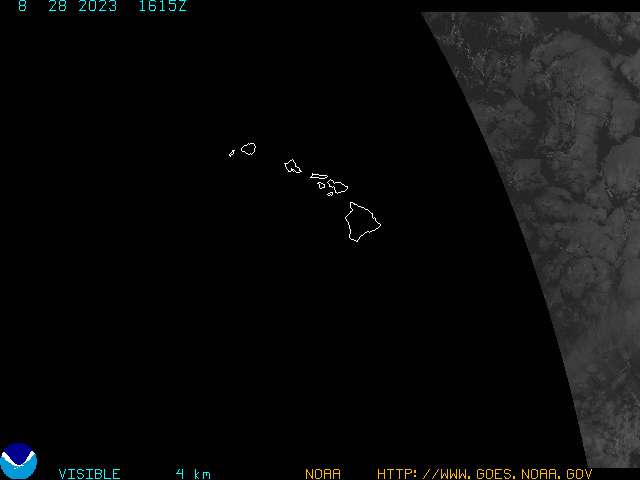



leslie Says:
can you please comment on the seemingly unusual number of earthquakes occurring at the moment that also seem to coincide with the full moon and if this is unusual or some trend the earth is going thru. thanx~~~That of course is a good question Leslie, although I don’t rightly have any good answer in response…sorry! Any of you readers like to take a shot at this? Aloha, Glenn