











February 12-13, 2010
Air Temperatures – The following maximum temperatures were recorded across the state of Hawaii Friday afternoon:
Lihue, Kauai – 76
Honolulu, Oahu – 80
Kaneohe, Oahu – 77
Kaunakakai, Molokai – 77
Kahului, Maui – 82
Hilo, Hawaii – 80
Kailua-kona – 81
Air Temperatures ranged between these warmest and coolest spots near sea level around the state – and on the highest mountains…at 5pm Friday evening:
Kailua-kona – 79F
Lihue, Kauai – 71
Haleakala Crater – 48 (near 10,000 feet on Maui)
Mauna Kea summit – 39 (near 14,000 feet on the Big Island)
Precipitation Totals – The following numbers represent the largest precipitation totals (inches) during the last 24 hours on each of the major islands, as of Friday afternoon:
0.02 Omao, Kauai
0.77 Manoa Valley, Oahu
0.10 Molokai
0.00 Lanai
0.03 Kahoolawe
0.71 Puu Kukui, Maui
0.61 Kawainui Stream, Big Island
Marine Winds – Here’s the latest (automatically updated) weather map showing high pressure systems located far to the east-northeast and west-northwest…with a ridge of high pressure to the north of Kauai. This pressure configuration will keep trade winds blowing this weekend.
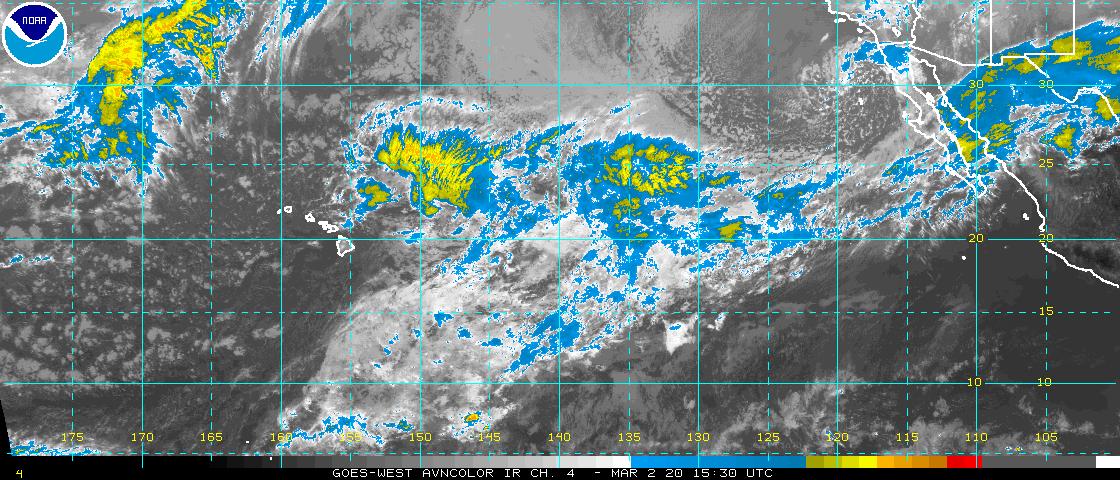
Satellite and Radar Images: To view the cloud conditions we have here in Hawaii, please use the following satellite links, starting off with this Infrared Satellite Image of the islands to see all the clouds around the state during the day and night. This next image is one that gives close images of the islands only during the daytime hours, and is referred to as a Close-up visible image. This next image shows a larger view of the Pacific…giving perspective to the wider ranging cloud patterns in the Pacific Ocean. Finally, here’s a Looping IR satellite image, making viewable the clouds around the islands 24 hours a day. To help you keep track of where any showers may be around the islands, here’s the latest animated radar image.
Hawaii’s Mountains – Here’s a link to the live webcam on the summit of near 14,000 foot Mauna Kea on the Big Island of Hawaii. The tallest peak on the island of Maui is the Haleakala Crater, which is near 10,000 feet in elevation. These two webcams are available during the daylight hours here in the islands…and when there’s a big moon rising just after sunset for an hour or two! Plus, during the nights and early mornings you will be able to see stars, and the sunrise too…depending upon weather conditions.
Tropical Cyclone activity in the eastern and central Pacific – Here’s the latest weather information coming out of the National Hurricane Center, covering the eastern north Pacific. You can find the latest tropical cyclone information for the central north Pacific (where Hawaii is located) by clicking on this link to the Central Pacific Hurricane Center. Here’s a tracking map covering both the eastern and central Pacific Ocean. A satellite image, which shows the entire ocean area between Hawaii and the Mexican coast…can be found here.
Aloha Paragraphs

South Point…on the Big Island
Our local weather will remain fairly smooth, with no major changes on our horizon here in the islands, for the time being. The trade winds will prevail through the early part of the new week ahead, as they have been the last several days. This weather map shows high pressure centers far to the west-northwest, and far to the east-northeast…with a very long ridge extending between the two…running just to the north of
The computer models suggest that we’ll see little change in the trade wind strength or direction into the new week. This will keep generally nice weather over the state, with relatively warm easterly trade winds blowing across our islands. If we check this forecast weather map, we can see the same pressure configuration exists out 72 hours, or through Monday. At that time, we see a potent 983 millibar storm low pressure system to the northwest of the islands…with a cold front. The models want to push this cold front down into our area Tuesday evening into Wednesday. The trade winds look like they will continue to blow, although the cold front should push the trade wind producing high and ridge down closer to the state…probably slowing them down in the process.
Between now and the cold front’s arrival, we should see off and on passing showers along our windward sides. This precipitation isn’t expected to be heavy, although the islands of Maui and the
The surf will remain active along the north and west facing beaches and along the south and east facing shores as well…although it will be smaller there. The north and west shores will be on the receiving end of waves being generated by storms in the north Pacific. The east shores will have some fairly minor waves breaking, generated by the trade winds upstream of the islands. Meanwhile, the southern leeward beaches will find waves breaking, thanks to storms in the far southern hemisphere. This is all good news for our local water sports communities, who will be taking full advantage of these breaking waves and wind! The surf will be slowly losing size as we move through the weekend, although will be around next week too…even on the south facing beaches, which is unusual for this winter month of February.
It’s Friday evening, as I begin writing the last section of today’s narrative. As noted above, the trade winds will dominate our local weather picture well into the future. The next interruption to this generally fine weather pattern, would be later next Tuesday into Wednesday. This may bring not only showers, mostly along the windward sides of the islands…but also another one of those brief tropical cool snaps for a couple of days. The computer models show a second showery frontal band of clouds arriving early next weekend. The main thing now though, is the pleasant weather conditions between now and the middle of next week.
~~~ The Beach Boys are playing on Maui this evening, which should be a good outdoor concert. I had wanted to go to see them, as they were one of my favorite bands while I was a kid, being a surfer and all. However, I have an early morning Saturday, as I’m going to join a group of friends who are meditating in Haiku. So, instead I’m going to see a new film in Kahului. I’ve actually been looking forward to seeing film, called Crazy Heart (2009), starring Jeff Bridges, Maggie Gyllenhaal, Robert Duvall…among others. A short synopsis: Bad Blake (Bridges) is a broken-down, hard-living country music singer who’s had way too many marriages, far too many years on the road, and one too many drinks…way too many times. And yet, Bad can’t help but reach for salvation with the help of Jean, a journalist who discovers the real man behind the musician. As he struggles down the road of redemption, Bad learns the hard way just how tough life can be on one man’s crazy heart. Here’s a trailer for this film.
As usual, I’ll let you know what I thought when I get back online early Saturday morning, to prepare your next new weather narrative. I hope you have a great Friday night until then! Aloha for now…Glenn.
Extra: Pigeon Impossible
Interesting: Yields from some of the most important crops begin to decline sharply when average temperatures exceed about 86 Fahrenheit. Projections are that by the end of this century much of the tropics and subtropics will regularly see growing season temperatures above that level, hotter than the hottest summers now on record.
An international panel of scientists writing in the Feb. 12 edition of the journal Science is urging world leaders to dramatically alter their notions about sustainable agriculture to prevent a major starvation catastrophe by the end of this century among the more than 3 billion people who live relatively close to the equator.
Specifically they urge world leaders to "get beyond popular biases against the use of agricultural biotechnology," particularly crops genetically modified to produce greater yields in harsher conditions, and to base the regulations of such crops on the best available science.
"You’re looking at a 20 percent to 30 percent decline in production yields in the next 50 years for major crops between the latitudes of southern California or southern Europe to South Africa," said David Battisti, a University of Washington atmospheric sciences professor.
He is a coauthor of a Perspectives article in Science that urges food production experts, scientists and world leaders to begin thinking in dramatically different ways to meet food needs in a significantly warmer world. Lead author is Nina Federoff, science and technology adviser to Secretary of State Hillary Rodham Clinton.
"I grow increasingly concerned that we have not yet understood what it will take to feed a growing population on a warming planet," said Federoff, who also is a biology professor at Pennsylvania State University. The challenge is becoming more difficult, the scientists said, because the world’s population is likely to have increased more than 30 percent, to 9 billion people, by 2050.
Even without climate change, feeding all of these people will require doubling the grain production in the tropics, Battisti said, but a warmer climate will reduce yields because the temperature will be too high to achieve the most efficient photosynthesis. That factor, combined with less rainfall in major food-producing regions and increasing pressure from pests and pathogens, is likely to cut major food crop yields a minimum of 20 percent to 30 percent.
The authors advocate developing systems that have the potential to decrease the land, energy and fresh water needed for agriculture and at the same time reducing the pollution associated with agricultural chemicals and animal waste.
Interesting2: Depicting a cause-and-effect scenario that spans thousands of miles, a scientist at Scripps Institution of Oceanography at UC San Diego and his collaborators discovered that ocean waves originating along the Pacific coasts of North and South America impact Antarctic ice shelves and could play a role in their catastrophic collapse. Peter Bromirski of Scripps Oceanography is the lead scientist in a new study published in the journal Geophysical Research Letters that describes how storms over the North Pacific Ocean may be transferring enough wave energy to destabilize Antarctic ice shelves.
The California Department of Boating and Waterways and the National Science Foundation supported the study. According to Bromirski, storm-driven ocean swells travel across the Pacific Ocean and break along the coastlines of North and South America, where they are transformed into very long-period ocean waves called "infragravity waves" that travel vast distances to Antarctica. Bromirski, along with coauthors Olga Sergienko of Princeton University and Douglas MacAyeal of the University of Chicago, propose that the southbound travelling infragravity waves.
"may be a key mechanical agent that contributes to the production and/or expansion of the pre-existing crevasse fields on ice shelves," and that the infragravity waves also may provide the trigger necessary to initiate the collapse process. The researchers used seismic data collected on the Ross Ice Shelf to identify signals generated by infragravity waves that originated along the Northern California and British Columbia coasts, and modeled how much stress an ice shelf suffers in response to infragravity wave impacts.
Bromirski said only recently has technology advanced to allow scientists to deploy seismometers for the extended periods on the ice shelf needed to capture such signals. The study found that each of the Wilkins Ice Shelf breakup events in 2008 coincided with the estimated arrival of infragravity waves. The authors note that such waves could affect ice shelf stability by opening crevasses, reducing ice integrity through fracturing and initiating a collapse.
"(Infragravity waves) may produce ice-shelf fractures that enable abrupt disintegration of ice shelves that are also affected by strong surface melting," the authors note in the paper. Whether increased infragravity wave frequency and energy induced by heightened storm intensity associated with climate change ultimately contribute to or trigger ice shelf collapse is an open question at this point, said Bromirski. More data from Antarctica are needed to make such a connection, he said.
 Email Glenn James: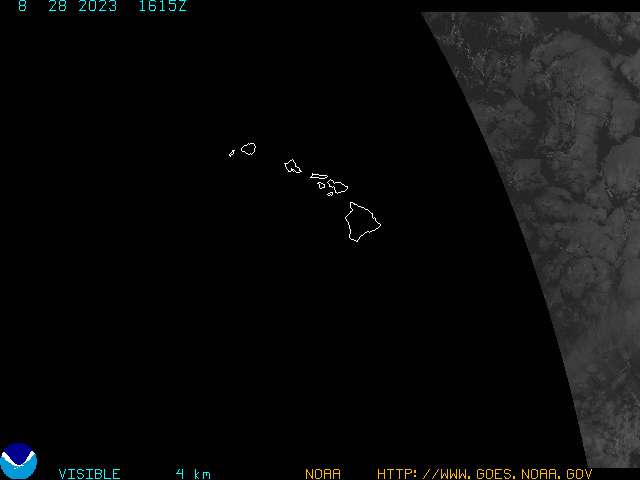



Paula Says:
Glenn,
Thank you for the great info, my first visit to the islands is next week. I want fantastic weather. So do a little "perfect weather" dance for me. Although I have been caught in torrential rains of the coast of N. Carolina on Shackleford Island on a photo treck. No pics that day, but had a wonderful time and ended up hanging out with the locals at a little pub in Beauford. Maui bound and over the top excited!~~~Paula, can understand your over the topness! Your excitement is warranted, you will have a super time…I can feel it in my bones. Come ahead, get ready for paradise to da max. Aloha, Glenn
Mo Says:
Hey Glenn, love your website. I look at it everyday just to have a little Hawaii dreaming.
Coming to you from San Francisco and wanted to let you know the the Mavericks are going to be out this weekend with the surf contest scheduled for tomorrow, 02/13/2010. I’ve seen them once about 10 years ago, and consider it a “once in a lifetime expirence”, only because with all the publicity, you can’t get near them now.
Mo~~~Hi Mo, good to hear from you there in the Bay area. I understand the surf is going to be large along your coast this weekend! Glad you enjoy coming to my website, I appreciate that…Aloha, Glenn