











February 3-4, 2010
Air Temperatures – The following maximum temperatures were recorded across the state of Hawaii Wednesday afternoon:
Lihue, Kauai – 73
Honolulu, Oahu – 75
Kaneohe, Oahu – 74
Kaunakakai, Molokai – 69
Kahului, Maui – 77
Hilo, Hawaii – 76
Kailua-kona – 82
Air Temperatures ranged between these warmest and coolest spots near sea level around the state – and on the highest mountains…at 5pm Wednesday evening:
Kailua-kona – 78F
Lihue, Kauai – 68
Haleakala Crater – 45 (near 10,000 feet on Maui)
Mauna Kea summit – 35 (near 14,000 feet on the Big Island)
Precipitation Totals – The following numbers represent the largest precipitation totals (inches) during the last 24 hours on each of the major islands, as of Wednesday afternoon:
0.08 Kokee, Kauai
0.84 Schofield Barracks, Oahu
1.60 Molokai
0.01 Lanai
0.25 Kahoolawe
0.90 Kihei, Maui
1.08 Laupahoehoe, Big Island
Marine Winds – Here’s the latest (automatically updated) weather map showing a cold front dissipating to the southeast of the Big Island. A new high pressure system will be moving into the area north of the islands…with cool breezes from the northeast through Thursday, becoming trade winds Friday.
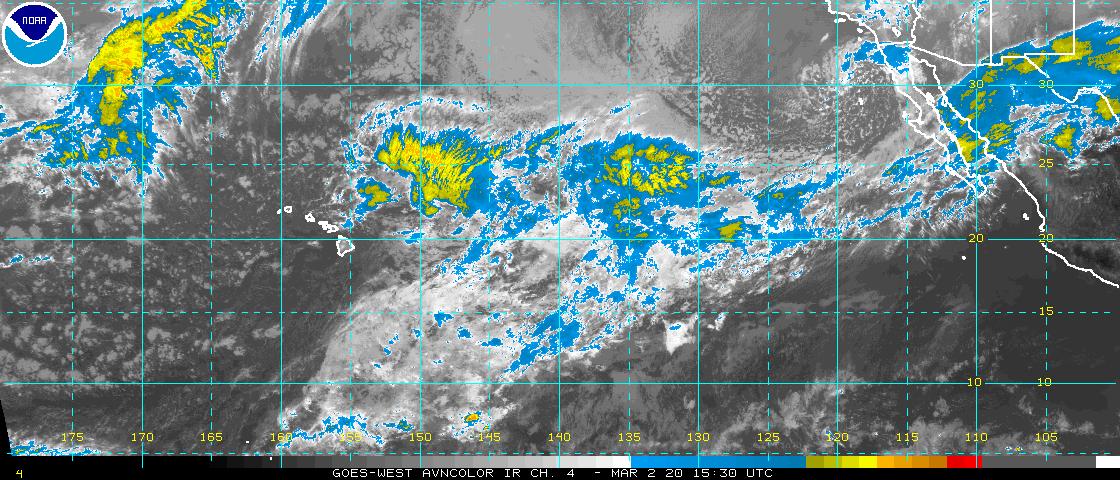
Satellite and Radar Images: To view the cloud conditions we have here in Hawaii, please use the following satellite links, starting off with this Infrared Satellite Image of the islands to see all the clouds around the state during the day and night. This next image is one that gives close images of the islands only during the daytime hours, and is referred to as a Close-up visible image. This next image shows a larger view of the Pacific…giving perspective to the wider ranging cloud patterns in the Pacific Ocean. Finally, here’s a Looping IR satellite image, making viewable the clouds around the islands 24 hours a day. To help you keep track of where any showers may be around the islands, here’s the latest animated radar image.
Hawaii’s Mountains – Here’s a link to the live webcam on the summit of near 14,000 foot Mauna Kea on the Big Island of Hawaii. The tallest peak on the island of Maui is the Haleakala Crater, which is near 10,000 feet in elevation. These two webcams are available during the daylight hours here in the islands…and when there’s a big moon rising just after sunset for an hour or two! Plus, during the nights and early mornings you will be able to see stars, and the sunrise too…depending upon weather conditions.
Tropical Cyclone activity in the eastern and central Pacific – Here’s the latest weather information coming out of the National Hurricane Center, covering the eastern north Pacific. You can find the latest tropical cyclone information for the central north Pacific (where Hawaii is located) by clicking on this link to the Central Pacific Hurricane Center. Here’s a tracking map covering both the eastern and central Pacific Ocean. A satellite image, which shows the entire ocean area between Hawaii and the Mexican coast…can be found here.
Aloha Paragraphs

Sunny leeward skies Thursday…still on the cool side
The cold front that dropped down through the island last evening and overnight, continues moving away…to the southeast of the
These cooler than normal north winds were coming our way thanks to a 1023 millibar high pressure system, following in the wake of the cold front. This anticyclone will push into the area north-northwest of our
Looking a bit further ahead, the previously forecast cold front for this weekend, is now predicted to remain to our north…missing us altogether. This doesn’t mean that it won’t have its subtle influence on our islands however. As we move into Friday, the long lost trade winds will reappear briefly, helping to warm things up then. Those trade winds won’t last long though, as the cold front, despite it’s not dropping down over us, will push a high pressure ridge over the Aloha state on Saturday. This in turn will swing us back into a light and variable wind condition. It will depend upon just how far into the state this ridge gets, whether any volcanic haze spreads up over the smaller islands…from the vents on the
It’s Wednesday evening, as I begin writing the last section of today’s narrative.
As described above, Wednesday was anything but a warm day here in Hawaii! Air temperatures were restricted to the 70F’s near sea level, with just two exceptions. The Kona coast on the Big Island reached 81 degrees, due to the blocking of the chilly northerly breezes…by the tall mountains there. Then, back on the cool side, the Molokai airport topped out at only 69 degrees, not even able to reach 70 today! As the winds continue blowing tonight, it will keep our overnight minimum temperatures from plunging too terribly low. That doesn’t mean its not going to be feeling cold however. As I sometimes say during winter, "drag that extra blanket out before going to bed"…maybe two! Thursday should be slightly warmer, as there will be generally fewer clouds, at least on the sunny leeward sides of the islands. ~~~ Here in Kula, at 558pm, my thermometer was reading a chilly 55.2 degrees…with blustery winds, and light mist being blown over from the north shore! [It’s now 8pm, and the temperature has fallen to 53.8 degrees]. I’ve been working from home this week, as I tweaked my lower back recently, although its getting better now. At any rate, during the day today, I was here sitting in my weather tower all day, and only twice, briefly…did the temperature reach 60.2 degrees. I must admit that I love these winterized days of February, the coolest month of the year here in the islands. ~~~ I’ll be back Thursday morning with your next new weather narrative, from chilly paradise. I hope you have a great Wednesday night until then, tucked deeply under your covers! Aloha for now…Glenn.
Interesting: A key deadline for countries to submit emission reduction goals to the United Nations as part of the recently negotiated Copenhagen Accord passed last Sunday. The U.N. received commitments from 55 nations, but 139 countries remain unsupportive of the political statement, leading the international body to push back the commitment deadline indefinitely.
Since the high-level climate change summit in Copenhagen concluded in December, global climate talks have been in a state of confusion. Two parallel tracks are already under way – one that includes the United States and one that omits this significant world emitter.
The Copenhagen Accord, some say, threatens to introduce a third procedural track, complicating the already tense deliberations. The Accord, a non-binding political statement introduced at the 11th hour of the Copenhagen summit, has been praised by some for garnering stronger commitments from major developing nations, which could in turn deliver a binding global climate treaty.
Yet its formulation has also threatened to destabilize the nearly 20-year old process developed under the U.N.’s Framework Convention on Climate Change (UNFCCC), the leading international body for climate change negotiations. The United States, Brazil, South Africa, India and China formulated the Accord with the understanding that the text would later be adopted by all 194 nations.
But many participants considered this outcome to be undemocratic and a departure from a U.N. process meant to offer equal voice to every nation. Many had hoped that the Copenhagen conference would deliver a legally binding international treaty on climate change, or at least provide direction on many of the core components under negotiation.
But the Accord itself contains little of these details and provides instead for countries to set their own emission reduction targets unilaterally. Among other elements, it states that 2 degrees centigrade is the target above which global temperatures must not rise; it proposes the mobilization of $30 billion by 2012 and $100 billion by 2020 for developing countries to address climate change; and it calls on developed and developing countries to submit their national actions on climate change to the U.N. by January 31, a deadline that has now been postponed "indefinitely."
Interesting2: Southern Brazil is in the midst of an intense heat wave that has been burning up the region since the weekend. High temperatures for Wednesday are set to reach 102F degrees in Port Alegre, and peaked at 102.7F on Tuesday during the day in Campo Bom. Pelotas also recorded a high of 102F during the day on Wednesday.
According to Metsul, Tuesday’s high in Campo Bom was a February record, not seen in the city since 2003 when a past heat wave brought temperatures reaching 103F. While no major high temperature records have been broken, temperatures are some of the hottest Southern Brazil has recorded for a February since the late 1920s.
The heat wave could be peaking Wednesday morning, but Rio de Janiero and most of Southern Brazil will continue to see temperatures in the high 90’s late week and through the upcoming weekend. While beach goes have enjoyed the heat, nights of oppressive warmth has been problematic for several Brazilians.
The demand for energy has reached the state record for Rio Grande do Sul after Tuesday’s temperatures. This is likely due to an increased demand in air conditioning and other cooling devices.
Interesting3: Why America’s Favorite Seafood Is a Health and Environmental Nightmare. The environmental impact of shrimp can be horrific. But most Americans don’t know where their shrimp comes from or what’s in it. Americans love their shrimp. It’s the most popular seafood in the country, but unfortunately much of the shrimp we eat are a cocktail of chemicals, harvested at the expense of one of the world’s productive ecosystems.
Worse, guidelines for finding some kind of "sustainable shrimp" are so far nonexistent. In his book, Bottomfeeder: How to Eat Ethically in a World of Vanishing Seafood, Taras Grescoe paints a repulsive picture of how shrimp are farmed in one region of India.
The shrimp pond preparation begins with urea, superphosphate, and diesel, then progresses to the use of piscicides (fish-killing chemicals like chlorine and rotenone), pesticides and antibiotics (including some that are banned in the U.S.), and ends by treating the shrimp with sodium tripolyphosphate (a suspected neurotoxicant), Borax, and occasionally caustic soda.
Upon arrival in the U.S., few if any, are inspected by the FDA, and when researchers have examined imported ready-to-eat shrimp, they found 162 separate species of bacteria with resistance to 10 different antibiotics. And yet, as of 2008, Americans are eating 4.1 pounds of shrimp apiece each year — significantly more than the 2.8 pounds per year we each ate of the second most popular seafood, canned tuna. But what are we actually eating without knowing it?
And is it worth the price — both to our health and the environment? Understanding the shrimp that supplies our nation’s voracious appetite is quite complex. Overall, the shrimp industry represents a dismantling of the marine ecosystem, piece by piece. Farming methods range from those described above to some that are more benign.
Problems with irresponsible methods of farming don’t end at the "yuck," factor as shrimp farming is credited with destroying 38 percent of the world’s mangroves, some of the most diverse and productive ecosystems on earth.
Mangroves sequester vast amounts of carbon and serve as valuable buffers against hurricanes and tsunamis. Some compare shrimp farming methods that demolish mangroves to slash-and-burn agriculture. A shrimp farmer will clear a section of mangroves and close it off to ensure that the shrimp cannot escape.
Then the farmer relies on the tides to refresh the water, carrying shrimp excrement and disease out to sea. In this scenario, the entire mangrove ecosystem is destroyed and turned into a small dead zone for short-term gain. Even after the shrimp farm leaves, the mangroves do not come back.
Interesting4: Three-quarters of nurses providing private and public care experienced workplace violence, but only one in six incidents were formally reported, according to study published in the February issue of the Journal of Clinical Nursing. The majority (92%) said they had been verbally abused, 69% had been physically threatened and 52% had been physically assaulted.
A total of 2,354 incidents were reported to the research team, with nurses facing an average of two to 46 incidents a year. "Many of the nurses who took part in the research said that they did not report incidents because they felt that workplace violence was just part of the job" says lead author Dr Rose Chapman, from Curtin University of Technology in Perth, Western Australia.
The 113 nurses who took part in the study were mainly female, in their early 40s and had been in the profession for between six months and 40 years, with an average service of just under 18 years. Nearly two-thirds worked part-time.
 Email Glenn James: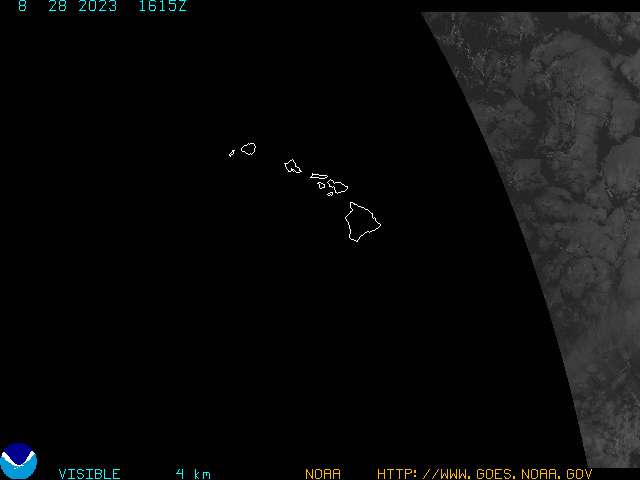



Helen Says:
Aloha Glenn,
I am so happy that Molokai has gotten some rain !! We got some as well the other day and today it was fun to wear a scarf and jacket.
Aloha,Helen
PS I hope your back feels better soon.~~~Hi Helen, yes actually Molokai has had the state’s largest rainfall totals the last couple of days. You got to wear a scarf and jacket, nice! I was dressed all day in down, and turtle necks, and shearling wool ankle slippers…as I worked from home in Kula again today. My lower back, it’s much improved today, thanks for your well wishes. Aloha, Glenn
Pat Says:
Glen, we read your forecasts in Denver all the time and wanted to ask you now that were here in Maui, when should
we plan our Whale watching trip on the Teralani 2 that
leaves at 4:30 PM daily?? How’s the next few days looking?
Aloha, Pat and Sandy from Colorado~~~Hi Pat and Sandy, I’d say that your best day might be this Saturday, as I expect the lightest winds this week then. I understand that there are lots of whales around to see…have fun! Aloha, Glenn
Janet Says:
Just want to say thanks Glen! Just moved here and check in regularly. Kids will wear sweaters today!~~~Hi Janet, that’s one of my sisters names. You’re very welcome, one of the few days per year when it actually feels cool. Welcome to the islands, Aloha…Glenn