











February 1-2, 2010
Air Temperatures – The following maximum temperatures were recorded across the state of Hawaii Monday afternoon:
Lihue, Kauai – 78
Honolulu, Oahu – 80
Kaneohe, Oahu – 80
Kaunakakai, Molokai – 80
Kahului, Maui – 85
Hilo, Hawaii – 82
Kailua-kona – 81
Air Temperatures ranged between these warmest and coolest spots near sea level around the state – and on the highest mountains…at 5pm Monday evening:
Kahului, Maui – 81F
Lihue, Kauai – 76
Haleakala Crater – 46 (near 10,000 feet on Maui)
Mauna Kea summit – 41 (near 14,000 feet on the Big Island)
Precipitation Totals – The following numbers represent the largest precipitation totals (inches) during the last 24 hours on each of the major islands, as of Monday afternoon:
0.03 Poipu, Kauai
0.19 Wilson Tunnel, Oahu
0.05 Molokai
0.01 Lanai
0.00 Kahoolawe
0.47 Oheo Gulch, Maui
0.78 Glenwood, Big Island
Marine Winds – Here’s the latest (automatically updated) weather map showing a weak high pressure near Kauai, moving southward. Meanwhile, a cold front is approaching from the northwest. Winds will be south to southwest ahead of the front…then cooler from the north to northeast in its wake.
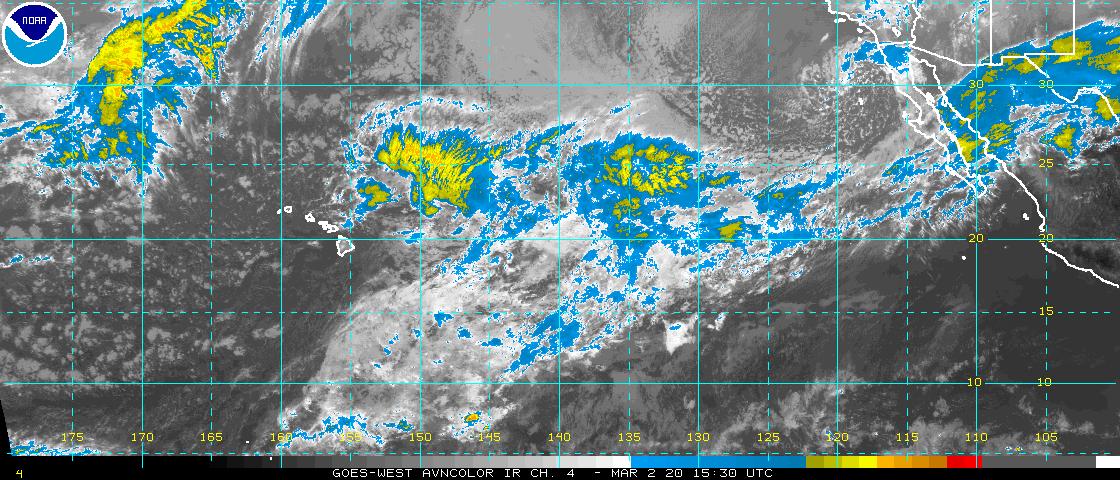
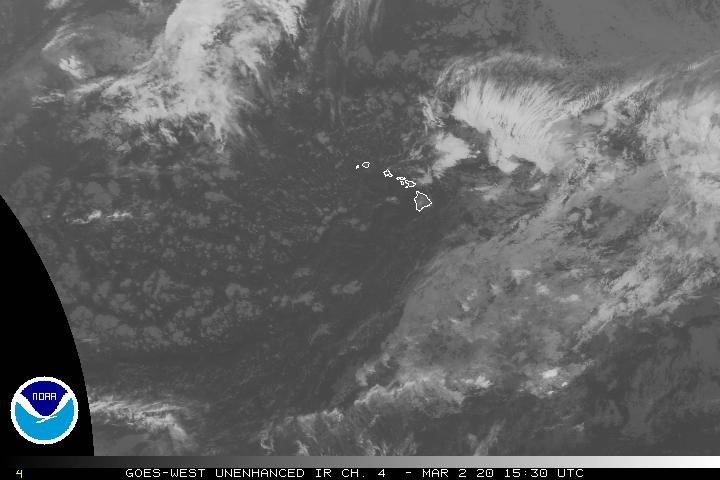
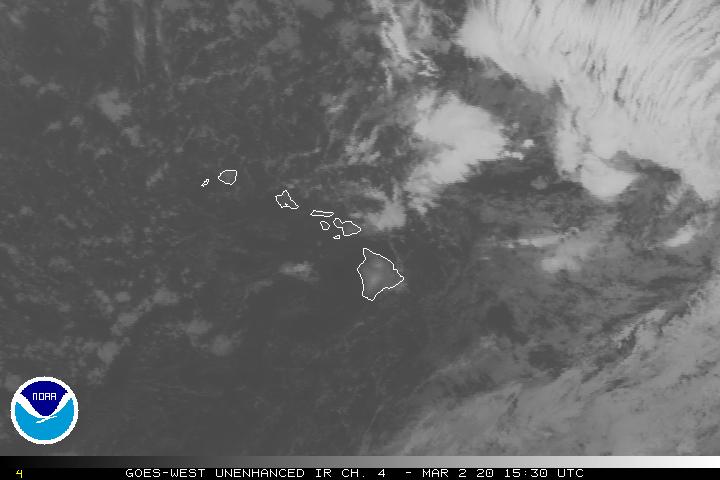
Satellite and Radar Images: To view the cloud conditions we have here in Hawaii, please use the following satellite links, starting off with this Infrared Satellite Image of the islands to see all the clouds around the state during the day and night. This next image is one that gives close images of the islands only during the daytime hours, and is referred to as a Close-up visible image. This next image shows a larger view of the Pacific…giving perspective to the wider ranging cloud patterns in the Pacific Ocean. Finally, here’s a Looping IR satellite image, making viewable the clouds around the islands 24 hours a day. To help you keep track of where any showers may be around the islands, here’s the latest animated radar image.
Hawaii’s Mountains – Here’s a link to the live webcam on the summit of near 14,000 foot Mauna Kea on the Big Island of Hawaii. The tallest peak on the island of Maui is the Haleakala Crater, which is near 10,000 feet in elevation. These two webcams are available during the daylight hours here in the islands…and when there’s a big moon rising just after sunset for an hour or two! Plus, during the nights and early mornings you will be able to see stars, and the sunrise too…depending upon weather conditions.
Tropical Cyclone activity in the eastern and central Pacific – Here’s the latest weather information coming out of the National Hurricane Center, covering the eastern north Pacific. You can find the latest tropical cyclone information for the central north Pacific (where Hawaii is located) by clicking on this link to the Central Pacific Hurricane Center. Here’s a tracking map covering both the eastern and central Pacific Ocean. A satellite image, which shows the entire ocean area between Hawaii and the Mexican coast…can be found here.
Aloha Paragraphs

Clouds…some showers Tuesday-Wednesday
Our weather here in the islands turned out pretty good Monday, although clouds and a few showers formed over the mountains during the afternoon. The next event in our
Looking a bit further ahead, the computer models show this next cold front getting into the state later Tuesday into Wednesday. As this next frontal boundary gets closer, our winds will pick up a little on the southwest Kona breezes. There’s a good chance of prefrontal showers arriving ahead of the front. The bulk of those showers, arriving tonight into Tuesday, will take aim on the islands of Kauai and
It’s Monday evening, as I begin writing the last section of today’s narrative.
As described above, Monday was a nice day, with just those afternoon clouds around the slopes. ~~~ As we get into Tuesday, the remnant clouds from the last cold front, now to the southwest of Kauai and Oahu, will be carried our way on the Kona winds. Here’s a looping radar image, so we see those showers moving towards Kauai and Niihau. The classic windward sides, on the north and east facing shores, should have decent weather extending into Tuesday, with most of the clouds and showers concentrating their efforts along the south and west facing leeward coasts and slopes. ~~~ The cold front itself isn’t expected to be all that impressive, although some showers will arrive with its passing. We will see a brief period of chilly weather surge in over the state…on the brisk north to northeast winds Wednesday into Thursday. Then, warmth will return on the easterly trade winds into the weekend, with generally good weather prevailing just about everywhere. The windward sides will have some showers, but with a relatively dry atmosphere then, they shouldn’t be too overbearing by any means. ~~~ Looking out the windows of my Kula, Maui, weather tower this evening, it’s cloudy up here. There’s a swath of high cirrus clouds that have been carried over the southern part of the state, on the upper winds aloft. This may add some color to our skies as the sunset occurs. At the same time, there’s some vog that has been carried our way on the surface breezes, which are very light today…from the south. ~~~ I’m about to get out there for my evening walk, but will be back early Tuesday morning with your next new weather narrative, I hope you have a great Monday night until then! Aloha for now…Glenn.
Interesting: Despite a decade of efforts worldwide to curb its release into the atmosphere, NOAA and university scientists have measured increased emissions of a greenhouse gas that is thousands of times more efficient at trapping heat than carbon dioxide and persists in the atmosphere for nearly 300 years. The substance HFC-23, or trifluoromethane, is a byproduct of chlorodifluoromethane, or HCFC-22, a refrigerant in air conditioners and refrigerators and a starting material for producing heat and chemical-resistant products, cables and coatings.
"Without the international effort to reduce emissions of HFC-23, its emissions and atmospheric abundance would have been even larger in recent years," said Stephen Montzka, a NOAA research chemist and lead author of the collaborative study between NOAA and university scientists. "As it was, emissions in 2006-2008 were about 50 percent above the 1990-2000 average." HFC-23 is one of the most potent greenhouse gases emitted as a result of human activities.
Over a 100-year time span, one pound of HFC-23 released into the atmosphere traps heat 14,800 times more effectively than one pound of carbon dioxide. To date, the total accumulated emission of HFC-23 is small relative to other greenhouse gases, making this gas a minor (less than one percent) contributor to climate change at present. Because HFC-23 is such a potent greenhouse gas, the United Nations Framework Convention on Climate Change (UNFCCC) has facilitated the destruction of substantial quantities of HFC-23 in developing countries since 2003.
The study by Montzka and colleagues shows for the first time that even with these actions HFC-23 emissions from developing countries remained substantial compared to recent years. The Montreal Protocol, which is the international agreement that phases out ozone-depleting substances, requires the end of HCFC-22 production by 2020 in developed countries and 2030 in developing counties for uses that result in the HCFC-22 escaping to the atmosphere.
This Protocol does not restrict HCFC-22 production in the synthesis of fluoropolymers or the HFC-23 that is co-produced. The future atmospheric abundance of HFC-23 and its contribution to future climate change depends on amounts of HCFC-22 produced and the success of programs to reduce emissions of the co-generated HFC-23. Scientists measured air collected from above the snow surface and down to 380 feet below the snow surface during field studies in Antarctica in 2001, 2005 and 2009.
Using these results, they were able to determine how amounts of HFC-23 and other gases affecting climate and stratospheric ozone have changed in the recent past. The first published measurements of HFC-23 appeared in 1998 but this was the first time scientists examined how HFC-23 emissions have changed since 1996, particularly in developing nations and since the UNFCCC’s projects to reduce emissions began in 2003.
Interesting2: Up to now, the more than 28 desalination plants scattered around the Kingdom have had to rely of fossil fuel, most notably fuel oil, to provide to power to run the equipment used to extract salt and other minerals from sea water. Much of this may be changing, however, as Saudi Arabia is now interested in using solar energy to provide the power needed, instead of oil. According to an article on the UAE Top News media site, the Kingdom is now planning to build solar energy based desalination plants in order to save on energy costs, as well as be in tune with new environmental polices.
This might be to secure membership in the International Renewable Energy Agency, otherwise known as IRENA. Saudi Finance Minister Ibrahim Al Assaf said "desalination is our strategic choice to supply an adequate supply of drinking water to people across the Kingdom." He added that by using solar energy instead of oil, it will focus more on using renewable energy and even become an exporter of this clean form of energy as it has been doing with oil.
A tremendous amount of oil is currently being used to provide power for the country’s desalination plants; around 1.5 million barrels per day. This has caused the price of desalinated water to rise as oil prices have risen. The use of solar energy to power desalination plants is just one of several projects in the Kingdom that are more environmentally friendly. The Kingdom is also embarking of projects to improve its inland transport systems including building a high speed train network to carry pilgrims to and from the annual Hajj pilgrimage in the Holy Cities of Mecca and Medina.
Interesting3: Sometime around 2050 researchers estimate that the global population will level-out at nine billion people, adding over two billion more people to the planet. Since, one billion of the world’s population (more than one in seven) are currently going hungry—the largest number in all of history—scientists are struggling with how, not only to feed those who are hungry today, but also the additional two billion that will soon grace our planet.
In a new paper, published in Science, researchers make recommendations on how the world may one day feed nine billion people—sustainably. The difficulties are many and large, according to the paper: "growing competition for land, water and energy, and the over-exploitation of fisheries, will affect our ability to produce food, as will the urgent requirement to reduce the impact of the food system on the environment."
The finiteness of arable land and freshwater will be further strained by what the authors call "higher purchasing power", which increases the demand in the developing world for "processed food, meat, dairy and fish, all of which adds pressure to the food supply system." Further complicating the problem of limited—and over-stretched resources—will be the need to adapt to a changing climate.
Interesting4: A study that looked at how people behave during pandemics has identified key demographic and psychological factors that may predict protective behaviors. The study is published online January 30 2010, in the British Journal of Health Psychology. Dr Alison Bish and Professor Susan Michie at the Health Psychology Unit, University College London, investigated the results of a number of studies into how people behave during pandemics, such as the recent swine flu outbreak, to better understand protective behavior and to improve interventions and communication in the future.
The review included the results of 26 published studies on associations between demographic factors, attitudes and behavioral measures during outbreaks including SARS (Severe Acute Respiratory Syndrome) between November 2002 and July 2003, Bird Flu (Avian influenza) in 1997, and Swine Flu (in 2009). Dr Bish said: "These illnesses have far reaching effects because of how easily they are transmitted. When an outbreak occurs however, people can choose to take steps to protect themselves.
Protective behaviors can be preventative, avoidant or disease management, such as hand washing, avoiding public places, or taking antiviral medication. We wanted to discover the groups of people that are most likely to take such steps, and the attitudes that are associated with these behaviors." Many of the studies found significant gender differences in protective behaviors. Studies in Hong Kong and Singapore, the UK and the USA found that women were more likely than men to carry out protective behaviors such as washing their hands, wearing a mask or following quarantine restrictions.
Older people were also found to be more likely to carry out such protective behaviors. Dr Bish explains: "These patterns could be explained in terms of perceived risk, with women and older people feeling that they may be more susceptible to disease than men, or younger people do." In fact, greater perceived susceptibility to disease was found to be a strong predictor of protective behaviors in studies carried out in the UK, Hong Kong, Australia and the Netherlands, with those people who felt they were more at risk carrying out more protective behaviors such as good hygiene, vaccination, and disinfecting the home.
In studies investigating SARS and swine flu, greater perceived susceptibility was associated with avoidant behavior such as avoiding public places. Having a high level of trust in authorities was found to be associated with compliance with preventative, avoidant and management of illness behaviors. Dr Bish explains: "As trust is a key emotion relevant to risk behavior, people who trust in authorities are more likely to follow their advice.
The issue of trust becomes weightier in uncertain situations, making this an important factor in whether people follow government advice during pandemics." Dr Bish concluded: "We hope that this insight into the demographic and psychological variables associated with protective behavior during a pandemic can be used in future pandemic situations to encourage behavior that will reduce the spread and impact of disease."
 Email Glenn James: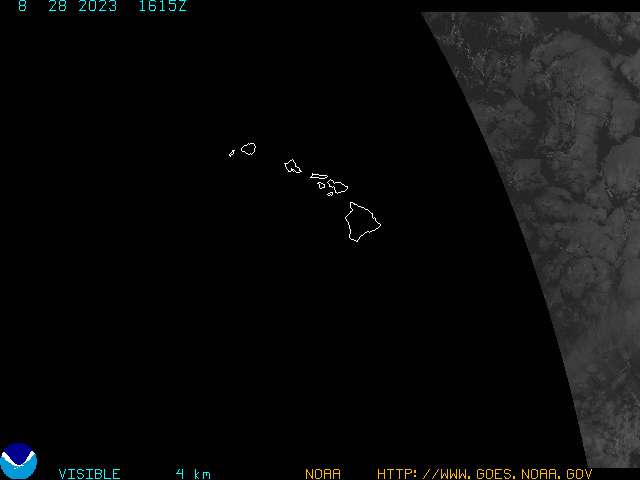

Leimomi Says:
Hiya Glenn! Just wanted to stop in and say hello. Saw Ian this past weekend and got to talking about you, how we miss your show and how much it used to be such a ritual for many of us. Thank God you still do your website. So much easier to get a synopsis from you than the national weather service pages…sometimes, I don’t have time for all the details, but always get caught up and distracted by the details.
Anyway, so we says hi, hope all is well, and we miss you!
Aloha, Leimomi~~~Hi Leimomi, great to hear from you, over there on the Gathering Place Island of Oahu. Good to hear that you and Ian were talking, and yes…I miss the show too of course. I’m glad that you can come to my website, and get what you need, easily. Please give my best to everyone on Oahu for me, and please tell them that I miss them too! Aloha, Glenn