











January 26-27, 2010
Air Temperatures – The following maximum temperatures were recorded across the state of Hawaii Tuesday afternoon:
Lihue, Kauai – 78
Honolulu, Oahu – 84
Kaneohe, Oahu – 85
Kaunakakai, Molokai – 82
Kahului, Maui – 83
Hilo, Hawaii – 84
Kailua-kona – 83
Air Temperatures ranged between these warmest and coolest spots near sea level around the state – and on the highest mountains…at 4pm Tuesday afternoon:
Hilo, Oahu – 83F
Barking Sands, Kauai – 77
Haleakala Crater – 59 (near 10,000 feet on Maui)
Mauna Kea summit – 46 (near 14,000 feet on the Big Island)
Precipitation Totals – The following numbers represent the largest precipitation totals (inches) during the last 24 hours on each of the major islands, as of Tuesday afternoon:
1.24 Puu Opae, Kauai
0.17 Palehua, Oahu
0.30 Molokai
0.04 Lanai
0.00 Kahoolawe
0.03 Puu Kukui, Maui
0.25 Pali 2, Big Island
Marine Winds – Here’s the latest (automatically updated) weather map showing a cold front moving towards the state, with locally gusty southwest Kona winds blowing ahead of it. Winds will veer around to the north in the wake of the frontal passage.
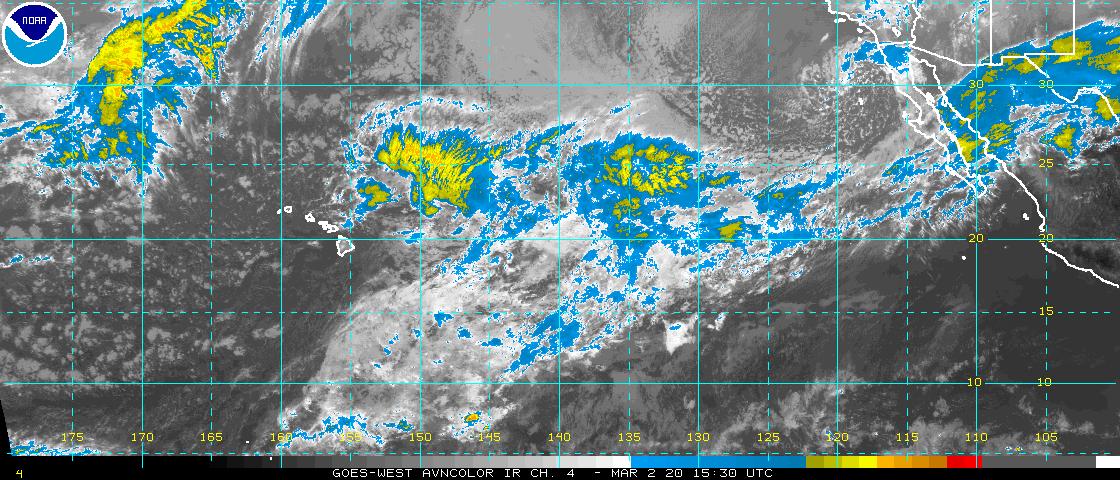
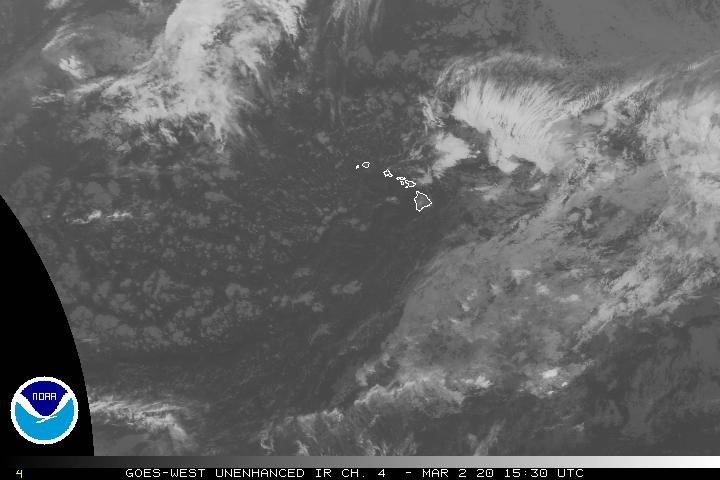
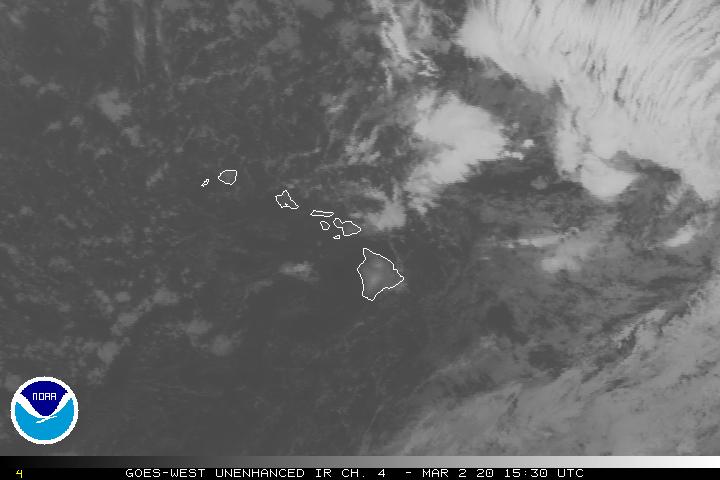
Satellite and Radar Images: To view the cloud conditions we have here in Hawaii, please use the following satellite links, starting off with this Infrared Satellite Image of the islands to see all the clouds around the state during the day and night. This next image is one that gives close images of the islands only during the daytime hours, and is referred to as a Close-up visible image. This next image shows a larger view of the Pacific…giving perspective to the wider ranging cloud patterns in the Pacific Ocean. Finally, here’s a Looping IR satellite image, making viewable the clouds around the islands 24 hours a day. To help you keep track of where any showers may be around the islands, here’s the latest animated radar image.
Hawaii’s Mountains – Here’s a link to the live webcam on the summit of near 14,000 foot Mauna Kea on the Big Island of Hawaii. The tallest peak on the island of Maui is the Haleakala Crater, which is near 10,000 feet in elevation. These two webcams are available during the daylight hours here in the islands…and when there’s a big moon rising just after sunset for an hour or two! Plus, during the nights and early mornings you will be able to see stars, and the sunrise too…depending upon weather conditions.
Tropical Cyclone activity in the eastern and central Pacific – Here’s the latest weather information coming out of the National Hurricane Center, covering the eastern north Pacific. You can find the latest tropical cyclone information for the central north Pacific (where Hawaii is located) by clicking on this link to the Central Pacific Hurricane Center. Here’s a tracking map covering both the eastern and central Pacific Ocean. A satellite image, which shows the entire ocean area between Hawaii and the Mexican coast…can be found here.
Aloha Paragraphs

Showery cold front moving through the state soon
The winds picked up substantially over the islands from the southwest Kona direction, ahead of a cold front which will reach Kauai this evening…and Oahu overnight. The good thing about this is that the volcanic haze has been blown to the north of the state. There have been showers arriving ahead of the cold front, which has brought welcome rainfall to our leeward sides in places. This satellite image shows the cold front bearing down on us from the northwest direction. We can also see an area of pre-frontal moisture, being carried our way on the gusty Kona winds. These are bringing the first showers, followed by the rainfall moving in with the cold front itself. Here’s a closer IR satellite image of the leading edge of this cold front.
This cold front won’t be the last, as we have several more of these weather features heading our way through the next week. The computer forecast models suggest that after this initial frontal passage tonight into Wednesday, that we will find another cold front arriving this Friday evening into Saturday…with yet another as we move into early next week. The Kona winds will precede the cold fronts, followed by cooler north to northeast breezes in their wake. This is all good news, as we can certainly use all the precipitation we can get. Drought conditions are the reason for this welcoming mat, in terms of desiring much needed water. It’s too early to speak much about later next week, in terms of more cold frontal activity…but we can certainly hope that this sort of thing continues! Speaking of water falling from the sky, here’s a looping radar image, so we can follow its progress into the state.
It’s Tuesday evening, as I begin writing the last section of today’s narrative. Everything seems to be coming together according to the script, with the Kona winds blowing, the prefrontal showers falling, the cold front itself just about ready to move over Kauai (as of 530pm Tuesday)…and the large to very large northwest swell train of waves on tap for Wednesday into Thursday. Speaking of the NW swell, the NWS forecast office in Honolulu has now issued a high surf warning for the north and west shores from Kauai down through Maui. The wave faces along the north shores are expected to be 25 to 35 feet! Meanwhile, while the Big Island won’t see the largest waves, they have their own thing going on, with a wind advisory in effect now for gusty winds of 20-30 mph blowing atop the summits of that southern-most island…with gusts to 45 mph. I can’t help but say that this has me going quite a bit, all these elemental weather features coming together like they are! I just looked out the window here in Kihei, before I leave for the drive back upcountry to Kula, and the entire flank of the Haleakala Crater is absolutely clear, without the slightest bit of volcanic haze…blown away on the stiff Kona winds. ~~~ I’d best be taking that drive now, so that I’ll have time to get out there for my evening walk. I’ll be back well before the crack of dawn, back at my computer at home, preparing your next new weather narrative from paradise. I hope you have a great Tuesday night until then! Aloha for now…Glenn.
Interesting: The aftershock sequence of the magnitude 7 earthquake that struck near Port-au-Prince, Haiti, on January 12, 2010, will continue for months, if not years. The frequency of events will diminish with time, but damaging earthquakes will remain a threat. It is essential that the rebuilding effort in Haiti take into account the potential for, indeed the inevitability of, future strong earthquakes.
Haiti is cut by two major plate boundary fault zones. Over the past three centuries, earthquakes comparable to or stronger than the recent one have struck Haiti at least four times, including those in 1751 and 1770 that destroyed Port-au-Prince. It is also not just Haiti that has this potential.
The geologic fault that caused the Port-au-Prince earthquake is part of a seismically active zone between the North American and Caribbean tectonic plates. The earthquake undoubtedly relieved some stress on the fault segment that ruptured during the event, but the extent of rupture along the fault is unclear at this time.
In historic times, Haiti has experienced multiple large earthquakes, apparently on adjacent faults. Future quakes have to be anticipated. Similar earthquakes have happened in what the United States might be considered low risk areas. The Charleston Earthquake of 1886 was the most damaging quake to hit the Southeastern United States.
It occurred at 9:50 p.m. on August 31, 1886, and lasted just under a minute. The earthquake caused severe damage in Charleston, South Carolina, damaging 2,000 buildings and causing $6 million worth in damages, while in the whole city the buildings were only valued at approximately $24 million. Between 60 and 110 lives were lost. Some of the damage is still seen today.
The 1811 and 1812 New Madrid Earthquakes are the most intense intraplate earthquake series to have occurred in the contiguous United States in historic times, beginning with an initial pair of very large earthquakes on December 16, 1811. These earthquakes, as well as the seismic zone of their occurrence, were named for the Mississippi River town of New Madrid, Louisiana Territory, now Missouri.
Though the seismic rating of the quake was never measured, it has been estimated as high as 8. There are estimates that the earthquakes were felt strongly over roughly 50,000 square miles, and moderately across nearly 1 million square miles. The historic 1906 San Francisco earthquake, by comparison, was felt moderately over roughly 6,000 square miles.
These American areas continue to be of potential concern. What happened in Haiti could happen in St. Louis or Charleston. Seismic hazard assessments provide the basis for the development of appropriate building codes and the identification of regions at greatest risk. A thorough seismic hazard assessment of Haiti, as well as of other countries in the Caribbean, will provide the basis for establishing or improving building codes and strengthening building resilience over the long term.
The development of more resilient structures and infrastructure is a long term goal, particularly in the face of economic limitations. Over the short term, it is critical that the rebuilding effort be undertaken with an awareness of the potential for subsequent damaging events during the next months and years. It is essential that structures such as hospitals, schools, and critical facilities be reconstructed with greater resilience for the preservation of life and functionality.
Interesting2: The United Nations climate science panel faces new controversy for wrongly linking global warming to an increase in the number and severity of natural disasters such as hurricanes and floods. It based the claims on an unpublished report that had not been subjected to routine scientific scrutiny — and ignored warnings from scientific advisers that the evidence supporting the link too weak.
The report’s own authors later withdrew the claim because they felt the evidence was not strong enough. The claim by the Intergovernmental Panel on Climate Change (IPCC), that global warming is already affecting the severity and frequency of global disasters, has since become embedded in political and public debate.
It was central to discussions at last month’s Copenhagen climate summit, including a demand by developing countries for compensation of $100 billion (£62 billion) from the rich nations blamed for creating the most emissions. Ed Miliband, the energy and climate change minister, has suggested British and overseas floods — such as those in Bangladesh in 2007 — could be linked to global warming. Barack Obama, the US president, said last autumn: "More powerful storms and floods threaten every continent."
Interesting3: A major increase in maximum ocean wave heights off the Pacific Northwest in recent decades has forced scientists to re-evaluate how high a "100-year event" might be, and the new findings raise special concerns for flooding, coastal erosion and structural damage. The new assessment concludes that the highest waves may be as much as 46 feet, up from estimates of only 33 feet that were made as recently as 1996, and a 40 percent increase.
December and January are the months such waves are most likely to occur, although summer waves are also significantly higher. In a study just published online in the journal Coastal Engineering, scientists from Oregon State University and the Oregon Department of Geology and Mineral Industries report that the cause of these dramatically higher waves is not completely certain, but "likely due to Earth’s changing climate."
Using more sophisticated techniques that account for the "non-stationarity" in the wave height record, researchers say the 100-year wave height could actually exceed 55 feet, with impacts that would dwarf those expected from sea level rise in coming decades. Increased coastal erosion, flooding, damage to ocean or coastal structures and changing shorelines are all possible, scientists say.
"The rates of erosion and frequency of coastal flooding have increased over the last couple of decades and will almost certainly increase in the future," said Peter Ruggiero, an assistant professor in the OSU Department of Geosciences. "The Pacific Northwest has one of the strongest wave climates in the world, and the data clearly show that it’s getting even bigger.
"Possible causes might be changes in storm tracks, higher winds, more intense winter storms, or other factors," Ruggiero said. "These probably are related to global warming, but could also be involved with periodic climate fluctuations such as the Pacific Decadal Oscillation, and our wave records are sufficiently short that we can’t be certain yet. But what is clear is the waves are getting larger."
In the early 1990s, Ruggiero said, a fairly typical winter might have an offshore wave maximum of a little more than 25 feet. It was believed then — based primarily on data from two offshore buoys — that 10 meters, or 33 feet, would be about as large as waves would ever get, even in a massive "100-year" storm.
But then a major El Nino — which tends to bring larger waves, higher water levels and increased erosion — happened in 1997-98 and led to a string of "100-year" wave events of around and above 33 feet. Researchers went back to the drawing board, continued to study data and storm events, and now believe that the maximum waves the region may face could approach or even exceed 50 feet.
Increasing wave heights, they said, have had double or triple the impact in terms of erosion, flooding and damage as sea level rise over the last few decades. If wave heights continue to increase, they may continue to dominate over the acceleration in sea level that’s anticipated over the next couple of decades. The prior concern about what sea level rise could do, in other words, is already a reality.
If sea levels do increase significantly in future decades and centuries, that will only add to the damage already being done by higher waves. Exactly what impacts this will have in terms of beach erosion and shifting shorelines is difficult to predict, scientists say, because currents and sand move in complex ways, creating both "winners and losers" in terms of beach stability. But some effects are already visible, Ruggiero said.
"Neskowin is already having problems with high water levels and coastal erosion," Ruggiero said. "Some commercial structures there occasionally lose the use of their lower levels. "Going to the future, communities are going to have to plan for heavier wave impacts and erosion, and decide what amounts of risk they are willing to take, how coastal growth should be managed and what criteria to use for structures," he said.
Interesting4: NASA’s Wide-field Infrared Survey Explorer, or WISE, has spotted its first never-before-seen near-Earth asteroid, the first of hundreds it is expected to find during its mission to map the whole sky in infrared light. There is no danger of the newly discovered asteroid hitting Earth. The near-Earth object, designated 2010 AB78, was discovered by WISE Jan. 12.
The mission’s sophisticated software picked out the moving object against a background of stationary stars. As WISE circled Earth, scanning the sky above, it observed the asteroid several times during a period of one-and-a-half days before the object moved beyond its view. Researchers then used the University of Hawaii’s 88-inch visible-light telescope near the summit of Mauna Kea to follow up and confirm the discovery.
The asteroid is currently about 98 million miles from Earth. It is estimated to be roughly 0.6 miles in diameter and circles the sun in an elliptical orbit tilted to the plane of our solar system. The object comes as close to the sun as Earth, but because of its tilted orbit, it will not pass very close to Earth for many centuries.
This asteroid does not pose any foreseeable impact threat to Earth, but scientists will continue to monitor it. Near Earth objects are asteroids and comets with orbits that pass relatively close to Earth’s path around the sun. In extremely rare cases of an impact, the objects may cause damage to Earth’s surface.
An asteroid about 6 miles wide is thought to have plunged into our planet 65 million years ago, triggering a global disaster and killing off the dinosaurs. Additional asteroid and comet detections will continue to come from WISE. The observations will be automatically sent to the clearinghouse for solar system bodies, the Minor Planet Center in Cambridge, Mass., for comparison against the known catalog of solar system objects.
A community of professional and amateur astronomers will provide follow-up observations, establishing firm orbits for the previously unseen objects. "This is just the beginning," said Ned Wright, the mission’s principal investigator from UCLA. "We’ve got a fire hose of data pouring down from space."
 Email Glenn James: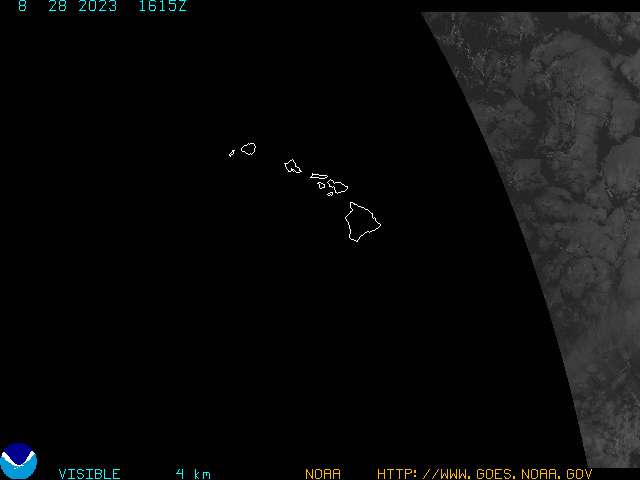

Frank Parrino Says:
Glorious showers this morning ….West End Molokai. Will report total at first light~~~Nice Frank, good to hear of those showers! Aloha, Glenn
jack weber Says:
Glenn, good eve, you think we going to get any of this storm water down here?
Aloha, Jack~~~Hi Jack, it’s lightly drizzling here in Kula, Maui this morning, and I do think you will get some water down there…how much is still in question. I hope so! Aloha, Glenn