January 23-24, 2010
Air Temperatures – The following maximum temperatures were recorded across the state of Hawaii Saturday afternoon:
Lihue, Kauai – 82
Honolulu, Oahu – 80
Kaneohe, Oahu – 82
Kaunakakai, Molokai – 80
Kahului, Maui – 82
Hilo, Hawaii – 80
Kailua-kona – 81
Air Temperatures ranged between these warmest and coolest spots near sea level around the state – and on the highest mountains…at 7pm Saturday evening:
Honolulu, Oahu – 77F
Lihue, Kauai – 73
Haleakala Crater – 46 (near 10,000 feet on Maui)
Mauna Kea summit – 37 (near 14,000 feet on the Big Island)
Precipitation Totals – The following numbers represent the largest precipitation totals (inches) during the last 24 hours on each of the major islands, as of Saturday evening:
0.26 Puu Alua, Kauai
0.01 Waimanalo, Oahu
0.00 Molokai
0.00 Lanai
0.00 Kahoolawe
0.00 Maui
0.09 Saddle Quarry, Big Island
Marine Winds – Here’s the latest (automatically updated) weather map showing a weakening cold front moving over Kauai to Oahu. Our winds will be light from the south and southwest ahead of front, remaining light as a new high pressure moves in close to the state…behind the front Sunday into Monday.
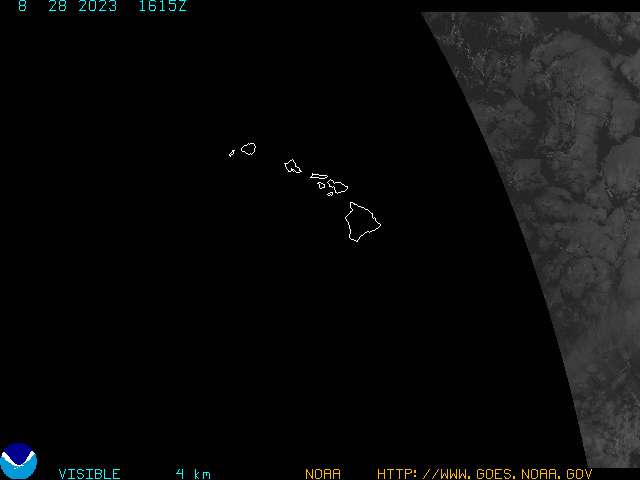
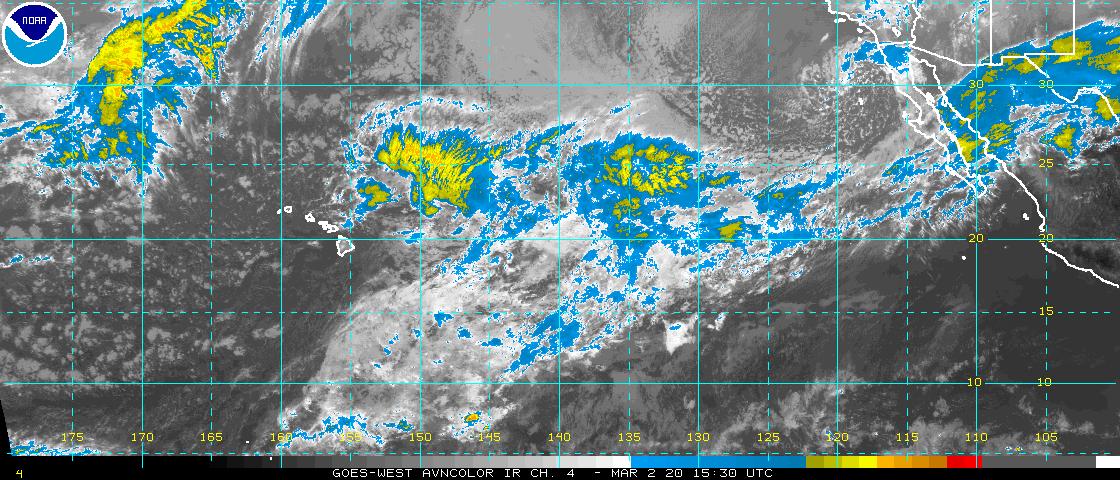
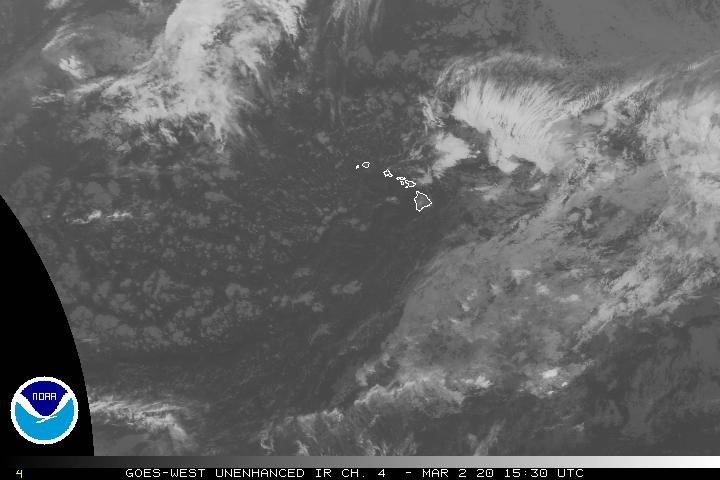
Satellite and Radar Images: To view the cloud conditions we have here in Hawaii, please use the following satellite links, starting off with this Infrared Satellite Image of the islands to see all the clouds around the state during the day and night. This next image is one that gives close images of the islands only during the daytime hours, and is referred to as a Close-up visible image. This next image shows a larger view of the Pacific…giving perspective to the wider ranging cloud patterns in the Pacific Ocean. Finally, here’s a Looping IR satellite image, making viewable the clouds around the islands 24 hours a day. To help you keep track of where any showers may be around the islands, here’s the latest animated radar image.
Hawaii’s Mountains – Here’s a link to the live webcam on the summit of near 14,000 foot Mauna Kea on the Big Island of Hawaii. The tallest peak on the island of Maui is the Haleakala Crater, which is near 10,000 feet in elevation. These two webcams are available during the daylight hours here in the islands…and when there’s a big moon rising just after sunset for an hour or two! Plus, during the nights and early mornings you will be able to see stars, and the sunrise too…depending upon weather conditions.
Tropical Cyclone activity in the eastern and central Pacific – Here’s the latest weather information coming out of the National Hurricane Center, covering the eastern north Pacific. You can find the latest tropical cyclone information for the central north Pacific (where Hawaii is located) by clicking on this link to the Central Pacific Hurricane Center. Here’s a tracking map covering both the eastern and central Pacific Ocean. A satellite image, which shows the entire ocean area between Hawaii and the Mexican coast…can be found here.
Aloha Paragraphs

Cold front over Kauai and Oahu…hazy elsewhere
Our winds remain from the southwest Saturday night…ahead of a weak cold front moving over Kauai and Oahu. A high pressure system is located far to the east-northeast of the islands now…having been pushed southeast by this dissipating cold front. These more southerly and SW winds have carried considerable volcanic haze up from the Big Island vents, over the smaller islands. We’ll find light winds hanging around in the wake of the cold front Sunday. There may be some temporary clearing of the vog for Kauai and Oahu, although Maui County, and many parts of the Big Island will remain hazy. This slack wind condition Monday through Tuesday, will keep hazy conditions in place for the entire state. The winds will pick up again from the Kona direction, ahead of the next cold front, arriving around the middle of the new week ahead…with yet another pushing in our direction late in the work week.
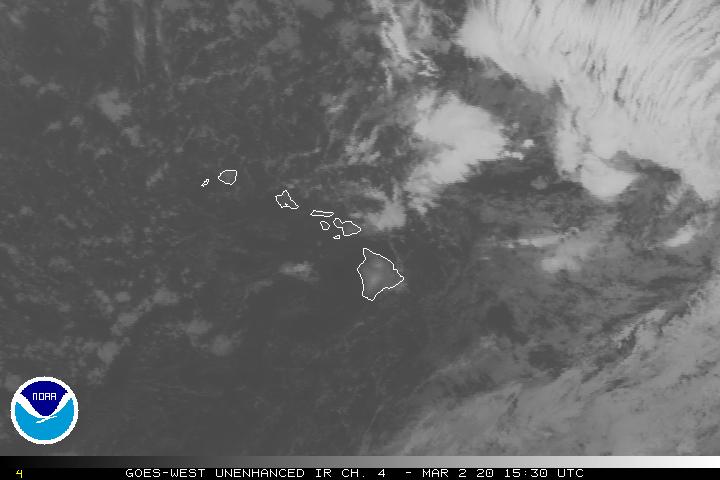
This weakening cold front has moved over Kauai, and will arrive and then stall over Oahu…Saturday night into Sunday. The clouds associated with the frontal boundary, are shown well by using this closer IR satellite image view. The front cloud band, arriving first over Kauai, brought increasing clouds and showers. The showers will reach Oahu, although will likely skid to a stop there. This leaves the parched islands of Maui County, and the Big Island, even further away from the cold front…dry as a bone. The next chance for more showers will be around the middle of the new week, when another cold front arrives. It’s still too early to know how many showers it will bring, or if it will stall moving through the island chain. Then, as mentioned above, yet another cold front will try and move into the state around next Friday.
It’s Saturday evening, as I begin writing the last section of today’s narrative. As noted above, about half of the island chain, from Kauai to Oahu, will be on the receiving end of this cold front’s showers. We can use this looping radar image to see the showers as they slide down over the Gathering Place island of Oahu tonight. The big thing from Maui County down through the Big Island Saturday evening, besides the lack of rain, is the thick volcanic haze, better known as vog. It was thick here on Maui Saturday, with very poor air visibilities! ~~~ Friday evening after work, I went to see the new film called Sherlock Holmes (2009), starring Robert Downey Jr. and Jude Law…among many others. As I had heard from just about everyone, it was a top notch film, that took me on a wild ride. It was fast paced, and a little crazy, as the legendary London detective investigates a mysterious nemesis who threatens all of England.
I must say that I thoroughly enjoyed this film, and could easily give it a B+ grade. If you haven’t seen this yet, here’s a trailer, so you can see if it might appeal to you. ~~~ I had a good day, hanging out at the beach in Paia for a while this morning, and then taking a great swim on the ocean. I went shopping, before heading back up to Kula. I went with a friend for a walk at a place called Thompson Ranch Rd. out in Keokea…near Ulupalakua. We had dinner together, which is the reason this narrative update was put out later than normal. I’ll be back Sunday morning with your next new weather narrative, I hope you have a great Saturday night until then! Aloha for now…Glenn.
Interesting: A new scientific paper co-authored by a University of Adelaide researcher reports strong evidence that humans, not climate change, caused the demise of Australia’s mega-fauna — giant marsupials, huge reptiles and flightless birds — at least 40,000 years ago. In a paper published in the journal Science, two Australian scientists claim that improved dating methods show that humans and mega-fauna only co-existed for a relatively short time after people inhabited Australia, adding weight to the argument that hunting led to the extinction of large-bodied species.
According to Professor Richard ‘Bert’ Roberts from the University of Wollongong and Professor Barry Brook from the University of Adelaide, new methods to directly date bones and teeth of extinct species show that mega-fauna fossils and Aboriginal tools do not all date from the same period.
"Debate about the possible cause of these late Pleistocene extinctions has continued for more than 150 years, with scientists divided over whether climate change or the arrival of humans has been responsible for their demise," Professor Brook says. "Australia was colonized during a time when the climate was relatively benign, supporting the view that people, not climate change, caused the extinctions here," he says.
Interesting2: A new analysis of global surface temperatures by NASA scientists finds the past year was tied for the second warmest since 1880. In the Southern Hemisphere, 2009 was the warmest year on record. Although 2008 was the coolest year of the decade because of a strong La Nina that cooled the tropical Pacific Ocean, 2009 saw a return to a near-record global temperatures as the La Nina diminished, according to the new analysis by NASA’s Goddard Institute for Space Studies (GISS) in New York.
The past year was a small fraction of a degree cooler than 2005, the warmest on record, putting 2009 in a virtual tie with a cluster of other years –1998, 2002, 2003, 2006, and 2007 — for the second warmest on record. "There’s always interest in the annual temperature numbers and a given year’s ranking, but the ranking often misses the point," said James Hansen, GISS director. "There’s substantial year-to-year variability of global temperature caused by the tropical El Nino-La Nina cycle.
When we average temperature over five or ten years to minimize that variability, we find global warming is continuing unabated." January 2000 to December 2009 was the warmest decade on record. Looking back to 1880, when modern scientific instrumentation became available to monitor temperatures precisely, a clear warming trend is present, although there was a leveling off between the 1940s and 1970s. In the past three decades, the GISS surface temperature record shows an upward trend of about 0.36 degrees F per decade.
In total, average global temperatures have increased by about 1.5 degrees F since 1880. "That’s the important number to keep in mind," said GISS climatologist Gavin Schmidt. "The difference between the second and sixth warmest years is trivial because the known uncertainty in the temperature measurement is larger than some of the differences between the warmest years." The near-record global temperatures of 2009 occurred despite an unseasonably cool December in much of North America.
High air pressures from the Arctic decreased the east-west flow of the jet stream, while increasing its tendency to blow from north to south. The result was an unusual effect that caused frigid air from the Arctic to rush into North America and warmer mid-latitude air to shift toward the north. This left North America cooler than normal, while the Arctic was warmer than normal.
"The contiguous 48 states cover only 1.5 percent of the world area, so the United States’ temperature does not affect the global temperature much," Hansen said. GISS uses publicly available data from three sources to conduct its temperature analysis. The sources are weather data from more than a thousand meteorological stations around the world, satellite observations of sea surface temperatures, and Antarctic research station measurements.
Other research groups also track global temperature trends but use different analysis techniques. The Met Office Hadley Centre in the United Kingdom uses similar input measurements as GISS, for example, but it omits large areas of the Arctic and Antarctic where monitoring stations are sparse.
Although the two methods produce slightly differing results in the annual rankings, the decadal trends in the two records are essentially identical. "There’s a contradiction between the results shown here and popular perceptions about climate trends," Hansen said. "In the last decade, global warming has not stopped."
Interesting3: The world’s mountainous regions are home to about 800 million people and the source of some of the world’s major rivers. In these regions, runoff is strongly affected by temperature. This suggests that flooding could be quite sensitive to global warming, but there has been some lack of scientific consensus on the effects of temperature variations on floods.
Allamano et al. show that global warming does increase flood risk significantly. The authors analyzed runoff data recorded by 27 stations in the Swiss Alps and used a simple probabilistic model to study how flood risk varies with temperature, precipitation, and elevation in mountainous regions.
The researchers found that large floods have occurred more frequently in recent years than in the past, and they predict that global warming will result in such floods occurring even more often in the future. In particular, they found that if global temperatures increase by 3.6 degrees Fahrenheit, then large floods that occurred about once every 100 years could occur up to 5 times more often. The research appears in the journal Geophysical Research Letters.
 Email Glenn James: