











January 12-13, 2010
Air Temperatures – The following maximum temperatures were recorded across the state of Hawaii Tuesday afternoon:
Lihue, Kauai – 76
Honolulu, Oahu – 81
Kaneohe, Oahu – 78
Kaunakakai, Molokai – 80
Kahului, Maui – 80
Hilo, Hawaii – 76
Kailua-kona – 75
Air Temperatures ranged between these warmest and coolest spots near sea level around the state – and on the highest mountains…at 5pm Tuesday evening:
Poipu, Kauai – 79F
Hilo, Hawaii – 70
Haleakala Crater – 50 (near 10,000 feet on Maui)
Mauna Kea summit – 41 (near 14,000 feet on the Big Island)
Precipitation Totals – The following numbers represent the largest precipitation totals (inches) during the last 24 hours on each of the major islands, as of Tuesday afternoon:
0.02 Port Allen, Kauai
0.01 Waimanalo, Oahu
0.00 Molokai
0.00 Lanai
0.00 Kahoolawe
1.24 West Wailuaiki, Maui
1.66 Kawainui Stream, Big Island
Marine Winds – Here’s the latest (automatically updated) weather map showing a dissipating cold front near the Big Island. Our recent northeast winds will become light and variable with a tendency to southeast to south and southwest ahead of the next approaching cold front. Then the winds will clock around to the northwest and north later Wednesday…ending up northeast again on Thursday – cooler.
Satellite and Radar Images: To view the cloud conditions we have here in Hawaii, please use the following satellite links, starting off with this Infrared Satellite Image of the islands to see all the clouds around the state during the day and night. This next image is one that gives close images of the islands only during the daytime hours, and is referred to as a Close-up visible image. This next image shows a larger view of the Pacific…giving perspective to the wider ranging cloud patterns in the Pacific Ocean. Finally, here’s a Looping IR satellite image, making viewable the clouds around the islands 24 hours a day. To help you keep track of where any showers may be around the islands, here’s the latest animated radar image.
Hawaii’s Mountains – Here’s a link to the live webcam on the summit of near 14,000 foot Mauna Kea on the Big Island of Hawaii. The tallest peak on the island of Maui is the Haleakala Crater, which is near 10,000 feet in elevation. These two webcams are available during the daylight hours here in the islands…and when there’s a big moon rising just after sunset for an hour or two! Plus, during the nights and early mornings you will be able to see stars, and the sunrise too…depending upon weather conditions.
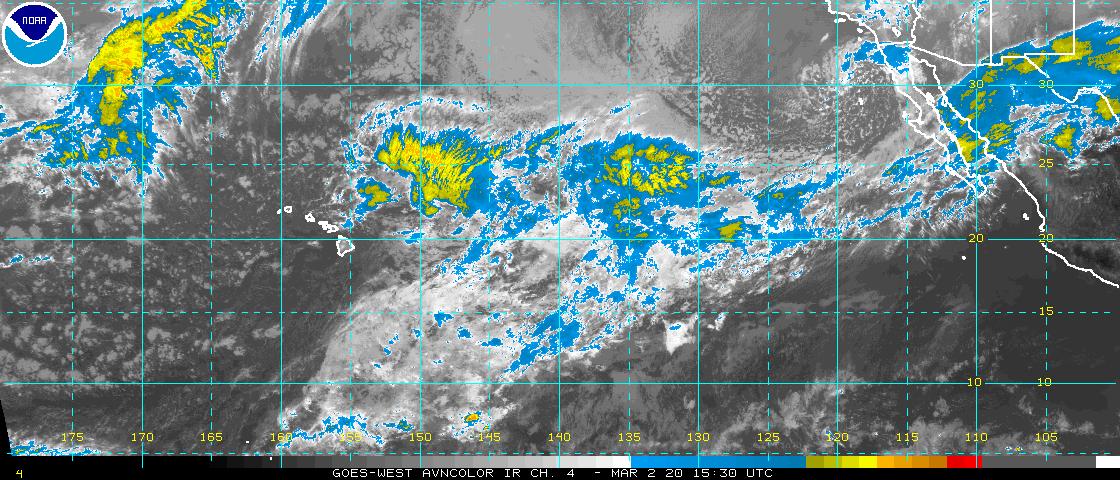
Tropical Cyclone activity in the eastern and central Pacific – Here’s the latest weather information coming out of the National Hurricane Center, covering the eastern north Pacific. You can find the latest tropical cyclone information for the central north Pacific (where Hawaii is located) by clicking on this link to the Central Pacific Hurricane Center. Here’s a tracking map covering both the eastern and central Pacific Ocean. A satellite image, which shows the entire ocean area between Hawaii and the Mexican coast…can be found here.
Aloha Paragraphs

A cold front will bring some showers…and cooler weather soon
A retired cold front kept some clouds and localized showers over the Big Island and Maui County Tuesday. The
The recent slightly cool northeast breezes, behind the retired cold front, will be giving way to light east, southeast, and finally southerly breezes ahead of Wednesday’s frontal passage. The northeast wind direction has helped to keep some of the front’s remnant moisture around Maui and the
This winter we’ve seen more than the ordinary amount of larger than normal swells arriving! Looking ahead, another very large swell will build Wednesday night into Thursday, remaining large for a couple of days thereafter. Then, during the second half of this coming weekend, yet another very large NW swell arrive. In between these extra large swell days, we’ll have large swells breaking along our north and west facing shores. This is the time of year when we often see these frequent high surf episodes, with the current swell having diminished in size…so that the recent high surf warning level waves have been replaced with smaller high surf advisories.
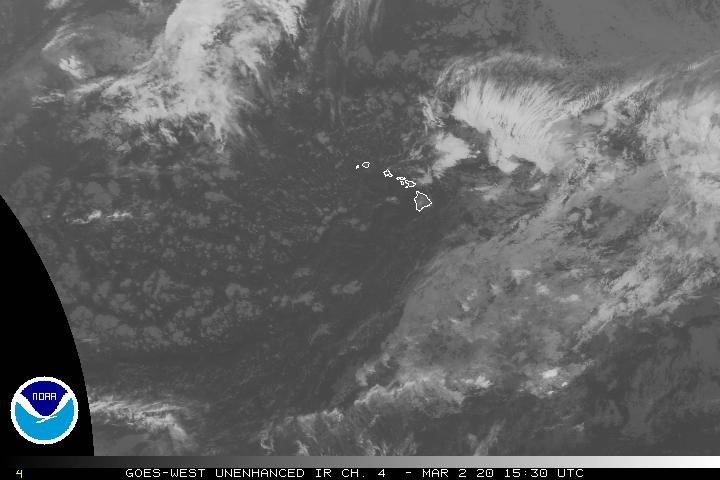
It’s early Tuesday evening, as I begin writing the last section of today’s narrative. As noted above, our pattern of weak cold fronts pushing in our direction continues. These fronts aren’t bringing the kind of precipitation that we need to push back the drought conditions that exist now. The parent low pressure systems, the gales and storms, of these weak cold fronts, have sure been able to generate large swell trains of waves in our direction though! This has been an interesting winter so far, what with the El Nino influences. We’re about to break out of this long lasting pattern however, shifting into a trade wind weather pattern soon. This isn’t going to be one of those that lasts for one or two days at most. This time around, if the computer forecast models have a good handle on this, they should last Friday through the weekend, and then through most of next week. Generally when we have the trade winds blowing our leeward beaches have good weather. The models are suggesting that despite the trade winds blowing, our overlying atmosphere will be dry and stable, which will limit our rainfall even along the windward sides. ~~ Here’s an even closer view of the Hawaiian Islands, using this IR satellite image. We can see the leftover cumulus clouds, and some showers too, from the old cold front around the Big Island and Maui. We’ll be able to see the first part of the cold front approaching on this satellite picture by Wednesday morning. While we’re keeping an eye out for the cold front, we’d better add this looping radar image, so we can see when the leading edge of the frontal boundary brings its associated moisture. It wouldn’t surpise me to begin seeing some haze coming up over Maui County during the night either. ~~~ I’ll look forward to catching up with you early Wednesday morning, when I’ll be back at the drawing board, preparing your next weather narrative. I hope you have a great Tuesday night until then! Aloha for now…Glenn.
Interesting: Beginning January 18, NASA’s Mars Odyssey orbiter will listen for possible, though improbable, radio transmissions from the Phoenix Mars Lander, which completed five months of studying an arctic Martian site in November 2008. The solar-powered Lander operated two months longer than its three-month prime mission during summer on northern Mars before the seasonal ebb of sunshine ended its work. Since then, Phoenix’s landing site has gone through autumn, winter and part of spring.
The Lander’s hardware was not designed to survive the temperature extremes and ice-coating load of an arctic Martian winter. In the extremely unlikely case that Phoenix survived the winter, it is expected to follow instructions programmed on its computer. If systems still operate, once its solar panels generate enough electricity to establish a positive energy balance, the Lander would periodically try to communicate with any available Mars relay orbiters in an attempt to reestablish contact with Earth.
During each communications attempt, the Lander would alternately use each of its two radios and each of its two antennas. Odyssey will pass over the Phoenix landing site approximately 10 times each day during three consecutive days of listening this month and two longer listening campaigns in February and March. "We do not expect Phoenix to have survived, and therefore do not expect to hear from it.
However, if Phoenix is transmitting, Odyssey will hear it," said Chad Edwards, chief telecommunications engineer for the Mars Exploration Program at NASA’s Jet Propulsion Laboratory, Pasadena, Calif. "We will perform a sufficient number of Odyssey contact attempts that if we don’t detect a transmission from Phoenix, we can have a high degree of confidence that the Lander is not active."
The amount of sunshine at Phoenix’s site is currently about the same as when the Lander last communicated, on Nov. 2, 2008, with the sun above the horizon about 17 hours each day. The listening attempts will continue until after the sun is above the horizon for the full 24.7 hours of the Martian day at the Lander’s high-latitude site.
During the later attempts in February or March, Odyssey will transmit radio signals that could potentially be heard by Phoenix, as well as passively listening. If Odyssey does hear from Phoenix, the orbiter will attempt to lock onto the signal and gain information about the Lander’s status. The initial task would be to determine what capabilities Phoenix retains, information that NASA would consider in decisions about any further steps.
Interesting2: Cities, which already host half the world’s population, are predicted to absorb nearly all of the growth of population over the next three decades. The concentration of humanity in relatively small spaces brings with it enormous environmental challenges, particularly in the low-income and middle-income countries.
Among many factors that influence the quality of the urban environment, biodiversity is arguably the least appreciated. It is welcome, therefore, that the key role played by biodiversity in providing a host of ecosystem services to people is being emphasized during 2010, declared as the International Year of Biodiversity by the United Nations General Assembly.
In the cities, green areas reduce pollution and improve the quality of air; wetlands break down waste and recycle it; and parks and woodlands with their colorful flora and fauna help city-dwellers connect with nature in their backyard. City governments must reflect on the ways in which the negative impact of urbanization on biodiversity can be minimized, and biodiversity enhanced. As conurbations and megacities grow, nature-provided commons such as air, water, and green areas need to be zealously protected.
Cities occupy less than three per cent of the world’s land surface and their activities can be regulated. On the other hand, the number of cities with a population of over a million is increasing rapidly, leaving a disproportionately large ecological footprint on natural resources extracted from elsewhere. It is interesting that several cities, including Curitiba, Nagoya, Brussels, and Paris, are testing a new framework to assess the health of their urban biodiversity.
This tool, the Singapore Index on Cities’ Biodiversity created under the Convention on Biological Diversity of the United Nations Environment Program, should be of great interest to India. The index, which has some core indicators such as birds, butterflies, and plants, and a broader range of optional indicators, including mammals, can lead to a good assessment of the stressors that are depleting cities of biodiversity (such as unregulated building, loss of green areas, and wetlands), and thus affecting ecosystem services.
Many cities in developing countries, particularly those in the tropics, can benefit from an honest appraisal of the biodiversity they retain. Such data are vital, because research shows that compensatory efforts to replace lost ecology are inferior in biodiversity terms. Artificial wetlands, for instance, cannot maintain the same level of ecological function as natural ones as they lack the full range of life forms. Cities stand greatly to benefit from enhanced biodiversity, and mayors and governments must factor that into their development plans.
Interesting3: The pure white snow atop the Andes Mountains may not be so pure after all. Scientists have found traces of toxic pollutants called PCBs in snow samples taken from Aconcagua Mountain, the highest peak in the Americas. While the overall PCB levels were quite low, the results show that these long-lasting contaminants, notorious for causing myriad health problems, can end up at altitudes as high as 20,340 feet, making their way through the atmosphere to these remote areas.
PCBs, or polychlorinated biphenyls, break down slowly, and as a result, can last for many years in the environment. They can be transported through the air long distances, and have been found in mountain ranges in Europe and Canada, as well as the Arctic. The researchers say that mountain ranges may act as "traps" for PCBs. In addition, they figure climate change could lead to the spread of such pollutants.
"The shrinking of the glaciers could lead to the pollutants stored in the glacier snow being carried down with the melt water," said Roberto Quiroz, now at the EULA Chile Environmental Sciences Center. (He completed the work while at IIQAB, the Spanish research institute for environmental chemistry, in Barcelona, Spain.)
Since the melt water is used for agriculture and drinking, contaminants in the water could pose a health risk. PCBs are man-made organic chemicals that contain chlorine atoms, and are part of a larger group of compounds known as chlorinated hydrocarbons. Before being banned in the United States in 1979 (and around the world in 2001), these chemicals were found in a variety of products, including electrical equipment, paints, plastics and carbonless copy paper, according to the U.S. Environmental Protection Agency (EPA).
Research in animals has shown exposure to PCBs can increase the likelihood of various health problems, including cancer, decreased immune responses, neurological problems, and offspring with low birth weights. Studies on humans further support the view that PCBs are dangerous. In the new study, Quiroz and colleagues investigated PCB levels on the Aconcagua Mountain, located near the Chile-Argentina border.
The team gathered samples from several elevations, ranging from 11,482 feet to 20,340 feet, during an expedition in 2003. They found the snow contained low concentrations of PCBs, less than half a nanogram per liter (a nanogram is one billionth of a gram). In comparison, PCB levels in the Italian Alps have been found to be four times higher.
However, it’s interesting to see this contaminant in the Southern Hemisphere at all, said Ricardo Barra of the University of Concepcion in Chile, because most PCB use was in the Northern Hemisphere. The authors note that their work alone does not provide a complete picture of PCBs in the Andes, and more studies with more sampling sites are needed to better understand the movement and accumulation of PCBs in this mountain range.
Interesting4: Which way will it go? On Thursday the Bulletin of the Atomic Scientists will adjust the minute hand on its iconic clock, showing how many minutes we are to midnight. In ominous Cold War symbolism, it illustrates how close the Bulletin thinks humanity is to ultimate catastrophe. Are we closer to midnight? Or have we moved, shaking but relieved, a little further away?
The blogosphere offers a range of bets. My favorite: it should move to five past midnight, reflecting the fact that it is already too late to stave off some degree of global warming. But if I had to bet, I’d go for another few minutes away, perhaps from the current five minutes to midnight back down to seven.
After all, the last time the hand moved, in 2007, it was from seven to five, partly because of then-US President George W. Bush’s faith in nukes and dislike of arms control. It seems only fair that as well as garnering a Nobel Peace Prize, the resuscitation of arms control by Bush’s successor should elicit a reciprocal move. Besides, the farthest the hand has ever been from midnight – 11:43 – was in 1991 when Russia and the US signed the Strategic Arms Control Treaty, START.
That treaty’s successor is about to emerge, we are told, from US-Russian negotiations that will resume later this month. That surely should be worth a few more minutes’ reprieve. On the other hand, climate change has now joined nuclear peril among the Atomic Scientists’ worries, and Copenhagen was hardly reassuring. But moving the hand is a publicity stunt – possibly the only one involving 17 Nobel laureates.
I’m betting that it will be the soapbox for an effort to influence the arms control battle now shaping up in Washington. It is bewildering: the coming global show-down over the Nuclear Non-Proliferation Treaty will fail if the US doesn’t make good on renewing START, say the wonks, but that requires ratification by the US Senate. So does another vital piece in the nuclear arms control puzzle, the Comprehensive Test Ban Treaty.
The battle over the trade-offs some Senators want for one or the other has already begun. The event will be streamed live on the Web at turnbacktheclock.org from the New York Academy of Sciences. Tune in at 10am New York, Eastern Standard Time. That’s 3pm in London, 4pm in Berlin, 7pm in nuclear wannabe Tehran, and midnight in Pyongyang, capital of the last country to stage a nuclear test. Perhaps deliberate?
Interesting5: The increase in temperature in the Arctic has already caused the sea-ice there to melt. According to research conducted by the University of Gothenburg, if the Arctic tundra also melts, vast amounts of organic material will be carried by the rivers straight into the Arctic Ocean, resulting in additional emissions of carbon dioxide.
Several Russian rivers enter the Arctic Ocean particularly in the Laptev Sea north of Siberia. One of the main rivers flowing into the Laptev Sea is the Lena, which in terms of its drainage basin and length is one of the ten largest rivers in the world.
The river water carries organic carbon from the tundra, and research from the University of Gothenburg shows that this adds a considerable amount of carbon dioxide to the atmosphere when it is degraded in the coastal waters.
The increase in temperature in the Arctic, which has already made an impact in the form of reduced sea-ice cover during the summer, may also cause the permafrost to melt. "Large amounts of organic carbon are currently stored within the permafrost and if this is released and gets carried by the rivers out into the coastal waters, then it will result in an increased release of carbon dioxide to the atmosphere," says Sofia Hjalmarsson, native of Falkenberg and postgraduate student at the Department of Chemistry.
In her thesis, Sofia Hjalmarsson has studied the carbon system in two different geographical areas: partly in the Baltic Sea, the Kattegat and the Skagerrak, and partly in the coastal waters north of Siberia (the Laptev Sea, the East Siberian Sea and the Chukchi Sea). The two areas have in common the fact that they receive large volumes of river water containing organic carbon and nutrients, mainly nitrogen.
Interesting6: Sea water under an East Antarctic ice shelf showed no sign of higher temperatures despite fears of a thaw linked to global warming that could bring higher world ocean levels, first tests showed on Monday. Sensors lowered through three holes drilled in the Fimbul Ice Shelf showed the sea water is still around freezing and not at higher temperatures widely blamed for the break-up of 10 shelves on the Antarctic Peninsula, the most northerly part of the frozen continent.
"The water under the ice shelf is very close to the freezing point," Ole Anders Noest of the Norwegian Polar Institute wrote in a statement after drilling through the Fimbul, which is between 820-1,310 feet thick. "This situation seems to be stable, suggesting that the melting under the ice shelf does not increase," he wrote of the first drilling cores.
The findings, a rare bit of good news after worrying signs in recent years of polar warming, adds a small bit to a puzzle about how Antarctica is responding to climate change, blamed largely on human use of fossil fuels. Antarctica holds enough water to raise world sea levels by 187 feet. if it ever all melted, so even tiny changes are a risk for low-lying coasts or cities from Beijing to New York.
The Institute said the water under the Fimbul was about -2.05 Celsius (28.31 Fahrenheit) — salty water freezes at a slightly lower temperature than fresh water. And it was slightly icier than estimates in a regional computer model for Antarctica, said Nalan Koc, head of the Norwegian Polar Institute’s Center for Ice, Climate and Ecosystems. "The important thing is that we are now in a position to monitor the water beneath the ice shelf," she told Reuters. "If there is a warming in future we can tell."
 Email Glenn James: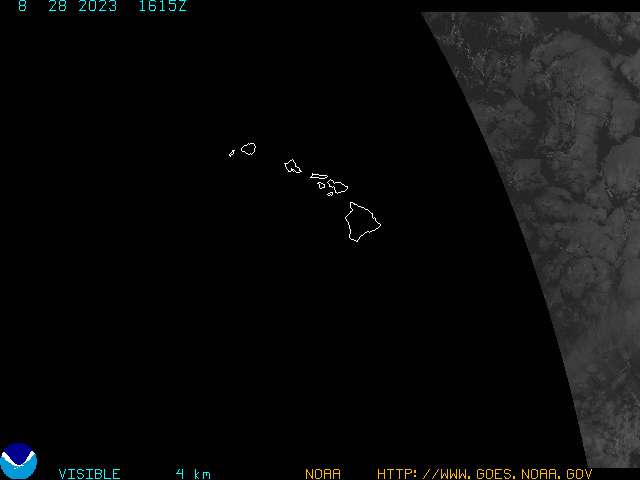


Fleur Harwood Says:
Hi Glenn, I really enjoy reading your Hawaii weather reports. Lovely to hear of sunshine and blue skies, makes me long to be in Maui. Lots of snow here in England, the first cold winter for years. Coming to Oahu at the end of January for three weeks and I know rain is desperately needed but hoping for some sunshine. Best wishes. Fleur~~~Hello Fleur, nice to hear from you from all the way over in England! We’ve heard of the very cold weather, and it’s a good thing that you will escape to Maui, and our warmth. As for rain, there might be some, although the way things have been going, there might not. I know you will have fun either way, and so here’s wishing you a lovely journey to paradise! Aloha, Glenn
jack weber Says:
Glenn, thanks for the word that we are entering a trade wind pattern soon, albeit a dry one. we are up in arms over here, so to speak, about the lack of rain. Many farms around me, including mine, are losing plants and stressed out about the lack of water. I hope the trades help us out, at least some. Thanks for the updates, as always.
J*~~~Hi Jack, likely the returning trade winds are your best bet for getting a little water on those plants. The cold fronts sure haven’t given you much, if any. So, lets keep our fingers crossed, or whatever it takes, to have some precipitation for you farmers down there on the Big Island…and everywhere in the dry state of Hawaii for that matter. Aloha, Glenn
Dan Hunt Says:
Hi Glenn : Happy New Year ! I hope you and your family are well. Just read the article about pollution in the Andes. So sad we have to spoil even the most pristine areas of our world. Anyway Take Care. Dan~~~Hi Dan, good to hear from you in 2010, thanks. You’re absolutely correct, there are many sad things about what is happening to our fragile planet. I trust you and your family is doing well on the mainland. Aloha, Glenn