











Air Temperatures – The following maximum temperatures were recorded across the state of Hawaii Tuesday afternoon:
Lihue, Kauai – 77
Honolulu airport, Oahu – 81
Kaneohe, Oahu – 79
Molokai airport – 82
Kahului airport, Maui – 85
Kona airport – 82
Hilo airport, Hawaii – 83
Air Temperatures ranged between these warmest and coolest spots near sea level – and on the highest mountain tops…as of 5pm Tuesday evening:
Barking Sands, Kauai – 80F
Lihue, Kauai – 75
Haleakala Crater – missing (near 10,000 feet on Maui)
Mauna Kea summit – 37 (near 14,000 feet on the Big Island)
Precipitation Totals – The following numbers represent the largest precipitation totals (inches) during the last 24 hours on each of the major islands, as of Tuesday afternoon:
0.01 Hanalei River, Kauai
1.37 Waianae, Oahu
0.00 Molokai
0.00 Lanai
0.00 Kahoolawe
0.04 West Wailuaiki, Maui
0.14 Kamuela, Big Island
Marine Winds – Here’s the latest (automatically updated) weather map showing a 1037 millibar high pressure system far to our north-northwest. At the same time we find a low pressure system to our west-northwest. Our winds will be south to southeast well into the future.
Satellite and Radar Images: To view the cloud conditions we have here in Hawaii, please use the following satellite links, starting off with this Infrared Satellite Image of the islands to see all the clouds around during the day and night. This next image is one that gives close images of the islands only during the daytime hours, and is referred to as a Close-up visible image. This next image shows a larger view of the Pacific…giving perspective to the wider ranging cloud patterns in the Pacific Ocean. Finally, here's a Looping IR satellite image, making viewable the clouds around the islands 24 hours a day. To help you keep track of where any showers may be around the islands, here’s the latest animated radar image.
Hawaii’s Mountains – Here’s a link to the live web cam on the summit of near 14,000 foot Mauna Kea on the Big Island of Hawaii. The tallest peak on the island of Maui is the Haleakala Crater, which is near 10,000 feet in elevation. These two web cams are available during the daylight hours here in the islands…and when there’s a big moon rising just after sunset for an hour or two! Plus, during the nights and early mornings you will be able to see stars, and the sunrise too…depending upon weather conditions.
Tropical Cyclone activity in the eastern and central Pacific – Here’s the latest weather information coming out of the National Hurricane Center, covering the eastern north Pacific. You can find the latest tropical cyclone information for the central north Pacific (where Hawaii is located) by clicking on this link to the Central Pacific Hurricane Center. Here’s a tracking map covering both the eastern and central Pacific Ocean. A satellite image, which shows the entire ocean area between Hawaii and the Mexican coast…can be found here. Of course, as we know, our hurricane season ends November 30th here in the central Pacific.
Aloha Paragraphs

High clouds, volcanic haze…afternoon showers locally
This is what our sunrise and sunsets look like…with the vog
The customary trade winds are nowhere to be found, replaced now with generally light southeast breezes…although locally a bit stronger. This weather map shows a 1037 millibar high pressure system far to our north-northwest. Winds are coming in from the southeast now, at least over the ocean ocean around the islands, and will remain from this general direction through the rest of this week. This will keep widespread and localized volcanic haze in our Hawaiian Islands weather picture. There are no signs of returning trade winds…which would be the weather agent to clear our local skies of this vog typically.
Winds will be generally light to moderate, although locally a tad stronger…the following numbers represent the strongest gusts, along with directions Tuesday evening:
20 mph Barking Sands, Kauai – SE
14 Kahuku, Oahu – NE
07 Molokai – NE
21 Kahoolawe – E
16 Kapalua, Maui – E
12 Lanai Airport – N
30 South Point, Big Island – NE
We can use the following links to see what’s going on in our local skies Monday afternoon. This large University of Washington satellite image shows lots of clouds over the ocean to our west…associated with a low pressure system to the west. Looking at this NOAA satellite picture, we see those thick clouds coming in over our islands from the west and northwest Tuesday night. We can use this looping satellite image to see those streaks of cirrus arriving over the state, some of which are quite thick…which will filter and dimming our sunshine during the days. We can also see the counterclockwise rotating upper level low pressure system to the west-northwest of Hawaii. Checking out this looping radar image, it shows that most of the showers are falling over the ocean to our south. There are cloud pockets with their associated showers falling over parts of the state at times.
A modest convective weather pattern will persist for the time being, with a few afternoon showers breaking out in the interior sections at times…otherwise quite dry. As the southeast winds remain light to moderately strong over most of the islands, the interior sections of the islands will likely see a few showers developing under the influence of daytime heating. This mild convective weather pattern will continue as we move through this week. This week will be volcanically hazy, with this vog rather widespread and locally quite dense on some of the islands. We will see a cold front edging up towards Kauai later this week, which could increase showers on that side of the island chain Thursday into the weekend.
In sum: generally light to moderately strong southeast winds will blow this week, with a few showers, increasing towards the end of the work week on the Kauai end of the chain…and again that volcanic haze will prevail. The days will likely start off in a clear to partly cloudy way, with afternoon clouds forming each day over and around the slopes of the mountains…leading to showers here and there. The low pressure system to our west will continue to interrupt our common trade winds. This weather feature is also expected to send a cold front our way later in the week. The latest computer forecast models are suggesting that this frontal boundary will edge up close to Kauai by Thursday. The question remains whether this front will bring rain to just Kauai or perhaps to Oahu as well.
~~~ Here in Kihei, Maui at around 535pm, skies were partly to mostly cloudy…with that seemingly ever present volcanic haze around too. The winds are light, after becoming briefly quite strong earlier in the day. The NWS forecast office in Honolulu issued a short lived wind advisory for the area around the Big Island. Winds at South Point on the Big Island reached near 40 mph in gusts at one point. It appears that that low pressure system to our west, with all its very impressive cloudiness, will stick around for another couple of days. As it finally ejects northeast into the mid-latitudes, its associated cold front will push in our direction. The computer models continue to insist it won't sweep through the state, bringing rainfall with it. They are showing Kauai and maybe Oahu will see whatever showers accompany the frontal boundary, as it stalls near Kauai into the weekend. The winds will remain light over Maui County and the Big Island, likely at least, which would promote afternoon convective clouds…and perhaps some showers on those islands too. I'll be back early Wednesday morning with your next new weather narrative, I hope you have a great Tuesday night until then! Aloha for now…Glenn.
Interesting: A bird that lives as long in legends as it does life: The Albatross remains one of most majestic of all of the Antarctic birds. This rather stunning bird can be traced as far back as the time of the first modern mammals, over 50 million years. And with an average life span of 50 years that’s a lot of birds.
Though as a species they aren't so lucky, endangered the world over mostly as a result of human practices. These birds have come to be greatly respected, and have even become symbols of luck.
Whether it is harboring the sacred soul of a dead sailor or filling a ship's sails with wind to aid its progress; you do not have to look far to realize why it is so special. As one of the largest flying birds, the albatross has one of the largest wingspans of any bird still alive today at an incredible 11ft.
The number of albatross species is hotly debated, ranging between 13 and 24 species groups, the classification process involving their size, legs and arrangement of the nasal tubes all come into play when defining what really constitutes an albatross. One thing is for certain; their life in the air is quite unique.
Some birds struggle to overcome high winds during rough weather, but the albatross thrives on it. With an impressive wingspan of 11ft and skills such as 'dynamic' and 'slope' soaring, these birds are able to retain a heart rate close to resting when taking on the rugged seascapes, in fact they are so well suited to this not only do they sleep while flying they only come to land to breed.
The adult albatross use their flying skills for a very valuable purpose. Gathering enough food for their newborns, no matter how long or far it takes them. It may only take the young albatross within three to ten months to be brave enough to take on life in the air, but once it is there it may leave land for up to ten years before returning themselves to begin their mature lives and meet a mate.
Interesting2: Monarch butterfly colonies in Mexico more than doubled in size this winter after bad storms devastated their numbers a year ago, conservationists said on Monday although the migrating insect remains under threat. Millions of butterflies make a 2,000-mile journey each year from Canada to winter in central Mexico's warmer weather but the size of that migration can vary wildly.
Fewer of the orange and black insects arrived in Mexico last year than ever before, researchers said, but the butterfly colonies increased by 109 percent this year to cover roughly 10 acres of forest. Researchers estimate the size of the butterfly colonies based on the area they occupy in a forest.
"Certainly this is good news and indicates a recovering trend," said Omar Vidal, director of the Mexico branch of the World Wildlife Fund (WWF). But while the monarch colonies rebounded this winter, it is still the fourth-lowest year for the butterfly since researchers started census-taking in 1993.
Illegal loggers have picked away roughly 3 percent of a 138,000 acre reserve since it was created in 2000 but officials say they now have that illicit harvest under control. Severe winter weather linked to climate change is more of a long-term threat, along with large-scale farming that crowds out the milkweed that the butterflies dine on during their cross-continental flight.
"The caterpillars feed on milkweed so changing soil use in the United States and Canada is definitely having an impact on the butterflies," said Vidal, who helps manage the authoritative study on monarch populations in Mexico.
Interesting3: That human evolution follows a progressive trajectory is one of the most deeply-entrenched assumptions about our species. This assumption is often expressed in popular media by showing cavemen speaking in grunts and monosyllables (the Geico Cavemen being a notable exception). But is this assumption correct? Were the earliest humans significantly different from us?
In a paper published in the latest issue of Current Anthropology, archaeologist John Shea (Stony Brook University) shows they were not. The problem, Shea argues, is that archaeologists have been focusing on the wrong measurement of early human behavior.
Archaeologists have been searching for evidence of "behavioral modernity," a quality supposedly unique to Homo sapiens, when they ought to have been investigating "behavioral variability," a quantitative dimension to the behavior of all living things.
Human origins research began in Europe, and the European Upper Paleolithic archaeological record has long been the standard against which the behavior of earlier and non-European humans is compared.
During the Upper Paleolithic (45,000-12,000 years ago), Homo sapiens fossils first appear in Europe together with complex stone tool technology, carved bone tools, complex projectile weapons, advanced techniques for using fire, cave art, beads and other personal adornments.
Similar behaviors are either universal or very nearly so among recent humans, and thus, archaeologists cite evidence for these behaviors as proof of human behavioral modernity. Yet, the oldest Homo sapiens fossils occur between 100,000-200,000 years ago in Africa and southern Asia and in contexts lacking clear and consistent evidence for such behavioral modernity.
For decades anthropologists contrasted these earlier "archaic" African and Asian humans with their "behaviorally-modern" Upper Paleolithic counterparts, explaining the differences between them in terms of a single "Human Revolution" that fundamentally changed human biology and behavior.
Archaeologists disagree about the causes, timing, pace, and characteristics of this revolution, but there is a consensus that the behavior of the earliest Homo sapiens was significantly that that of more-recent "modern" humans.
Shea tested the hypothesis that there were differences in behavioral variability between earlier and later Homo sapiens using stone tool evidence dating to between 250,000- 6000 years ago in eastern Africa.
This region features the longest continuous archaeological record of Homo sapiens behavior. A systematic comparison of variability in stone tool making strategies over the last quarter-million years shows no single behavioral revolution in our species' evolutionary history.
Instead, the evidence shows wide variability in Homo sapiens tool making strategies from the earliest times onwards. Particular changes in stone tool technology can be explained in terms of the varying costs and benefits of different tool making strategies, such as greater needs for cutting edge or more efficiently-transportable and functionally-versatile tools.
One does not need to invoke a "human revolution" to account for these changes, they are explicable in terms of well-understood principles of behavioral ecology. This study has important implications for archaeological research on human origins.
Shea argues that comparing the behavior of our most ancient ancestors to Upper Paleolithic Europeans holistically and ranking them in terms of their "behavioral modernity" is a waste of time. There are no such things as modern humans, Shea argues, just Homo sapiens populations with a wide range of behavioral variability.
Whether this range is significantly different from that of earlier and other hominin species remains to be discovered. However, the best way to advance our understanding of human behavior is by researching the sources of behavioral variability in particular adaptive strategies.
 Email Glenn James: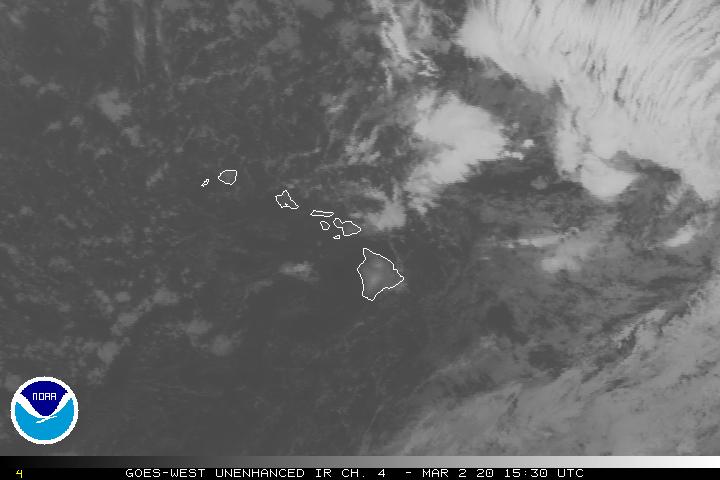
Megan Says:
Hi,
Boy, it sure looks like the islands have been experiencing quite a bit of cloudy weather! We'll be in Kauai during the first couple weeks of March. Any chance the weather will improve by then?
Megan~~~Hi Megan, despite all the clouds, and even the volcanic haze…our islands are still nice! March, hmmm…that’s still quite a ways into the future, although I would imagine that your vacation will be a wonderful one. I’ll bet you go back home afterwards, not wanting to leave…and already making plans for your next vacation. Aloha, Glenn