











December 29-30, 2009
Air Temperatures – The following maximum temperatures were recorded across the state of Hawaii Tuesday afternoon:
Lihue, Kauai – 80
Honolulu, Oahu – 82
Kaneohe, Oahu – 84
Kaunakakai, Molokai – 82
Kahului, Maui – 83
Hilo, Hawaii – 85
Kailua-kona – 85
Air Temperatures ranged between these warmest and coolest spots near sea level around the state – and on the highest mountains…at 5pm Tuesday evening:
Kapalua, Maui – 81F
Port Allen, Kauai – 75
Haleakala Crater – 50 (near 10,000 feet on Maui)
Mauna Kea summit – 43 (near 14,000 feet on the Big Island)
Precipitation Totals – The following numbers represent the largest precipitation totals (inches) during the last 24 hours on each of the major islands, as of Tuesday afternoon:
0.70 Puu Opae, Kauai
0.01 Waimanalo, Oahu
0.00 Molokai
0.00 Lanai
0.00 Kahoolawe
0.02 Puu Kukui, Maui
0.80 Pali 2, Big Island
Marine Winds – Here’s the latest (automatically updated) weather map showing a 1026 millibar high pressure system to the northeast of the islands. Our winds will remain light from the south to southwest…ahead of a stalling cold front, then light again on Thursday.
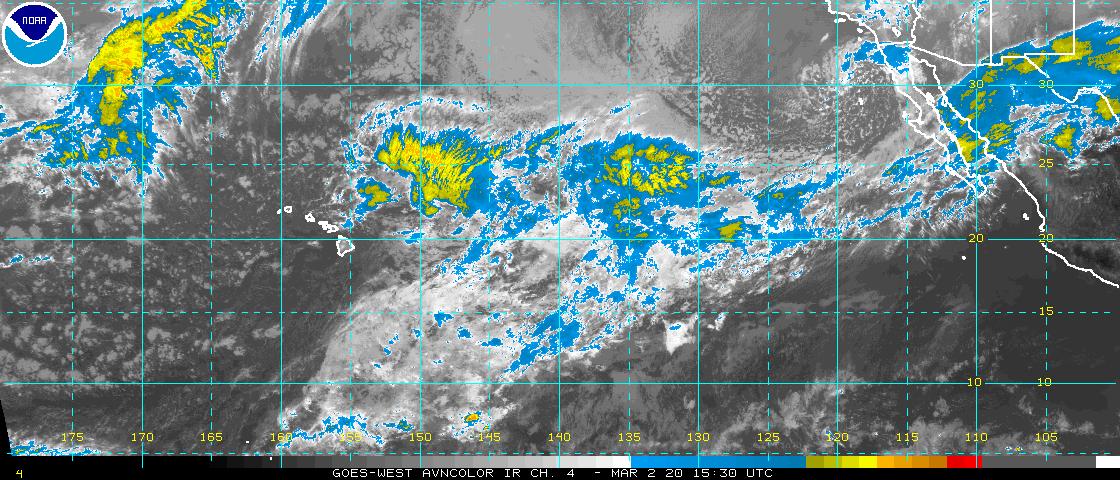
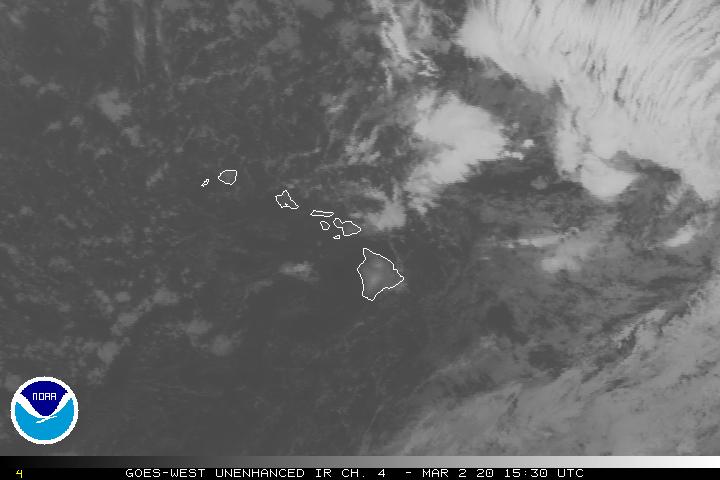
Satellite and Radar Images: To view the cloud conditions we have here in Hawaii, please use the following satellite links, starting off with this Infrared Satellite Image of the islands to see all the clouds around the state during the day and night. This next image is one that gives close images of the islands only during the daytime hours, and is referred to as a Close-up visible image. This next image shows a larger view of the Pacific…giving perspective to the wider ranging cloud patterns in the Pacific Ocean. Finally, here’s a Looping IR satellite image, making viewable the clouds around the islands 24 hours a day. To help you keep track of where any showers may be around the islands, here’s the latest animated radar image.
Hawaii’s Mountains – Here’s a link to the live webcam on the summit of near 14,000 foot Mauna Kea on the Big Island of Hawaii. The tallest peak on the island of Maui is the Haleakala Crater, which is near 10,000 feet in elevation. These two webcams are available during the daylight hours here in the islands…and when there’s a big moon rising just after sunset for an hour or two! Plus, during the nights and early mornings you will be able to see stars, and the sunrise too…depending upon weather conditions.
Tropical Cyclone activity in the eastern and central Pacific – Here’s the latest weather information coming out of the National Hurricane Center, covering the eastern north Pacific. You can find the latest tropical cyclone information for the central north Pacific (where Hawaii is located) by clicking on this link to the Central Pacific Hurricane Center. Here’s a tracking map covering both the eastern and central Pacific Ocean. A satellite image, which shows the entire ocean area between Hawaii and the Mexican coast…can be found here.
Aloha Paragraphs

Hanauma Bay…where President Obama visited Tuesday
A weakening cold front will bring precipitation to Kauai and
The expectation is for this frontal boundary to arrive late Tuesday night over Kauai, and then sag down over
As far as winds go, they will remain light or a little stronger, generally from the south to southwest. These winds have remained light thus far, although as the cold front bears down on Kauai and
This voggy reality will remain in place through New Year’s Eve, mixing with the smoke generated by fireworks. We should begin to see some relief as we get into New Year’s Day, as a quickly passing high pressure system, moving by to our north, will draw the high pressure ridge northward some. The hope is that it will migrate far enough north to bring back a short spell of light trade winds. This in turn would help to ventilate our hazy atmosphere Friday into at least part of Saturday. Then, the next cold front will be approaching, which will force the ridge back down over us, with more volcanic haze being drawn up over the island chain from the
It’s early Tuesday evening here on Maui, as I begin writing the last section of today’s narrative. The weather here in the islands responded to the approaching cold front Tuesday, pretty much as expected. As the looping radar image up the page shows, the prefrontal showers have been taking turns falling over both Kauai and Oahu. At the time of this writing, early Tuesday evening, they were generally in the Kauai channel between these two islands. As the cold front pushes closer, those showers will edge southeast over Oahu, at least likely. When the cold front itself arrives, it will bring both of those islands more showers. The rest of the state may see a few showers, but aren’t expected to see anything significant. As has been the case lately, the voggy weather prevails as we move into the sunset hour. ~~~ Speaking of sunset, I’m anxious to get out on my weather deck to take in the setting sun. There’s more clouds stretching into our area from the south and southwest now, but most of those will collapse as soon as the sun goes down. ~~~ The cold front isn’t the only thing bearing down on us now, that’s for sure! Yes, I’m referring to the New Year’s Eve celebrations…we’re getting close now. One of the things that will make it really even more special, will be the second full moon of the month, called the blue moon…which is already looking pretty full already! Plus, we have the President of the United States of America, and his family of course, spending this most exciting night of the year with us here in Hawaii! ~~~ Ok, that’s it, I’m out of here, or at least out on the deck now. I’ll meet you here dark and early Wednesday morning, with your next new weather narrative from paradise. I hope you have a great Tuesday night until then! Aloha for now…Glenn.
Extra: NASA wallpaper website
Extra2: Fleetwood Mac…Dreams
——> It’s almost New Year’s Eve!
Extra3: The Cranberries…Dreams
Interesting: This month, conservationists in the Czech Republic and Kenya launched an audacious bid to save one of the world’s rarest animals: the northern white rhinoceros. Four of the last eight known northern whites in the world, two male and two female, were packed into wooden crates and sent from a Czech zoo to Kenya, where scientists hope they will get down to the business of breeding.
The rhinos arrived at Nairobi’s main airport at 3:30 a.m. on Dec. 19. Hamish Currie prowled the tarmac directing trucks, tractors and a giant crane as the animals came off the 747. "The trip went very well; they’re all relaxed," said Currie, who directs the Back to Africa program, which helps return zoo animals to the wild.
"But obviously we want to get them on the road as soon as possible and reduce their stress. So the trucks are waiting now and we’re going to load two onto a truck with a crane, fasten them down and get out of here." The rhinos were headed to the Ol Pejeta Conservancy near Mount Kenya to see if the climate and terrain will encourage them to breed.
Interesting2: Over the past decade, researchers have developed a variety of reliable real-time and archival instruments to study sounds made or heard by marine mammals and fish. These new sensors are now being used in research, management, and conservation projects around the world, with some very important practical results. Among them is improved monitoring of endangered North Atlantic right whales in an effort to reduce ship strikes, a leading cause of their deaths.
"The tools available to both acquire and analyze passive acoustic data have undergone a revolutionary change over the last ten years, and have substantially increased our ability to collect acoustic information and use it as a functional management tool," said Sofie Van Parijs, lead author and a bio-acoustician at NOAA’s Northeast Fisheries Science Center laboratory in Woods Hole, Mass.
"These tools have significantly improved monitoring of North Atlantic right whales and enhanced the efficacy of managing ship traffic to reduce ship strikes of whales through much of the western North Atlantic off the U.S. East Coast." Van Parijs is one of many researcher whose work is described this month in the journal Marine Ecology Progress Series. Her paper is one of about a dozen in a special theme issue focused on acoustics in marine ecology.
Van Parijs, who currently heads the NEFSC’s Protected Species Branch, is also a co-author of a related paper on acoustic interference or masking, in which marine animals alter their use of sound as a result of changing background noise. Van Parijs and her colleagues focus on two types of acoustic sensors, real-time and archival.
Real-time sensors are mounted on surface buoys, usually anchored or cabled to the ocean bottom, or deployed as arrays towed from a surface vessel. Archival sensors are affixed on bottom-moored buoys equipped with hydrophones to continuously record ocean sounds for long periods of time, often up to three months, before the sensors are temporarily recovered and their batteries refreshed.
Some archiving sensors can be mounted of individual animals. "Marine animals live their lives and communicate acoustically across different time and space scales and use sound for different reasons," said Van Parijs. "We need to use the right tool in the right place for the right need. There is no ‘one size fits all’ when it comes to using technology in the ocean." Large whales move and communicate over great distances, while smaller whales and dolphins tend to communicate over smaller areas.
Pinnipeds, the group of marine mammals that includes seals, walrus and sea lions, can breed on land, on ice or in the water, and move and communicate from small to medium distances. Human-produced sounds complicate the sensing problem by adding sounds to what can be a very noisy environment.
The use of passive acoustic monitoring is increasing as improved reliability and lower hardware and software costs provide researchers with a set of tools that can answer a broad range of scientific questions. This information can, in turn, be used in conservation management and mitigation efforts. While most of the new technologies have been applied in studies of whales and dolphins, the researchers say the sensors can also be used in studying pinnipeds, sirenians (manatees and dugongs), and fish.
Interesting3: The background lighting provided in a room has an influence on how we taste wine. This is the result of a survey conducted by researchers at the Institute of Psychology at Johannes Gutenberg University Mainz, Germany. Several sub-surveys were conducted in which about 500 participants were asked how they liked a particular wine and how much they would pay for it. It was found that the same wine was rated higher when exposed to red or blue ambient light rather than green or white light.
The test persons were even willing to spend in excess of one Euro more on a specific bottle of Riesling when it was offered in red instead of green light. "It is already known that the color of a drink can influence the way we taste it," says Dr Daniel Oberfeld-Twistel of the General Experimental Psychology division. "We wanted to know whether background lighting, for example in a restaurant, makes a difference as well."
The survey showed, among other things, that the test wine was perceived as being nearly 1.5 times sweeter in red light than in white or green light. Its fruitiness was also most highly rated in red light. Accordingly, one conclusion of the study is that the color of ambient lighting can influence how wine tastes, even when there is no direct effect on the color of the drink. "The extreme lighting conditions found in some bars can undoubtedly influence the way a wine tastes," concludes Oberfeld-Twistel.
He also recommends that serious wine tasting should be conducted in a neutral light color environment. Perhaps a partial explanation of why lighting influences the way we taste wine is that in what we perceive to be pleasant lighting conditions, we also regard the wine as being more pleasant too. Additional research is planned to provide further insight into this fascinating phenomenon.
Interesting4: Using disinfectants could cause bacteria to become resistant to antibiotics as well as the disinfectant itself, according to research published in the January issue of Microbiology. The findings could have important implications for how the spread of infection is managed in hospital settings.
Researchers from the National University of Ireland in Galway found that by adding increasing amounts of disinfectant to laboratory cultures of Pseudomonas aeruginosa, the bacteria could adapt to survive not only the disinfectant but also ciprofloxacin — a commonly-prescribed antibiotic — even without being exposed to it.
The researchers showed that the bacteria had adapted to more efficiently pump out antimicrobial agents (disinfectant and antibiotic) from the bacterial cell. The adapted bacteria also had a mutation in their DNA that allowed them to resist ciprofloxacin-type antibiotics specifically. P. aeruginosa is an opportunistic bacterium that can cause a wide range of infections in people with weak immune systems and those with diseases such as cystic fibrosis (CF) and diabetes. P. aeruginosa is an important cause of hospital-acquired infections.
Disinfectants are used to kill bacteria on surfaces to prevent their spread. If the bacteria manage to survive and go on to infect patients, antibiotics are used to treat them. Bacteria that can resist both these control points may be a serious threat to hospital patients. Importantly, the study showed that when very small non-lethal amounts of disinfectant were added to the bacteria in culture, the adapted bacteria were more likely to survive compared to the non-adapted bacteria.
Dr. Gerard Fleming, who led the study, said, "In principle this means that residue from incorrectly diluted disinfectants left on hospital surfaces could promote the growth of antibiotic-resistant bacteria. What is more worrying is that bacteria seem to be able to adapt to resist antibiotics without even being exposed to them."
Dr. Fleming also stressed the importance of studying the environmental factors that might promote antibiotic resistance. "We need to investigate the effects of using more than one type of disinfectant on promoting antibiotic-resistant strains. This will increase the effectiveness of both our first and second lines of defense against hospital-acquired infections," he said.
Interesting5: There is increased evidence that the Arctic could face seasonally ice-free conditions and much warmer temperatures in the future. This has happened before. Scientists have documented evidence that the Arctic Ocean and Nordic Seas were too warm to support summer sea ice during the mid-Pliocene warm period (3.3 to 3 million years ago). This period is characterized by warm temperatures similar to those projected for the end of this century, and is used to help understand future conditions.
The US Geological Survey (USGS) has found that summer sea surface temperatures in the Arctic were between 50 to 64°F during the mid-Pliocene, while current temperatures are around 32°F. The Pliocene is a time period 2.5 to 5 million years before the present year. The Arctic Ocean is of particular interest because in this region climate models struggle to predict climate sensitivity and the response of sea ice.
In order to provide the first quantitative climate data from this region during this period, sea surface temperatures were estimated from several ocean drilling sites. Evidence of much warmer than modern conditions in the Arctic Ocean during this time frame with temperatures as high as 65F was found. Examining past climate conditions will allow for a true understanding of how Earth’s climate system really functions.
Loss of sea ice could have varied and the consequences will have varied considerably. As examples rain fall patters would have been far different. Some deserts would have bloomed and some grass lands would have become deserts. "In looking back 3 million years, we see a very different pattern of heat distribution than today with much warmer waters in the high latitudes,” said USGS scientist Marci Robinson.
"The lack of summer sea ice during the mid Pliocene suggests that the record setting melting of Arctic sea ice over the past few years could be an early warning of more significant changes to come." Global average surface temperatures during the mid-Pliocene were about 5.5°F greater than today and within the range projected for the 21st century. So our present global temperatures are not as hot as they once were.
The world has been here before. Scientists have also studied conditions during the mid-Pliocene by analyzing fossils dated back to this time period. An acknowledgment of past animal and plant life will help understand and confirm how climate has changed in particular global locations. This plus continued scientific investigation will help a greater understanding of how climate has already changed over millions of years.
 Email Glenn James: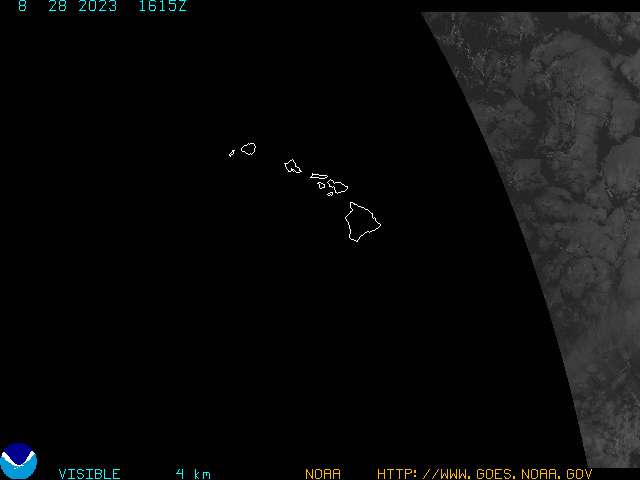


David Brewer Says:
Glenn, Aloha,
We are coming over next week and I have been checking the NWS website (in addition to yours) for weather updates. I noted the NWS forecast for Honolulu keeps mentioning “haze”—is that due to the VOG? Just curious, we own a condo in Maalaea and will be stopping to see friends on Oahu.
Thanks and we really appreciate the great work you do keeping us updated.
D~~~Hi David, thanks for your positive comment. Yes, the vog is volcanic haze, and that is what’s being referred to here and elsewhere. It has been voggy for several, several days here on Maui, although not having gotten as thick as it sometimes does. I hope you folks will have a wonderful vacation, Happy New Year! Aloha, Glenn
jack weber Says:
Great “Interestings,” Glenn! I appreciate your posting these tidbits, always of an Earth-friendly variety, for us to keep abreast of world changes and issues. Mahalo.~~~Thanks Jack, always appreciate your supportive comments! Aloha, Glenn
J*