











January 20-21, 2011
Air Temperatures – The following maximum temperatures were recorded across the state of Hawaii Thursday afternoon:
Lihue airport, Kauai – 79
Honolulu airport, Oahu – 83
Kaneohe, Oahu – 78
Molokai airport – 77
Kahului airport, Maui – 86
Kona airport – 82
Hilo airport, Hawaii – 82
Air Temperatures ranged between these warmest and coolest spots near sea level – and on the highest mountain tops…as of 5pm Thursday evening:
Kahului, Maui – 81F
Hilo, Hawaii – 72
Haleakala Crater – missing (near 10,000 feet on Maui)
Mauna Kea summit – 30 (near 14,000 feet on the Big Island)
Precipitation Totals – The following numbers represent the largest precipitation totals (inches) during the last 24 hours on each of the major islands, as of Thursday evening:
0.01 Port Allen, Kauai
0.22 Oahu Forest NWR, Oahu
0.00 Molokai
0.00 Lanai
0.00 Kahoolawe
0.01 Puu Kukui, Maui
0.50 Mountain View, Big Island
Marine Winds – Here’s the latest (automatically updated) weather map showing a 1031 millibar high pressure system far to our northeast…with a high pressure ridge to the north and northwest of Kauai. Our winds will be blow in the light to moderately strong range, from the trade wind direction Friday and Saturday.
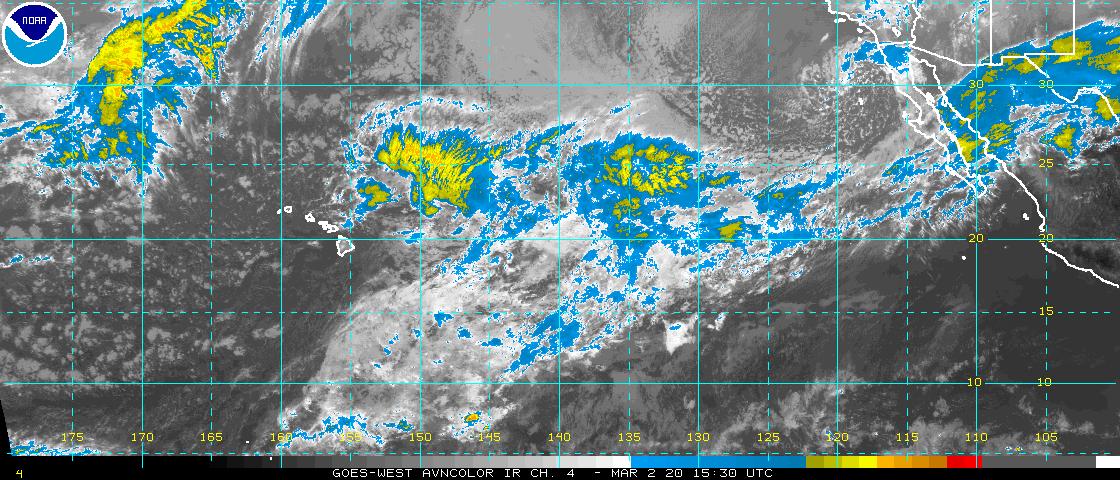
Satellite and Radar Images: To view the cloud conditions we have here in Hawaii, please use the following satellite links, starting off with this Infrared Satellite Image of the islands to see all the clouds around during the day and night. This next image is one that gives close images of the islands only during the daytime hours, and is referred to as a Close-up visible image. This next image shows a larger view of the Pacific…giving perspective to the wider ranging cloud patterns in the Pacific Ocean. Finally, here's a Looping IR satellite image, making viewable the clouds around the islands 24 hours a day. To help you keep track of where any showers may be around the islands, here’s the latest animated radar image.
Hawaii’s Mountains – Here’s a link to the live web cam on the summit of near 14,000 foot Mauna Kea on the Big Island of Hawaii. The tallest peak on the island of Maui is the Haleakala Crater, which is near 10,000 feet in elevation. These two web cams are available during the daylight hours here in the islands…and when there’s a big moon rising just after sunset for an hour or two! Plus, during the nights and early mornings you will be able to see stars, and the sunrise too…depending upon weather conditions.
Tropical Cyclone activity in the eastern and central Pacific – Here’s the latest weather information coming out of the National Hurricane Center, covering the eastern north Pacific. You can find the latest tropical cyclone information for the central north Pacific (where Hawaii is located) by clicking on this link to the Central Pacific Hurricane Center. Here’s a tracking map covering both the eastern and central Pacific Ocean. A satellite image, which shows the entire ocean area between Hawaii and the Mexican coast…can be found here. Of course, as we know, our hurricane season won't end until November 31st here in the central Pacific.
Aloha Paragraphs

Trade winds…large surf north and west shores
Active trade winds, light to moderately strong into early next week…then becoming much lighter by the middle of the week. This weather map shows a moderately strong 1031 millibar high pressure system far to our northeast, with its associated ridge of high pressure (orange zigzag line) extending southwest, to the north and northwest of the islands. At the same time we find a trough of low pressure moving through the state, which will allow the trade winds to strengthen in its wake.
Winds will strengthen…the following numbers represent the strongest gusts, along with directions Thursday evening:
14 mph Lihue, Kauai – NE
21 Kahuku, Oahu – SE
25 Molokai – NE
30 Kahoolawe – ENE
22 Lipoa, Maui – ENE
12 Lanai Airport – ENE
38 South Point, Big Island – NE
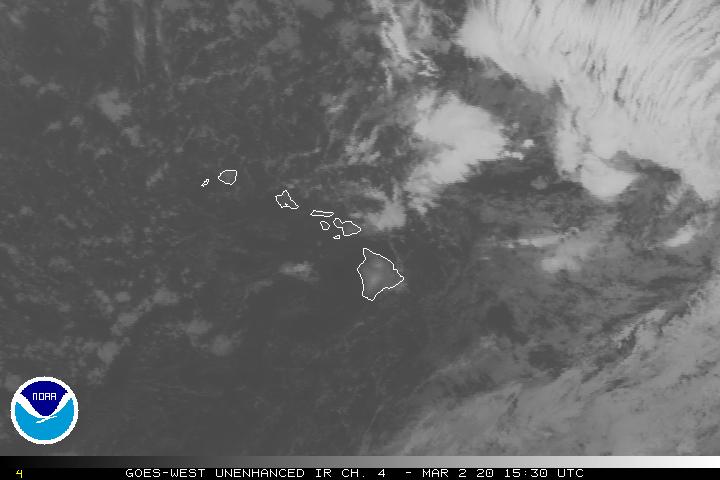
Generally clear skies prevail across the islands Thursday evening, although some increase in clouds and windward biased showers will arrive later tonight into Friday. This large University of Washington satellite image shows fairly clear to partly cloudy skies across the islands, with showery looking clouds arriving along our windward sides from the east. Looking at this NOAA satellite picture, it shows the leeward sides are clear to partly cloudy at the time of this writing.
Most leeward areas will remain generally dry going forward, although as the trade winds pick up, the windward sides will receive those showers. We can use this looping satellite image to see yesterday's low pressure system now to the southwest, and moving away. The bright white clouds associated with this departing low, to the south of the Big Island, will gradually shift further away into Friday. Checking out this looping radar image it shows a minimum amount of showers arriving along our windward sides on the freshening trade winds…although showers should increase during the night into Friday morning.
The very large swell we saw breaking Thursday, will gradually lower in height Friday into Saturday. The NWS office continues its high surf warnings for the north and west facing shores, through Friday at 6pm. Folks unfamiliar with breaking waves, should remain well away from the ocean. Only the most experienced water persons should be out in the ocean during this episode. Weather maps and wave models show yet another larger than normal west-northwest swell arriving Sunday into early next week.
The trade winds are increasing, while the high surf will slowly lower…Friday into the weekend. The trade winds were gusting to almost 40 mph down at South Point on the Big Island early Thursday evening. They will likely become a bit softer overnight, and then increase again during the day Friday. Meanwhile, the north and west shores of all the islands continue to have pounding high surf. Conditions will improve some as we move into the weekend, although then rise again Sunday night into early next week. Weather conditions will be decent, that is after some increasing windward showers overnight into Friday morning. As we get into later Friday and the weekend, we should nice weather returning. Speaking of returning, I'll be back early Friday morning with your next new weather narrative. I hope you have a great Thursday night until then! Aloha for now…Glenn.
Interesting: Earlier this month, scientists with the National Oceanic and Atmospheric Administration (NOAA) managed to save a North Atlantic Right Whale which entangled itself in ropes around its mouth and flippers. They sedated the mighty creature in order to get close enough to cut the ropes. This marks only the second time in which an entangled whale has been sedated in open sea.
"Our recent progress with chemical sedation is important because it's less stressful for the animal, and minimizes the amount of time spent working on these animals while maximizing the effectiveness of disentanglement operations," said Jamison Smith, Atlantic Large Whale Disentanglement Coordinator for NOAA's Fisheries Service.
"This disentanglement was especially complex, but proved successful due to the detailed planning and collective expertise of the many response partners involved" The ropes in which the whale was tangled is believed to be fishing gear. Along with ropes, the rescuers found wire mesh material which is commonly found in lobster traps or pot fisheries.
The specific fishery remains to be seen pending an investigation. Fisheries and lobster/crab traps are found commonly in the Northeastern US and Canadian coasts, as well as in the mid-Atlantic. The North Atlantic Right Whale is listed as an endangered species and is protected under the US Endangered Species Act of 1973 and the Marine Mammal Protection Act of 1972.
There are estimated to be only 300-400 left in existence. Two of their biggest threats are swimming into vessels and becoming entangled in fixed fishing gear. NOAA rescuers hooked on a digital monitoring tag to the whale to record the whale's behavior before, during, and after sedation.
The information collected will be instrumental to any future attempts at whale sedation. After the whale was disentangled, they gave the whale antibiotics to treat the wounds and drugs to reverse sedation.
The only other time a whale has been successfully sedated and disentangled was in March 2009 off the coast of Florida. This recent incident also occurred off the coast of Florida near Cape Canaveral. It was reported in the Daytona Beach News Journal.
Interesting2: Algeria is aiming to generate 40 per cent of its electricity from renewable sources by 2020, energy minister Youcef Yousfi has announced. About 60 renewable energy projects will be launched to give a capacity of 3,000 megawatts, he told a press conference held to announce the strategy (2 January). "The main purpose of this new policy is to prepare the country for the post-petrol era," Yousfi said.
Currently, fossil fuels account for 96 per cent of export revenue, and are the basis of the national economy. The country hopes to supplement this revenue from exports of renewably sourced energy. "Algeria has been late in developing the renewable energy sector, but by stepping up the launch of projects we can catch up," said Omar Bouhadjar, research manager at Algeria's Centre for Development of Renewable Energies (CDER).
"Important projects were announced last month that will support the new Algerian strategy," he added. But legislators were forced to postpone a discussion of a draft of the renewable energy development strategy, due to take place on 4 January, because of political disturbances.
Interesting3: Thailand is closing dozens of dive sites to tourists after unusually warm seas caused severe damage to coral reefs in the Andaman Sea, one of the world's top diving and beach resort regions, authorities said on Thursday. More than half of southern Thailand's 15,000 hectares of coral reefs are suffering from bleaching, or the shedding of coral colors, a phenomenon caused largely by rising sea temperatures over an extended period, officials said.
"We will study the cause and effect and find a way to restore them," Sunan Arunnopparat, director of the Department of National Parks, told Reuters, adding that the reefs will be closed across seven national parks. "This is part of an effort to restore the reefs." He declined to say how many diving spots would be closed or how extensive the damage was to the reefs.
He said diving sites where bleaching had spread to 80 percent of the reefs would be shut for an unspecified period. The coral bleaching — whitening due to heat driving out the algae living within the coral tissues — was first reported in May after a surge in temperatures across the Andaman Sea from the northern tip of Sumatra Island to Thailand and Myanmar. Other parts of Southeast Asia have also suffered.
n international team of scientists studying bleaching off Indonesia's Aceh province found that 80 percent of some species have died between May and August.
Interesting4: For a long time there has been speculation of whether there is or was life on Mars. A really good answer would have been to have one of the Mars rover devices to photograph something moving about and obviously alive. Well that did not happen so a search for more subtle clues of smaller life forms or something from the deep past is in progress. The next rover to be delivered to Mars will contain a SAM.
The instrument is Sample Analysis at Mars, or SAM, built by NASA's Goddard Space Flight Center, Greenbelt, Md. At the carefully selected landing site for the Mars rover named Curiosity, one of SAM's key jobs will be to check for carbon-containing compounds called organic molecules, which are among the building blocks of life on Earth.
The clean-room suits worn by Curiosity's builders at NASA's Jet Propulsion Laboratory, Pasadena, Calif., are just part of the care being taken to keep biological material from Earth from showing up in results from SAM. Organic chemicals consist of carbon and hydrogen and, in many cases, additional elements. They can exist without life, but life as we know it cannot exist without them.
SAM can detect a fainter trace of organics and identify a wider variety of them than any instrument yet sent to Mars. It also can provide information about other ingredients of life and clues to ancient Martian environments. Researchers will use SAM and nine other science instruments on Curiosity to study whether one of the more intriguing areas on Mars has offered environmental conditions favorable for life and favorable for preserving evidence about whether life has ever existed there.
NASA will launch Curiosity from Florida between November 25 and December 18, 2011, as part of the Mars Science Laboratory mission's spacecraft. The spacecraft will deliver the rover to the Martian surface in August 2012. The mission plan is to operate Curiosity on Mars for two years. "If we don't find any organics, that's useful information," said Mahaffy, of NASA's Goddard Space Flight Center. "That would mean the best place to look for evidence about life on Mars may not be near the surface.
It may push us to look deeper." It would also aid understanding of the environmental conditions that remove organics. "If we do find detectable organics, that would be an encouraging sign that the immediate environment in the rocks we're sampling is preserving these clues," he said. "Then we would use the tools we have to try to determine where the organics may have come from."
Organics delivered by meteorites without involvement of biology come with more random chemical structures than the patterns seen in mixtures of organic chemicals produced by organisms. Meteorites are known to have organic materials in them which are called carbonaceous chondrites. An example is the Murchison Meteorite that was observed to fall to Earth in 1969.
Murchison contains over 100 amino acids (some of the basic components of life. "It has been a long haul getting to this point," Mahaffy said. "We've taken a set of experiments that would occupy a good portion of a room on Earth and put them into that box the size of a microwave oven." SAM has three laboratory tools for analyzing chemistry.
The tools will examine gases from the Martian atmosphere, as well as gases that ovens and solvents pull from powdered rock and soil samples. Curiosity's robotic arm will deliver the powdered samples to an inlet funnel. SAM's ovens will heat most samples to about 1,800 degrees Fahrenheit. One tool, a mass spectrometer, identifies gases by the molecular weight and electrical charge of their ionized states.
It will check for several elements important for life as we know it, including nitrogen, phosphorous, sulfur, oxygen and carbon. Another tool, a laser spectrometer, uses absorption of light at specific wavelengths to measure concentrations of selected chemicals, such as methane and water vapor.
It also identifies the proportions of different isotopes in those gases. Isotopes are variants of the same element with different atomic weights, such as carbon-13 and carbon-12, or oxygen-18 and oxygen-16. Ratios of isotopes can be signatures of planetary processes.
For example, Mars once had a much denser atmosphere than it does today, and if the loss occurred at the top of the atmosphere, the process would favor increased concentration of heavier isotopes in the retained, modern atmosphere. Methane is an organic molecule.
Observations from Mars orbit and from Earth in recent years have suggested transient methane in Mars' atmosphere, which would mean methane is being actively added and subtracted at Mars. With SAM's laser spectrometer, researchers will check to confirm whether methane is present, monitor any changes in concentration, and look for clues about whether Mars methane is produced by biological activity or by processes that do not require life.
SAM's third analytical tool, a gas chromatograph, separates different gases from a mixture to aid identification. It does some identification itself and also feeds the separated fractions to the mass spectrometer and the laser spectrometer. NASA's investigation of organics on Mars began with the twin Viking landers in 1976.
Science goals of more recent Mars missions have tracked a "follow the water" theme, finding multiple lines of evidence for liquid water — another prerequisite for life — in Mars' past.
The Mars Science Laboratory mission will seek more information about those wet environments, while the capabilities of its SAM instrument add a trailblazing "follow the carbon" aspect and information about how well ancient environments may be preserved. In 1976 the NASA Viking landers took samples of soil on Mars and tested them for signs of organic carbon.
A reinterpretation of the results now suggests the samples did contain organic compounds, but the results were not understood because of the strong oxidation effects of perchlorate, a salt now known to be found in Martian soils. Reinterpreting the Viking results in the light of the new findings suggests the samples from landing site 1 contained 1.5 to 6.5 ppm organic carbon, while those from landing site 2 contained 0.7 to 2.6 ppm organic carbon. The original reports from Viking came up negative for organics.
How, then, might Curiosity find any? Mahaffy describes three possibilities. The first is about locations. Mars is diverse, not uniform. Copious information gained from Mars orbiters in recent years is enabling the choice of a landing site with favorable attributes, such as exposures of clay and sulfate minerals good at entrapping organic chemicals.
Mobility helps too, especially with the aid of high-resolution geologic mapping generated from orbital observations. The stationary Viking landers could examine only what their arms could reach. Curiosity can use mapped geologic context as a guide in its mobile search for organics and other clues about habitable environments.
Additionally SAM will be able to analyze samples from interiors of rocks drilled into by Curiosity, rather than being restricted to soil samples, as Viking was. Second, SAM has improved sensitivity, with a capability to detect less than one part-per-billion of an organic compound, over a wider mass range of molecules and after heating samples to a higher temperature.
Third, a lower-heat method using solvents to pull organics from some SAM samples can check a hypothesis that a reactive chemical recently discovered in Martian soil may have masked organics in soil samples baked during Viking tests. The lower-heat process also allows searching for specific classes of organics with known importance to life on Earth.
For example, it can identify amino acids, the chain links of proteins. Other clues from SAM could also be hints about whether organics on Mars — if detected at all — come from biological processes or without biology, such as from meteorites. Certain carbon-isotope ratios in organics compared with the ratio in Mars' atmosphere could suggest meteorite origin.
Patterns in the number of carbon atoms in organic molecules could be a clue. Researchers will check for a mixture of organics with chains of carbon atoms to see if the mix is predominated either by chains with an even number of carbon atoms or with an odd number.
That kind of pattern, rather than a random blend, would be typical of biological assembly of carbon chains from repetitious subunits. In the search for life, it is always better to see an animal or a plant but Mars does not have this option and the search is more for signs that life may have been there.
Interesting5: A massive California rain event — one expected to occur once every 200 years — would far surpass destruction caused by a "Big One" earthquake, causing more than $700 billion in damage and hobbling the state's economy for decades, federal scientists are warning. U.S. Geological Survey scientists ran an extreme hypothetical, called "ARkStorm," through simulation models and determined that a deluge not seen in California since 1862 could potentially cause three times more damage than a large earthquake on the San Andreas Fault.
The 1861-62 winter storm — what scientists call an "atmospheric river storm" — lasted for 45 days, producing precipitation that exceeded what some areas would experience once every 500 to 1,000 years. The flooding was so bad it reduced taxable land by a third, bankrupted the state government and left parts of the Central Valley looking more like an inland sea than the fertile farming area that today forms the backbone of the state's economy.
So USGS ran a scenario based on two recent storms, in 1969 and 1986, acting as if the accumulation of both occurred back to back. They found that rain would fall several feet deep, flood 9 million homes and probably overwhelm thousands of miles of levees and reservoirs. USGS Director Marcia McNutt called the scenario "hypothetical but very plausible" given California's historical rainfall trends as well as the predicted effects of climate change, which some say could heighten the likelihood of widespread flooding.
The point of the study, she said, is to help emergency planning efforts, as one dollar spent pre-emptively avoids hundreds spent later, she said. "If we had a catastrophic disaster that takes down the California economy, that is a problem of national significance," McNutt said. Lucy Jones, the primary architect of the ARkStorm test at USGS, added that the strength of such a storm is comparable to a intense hurricane but could leave behind far more damage as the atmospheric river keeps dumping water after a longer period.
She noted that California is the only state outside of the hurricane-prone Southeast that tends to see rainfall as large as, say, 16 inches over a three-day period. "This has to happen at some point," Jones said. "How prepared are we? That's essentially unanswerable. No flood control system can be or should be built to withstand every possible storm."
'Serious questions' ARkStorm report in hand, USGS held a conference last week with the Federal Emergency Management Agency and the California Emergency Management Agency to sound the alarm and try to get parties thinking about what comes next. Participants included more than 100 academics who participated in the process over the last two years, including researchers from the physical sciences as well as economists and social scientists.
The study itself looks at prehistoric geologic flood history in California alongside climate projections and flood mapping to try and point to the areas most likely to get hit hardest. Most of the damage would come from flooding, with as much as one-fourth of all houses in California damaged on some level. The report notes an initial $300 billion estimate in damage would likely be exceeded as serious flooding hampers the Central Valley, Orange County, Los Angeles County, San Diego, the San Francisco Bay area and other coastal communities.
The report says:
* Demand surge (an increase in labor rates and other repair costs) could increase property losses by 20 percent.
* Agricultural losses and other costs to repair lifelines, drain flooded islands and repair damage from landslides, brings the total direct property loss to nearly $400 billion, of which $20 billion to $30 billion would be recoverable through insurance.
* Power, water, sewer and other lifelines experience damage that takes weeks or months to restore.
* Flooding evacuation could involve 1.5 million residents in the inland region and delta counties, and business interruption costs could reach $325 billion in addition to the $400 billion in property repair costs, bringing ARkStorm's pricetag to the neighborhood of $725 billion.
"An ARkStorm raises serious questions about the ability of existing federal, state and local disaster planning to handle a disaster of this magnitude," the report concludes. Also detailed in the report are the first-ever landslide susceptibility maps for California, with hotspots identified along active coastal ranges, which have long been highly vulnerable to fatal slides in the middle of population centers.
Environmental damage was also assessed, given the likelihood that a series of storms akin to 1861-62 would overwhelm wastewater treatment facilities, refineries, mining operations and other industrial sources. Jones said the report, which did not look at effects on marine life, would at the very least bring severe runoff from industrial sources that would be carried into urban areas in a swirling mix.
"It's not something we usually talk about before lunch," she said. "It's an appalling mix." Establishing a warning system The conclusion for emergency planners is that such a scenario, many times worse than a Hurricane Katrina, would likely involve "decades of recovery" rather than months or years, said Nancy Ward of FEMA.
So the ARkStorm project reached out to emergency planners, businesses, universities, government agencies and others who prepare for major natural disasters, much like the "ShakeOut" earthquake scenario, published in May 2008 by USGS, looked at the effects of a 7.8 earthquake on the San Andreas Fault in Southern California.
"This is not just a 72-hour response, this is not just months of recovery," Ward said of the ARkStorm scenario. While comparisons to earthquake planning are inevitable in California, the experts said the type of rainfall assessed in the report would trump the biggest of quakes, including the 1906 trembler in San Francisco that burned much of the city to the ground and killed more than 3,000 residents.
Mark Jackson, of the National Weather Service, noted that an 1861-level rain event would be felt up and down the state, while a repeat of the 1906 quake — which measured about 8 on the Richter scale and ruptured 296 miles of the San Andreas Fault — would be more localized, even if devastating. ARkStorm, he said, "is not just what happens in your backyard. It would have a domino effect all the way through."
Jackson is currently engaged in trying to set up a warning system similar to the categories widely invoked to describe hurricane intensity. The floods in Southern California in December, for instance, measured about 20 "Mississippi atmospheric rivers" (about a Category 2 or 3 storm), while ARkStorm would easily surpass 50 Mississippis, he explained, comparing the amount of likely rainfall to the length and width of several Mississippi rivers.
A crucial challenge is simulating the network of remote sensors meteorologists use to detect wind speeds before a hurricane makes landfall. The same system does not exist in the Pacific to measure likely rainfall, but Jackson said NWS is working on new technologies. "We're in the very early stages of a work in progress," he said.
 Email Glenn James: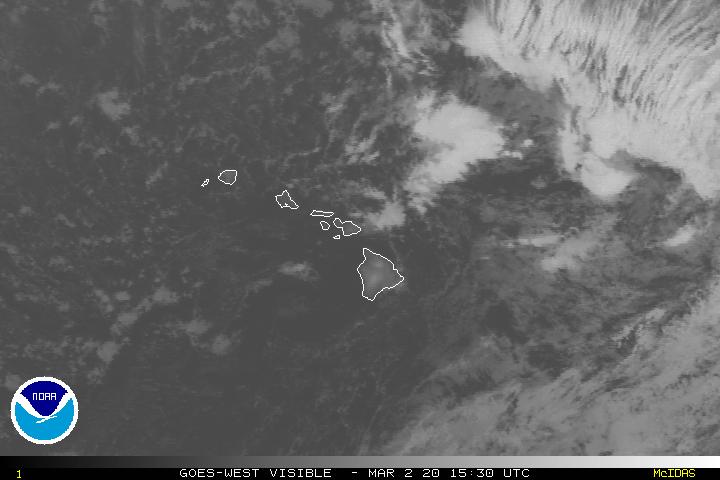


Mona Bailey Says:
Good Morning Glenn – I was looking for the 2 Haleakala Photos you posted yesterday. Is there a place I can find them? I was telling my co-workers about the photos you posted of the snow up there and would love to show them your photos. Mahalo, Mona~~~Hi Mona, to get back to yesterday’s narrative (where those pictures are), simply go to the left hand side of any page on this website, and click on Archived Narratives. Click on the date you are looking for, in this case yesterday’s…and up will pop the old narrative. You can go back over three years in time, to find any narrative that I’ve written. Aloha, Glenn
Robert Ryan Says:
Aloha Glen; We will be arriving Maui February 1 thru Feb 21. Hope you have a nice forecast for us. We will be celebrating our 60th wedding anniversary in March. This trip is a prelude to a South Carbbean cruise over our actual celebration.
Aloha Glen. Enjoy your Seattle adventure and visit with your family in Southland. Bob & Doreen~~~Hi Doreen, here’s wishing you a very special anniversary here in Hawaii, and in the Caribbean too…nice! Aloha, Glenn