December 23-24, 2009
Air Temperatures – The following maximum temperatures were recorded across the state of Hawaii Wednesday afternoon:
Lihue, Kauai – 77
Honolulu, Oahu – 80
Kaneohe, Oahu – 80
Kaunakakai, Molokai – 80
Kahului, Maui – 81
Hilo, Hawaii – 81
Kailua-kona – 80
Air Temperatures ranged between these warmest and coolest spots near sea level around the state – and on the highest mountains…at 5pm Wednesday evening:
Kailua-kona – 79F
Lihue, Kauai – 74
Haleakala Crater – 52 (near 10,000 feet on Maui)
Mauna Kea summit – 43 (near 14,000 feet on the Big Island)
Precipitation Totals – The following numbers represent the largest precipitation totals (inches) during the last 24 hours on each of the major islands, as of Wednesday afternoon:
0.01 Omao River, Kauai
0.05 Ahuimanu Loop, Oahu
0.00 Molokai
0.00 Lanai
0.00 Kahoolawe
0.09 West Wailuaiki, Maui
0.04 Kawainui Stream, Big Island
Marine Winds – Here’s the latest (automatically updated) weather map showing a weak 1016 millibar high pressure system to the east-northeast of the islands. Our winds will be light Thursday ahead of the next cold front…becoming cooler from the north to northeast in the wake of the cold front later Friday.
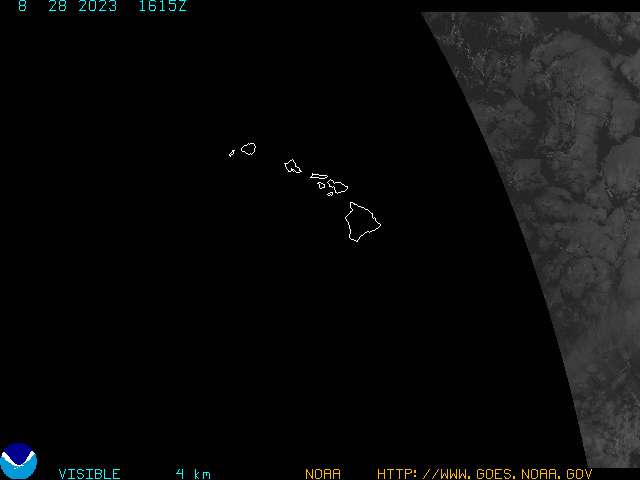
Satellite and Radar Images: To view the cloud conditions we have here in Hawaii, please use the following satellite links, starting off with this Infrared Satellite Image of the islands to see all the clouds around the state during the day and night. This next image is one that gives close images of the islands only during the daytime hours, and is referred to as a Close-up visible image. This next image shows a larger view of the Pacific…giving perspective to the wider ranging cloud patterns in the Pacific Ocean. Finally, here’s a Looping IR satellite image, making viewable the clouds around the islands 24 hours a day. To help you keep track of where any showers may be around the islands, here’s the latest animated radar image.
Hawaii’s Mountains – Here’s a link to the live webcam on the summit of near 14,000 foot Mauna Kea on the Big Island of Hawaii. The tallest peak on the island of Maui is the Haleakala Crater, which is near 10,000 feet in elevation. These two webcams are available during the daylight hours here in the islands…and when there’s a big moon rising just after sunset for an hour or two! Plus, during the nights and early mornings you will be able to see stars, and the sunrise too…depending upon weather conditions.
Tropical Cyclone activity in the eastern and central Pacific – Here’s the latest weather information coming out of the National Hurricane Center, covering the eastern north Pacific. You can find the latest tropical cyclone information for the central north Pacific (where Hawaii is located) by clicking on this link to the Central Pacific Hurricane Center. Here’s a tracking map covering both the eastern and central Pacific Ocean. A satellite image, which shows the entire ocean area between Hawaii and the Mexican coast…can be found here.
Aloha Paragraphs

The windward side of Oahu
Generally fair weather will remain in place Wednesday into Thursday…with a quickly weakening cold front bringing a few showers to some parts of the state into Friday. This cold front will arrive on Kauai later Christmas Eve day…bringing some showers with it. It will then move along to Oahu during the night, although is then expected to stall out somewhere between there and Maui County…perhaps not reaching the Big Island. Whatever showers that are able to fall will land along the windward sides, with the leeward coasts remaining dry for the most part.
The winds will be light ahead of the cold front, then turning cooler from the north to the northeast in its wake. Thereafter, our breezes will be light to locally moderate trade winds into the upcoming weekend. Typically when the trade winds are blowing, we would expect nice weather, which looks to be the case this time. There may be a few passing showers along our windward sides, but nothing out of the ordinary. The south and west facing leeward beaches will be generally dry, with lots of sunshine beaming down during the days.
Meanwhile, our big news will occur in the marine environment, as another very large northwest swell will arrive later Thursday…becoming locally giant into Friday. This swell, coming in from the northwest to west-northwest direction, will prompt high surf warning level waves breaking then. These swells were generated by deep storm low pressure systems in the northwest Pacific, that had hurricane force winds. The swell coming our way for Christmas Eve into Christmas Day, is being compared to the near giant surf we had a couple of weeks ago. Everyone should use caution when getting near the shorelines along our north and west facing beaches during this high surf episode! At the same time, an out of season south swell will arrive from the southern hemisphere, bringing the surf up some along our south facing beaches as well.
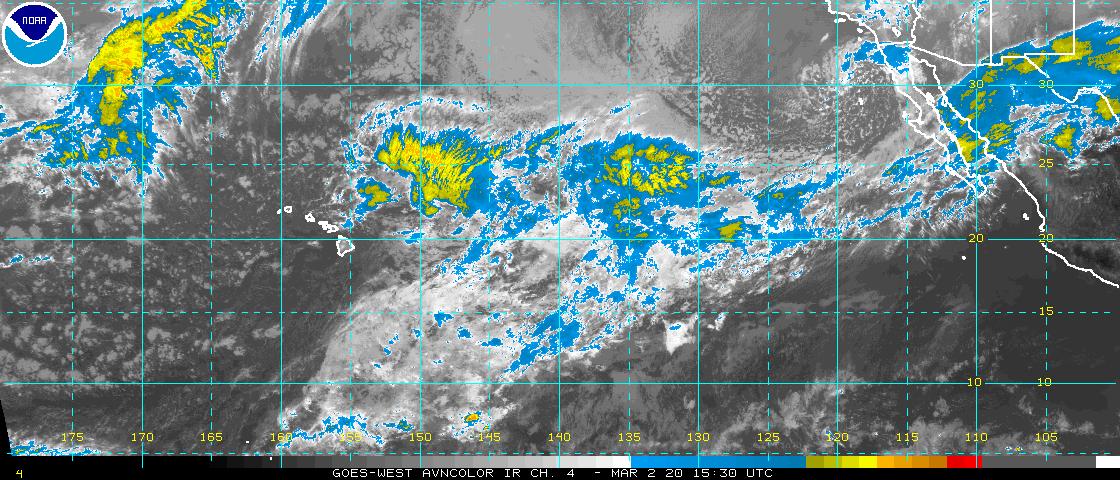
It’s early Wednesday evening here on Maui, as I begin writing this last section of today’s narrative. Our weather was terrific on Wednesday, with copious amounts of warm sunshine beaming down everywhere. There were a couple of the lightest possible showers, although most areas, remained totally dry. It looks like most of Thursday will remain in this favorably inclined state, at least until the next cold front arrives over Kauai late in the day, right around when the official Christmas Eve begins at 5pm. Speaking of the cold front, here’s a large view of the Pacific, showing the approaching cold front, in relation to the Hawaiian Islands…outlined in blue. The clouds, called stratocumulus, that are following closely behind the frontal boundary, usually indicate cooler air coming into the state. So, we can expect a little tropical chill to our atmosphere on Christmas Day, although there will be no white Christmas – smile. ~~~ I’m heading out now for the drive back upcountry to Kula, glancing out the window here in Kihei, before leaving, it’s clear, clear, clear! I’ll catch up with you early Thursday morning, when I’ll have your next new weather narrative from paradise, waiting for you then! Aloha for now…Glenn.
Interesting: The US EPA has finalized a rule setting tough engine and fuel standards for large US flagged ships, a major milestone in the agency’s coordinated strategy to slash harmful marine diesel emissions. The regulation harmonizes with international standards and will lead to significant air quality improvements throughout the country.
“There are enormous health and environmental consequences that come from marine diesel emissions, affecting both port cities and communities hundreds of miles inland. Stronger standards will help make large ships cleaner and more efficient, and protect millions of Americans from harmful diesel emissions,” said EPA Administrator Lisa P. Jackson.
“Port communities have identified diesel emissions as one of the greatest health threats facing their people — especially their children. These new rules mark a step forward in cutting dangerous pollution in the air we breathe and reducing the harm to our health, our environment, and our economy.”
Air pollution from large ships, such as oil tankers and cargo ships, will grow rapidly as port traffic increases. By 2030, the present domestic and international strategy is expected to reduce, from present levels, annual emissions of nitrogen oxides (NOx) from large marine diesel engines by about 1.2 million tons and particulate matter emissions by about 143,000 tons.
When fully implemented, this coordinated effort will reduce NOX emissions from ships by 80 percent, and particulate emissions by 85 percent, compared to current emissions. There are two types of diesel engines used on ocean-going vessels: main propulsion and auxiliary engines.
The main propulsion engines on most ocean-going vessels are very large. Auxiliary engines on ocean-going vessels typically range in size from small portable generators to locomotive-size engines with power of 4,000 kilowatts or more. Auxiliary engines on US flagged ocean-going vessels are subject to EPA’s marine diesel engine standards for engines with per-cylinder displacement up to 30 liters per cylinder.
The emission reductions from the strategy will yield significant health and welfare benefits that go well beyond the US port where the vessel is located. Less air emissions at the port will mean less emissions downwind of the port. EPA estimates that in 2030, this effort will prevent between 12,000 and 31,000 premature deaths and 1.4 million work days lost.
The estimated annual health benefits in 2030 as a result of reduced air pollution are valued between $110 and $270 billion, which is up to nearly 90 times the projected cost of $3.1 billion to achieve those results. This rule, under the Clean Air Act, complements a key piece of EPA’s strategy to designate an emissions control area for thousands of miles of US and Canadian coasts.
The International Maritime Organization (IMO), a United Nations agency, is set to vote in March 2010 on the adoption of the joint U.S.-Canada emissions control area, which would result in stringent standards for all large foreign-flagged as well as domestic ships operating within the designated area. The rule adds new lower NOX standards and strengthens EPA’s diesel fuel program for affected ships.
The intent was to reduced air emissions without compromising safety or the maritime economy. This action represents another milestone in EPA’s decade-long effort to reduce pollution from both new and existing diesel engines. This effort includes similar emissions from other diesel fueled engines including passenger cars, trucks and other internal combustion engines.
Interesting2: The US Department of Agriculture announced an agreement with U.S. dairy producers to accelerate adoption of innovative manure to energy projects on American dairy farms. The agreement represents a dynamic public/private partnership and is another demonstration of the Obama Administration’s commitment to curb the emissions of greenhouse gases.
"This historic agreement, the first of its kind, will help us achieve the ambitious goal of drastically reducing greenhouse gas emissions while benefitting dairy farmers," said Agriculture Secretary Tom Vilsack.
The "Use of manure to electricity technology is a win for everyone because it provides an untapped source of income for famers, provides a source of renewable electricity, reduces our dependence on foreign fossil fuels, and provides a wealth of additional environmental benefits."
With this Memorandum of Understanding, the Innovation Center for U.S. Dairy – part of the Dairy Management Inc. – the USDA and U.S. dairy producers will work together to reach a 25 percent reduction in greenhouse gas emissions by the year 2020. USDA will do so by undertaking research initiatives, allowing implementation flexibility, and enhancing marketing efforts of anaerobic digesters to dairy producers.
Anaerobic digester technology is a proven method of converting waste products, such as manure, into electricity. The technology utilizes generators that are fueled by methane captured from the animal manure. Currently, only about 2 percent of U.S. dairies that are candidates for a profitable digester are utilizing the technology.
Dairy operations with anaerobic digesters routinely generate enough electricity to power 200 homes. Through the agreement, USDA and the Innovation Center for U.S. Dairy will increase the number of anaerobic digesters supported by USDA programs. Beyond promoting the digesters, the agreement will encourage research, and development of new technologies to help dairies reduce greenhouse gas emissions.
Interesting3: The air in some school classrooms may contain higher levels of extremely small particles of pollutants — easily inhaled deep into the lungs — than polluted outdoor air, scientists in Australia and Germany are reporting in an article in Environmental Science & Technology. Lidia Morawska and colleagues note increasing concern in recent years over the health effects of airborne ultrafine particles.
Evidence suggests that they can be toxic when inhaled into the lungs. Much of the scientific research, however, has focused on outdoor sources of these invisible particles, particularly vehicle emissions. Little research has been done, however, on indoor sources, and even less on ultrafine particles in school classrooms.
In an effort to fill those gaps in knowledge, the scientists studied levels of ultrafine particles in 3 elementary school classrooms in Brisbane, Australia. They found that on numerous occasions ultrafine particle levels in the classrooms were significantly higher than outdoors.
The highest levels occurred during art activities such as gluing, painting and drawing when indoor levels were several times higher than outdoor levels. There also were significant increases in ultrafine particle levels when detergents were used for cleaning.
Interesting4: Disability rates among non-institutionalized older Americans increased between 2000 and 2005, a trend that could seriously impact the quality of life of seniors in the coming decades if it continues, according to a study led by researchers at the University of Toronto and the University of California, Berkeley. The findings are troubling, said the authors, because they suggest that the steady decline since the 1980s of disability rates among older adults may have ended.
Adding to the concern is the expected doubling between 2000 and 2030 of the number of Americans over 65 as the Baby Boom generation continues to age. "The combination of increasing disability rates plus a growing population of older adults emphasizes the importance of prevention of the many chronic conditions giving rise to disability in the first place," said the study’s lead author, Esme Fuller-Thomson, professor of social work at the University of Toronto.
"There is evidence, for example, that the doubling of obesity rates over the last three decades may be linked to rising disability in older people, yet the obesity problem is largely preventable." The study, appearing in the December issue of the Journals of Gerontology, reflects a 9 percent increase over five years in non-institutionalized adults 65 and over reporting difficulty in basic activities of daily living.
Those functions include dressing, bathing and in-home mobility due to a physical, mental or emotional condition lasting six months or more. "People are living longer, but many are also living sicker," said study co-author Amani Nuru-Jeter, assistant professor of community health and human development at UC Berkeley’s School of Public Health. "This study is providing an early warning sign that the decline in disability rates we’ve been hearing about might be ending."
Interesting5: The average low-income person loses 8.2 years of perfect health, the average high school dropout loses 5.1 years, and the obese lose 4.2 years, according to researchers at Columbia University’s Mailman School of Public Health. Tobacco control has long been one of the most important public health policies, and rightly so; the average smoker loses 6.6 years of perfect health to their habit.
But the nation’s huge high school dropout rate and poverty rates are typically not seen as health problems. This new study published in the December 2009 issue of the American Journal of Public Health, shows that poverty and dropout rates are at least as important a health problem as smoking in the United States.
These researchers define "low-income" as household earnings below 200% of the Federal Poverty Line, or roughly the bottom third of the U.S. population. On average, poverty showed the greatest impact on health. Smoking was second, followed by being a high school dropout, non-Hispanic Black, obese, a binge drinker, and uninsured.
The findings are based on data from various national datasets that are designed to measure both health and life expectancy. Healthy life lost combines both health and life expectancy into a single number, sometimes known as quality-adjusted life years.
 Email Glenn James: