December 22-23, 2009
Air Temperatures – The following maximum temperatures were recorded across the state of Hawaii Tuesday afternoon:
Lihue, Kauai – 77
Honolulu, Oahu – 82
Kaneohe, Oahu – 79
Kaunakakai, Molokai – 81
Kahului, Maui – 79
Hilo, Hawaii – 80
Kailua-kona – 87
Air Temperatures ranged between these warmest and coolest spots near sea level around the state – and on the highest mountains…at 5pm Tuesday evening:
Kailua-kona – 79F
Princeville, Kauai – 72
Haleakala Crater – 45 (near 10,000 feet on Maui)
Mauna Kea summit – 30 (near 14,000 feet on the Big Island)
Precipitation Totals – The following numbers represent the largest precipitation totals (inches) during the last 24 hours on each of the major islands, as of Tuesday afternoon:
0.40 Hanalei River, Kauai
0.86 Oahu Forest NWR, Oahu
0.50 Molokai
0.00 Lanai
0.00 Kahoolawe
2.20 Kahakuloa, Maui
0.92 Honokaa, Big Island
Marine Winds – Here’s the latest (automatically updated) weather map showing a 1019 millibar high pressure system moving by to the north of the islands. Our winds will come in from the trade wind direction, gradually lighter again Thursday ahead of the next cold front.
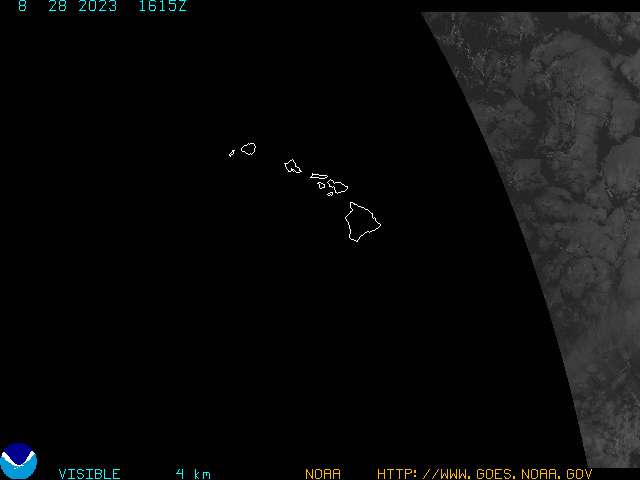
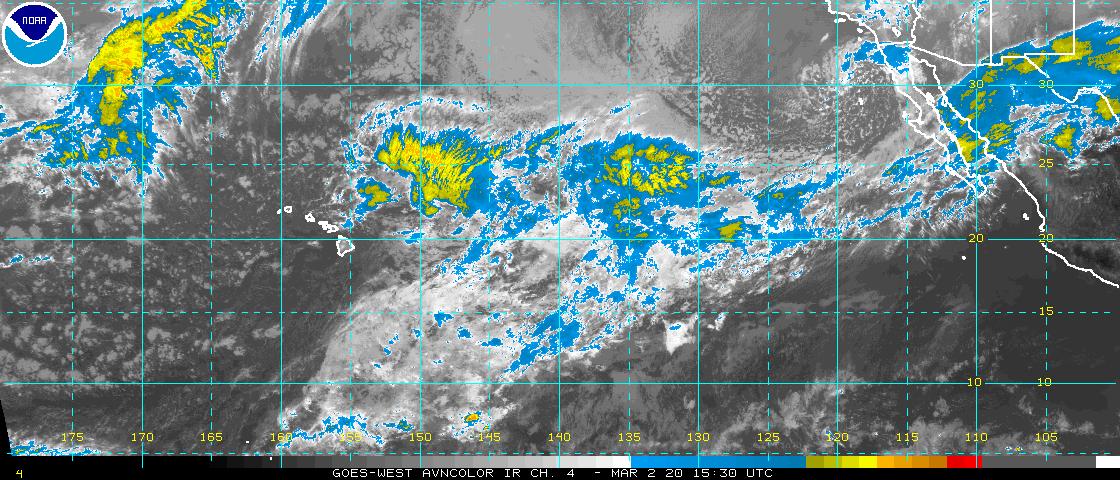
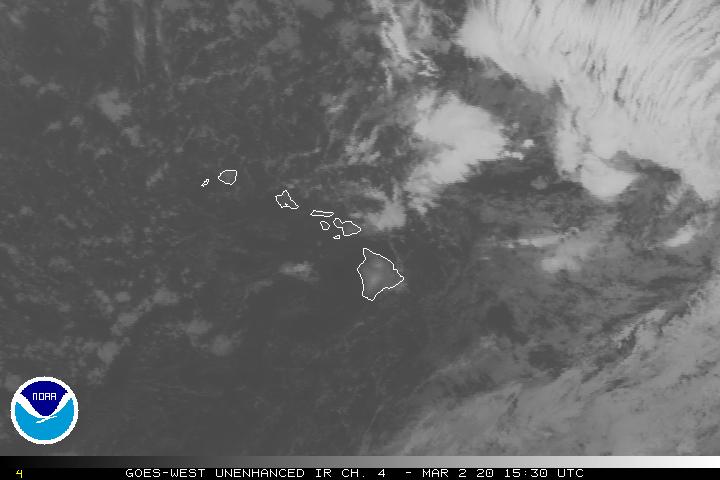
Satellite and Radar Images: To view the cloud conditions we have here in Hawaii, please use the following satellite links, starting off with this Infrared Satellite Image of the islands to see all the clouds around the state during the day and night. This next image is one that gives close images of the islands only during the daytime hours, and is referred to as a Close-up visible image. This next image shows a larger view of the Pacific…giving perspective to the wider ranging cloud patterns in the Pacific Ocean. Finally, here’s a Looping IR satellite image, making viewable the clouds around the islands 24 hours a day. To help you keep track of where any showers may be around the islands, here’s the latest animated radar image.
Hawaii’s Mountains – Here’s a link to the live webcam on the summit of near 14,000 foot Mauna Kea on the Big Island of Hawaii. The tallest peak on the island of Maui is the Haleakala Crater, which is near 10,000 feet in elevation. These two webcams are available during the daylight hours here in the islands…and when there’s a big moon rising just after sunset for an hour or two! Plus, during the nights and early mornings you will be able to see stars, and the sunrise too…depending upon weather conditions.
Tropical Cyclone activity in the eastern and central Pacific – Here’s the latest weather information coming out of the National Hurricane Center, covering the eastern north Pacific. You can find the latest tropical cyclone information for the central north Pacific (where Hawaii is located) by clicking on this link to the Central Pacific Hurricane Center. Here’s a tracking map covering both the eastern and central Pacific Ocean. A satellite image, which shows the entire ocean area between Hawaii and the Mexican coast…can be found here.
Aloha Paragraphs

Beautiful picture of Kauai
A series of fairly weak cold fronts will bring periodic showers to our islands through the next week…generally falling along the windward sides. The first of these frontal cloud bands will brush by the Aloha state to our northeast Tuesday night. Here’s a satellite image of this weak cold front, which shows that most of the precipitation falling over the ocean to the east of Hawaii. We may see a few very minor showers as a weak, associated cloud band progresses down through the island chain tonight. The next in this three part series of cold fronts, will arrive on Kauai Christmas Eve day…bringing some showers with it. This second cold front won’t amount to all that much either, although the models suggest it will be somewhat more robust, and bring clouds and showers down the island chain Thursday night into Friday.
The bulk of the showers from this second cold front will fall along the north and northeast…to ENE facing windward sides. Here’s a larger satellite image, showing this next cold front far to the north and northwest of our islands. Winds will be light, perhaps swinging around to the south or SW Kona direction preceding its arrival…depending upon how strong the cold front happens to be then. The winds will veer around to the north and northeast in the wake of that cold front…bringing a brief bout of slightly cooler air with it. The third cold front will arrive by later Sunday into Monday, likely followed by another day or two of northeast breezes, before a fourth possible cold front arrives around the middle of next week – please don’t quote me though, as that’s a bit too far out into the future to conjecture about all that strongly!
More importantly, and certainly more of a threatening nature…will be the large to extra large surf that will be breaking along our north and west facing beaches. These swells, coming in from the northwest direction generally, will keep high surf warning level waves breaking for the time being. These swells are being generated by deep storm low pressure systems in the far northwest Pacific. This latest weather map shows the very long fetch, that stretch of the ocean where storm force winds are blowing…in the direction of our islands today. The swell coming our way for Christmas Eve into Christmas Day, is being compared to the near giant surf we had a couple of weeks ago.
Folks that are drawn to the beaches of course, to watch these extra large waves, but should exercise caution…and remain well away from the shoreline. We were lucky a couple of weeks ago, as we didn’t lose anyone to the very rough ocean conditions, and we’d like to keep it that way! The El Nino phase of the ENSO cycle is helping to provide this extra large surf now, as it often does here in the islands. El Nino is forecast to bring drier than normal rainfall to the Aloha state, punctuated of course, by wet storms. El Nino periods can also bring up more than the ordinary amount of volcanic haze from the
It’s early Tuesday evening here on Maui, as I begin writing this last section of today’s narrative. Tuesday was a good day, with lots of sunshine available in most areas. The winds were a little cool, as they came in from a more northerly direction than usual. Even though, the Kona coast on the Big Island had a high temperature Tuesday afternoon, of a remarkable 87F degrees. This was due to the fact that the north breezes were blocked from arriving in Kona, due to the presence of the large mountains blocking that cool air. The rest of the state was mostly in the upper 70’s to very low 80’s. Air temperatures will be seasonable tonight, and then again on Wednesday. At noted above, later Christmas Eve Day, into Christmas Day, we’ll have a cold front bringing some showers to us, although the bulk of those will fall along the windward sides of the islands. ~~~ Looking out the window here in Kihei, just before I take the drive back upcountry to Kula, its generally clear outside. I expect some showers to come riding in along the windward sides this evening however, although I doubt whether very many of them, if any at all, will make the trip over to the leeward sides. I’ll meet you back here dark and early Wednesday morning, with your next new weather narrative waiting for you as usual. Aloha for now…Glenn.
Interesting: Federal officials are promoting the use of a chalky residue from coal-burning power plants as a fertilizer on U.S. farms, even as regulators simultaneously consider new rules for the waste, which contains small amounts of toxic metals. During the Bush administration, U.S. officials began promoting the agricultural use of a synthetic form of gypsum, a calcium-rich substance produced by the "scrubbers" that remove acid rain-causing sulfur from coal plant emissions.
As a cheaper alternative to mined gypsum in fertilizing crops, use of so-called flue gas desulfurization gypsum, or FGD gypsum, has tripled since 2001. And with the waste piling up at coal-fired power plants around the country, officials saw it as a more "beneficial use" than simply burying it in landfills.
But FGD gypsum also contains mercury, arsenic, and lead, and some environmentalists warn that not enough is known about the environmental and health effects. Federal officials insist the levels are so low that they pose no hazards to health. Meanwhile, the Environmental Protection Agency is crafting the first U.S. regulations for coal waste storage and disposal in response to a major coal ash spill from a Tennessee power plant that flooded 300 acres on Dec, 22, 2008 and caused about $1 billion in damage.
Update: EPA’s pending decision on regulating coal ash waste from power plants, expected this month, will be delayed for a short period due to the complexity of the analysis the agency is currently finishing. As part of her commitment to ensuring the protection of public health and the environment regarding coal ash, EPA Administrator Lisa P. Jackson had set a deadline to complete the regulatory decision before the close of this year. However, the agency is still actively clarifying and refining parts of the proposal.
Interesting2: Twenty-five years on, campaigners say the world’s worst-ever industrial accident is still claiming victims. Sanjay Kumar visits Bhopal in India and speaks to the locals who say their government has failed them badly. Bhopal is a beautiful city. Located about 750 kilometers south of Delhi and surrounded by lakes and lush greenery, Old and New Bhopal are a fascinating and thriving combination of Islamic and Hindu architecture vying for space in a city founded about 1000 years ago.
But perched a little away from the old and new cities is a quite different face of Bhopal. Here in Jayaprakash Nagar, or JP ith potholes and the lanes are dusty and unkempt. For this is a place that many want to forget–the location of the Union Carbide Plant, the scene of the world’s worst-ever industrial disaster.
Twenty-five years ago, in the early hours of December 3, deadly methyl isocyanate and other toxins leaked from the plant, exposing hundreds of thousands to the poisonous gas. Although no official total casualty count has been released, estimates based on hospital and rehabilitation records suggest that more than 25,000 people died either as a direct result of the gas leak or from diseases related to it, while tens of thousands more have reported being sick.
"I think it would have been better if we’d died that night," says Leela Bai. "At least then I wouldn’t have had to see my children in such a miserable condition." Leela’s daughter, Renu, was a year old when the gas leak occurred. She survived the incident, but has suffered the after-effects ever since. Her face became bloated, her hair grew thinner and she developed an abnormal growth near her stomach.
Renu eventually married, but her first husband left her after their first child was born because her poor health prevented her from performing daily chores. Her brother, meanwhile, could not escape the effects of the leak despite being born four years after the disaster. Even at 22 he’s more like a teenager, with both his physical and mental growth having been stunted.
Interesting3: The USEPA released in early December the 2008 Toxics Release Inventory (TRI) report which provides information on toxic chemicals used and released by utilities, refineries, chemical manufacturers, paper companies, and many other facilities across the nation to all media whether it is air, water or solid waste. The TRI is compiled from data submitted to EPA and the States by industry.
For the EPA’s mid-Atlantic region, the 2008 TRI data indicate a 9.1 percent decrease of 35.2 million pounds of on and off site chemical releases as compared with 2007. A total of 350 million pounds of chemicals were released during 2008 to the air, water or landfills by facilities in the mid-Atlantic region which includes Pennsylvania, Delaware, Maryland, Virginia, West Virginia and the District of Columbia.
When compared with the 2000 TRI data of 478.0 million pounds released, the 2008 figures represent a 27.0 percent reduction (128.0 million pounds) in toxic pollutants released by facilities in the mid-Atlantic region. This was accomplished by process changes, raw material substitution and pollution control equipment. From a national perspective all toxic releases were 3.86 billion pounds in 2008 which was down from 4.12 billion pounds in 2007 and 4.32 billion in 2006. This is a decrease of 10 % in just three years.
Interesting4: The British Antarctic Survey has released new photographs of ice fish, octopus, sea pigs, giant sea spiders, rare rays and beautiful basket stars that live in Antarctica’s continental shelf seas are revealed this week by the British Antarctic Survey (BAS). As part of an international study on sea surface to seabed biodiversity a research team from across Europe, USA, Australia and South Africa onboard the BAS Royal Research Ship James Clark Ross sampled a bizarre collection of marine creatures from the Bellingshausen Sea, West Antarctica — one of the fastest warming seas in the world.
Research cruise leader Dr. David Barnes of British Antarctic Survey said, "Few people realize just how rich in biodiversity the Southern Ocean is — even a single trawl can reveal a fascinating array of weird and wonderful creatures as would be seen on a coral reef. These animals are potentially very good indicators of environmental change as many occur in the shallows, which are changing fast, but also in deeper water which will warm much less quickly.
We can now begin to get a better understanding of how the ecosystem will adapt to change." "Our research on species living in the waters surrounding the BAS Rothera Research Station on the Antarctic Peninsula shows that some species are incredibly sensitive to temperature changes.
Our new studies on the diverse range of marine creatures living in the deep waters of the Bellingshausen Sea will help us build a more complete picture of Antarctica’s marine biodiversity and give us an important baseline against which we can compare future impact on marine life."
The teeth of some apes are formed primarily to handle the most stressful times when food is scarce, according to new research performed at the National Institute of Standards and Technology (NIST). The findings imply that if humanity is serious about protecting its close evolutionary cousins, the food apes eat during these tough periods — and where they find it — must be included in conservation efforts.
Interesting5: It’s known that escaped fish from Norwegian salmon farms can interbreed with wild salmon, and thus must have changed the genetic and physical makeup of the country’s famed wild salmon stocks. But how much? Biologists at the Norwegian University of Science and Technology (NTNU) are trying to answer this question by breeding special fish families to determine the exact genetic differences between farmed and wild salmon stocks.
Scientists at the Norwegian University of Science and Technology are trying to determine the genetic differences between farmed and wild salmon — and the effects of those differences — as a way to help protect the country’s unique wild salmon stocks. Beginning in 1971, aquaculture researchers combed 40 of Norway’s best wild salmon rivers to find the soundest genetic stock they could.
These fish, selected for their ability to grow rapidly and use food efficiently, formed the breeding lines for Norway’s wildly successful salmon aquaculture industry. Nearly 40 years and 10 salmon generations later, the industry has grown by a factor of more than 600, and had a turnover of roughly $3 billion US in 2007.
But producing more than 170 million farmed salmon results in at least some escapees — according to Statistics Norway, the official government statistics office, roughly 450,000 farmed salmon and trout escaped from Norwegian fish farms in 2007. In comparison, an estimated 470,000 wild Atlantic salmon approached the Norwegian coast in 2007 to spawn in one of Norway’s salmon rivers.
It’s known that escaped farmed fish can interbreed with wild salmon, and thus must have changed the genetic and physical makeup of today’s wild salmon stocks. But how much? Biologists at the Norwegian University of Science and Technology (NTNU) are trying to answer this question by breeding special fish families to determine the exact genetic differences between farmed and wild salmon stocks.
Led by Ole Kristian Berg and Sigurd Einum, professors at NTNU’s Department of Biology, researchers including have established 130 different salmon "families," where the father’s contribution comes from sperm taken from Norway’s first generation of farmed salmon (stored in a sperm bank), and the mother comes from a selection of Norwegian salmon rivers as well as from farmed stock.
The result is a combination of specially bred fish that can be compared to today’s stocks of wild fish. When the specially bred fish are five centimeters long, they will have grown enough so that their physical characteristics, as well as their genetic makeup, can be compared to wild salmon of today.
Norway is home to the world’s most genetically varied wild salmon stocks on the planet, with genetically distinct groups found in the country’s 452 different wild salmon rivers. But since 1970, wild salmon stocks have been reduced by roughly 80 per cent.
Fully 10 percent of the country’s salmon rivers have lost their populations, with another 32 rivers severely threatened because of the effects of hydropower development, acid rain, sea lice and the invasion of the parasite Gyrodactylus salaris.
In 2008, scientists from the Norwegian Institute for Nature Research, a government research institute, determined that fully 35 per cent of all salmon in the Surna River, one of Norway’s most important wild salmon rivers, were in fact farmed fish "That is very high for such a big salmon river," says Kjetil Hindar, a senior researcher at NINA.
"In rivers that have been affected by diseases or by parasites like Gyrodactylus, wild salmon stocks are weakened and are particularly vulnerable," says NTNU’s Berg. "It is easy for these stocks to be affected by wild salmon whose genes have been diluted by farmed fish."
Interesting6: Dasher and Dancer and Prancer and Vixen were no doubt keeping an eye on the recent climate conference in Copenhagen. Reindeer numbers have dropped nearly 60 percent in the last three decades due to climate change and habitat disturbance caused by humans, a study earlier this year found. The decline of reindeer is a hot topic to more than just Santa and millions of children around the world.
"The caribou is central to the normal function of northern ecosystems," Justina Ray, executive director of Wildlife Conservation Society-Canada, said last year. "With their huge range requirements and need for intact landscapes, these animals are serving as the litmus test for whether we will succeed in taking care of their needs in an area that is under intensifying pressure."
Here are some reindeer facts that might surprise you (especially the last one): They’re actually Caribou. Reindeer and Caribou are two names for the same species (Rangifer tarandus), with reindeer generally referring to the domesticated variety that are herded by humans and pull sleds. Such reindeer live mostly in Scandinavia and Siberia and are typically smaller with shorter legs than their wild caribou relatives.
In Siberia, caribou are called "wild" reindeer. The animal’s size and weight varies by gender and age, with adult caribou reaching 3 to 4 feet tall and weighing on average up to 375 pounds for males and 200 pounds for females. They’re fast. While they may not fly, scientists say caribou can run as fast as 48 mph, though their normal walk is a slow one.
When alarmed by a predator, however, a caribou will trot with its head held high and parallel to the ground, and its normally floppy tail held up in the air. When chased, it will gallop quickly. They get around. Caribou are known to travel up to 3,000 miles in a year, the longest documented movements of any terrestrial mammal, according to the IUCN.
Their counterpart in the water, the humpback whale, holds the record for the longest mammalian voyage, swimming 5,000 miles to their balmy breeding grounds in winter. They can handle the cold. These antlered deer live in Alaska, Canada, Scandinavia and Russia, where they graze on tundra plants.
Rather than a velvety suit, reindeer are covered with hollow hairs that trap in air and keep them well-insulated from the elements. Plus, their circulatory systems keep the cooler blood in the reindeer’s limbs from drawing heat from the warm blood in their core body. They’re quiet. Santa won’t have to worry about his reindeer waking up the kids (at least those without bells around their necks).
Female reindeer tend to communicate mainly in the first months after the birth of offspring in summer, while males vocalize exclusively during the autumn mating season. During other seasons when they do vocalize, here’s how: Scientists found males are equipped with a large air sac in the neck that enables them to emit a hoarse rattling sound, or mating call.
The throaty call could deter rival males while attracting a potential mate. For the females, such air sacs allow moms to individualize their calls when communicating with their young. Santa’s crew is all-female. Male reindeer shed their antlers at the end of the mating season in early December.
Females, however, keep their thinner antlers throughout the winter. If all the sightings are to be believed, then it is the gals tugging pudgy Santa and the goods through the winter sky. And this might be why Santa chose an all-female crew: Male reindeer carry as little as 5 percent body fat when Christmas rolls around, having lost much of their fatty stores during the mating season.
Female reindeer, however, enter winter carrying about 50 percent body fat. This natural insulator, which can be a couple of inches thick on their rumps, keeps the reindeer toasty in temperatures as low as minus 45 degrees Fahrenheit (minus 43 degrees Celsius).
 Email Glenn James: