December 21-22, 2009
Air Temperatures – The following maximum temperatures were recorded across the state of Hawaii Monday afternoon:
Lihue, Kauai – 78
Honolulu, Oahu – 81
Kaneohe, Oahu – 80
Kaunakakai, Molokai – 81
Kahului, Maui – 82
Hilo, Hawaii – 81
Kailua-kona – 79
Air Temperatures ranged between these warmest and coolest spots near sea level around the state – and on the highest mountains…at 5pm Monday evening:
Port Allen, Kauai – 81F
Princeville, Kauai – 73
Haleakala Crater – 46 (near 10,000 feet on Maui)
Mauna Kea summit – 39 (near 14,000 feet on the Big Island)
Precipitation Totals – The following numbers represent the largest precipitation totals (inches) during the last 24 hours on each of the major islands, as of Monday afternoon:
0.07 Mount Waialaele, Kauai
0.33 Oahu Forest NWR, Oahu
0.02 Molokai
0.00 Lanai
0.08 Kahoolawe
0.01 Kepuni, Maui
1.37 Mountain View, Big Island
Marine Winds – Here’s the latest (automatically updated) weather map showing a 1028 millibar high pressure system northeast of the islands. Our winds will come in from the trade wind direction, gradually picking up a little again Tuesday…then lighter again Wednesday.
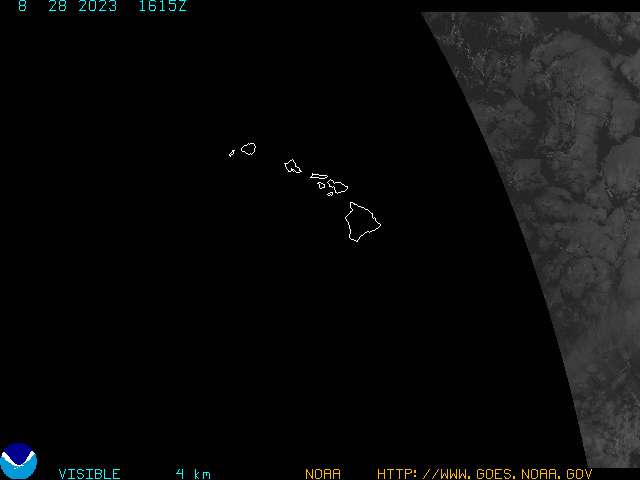
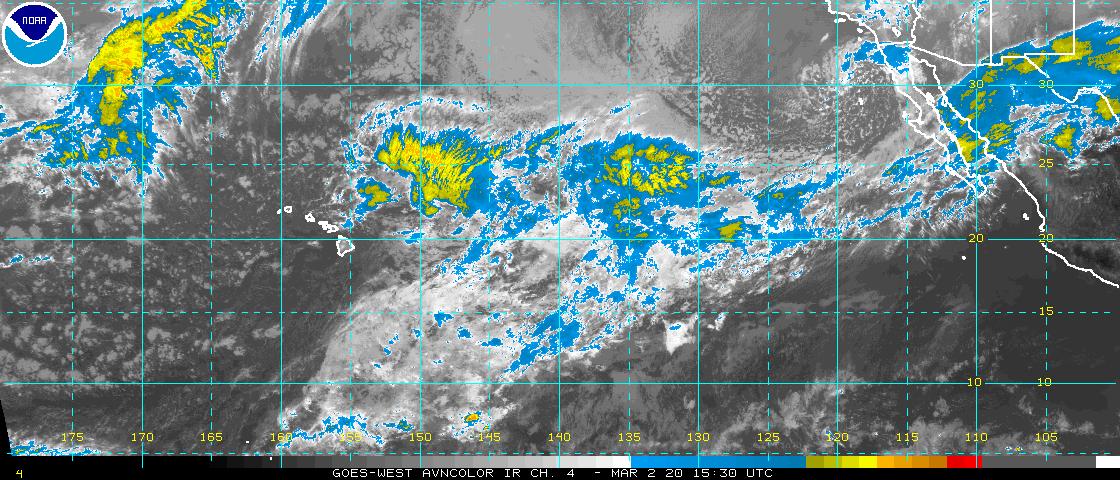
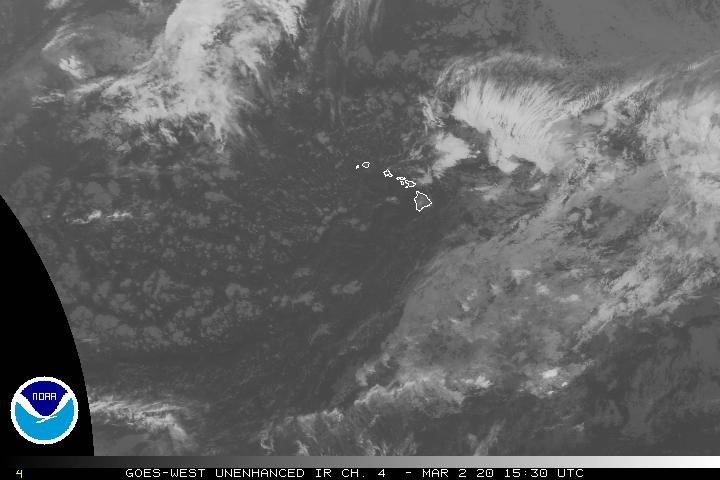
Satellite and Radar Images: To view the cloud conditions we have here in Hawaii, please use the following satellite links, starting off with this Infrared Satellite Image of the islands to see all the clouds around the state during the day and night. This next image is one that gives close images of the islands only during the daytime hours, and is referred to as a Close-up visible image. This next image shows a larger view of the Pacific…giving perspective to the wider ranging cloud patterns in the Pacific Ocean. Finally, here’s a Looping IR satellite image, making viewable the clouds around the islands 24 hours a day. To help you keep track of where any showers may be around the islands, here’s the latest animated radar image.
Hawaii’s Mountains – Here’s a link to the live webcam on the summit of near 14,000 foot Mauna Kea on the Big Island of Hawaii. The tallest peak on the island of Maui is the Haleakala Crater, which is near 10,000 feet in elevation. These two webcams are available during the daylight hours here in the islands…and when there’s a big moon rising just after sunset for an hour or two! Plus, during the nights and early mornings you will be able to see stars, and the sunrise too…depending upon weather conditions.
Tropical Cyclone activity in the eastern and central Pacific – Here’s the latest weather information coming out of the National Hurricane Center, covering the eastern north Pacific. You can find the latest tropical cyclone information for the central north Pacific (where Hawaii is located) by clicking on this link to the Central Pacific Hurricane Center. Here’s a tracking map covering both the eastern and central Pacific Ocean. A satellite image, which shows the entire ocean area between Hawaii and the Mexican coast…can be found here.
Aloha Paragraphs

Empty Hawaiian beach…ready for a long walk
The recent unusual weather has ended, as the responsible cold air aloft, mixing with the leftover moisture from last week’s cold fronts, shifts eastward…away from our islands. Stable conditions have returned in the wake of the departing upper level trough of low pressure. We remain in a light trade wind flow of air near the
The computer forecast models show periodic cold fronts approaching the islands this week. The first is expected late tonight into Tuesday, although won’t amount to much, perhaps most on Kauai and
It’s early Monday evening here on Maui, as I begin writing this last section of today’s narrative. Monday was a perfectly nice day, at least compared to what we saw Sunday, during the early morning hours. I already described all of that during the morning part of this narrative, so I won’t go into it again. You could always go to the left hand margin of this page, and click on the Archived Narratives link, and go back through the 1000+ past narratives that I’ve written! At any rate, Monday was a great day, as will be Tuesday and Wednesday. As noted above, several cold fronts will dive down towards us, although none of them are expected to be all that serious. There will be one Tuesday, and then around Christmas Day, and a third later this coming Sunday. ~~~ Today is/was the winter solstice, which marks that interface between autumn and winter. This is the time of year when we expect more frequent weather changes…which has been happening lately. ~~~ I’m about ready to take the drive back upcountry to Kula, and to hunker in until early Tuesday morning, when I’ll be up well before dawn to prepare your next new weather narrative. When I got home to Kula, it was foggy and lightly raining, took me by surprise, this seems to be happening more lately. I hope you have a great Monday night, see you in the morning! Aloha for now…Glenn.
Interesting: Chimps remain cool under fire, possessing a near human ability to predict how wildfires spread and react accordingly. This newfound capability of chimpanzees to understand flames might shed light on when and how our distant ancestors first learned to control fire, scientists now suggest. Primatologist Jill Pruetz at Iowa State University in Ames was observing savanna chimpanzees in Senegal in 2006 as people were setting wildfires, an annual tradition that clears land and aids hunting.
Most areas within the chimpanzees’ home range are burned to some degree. "It was the end of the dry season, so the fires burn so hot and burn up trees really fast, and they were so calm about it," Pruetz said of the chimps. "They were a lot better than I was, that’s for sure."
For the most part, wild animals consider fire very distressing, but the chimpanzees showed no sign of stress or fear with the wildfires, other than calmly avoiding the fire as it approached them. "I was surprised at how expert they were at handling the fire," Pruetz told LiveScience.
"The fire was burning really hot, and the flames were at least 10 feet high, up to 20 feet at times." The apes were experts at predicting where the fire would go, Pruetz noted. "I could predict it, sort of, but if it were just me, I would have left," she said. "At one time, I actually had to push through them because I could feel the heat from the fire that was on the side of me and I just wasn’t that comfortable with it."
Interesting2: Airline passengers, who sneak in cell phone calls, play with gaming devices or listen to their mp3 players, during takeoff or landing, probably won’t cause a plane crash, but they may risk a confrontation with flight attendants. Federal agencies and airlines typically err on the side of caution — even though researchers and aircraft companies have found almost no direct evidence of cell phones or other electronic devices interfering with aircraft systems.
Frequent flyers know the familiar drill of only using certain electronic devices at cruising altitudes. The Federal Aviation Administration (FAA) asked the RTCA, an independent industry standards organization, to study the issue of electronic devices on airplanes in 1992. The RTCA found no interference and eventually recommended allowing the use of laptops, gaming devices and music players.
Still, it suggested the precaution of banning the use of any and all devices during the critical takeoff and landing phases. Boeing also investigated several cases in the 1990s where aircraft crews reported that laptop computers or gaming devices caused autopilot disconnects, un-commanded airplane rolls or instrument display malfunctions. The aircraft manufacturer was never able to replicate the reported anomalies in lab tests. Cell phones and wireless devices such as laptops represent a different concern.
They emit active transmissions on the electromagnetic spectrum, which is used by devices that include phones, radios and Wi-Fi networks. But the FCC divided the spectrum into different chunks for different uses, and so a cell phone call should not interfere with the bands reserved for aircraft communications or GPS navigation systems. It turns out that the ban on wireless devices has a lot more to do with possible interference for ground networks, rather than any danger posed to aircraft systems.
The Federal Communications Commission (FCC) banned in-flight use of most cell phones and wireless devices in 1991, citing the reason of ground network interference. FAA regulations uphold the FCC decision. But some airlines allow passengers to use cell phones in "airplane mode," which shuts off phone transmissions.
The FCC briefly considered lifting the in-flight ban on wireless devices, but eventually decided in 2007 to keep the current rules in place because there wasn’t enough evidence to show whether in-flight wireless devices would cause harmful interference with ground networks.
There also wasn’t evidence demonstrating that the devices do cause interference, but the federal agency decided to play it safe. An RTCA report commissioned by the FAA in 2006 also cited a lack of evidence, and recommended keeping the current rules on electronic devices. All the regulations in the world still haven’t prevented airline passengers from casually whipping out the cell phone every now and then.
About one to four cell phone calls were made during every commercial flight, according to a 2006 study from Carnegie Mellon University in Pittsburgh. Funnily enough, the FAA even had to advise aircraft crewmembers to turn off their cell phones during takeoff and landing, after an incident in early 2009. In that case, a first officer’s ringtone proved potentially distracting during takeoff — but as the crew pointed out, their General Operations Manual did not prohibit them from keeping their cell phones on.
Travelers who can’t part with their wireless Internet connections can now at least pay for in-flight access on a growing number of airlines, or take advantage of a free Wi-Fi holiday deal on Virgin American flights. Such services use a dedicated chunk of the electromagnetic spectrum reserved for air-to-ground communication.
Cell phone use remains out of the question during flights, and ditto for Internet voice applications such as Skype. But passengers can at least comfort themselves by knowing that their flight won’t include anyone yammering loudly on a personal call. As the FAA notes, a majority of travelers probably prefer the silence.
Interesting3: A study published by U.S. scientists on Sunday said pollution has caused the world’s oceans to become noisier, causing more harmful effects to whales, dolphins, and other marine life. These effects include death and serious injury caused by brain hemorrhages or other tissue trauma, strandings and beachings, temporary and permanent hearing loss or impairment, displacement from preferred habitat and disruption of feeding, breeding, nursing, communication, sensing and other behaviors vital to the survival of these species.
An increase in motorboats, primarily commercial shipping traffic, exploration and extraction of oil and other minerals, sonar and even coastal jet ski traffic are contributing to the increased level of underwater noise. Man-made sounds are drowning out the calls of mates, calves and other pods that these mammals depend on.
The report, published in the science journal Nature, stated that the sound is absorbed mainly through the viscosity of the water and the presence of certain dissolved chemicals. But the concentration of chemicals that absorb sound in the oceans has declined as a result of ocean acidification, in turn caused by rising concentrations of carbon dioxide. Scientists say with the number of ships doubling over the past 40 years, levels of carbon dioxide have risen dramatically.
This causes pH levels to drop and acidity in the oceans to increase. They found that the increase in acidity could reduce seawater sound absorption by as much as 60 percent by 2100 in high latitude oceans. One of the negative effects of the increased acidity is the reduced rate of calcification, such as that seen in coral reefs.
The authors say, "However, a less anticipated consequence of ocean acidification is its effect on underwater sound absorption." "A decrease in seawater pH lowers sound absorption in the low-frequency range and, as a result, leads to increasing sound transmission," they added.
The study said future global warming may further decrease the ocean’s sound absorption capacity at certain frequencies. "High levels of low-frequency sound have a number of behavioral and biological effects on marine life," it added.
The effects of noise pollution are not as easy to notice as are the other more obvious and visible pollutants like oil spills and marine debris. To what extent these manmade sounds are negatively impacting the oceans is not fully known.
Interesting4: A rumbling volcano in the Philippines was on the verge of a major eruption today – but thousands of villagers living on its slopes are refusing to leave their homes. Already, 40,000 people have fled the no-go zone around Mount Mayon, which oozed crimson lava during eerie scenes captured last night. But around 3,000 residents, mostly farmers, remain – with some even returning after being evacuated up to three times by authorities.
As well as being covered by rivers of lava, those who stay face the additional danger of suffocating ash explosions, experts said. Scientists warned that powerful booms emanating from the country’s most active volcano – 200 miles from capital Manila – indicated that a major eruption was imminent.
After a week of puffing out ash and sending bursts of lava trickling down its steep slopes, the 8,070ft mountain overlooking the Gulf of Albay and Legazpi city in Albay province, in the central Philippines, has caused nearly 2,000 volcanic earthquakes and tremors since yesterday.
The emission of sulphur dioxide – an indication of magma rising inside the volcano – jumped to 6,000 tons per day from the normal 500, said the Philippine Institute of Volcanology and Seismology. It also reported ‘audible booming and rumbling sounds’ in the eastern flank of the volcano, accompanied by intensified crater glow at night.
Lava fountains bursting from the cone-shaped volcano overnight rose 650 feet in the air and red-hot lava flows have reached three miles from the crater, the institute said. Scientists raised the alert level yesterday to one step below a hazardous eruption, saying one was possible within days.
The only higher level is when a major eruption is already in progress. Army troops and police added more patrols to enforce a five-mile exclusion zone around the mountain. More than 40,000 residents were given sleeping mats and food inside school buildings, gyms and other emergency shelters, but some have still been spotted checking on their farms in the prohibited zone.
Albay province governer, Joey Salceda, said about 5,000 more villagers were being transported out of Mayon’s danger zone, but that they were struggling to get everyone to leave. He said: ‘There are people who have been evacuated three times and we sigh: “You again?” We’ve been playing cat and mouse with them.’
A major eruption could trigger pyroclastic flows – superheated gas and volcanic debris that race down the slopes at very high speeds, vaporizing everything in their path. More extensive explosions of ash could drift toward nearby towns and cities. The provincial capital of Legazpi is about nine miles away.
In Mayon’s other eruptions in recent years, pyroclastic flows had reached up to four miles from the crater. ‘The probability of survival in an eruption is zero if you’re in the danger area. The solution is obviously distance,’ Mr Salceda said. Mayon last erupted in 2006, when about 30,000 people were moved. Another eruption in 1993 killed 79 people.
The first recorded eruption was in 1616 but the most destructive came in 1814, killing more than 1,200 people and burying a town in volcanic mud. The ruins of the church in Cagsawa have become an iconic tourist spot. In 1991, Mount Pinatubo exploded in the northern Philippines in one of the biggest volcanic eruptions of the 20th century, killing about 800 people.
 Email Glenn James: