Weather Details and Aloha Paragraphs
Posted by GlennNovember 15-16 2006
Air Temperatures – The following maximum temperatures were recorded across Hawaii Wednesday:
Lihue, Kauai – 82F
Honolulu, Oahu – 84
Kaneohe, Oahu – 84
Kahului, Maui – 85
Hilo, Hawaii – 85
Kailua-Kona, Hawaii – 86
Temperatures early Thursday morning ranged between these warmest and coolest spots near sea level at the 4 a.m. hour:
Honolulu – 76F
Kahului airport – 72F
Precipitation Totals – The following numbers represent the largest precipitation totals (inches) during the last 24 hours on each of the major islands, as of Thursday morning:
0.73 MOUNT WAIALAELAE, KAUAI
0.65 WAIHEE PUMP, OAHU
0.03 MOLOKAI
0.36 LANAI
0.00 KAHOOLAWE
0.12 ULUPALAKUA, MAUI
0.12 HONAUNAU, BIG ISLAND
Weather Chart – Here’s the latest (automatically updated) weather map…showing a weak 1020 millibar high pressure system far ENE of the islands Thursday. This high’s ridge is now north of the state, allowing the brief return of light to locally moderate trade winds today, then gradually becoming SE later Friday. Here’s a Weather Map Symbol page for clarification about what all those weather symbols mean on the map.
Hawaii’s Mountains – Here’s a link to the live webcam on the summit of near 14,000 foot Mauna Kea on the Big Island of Hawaii. The tallest peak on the island of Maui is the Haleakala Crater, which is near 10,000 feet in elevation. These two webcams are available during the daylight hours here in the islands…and when there’s a big moon rising just after sunset for an hour or two! Plus, during the nights and early mornings you will be able to see stars, and the sunrise too…depending upon cloud conditions.
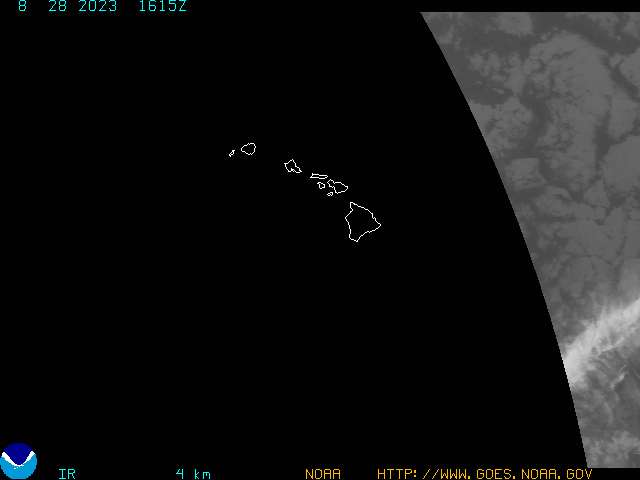
Satellite Images – To view the cloud conditions we have here in Hawaii, please use the following satellite links, starting off with the Infrared Satellite Image of the islands to see all the clouds around the state during the day and night. This next image is one that gives close images of the islands only during the daytime hours, and is referred to as a Close-up visible image. This next image shows a larger view of the Pacific…giving perspective to the wider ranging cloud patterns in the Pacific Ocean…out from the islands. To help you keep track of where any showers may be around the islands, here’s the latest animated radar image.
Tropical Cyclone Activity – The eastern Pacific hurricane season runs from May 15 through November 30…while the central Pacific (where Hawaii is) runs from June 1 through November 30. The latest storm information for the eastern Pacific can be found by clicking here. A storm tracking map for both the central and eastern areas can be found by clicking here. For the central Pacific, the latest storm information can be found by clicking here.
Aloha Paragraphs

Photo Credit: flikr.com
The Hawaiian Islands can expect one more day of humid and hazy weather, before the trade winds return Thursday into Friday. Recent moisture laden kona breezes, coming up from the south and SW directions, have kept the Aloha state shower prone the last couple of days. These showers, which have been locally heavy in places, have recently been concentrating their efforts most effectively over the island of Lanai, and into the Lahaina area of west Maui. The rain gauge at Lahainaluna, which is up above Lahaina, Maui, received 1.22" during the last 24 hours, making it the wettest spot in the state. The central islands will remain the most showery Wednesday, although other places around the state could see some isolated showers as well.
As we move into Thursday and early Friday, we’ll transition into a trade wind weather pattern, with a definite bias for showers to fall along the windward sides of the islands. Whatever is left of the moist clouds carried into the state by the last cold front, will be fuel for the incoming showers arriving with the trade winds. As we move into the coming weekend, weather models bring in a second cold front. It’s expected to stall near Kauai briefly, but the kona winds that develop ahead of the frontal boundary may be able to carry moist clouds up from the deeper tropics, bringing some showers into our area again. The trade winds will then make another appearance late Monday or early Tuesday in stronger form, and as they do, this second cold front’s moisture will make the windward sides potentially quite wet.
It was a big day in the Pacific Ocean today, starting off with a major earthquake off the Kuril Islands of Japan! A local tsunami was generated there, with refracted swells bouncing around the Pacific basin throughout the day elsewhere. Here in Hawaii we had some form of withdrawing water in places, with up to 6 foot surges thereafter. I heard that Crescent City, in far northern California had big damage as tsunamigenic waves tore down two piers there. I haven’t heard of any deaths, which is good news! In the world of weather here on Maui, we had much less showery weather, although the thick volcanic haze certainly was around in places again. A northerly breeze kicked up along the windward sides this afternoon, which helped to clear the skies a little, although it compounded the already hazy skies along the Haleakala leeward slopes…all the way down to Kihei and Wailea. It was such a busy day at the Pacific Disaster Center (my day job) that I didn’t get to the beach during my lunch break, but oh well, there’s always tomorrow. We should see the trade winds return Thursday, which will help to ventilate the atmosphere of haze, hopefully that is! I hope you have a good Wednesday night, and that you will meet me back here again Thursday. Aloha for now…Glenn.
I want to recommend that you use the advertising links on the left hand side of this page, as they all offer great services or products!
 Email Glenn James: