











January 7-8, 2011
Air Temperatures – The following maximum temperatures were recorded across the state of Hawaii Friday afternoon:
Lihue airport, Kauai – 75
Honolulu airport, Oahu – 76
Kaneohe, Oahu – 77
Molokai airport – 73
Kahului airport, Maui – 75
Kona airport – 81
Hilo airport, Hawaii – 74
Air Temperatures ranged between these warmest and coolest spots near sea level – and on the highest mountain tops…as of 5pm Friday evening:
Port Allen, Kauai – 77F
Kailua-kona – 70
Haleakala Crater – 36 (near 10,000 feet on Maui)
Mauna Kea summit – 21 (near 14,000 feet on the Big Island)
Precipitation Totals – The following numbers represent the largest precipitation totals (inches) during the last 24 hours on each of the major islands, as of Friday afternoon:
0.64 Kilohana, Kauai
0.03 Kamehame, Oahu
0.02 Molokai
0.00 Lanai
0.00 Kahoolawe
0.15 Oheo Gulch, Maui
0.41 Laupahoehoe, Big Island
Marine Winds – Here’s the latest (automatically updated) weather map showing a gale low pressure system to the north-northeast…with its associated cold front stalled near the Big Island. Our winds will be from the north turning more west or northwest Saturday….becoming stronger from the south and southwest later Sunday.
Satellite and Radar Images: To view the cloud conditions we have here in Hawaii, please use the following satellite links, starting off with this Infrared Satellite Image of the islands to see all the clouds around during the day and night. This next image is one that gives close images of the islands only during the daytime hours, and is referred to as a Close-up visible image. This next image shows a larger view of the Pacific…giving perspective to the wider ranging cloud patterns in the Pacific Ocean. Finally, here's a Looping IR satellite image, making viewable the clouds around the islands 24 hours a day. To help you keep track of where any showers may be around the islands, here’s the latest animated radar image.
Hawaii’s Mountains – Here’s a link to the live web cam on the summit of near 14,000 foot Mauna Kea on the Big Island of Hawaii. The tallest peak on the island of Maui is the Haleakala Crater, which is near 10,000 feet in elevation. These two web cams are available during the daylight hours here in the islands…and when there’s a big moon rising just after sunset for an hour or two! Plus, during the nights and early mornings you will be able to see stars, and the sunrise too…depending upon weather conditions.
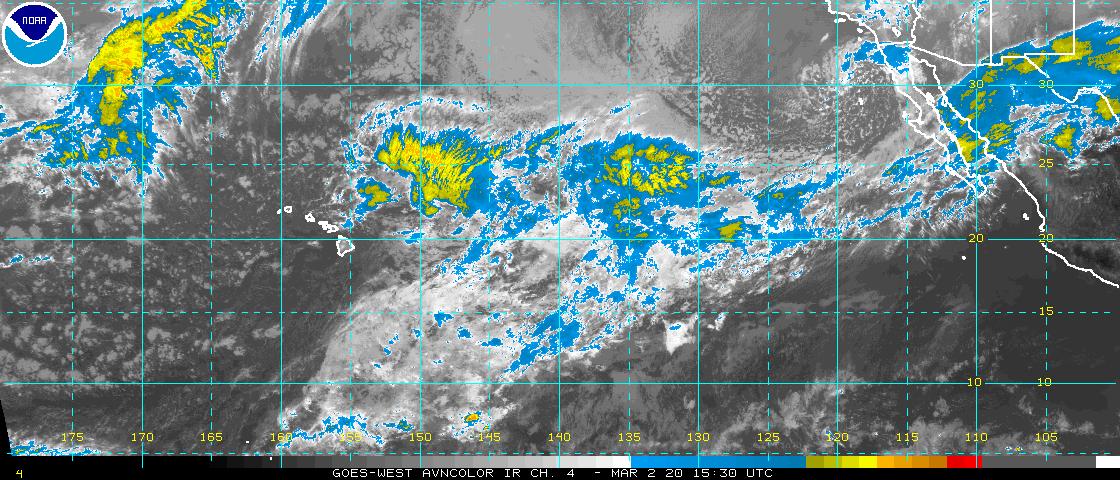
Tropical Cyclone activity in the eastern and central Pacific – Here’s the latest weather information coming out of the National Hurricane Center, covering the eastern north Pacific. You can find the latest tropical cyclone information for the central north Pacific (where Hawaii is located) by clicking on this link to the Central Pacific Hurricane Center. Here’s a tracking map covering both the eastern and central Pacific Ocean. A satellite image, which shows the entire ocean area between Hawaii and the Mexican coast…can be found here. Of course, as we know, our hurricane season won't end until November 31st here in the central Pacific.
Aloha Paragraphs

Cool Friday night…although generally a nice weekend
The cool weather pattern will prevail through the weekend. This weather map shows two low pressure systems to the north of our islands Friday night. An old cold front remains stalled just to the southeast of the Big Island. The air flow in the wake of this cold front is on the dry side. This generally dry reality will keep the air feeling slightly chilly, although gradually warming up as we get into later Sunday. A new fairly vigorous cold front will be approaching the state later this weekend, eventually turning our winds to the south and southwest. These breezes may become rather strong and gusty as we move into Sunday evening and night.
Cool, generally light winds are blowing early Friday evening…the following numbers represent the strongest breezes, along with directions:
17 mph Barking Sands, Kauai – SE
20 Waianae, Oahu – WSW
06 Molokai – NNW
12 Kahoolawe – N
14 Maalaea Bay, Maui – NNE
07 Lanai Airport – N
14 Hilo, Big Island – NNW
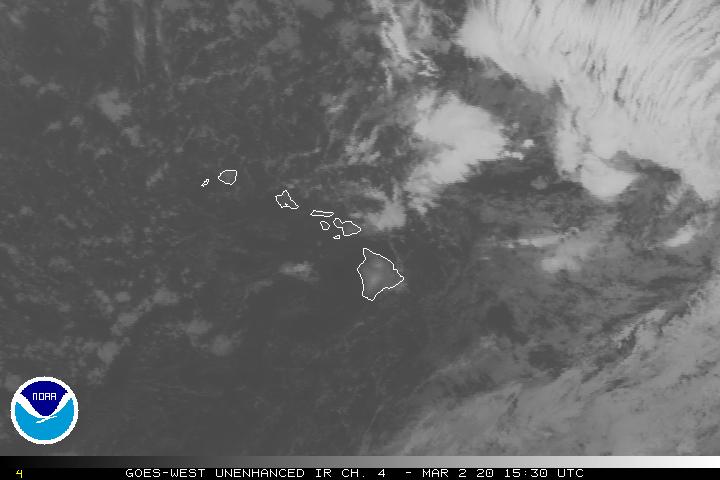
Skies will be clearing nicely, with the Big Island last to see the departing clouds. This large University of Washington satellite image shows the high and middle level clouds moving steadily eastward, with clearing skies over most of the state…which will continue overnight. Looking at this NOAA satellite picture, shows the heaviest clouds over the Big Island Friday evening, where a thunderstorm was noted before sunset. This instability was caused by the exceptionally cold air (at higher levels aloft) moving by to the north of the state. We can loop this satellite image, to see the clouds moving by from the west generally, which will bring clearing from that direction, over most of the state tonight, although some lower level clouds may arrive on the northwest air flow into Saturday. Checking out this looping radar image we the tail-end of the showers still over the Big Island, which will find drier air moving over there during the night into Saturday.
We're moving into what looks likes a relatively dry weekend, with good weather expected. As we move into the weekend, the next cold front will begin making its way in our direction from the northwest…although conditions should be favorably inclined for the most part. Winds will gradually shift to the west and then southwest ahead of this next front, later this weekend. This winter cold front will bring rainfall as it passes down through the island chain on Monday. The computer models continue to show yet another cold front arriving later Wednesday or Thursday.
Here in Kihei, Maui early Friday evening, skies had cleared nicely, with mostly clear skies finally having arrived. Earlier in the day Friday, there were several reports of ice pellets falling in the upcountry areas around Olinda through Kula. This of course is very unusual, triggered by all the very cold air that was passing over the state aloft. The surface air has been chilly as well, which will bring another cool morning on Saturday. ~~~ Since its Friday evening, I'm heading out to see a new film now, this one called Black Swan, starring Natalie Portman, and Vincent Cassel…among many others. The synopsis: a featured dancer in the New York City Ballet finds herself locked in a web of competitive intrigue…with a new rival at the company. The critics are giving this new film a highly rated A- grade, while the viewers are giving it a solid B+…which looks good to me! Oh yeah, here's the trailer for Black Swan, which apparently has a definite dark element to it. I'll of course let you know what I thought Saturday morning, when I'll be back online with your next new weather narrative from paradise. I hope you have a great Friday night until then! ~~~ Just one more thing, I just got home after seeing the great film this evening, and it's freezing up here in Kula. The air temperature at 950pm was 49.8F degrees, the coldest reading so far in 2011, and the coldest night since early last month, or was it back in November…when we had several mornings in the 40's. I would estimate that the temperature early Saturday morning up here will easily be down around 45 or so. I'll report back in the morning. Aloha for now…Glenn.
Interesting: The past few years have seen a sharp rise in awareness, and criticism, of Japanese whaling practices. The Oscar winning documentary The Cove and Animal Planet's television show Whale Wars have brought western public attention to the killing of both large and small cetaceans.
Whale meat is sold openly in Japanese markets and caught by a government supported fleet of five ships that operates under the guise of conducting experiments for Japan's Institute of Cetacean Research. A memorandum passed by the IWC (International Whaling Commission) in 1986 theoretically abolished commercial whaling but allows exceptions for research based killings.
Japan technically operates within this mandate. The country has been granted the authority to set its own quota for the hunt and currently, the fleet kills 940 minke and 10 fin whales annually. The ships typically depart mid-December and hunt in a whale sanctuary off the coast of Antarctica.
Japan has rejected offers to join non-lethal whale research programs and stands to make an estimated profit of 100,000 US dollars per year from its catch. International whaling Japan is the main focal point of international attention.
Most anti-whaling organizations and movements centre their causes around the Japanese fleet in the Southern Ocean but while the Land of the Rising Sun receives the most attention, it is by no means the only nation involved in the whale hunt.
Norway, Iceland and the Faroe Islands all continue to catch and kill whales, none of which is for research purposes. Food rather than science is behind the continuation of Scandinavian whaling operations.
Interesting2: China will step up its controls over the mining of rare earths and release new industry standards to cut pollution, a minister and media said on Friday, after the world's biggest supplier cut export quotas for the minerals. China, which produces about 97 percent of the global supply of the vital metals, slashed its export quota by 35 percent for the first half of 2011 compared with a year earlier, saying it wanted to conserve reserves and protect the environment.
China will "strengthen the supervision and management of mineral resources mining … and deepen control over rare earth mining capacity and extraction," Minister of Land and Resources Xu Shaoshi said on a webcast on the ministry's website.
He did not elaborate. Xu added that China's campaign against illegal rare earths mining and effort to better manage the industry had achieved "notable results."
Meanwhile, new environmental standards, described as "stringent" by an expert who helped draft the rules, would limit the amount of permissible pollutants in each liter of waste water, the official China Daily said.
Under the rules, expected to pinch rare earths miners with raised environmental protection costs, levels of ammonia nitrogen would be cut from 25 milligrams to 15 milligrams per liter, and radioactive elements and phosphorus emissions would be reduced.
The new regulations could be formally unveiled as soon as February after being approved by China's Ministry of Environmental Protection in December, the China Daily said.
Interesting3: Packaging that alerts consumers to food which is starting to go bad is being developed by researchers at the University of Strathclyde in Glasgow. The project aims to improve food safety and cut unnecessary food waste by developing a new type of indicator, made of 'intelligent plastics' which give a warning, by changing color, of when food is about to lose its freshness because it has broken or damaged packaging, has exceeded its 'best before' date or has been poorly refrigerated.
An estimated 8.3 million tons of household food- most of which could have been eaten- is wasted in the UK each year. The indicator is to be used as part of a form of food packaging known as modified atmosphere packaging, which keeps food in specially-created conditions that prolong its shelf life.
Freshness indicators typically take the form of labels inserted in a package but these come at a significant cost. Strathclyde researchers are looking to create a new type of indicator which is an integral part of the packaging, and so is far less expensive.
The project has received £325,000 in support from the Scottish Enterprise Proof of Concept Program. Professor Andrew Mills, who is currently leading the Strathclyde project, said: "At the moment, we throw out far too much food, which is environmentally and economically damaging.
"Modified atmosphere packaging is being used increasingly to contain the growth of organisms which spoil food but the costs of the labels currently used with it are substantial. We are aiming to eliminate this cost with new plastics for the packaging industry.
"We hope that this will reduce the risk of people eating food which is no longer fit for consumption and help prevent unnecessary waste of food. We also hope it will have a direct and positive impact on the meat and seafood industries."
By giving a clear and unambiguous sign that food is beginning to perish, the indicators being developed at Strathclyde could resolve potential confusion about the different significances of 'best before' dates and 'sell-by' dates. They could also help to highlight the need for food to be stored in refrigerators which are properly sealed.
Lisa Branter, acting head of the Proof of Concept Program, said: "Through the Proof of Concept Program, we are creating the opportunities to build high value, commercially viable spin-out companies from ground-breaking research ideas. What we want to achieve are more companies of scale created as a result of the Program, and this project is a great example of an idea which offers real business opportunities."
 Email Glenn James: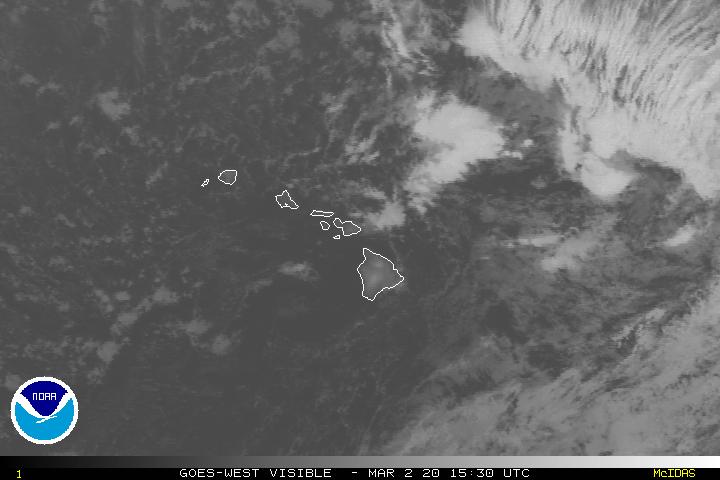




Dan Hunt Says:
Aloha Glenn : I never thought I would see the word " graupel " used in a forecast from Hawaii. We do see it from time to time here in Rochester. Take Care . Dan~~~Hi Dan, unusual for Hawaii, has to do with the very cold air currently over the islands, aloft. By the way, nice to hear from you again! Aloha, Glenn
merlin shimada Says:
aloha,, where do I ind the naval weather maps showing storm and large wave activity like the ones the tow in surfers use???
regarding your article on japans whaling; why is it that many other nations engage in whaling for research and food yet there's nowhere near the negative coverage that japan receive??
the japanese have been eating whale as long as any other country yet they are always pictured in a different light……..to me this sounds a bit unfair if not discrimanatory…. they have the same right to their quota as any other country that practices whaling for food..
they were not the ones who drove whales to becoming endangered it was the white man and if I'm not mistaken the USA was the major contributor…..its not right just because they've stopped that they can now point fingers and denounce other countries….
aloha,,, merlin shimada~~~Thanks for your note, the Navy weather maps can be found on my site both on the windsurf/kiteboarding page, and in several places on the narrative page too. As for whaling, I appreciate what you’re saying. Personally, I’d rather not see these whales chased, killed and eaten by any country! That’s just my personal opinion, as they seem like peaceful creatures, just trying to survive and raise their young. Anyone else have some feedback for Merlin? Aloha, Glenn