











January 3-4, 2011
Air Temperatures – The following maximum temperatures were recorded across the state of Hawaii Monday afternoon:
Lihue airport, Kauai – 79
Honolulu airport, Oahu – 82
Kaneohe, Oahu – 78
Molokai airport – 79
Kahului airport, Maui – 80
Kona airport – 81
Hilo airport, Hawaii – 79
Air Temperatures ranged between these warmest and coolest spots near sea level – and on the highest mountain tops…as of 5pm Monday evening:
Kailua-kona – 81F
Hilo, Hawaii – 72
Haleakala Crater – missing (near 10,000 feet on Maui)
Mauna Kea summit – missing (near 14,000 feet on the Big Island)
Precipitation Totals – The following numbers represent the largest precipitation totals (inches) during the last 24 hours on each of the major islands, as of Monday afternoon:
0.67 Mount Waialeale, Kauai
0.39 Oahu Forest NWR, Oahu
0.01 Molokai
0.00 Lanai
0.00 Kahoolawe
1.03 Puu Kukui, Maui
0.43 Pahoa, Big Island
Marine Winds – Here’s the latest (automatically updated) weather map showing a moderately strong 1029 millibar high pressure system to the northeast of our islands. Our winds will be active from the trade wind direction Tuesday…then calming down Wednesday.
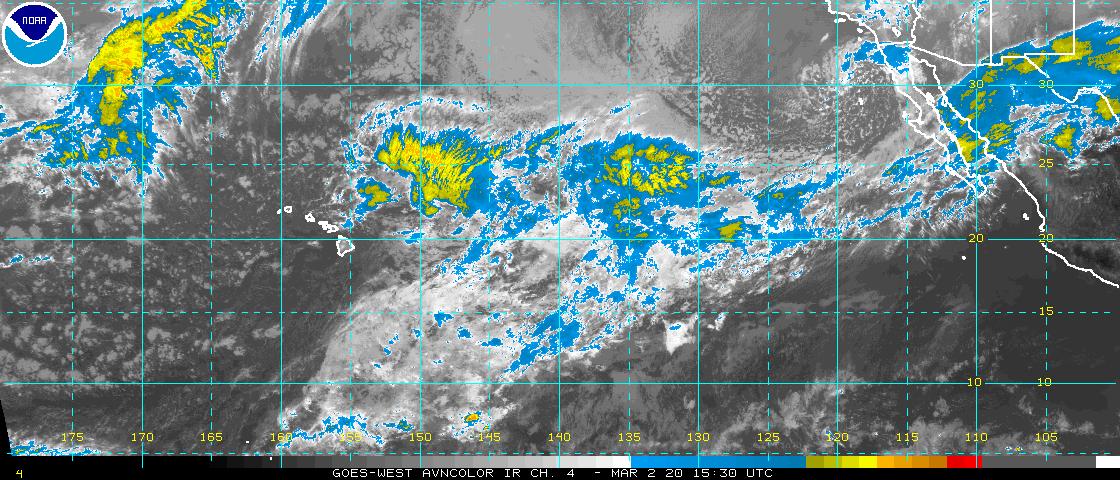
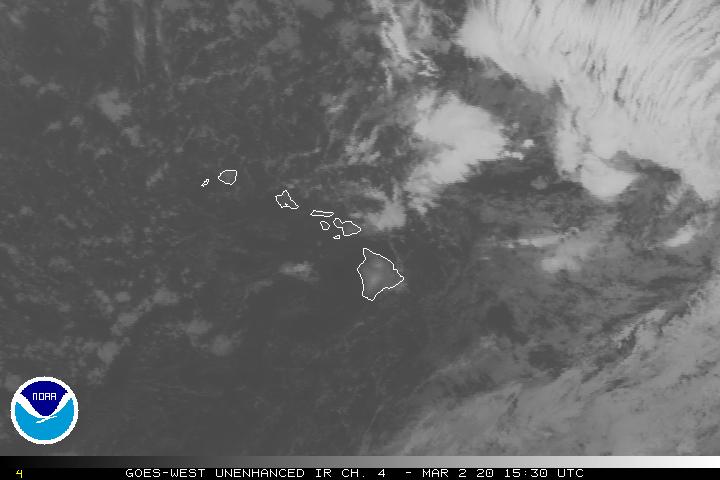
Satellite and Radar Images: To view the cloud conditions we have here in Hawaii, please use the following satellite links, starting off with this Infrared Satellite Image of the islands to see all the clouds around during the day and night. This next image is one that gives close images of the islands only during the daytime hours, and is referred to as a Close-up visible image. This next image shows a larger view of the Pacific…giving perspective to the wider ranging cloud patterns in the Pacific Ocean. Finally, here's a Looping IR satellite image, making viewable the clouds around the islands 24 hours a day. To help you keep track of where any showers may be around the islands, here’s the latest animated radar image.
Hawaii’s Mountains – Here’s a link to the live web cam on the summit of near 14,000 foot Mauna Kea on the Big Island of Hawaii. The tallest peak on the island of Maui is the Haleakala Crater, which is near 10,000 feet in elevation. These two web cams are available during the daylight hours here in the islands…and when there’s a big moon rising just after sunset for an hour or two! Plus, during the nights and early mornings you will be able to see stars, and the sunrise too…depending upon weather conditions.
Tropical Cyclone activity in the eastern and central Pacific – Here’s the latest weather information coming out of the National Hurricane Center, covering the eastern north Pacific. You can find the latest tropical cyclone information for the central north Pacific (where Hawaii is located) by clicking on this link to the Central Pacific Hurricane Center. Here’s a tracking map covering both the eastern and central Pacific Ocean. A satellite image, which shows the entire ocean area between Hawaii and the Mexican coast…can be found here. Of course, as we know, our hurricane season won't end until November 31st here in the central Pacific.
Aloha Paragraphs

Trade wind weather pattern ~
Large surf on north and west shores again later Tuesday
Feel like taking a nice sunset walk…of course!
We'll find moderately strong trade winds through Tuesday…then lighter breezes by Wednesday into the night. This weather map shows a moderately strong 1029 millibar high pressure system to the northeast of the islands, with its associated ridge to our north and northwest. Our winds will be active from the trade wind direction through Tuesday. The forecast continues showing that our winds will tumble Wednesday, and then become cooler from the north and northeast Thursday and Friday. As we move into the weekend, our local breezes will swing around through the southeast to south directions…possibly bringing volcanic haze up over the islands from the vents on the Big Island. A vigorous cold front will approach the islands Sunday into early next week, prompting strengthening south to southwest Kona winds ahead of it.
Trade winds will prevail Monday and Tuesday…the following numbers represent the strongest breezes early Monday evening, along with the directions:
27 mph Port Allen, Kauai – E
28 Honolulu, Oahu – NE
24 Molokai – NE
37 Kahoolawe – ESE
33 Kahului, Maui – NE
20 Lanai Airport – NE
35 South Point, Big Island – NE
Despite the gusty trade winds across our islands, the overlying atmosphere is quite dry and stable now…limiting showers through this first half of this work week. This large University of Washington satellite image shows an area of clouds over the ocean, southwest and southeast of our islands. At the same time, we see an extensive cold front far to our north. Looking at this next NOAA satellite picture, we see high and middle level clouds to our south and southeast, with a few minor patches of lower level clouds along our windward sides. Checking out this looping radar image we see just a few showers falling over the ocean, and a few along our windward sides too…being carried along in the generally northeast to east-northeast trade wind flow.
As noted in the paragraphs above, trade wind weather conditions will prevail through the next several days. Tuesday will continue the pleasant weather that we've seen Monday, with lots of sunshine, and just a few passing showers along the windward sides. An approaching weak cold front will help to knock our trade winds down by mid-week, and likely bring some showers to Kauai and Oahu by Thursday. The computer models show the cloud band dipping down to near Maui County thereafter, and dissipating in place…before arriving over the Big Island. A short period of cool north to northeast breezes will arrive in the wake of the frontal boundary, bringing a mild tropical cool snap to the Aloha state. As we move into the upcoming weekend, a stronger cold front will begin making its way in our direction. We could see a day of volcanic haze (vog) Saturday, before the winds swing around to the south and southwest later Sunday into Monday, becoming rather gusty. The cold front is liable to bring a day or two of rainfall as it passes down through the island chain early next week. This wet weather prospect will have to be fine tuned as we move through this week however…stay tuned.
~~~ Here in Kihei, Maui it was mostly clear early Monday evening. The entire western flank of the Haleakala Crater was clear, showing the very green pasture lands up in Kula, Keokea and Ulupalakua. The trade winds are blowing, and have been all day, which will continue into Tuesday. High temperatures at sea level were generally in the high 70F's and lower 80F's today, which should be about the same Tuesday as well. Actually, I don't expect any significant change in our very pleasant weather conditions likely through Wednesday. The winds will be lighter then, so we could see some increase in clouds over and around the mountains during the afternoon hours. ~~~ I'm about ready to head back upcountry to Kula, which again looks really nice up that way now. I'll be back early Tuesday morning with your next new weather narrative, I hope you have a great Monday night until then! Aloha for now…Glenn.
Extra: Little girl starts a catchy dance!
Interesting: Military aircraft flew supplies to an Australian town slowly disappearing under floodwaters, as authorities warned on Monday that record floods that have devastated the northeast were far from over. The spreading environmental disaster is estimated to have caused more than A$1 billion ($980 million) in damage, has forced thousands from their homes and has hit the economy hard, particularly coal mining and agriculture.
One person has been confirmed dead in what Queensland state Treasurer Andrew Fraser called a "disaster of biblical proportions". Rivers in the state's south have hit levels higher than any on record, and are predicted to go as high as 13 meters. The downpours have forced a string of mining companies to declare force majeure on coal contracts due to disruption to production and transport.
In the town of Rockhampton, a community of 77,000 situated 600 km (370 miles) north of the state capital Brisbane, floodwaters reached 9 meters (29.5 ft) early on Monday, said the state's emergency coordinator, police Deputy Commissioner Ian Stewart. Rockhampton's Fitzroy River is expected to hit a peak of around 9.4 meters by Wednesday, said Stewart.
"Today we'll see resupply of Rockhampton by military aircraft taking supplies into Mackay and then road transporting them down to Rockhampton. That will continue until such time as the road is cut," Stewart told a news conference. State Premier Anna Bligh is to fly in to visit the town on Monday morning, a spokeswoman said, and discuss disaster relief with local officials.
In the south of the state, floodwaters have reached 12.6 meters at the town of Surat, where the Balonne River was already at record levels, with a peak of over 13 meters predicted on Tuesday, while the nearby Condamine River was also in full flood. Stewart said police reinforcements had been sent to the area, amid fears of looting.
Interesting2: Residents of San Juan, Puerto Rico will remember 2010 as the wettest year on record. Throughout the year, 89.51 inches of rain accumulated in the city. This is nearly double the normal amount of yearly rainfall, which is 50.76 inches. Despite the excessive amount of rain, rain fell on 199 of the 365 days, which is nearly the average amount of rainy days in a year (average is 202 days).
San Juan did, however, break 2 records on the way to the yearly record. The first record was the number of rainfall amounts over 0.25 of an inch, which occurred 95 times. The other record was the number of 1 inch or more rainfall amounts, which occurred 28 times in 2010. San Juan was not the only location in the region to experience the excessive rainfall.
Puerto Rico as a whole reported 132 percent of normal rainfall, while the Virgin Islands reported 172 percent of normal rainfall for the year. In addition, Saint Thomas recorded their second wettest year on record, while Saint Croix reported their seventh wettest year on record. Two factors contributed to the unusually wet conditions across Puerto Rico and the Virgin Islands.
The first contributing factor was the El Nino during the dry season (December through April). When El Nino's occur during the dry season, there tends to be an increase in rainfall throughout the northern Caribbean Sea.
The second factor was the onset of a strong La Nina during the wet season (May through November). La Nina's that occur during the wet season also tend to produce more rain to the northern Caribbean Sea. These two factors have lead to excessive rainfall throughout the entire year.
Interesting3: A severely entangled North Atlantic right whale — a species whose numbers are down to just a few hundred — was swimming off Florida after experts managed to cut off much of the fishing ropes holding it back. "The team successfully removed more than 150 feet of ropes wrapped around the whale’s head and fins, and cut portions of entangling ropes that remain on the animal," the National Oceanic and Atmospheric Administration said in a statement.
"We were very concerned about this whale as the entangling ropes appeared to be life threatening," said NOAA official Jamison Smith. "Given the efforts of the disentanglement team we are optimistic the whale may shed the remaining ropes on its own, so we will continue to monitor its condition via aerial surveys and intervene again if necessary."
The whale, 30 feet long and thought to be less than 2 years old, was first spotted off Daytona on Christmas Day by a team doing aerial surveys to spot right whales. Those teams alert ships to any right whales so that they can then alter course to avoid potential collisions.
"The team was able to attach a satellite tracking buoy to the trailing lines," NOAA stated. In recent days, experts worked to remove ropes and wire mesh material "similar to what is found in the trap or pot fisheries for fish, crab and lobster," NOAA said. The waters off northeast Florida and Georgia are the only known birthing grounds of the North Atlantic right whale.
Interesting4: Growing plants on rooftops is an old concept that has evolved from simple sod roofing to roof gardens and new, lightweight "extensive green roofs." Modern green roofs have environmental and social benefits; they can reduce storm water runoff, improve air quality, mitigate urban heat, reduce the demand for air conditioning and greenhouse gas emissions, and provide habitat for birds and wildlife.
Long-used in urban planning in Europe, green roofs are becoming more popular in North America, and new research designed to promote the integration of green roofs into current and future buildings is burgeoning. Researchers from the Department of Horticulture at The Pennsylvania State University published a study in HortTechnology that evaluated the influence of substrate type and depth on establishment of five common green roof plants.
Plants suitable for extensive green roofs must tolerate extreme rooftop conditions, and the substrates in which they grow must meet both horticultural and structural requirements. Deeper substrates may retain more water for plants during dry periods, but they also weigh more, especially when near saturation.
The study by Christine E. Thuring, Robert D. Berghage, and David J. Beattie was designed to evaluate the effects of substrate type and depth on the establishment and early growth of five plants popular in North American green roof designs.
The researchers hypothesized that early drought is more harmful for plants grown in shallow rather than deeper substrate depths, and that plants that survived early drought conditions would produce less shoot biomass than those subjected to late drought.
Two stonecrops, one ice plant, and two herbaceous perennials were planted in three depths (30, 60, and 120 mm) of expanded shale and expanded clay, two commercially available green roof substrates. Study flats inside a plasticulture tunnel received three drought treatments: no drought, 2 weeks early drought, and 2 weeks late drought.
The two stonecrops performed well under most conditions, although tasteless stonecrop was stunted by early drought. Ice plant performed erratically and, along with maiden pink, poorly in face of drought during establishment. When subjected to any drought, the herbaceous perennials had the fewest survivors in the expanded shale.
The study plants were most affected by substrate depth, except for maiden pink, which responded solely to drought. When subjected to early drought conditions, the herbaceous perennials did not survive in 30 mm of either substrate, or in 60 mm of expanded shale; early drought appeared to be more harmful to plant survival and performance than late drought.
Although the stonecrops performed well in 60 mm of substrate when subjected to drought, their performance was superior in the expanded clay compared with shale. The three most resilient species used in the study — saxifrage pink, white stonecrop, and tasteless stonecrop — always produced more shoot biomass with increasing substrate depth, regardless of water availability.
A standout performer was saxifrage pink, which had an attractive appearance and persistent flowering habit, making it an excellent choice as a green roof plant. The experiment illustrates how appropriate species selection in the design of unirrigated extensive green roofs may be directed by factors such as substrate type and depth, as well as anticipated drought conditions.
"This experiment revealed the variability among drought-tolerant species to various treatments, as well as the different plant responses to substrate type during drought," concluded the scientists.
 Email Glenn James: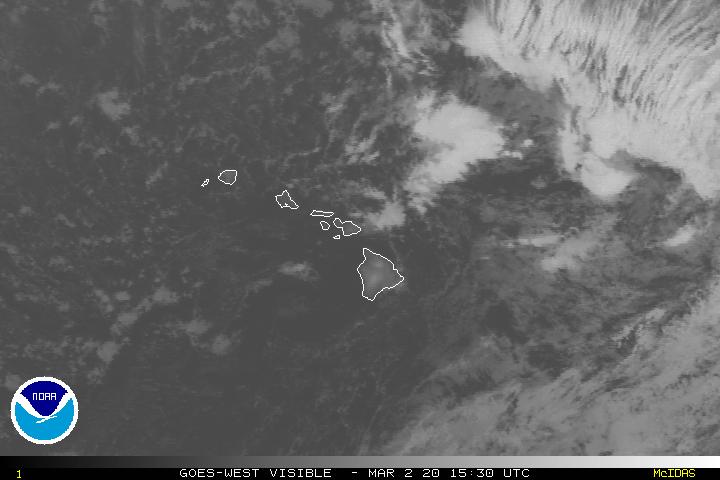


David Says:
Glen,
Great job as always. My wife and I have been to Hawaii five years in a row and have been to Maui four of those five years. I always check your your site before our visit and find myself reading it more and more even from our home state of NY. Thanks for the great daily Narrative…~~~David, great to hear from you there in NY, I appreciate your taking the few minutes to provide some positive feedback. It’s these kinds of notes that keep me getting up very early in the morning to bring you the next days narratives. Happy New Year, Aloha, Glenn