December 29-30, 2010
Air Temperatures – The following maximum temperatures were recorded across the state of Hawaii Wednesday afternoon:
Lihue airport, Kauai – 80
Honolulu airport, Oahu – 80
Kaneohe, Oahu – 78
Molokai airport – 81
Kahului airport, Maui – 84
Kona airport – 84
Hilo airport, Hawaii – 82
Air Temperatures ranged between these warmest and coolest spots near sea level – and on the highest mountain tops…as of 5pm Wednesday evening:
Barking Sands, Kauai – 82F
Molokai airport – 75
Haleakala Crater – 50 (near 10,000 feet on Maui)
Mauna Kea summit – 32 (near 14,000 feet on the Big Island)
Precipitation Totals – The following numbers represent the largest precipitation totals (inches) during the last 24 hours on each of the major islands, as of late Wednesday afternoon:
0.61 Mount Waialeale, Kauai
0.39 Oahu Forest NWR, Oahu
0.00 Molokai
0.00 Lanai
0.00 Kahoolawe
0.01 Oheo Gulch, Maui
0.04 Kealakomo, Big Island
Marine Winds – Here’s the latest (automatically updated) weather map showing a high pressure system to our northeast, with a high pressure ridge just to the north of Kauai. At the same time, we find a low pressure system to the north, moving northeast…dragging a trough of low pressure behind it. Our winds will become trades during the day Thursday into Friday.
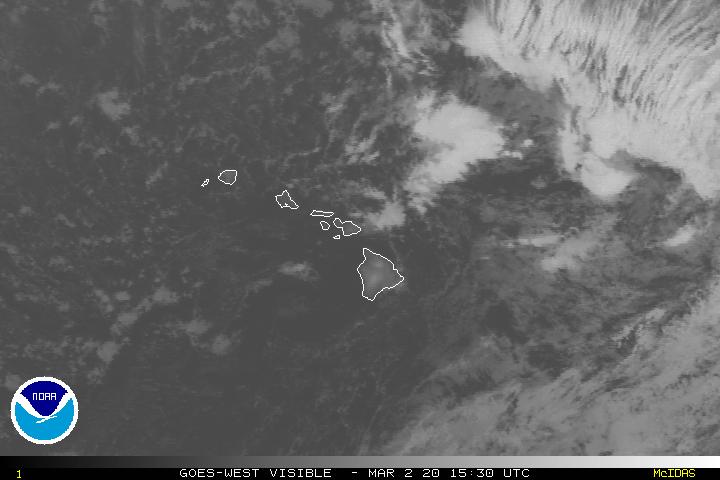
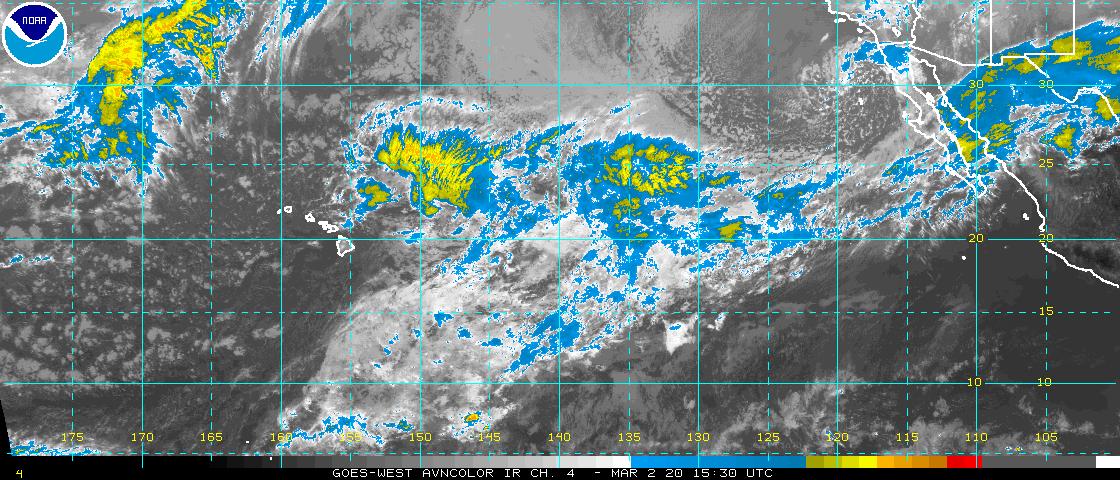
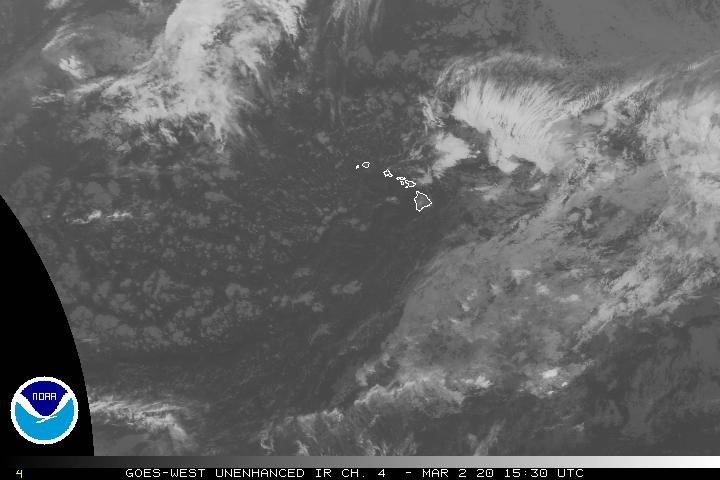
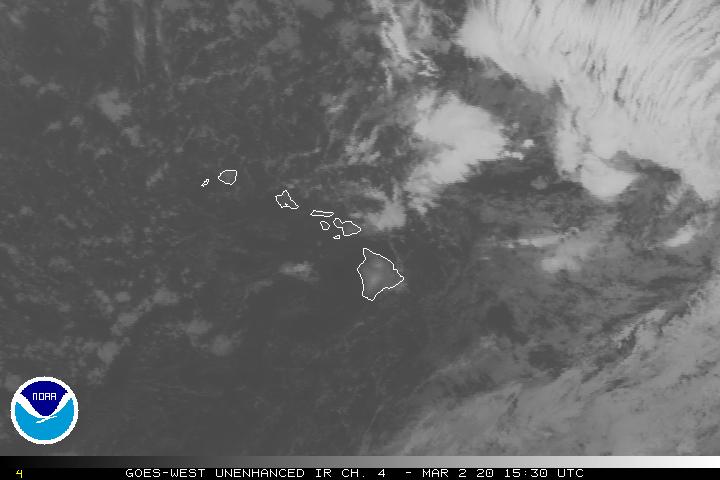
Satellite and Radar Images: To view the cloud conditions we have here in Hawaii, please use the following satellite links, starting off with this Infrared Satellite Image of the islands to see all the clouds around during the day and night. This next image is one that gives close images of the islands only during the daytime hours, and is referred to as a Close-up visible image. This next image shows a larger view of the Pacific…giving perspective to the wider ranging cloud patterns in the Pacific Ocean. Finally, here's a Looping IR satellite image, making viewable the clouds around the islands 24 hours a day. To help you keep track of where any showers may be around the islands, here’s the latest animated radar image.
Hawaii’s Mountains – Here’s a link to the live web cam on the summit of near 14,000 foot Mauna Kea on the Big Island of Hawaii. The tallest peak on the island of Maui is the Haleakala Crater, which is near 10,000 feet in elevation. These two web cams are available during the daylight hours here in the islands…and when there’s a big moon rising just after sunset for an hour or two! Plus, during the nights and early mornings you will be able to see stars, and the sunrise too…depending upon weather conditions.
Tropical Cyclone activity in the eastern and central Pacific – Here’s the latest weather information coming out of the National Hurricane Center, covering the eastern north Pacific. You can find the latest tropical cyclone information for the central north Pacific (where Hawaii is located) by clicking on this link to the Central Pacific Hurricane Center. Here’s a tracking map covering both the eastern and central Pacific Ocean. A satellite image, which shows the entire ocean area between Hawaii and the Mexican coast…can be found here. Of course, as we know, our hurricane season won't end until November 31st here in the central Pacific.
Aloha Paragraphs
Returning trade winds Thursday…fair weather into Friday
Southeast winds continue to blow across the islands Wednesday evening…with the trade winds on tap for Thursday. This weather map shows a high pressure system to our northeast, with a trough of low pressure to our west. The placement of these high and low pressure features will keep our winds coming to us from the southeast for a little while longer. The forecast continues to suggest that we’ll see trade winds returning during the day Thursday, lasting for a day or two only. We may see a let up of these trade winds at some point later Friday into Saturday, as a cold front digs in our direction from the northwest. This faltering of our wind speeds will be temporary however, as the computer models show the trade winds returning shortly thereafter…becoming quite strong moving into next week. This reduction in trade wind speeds, if it pans out during the New Year’s Eve celebrations Friday night, would allow fireworks smoke to collect in urban areas.
Winds remain generally light, although locally stronger…the following numbers represent the strongest breezes early Wednesday evening, along with the directions:
12 mph Port Allen, Kauai – SE
14 Kahuku, Oahu – NE
20 Molokai – NE
10 Kahoolawe – SE
18 Lipoa, Maui – SE
14 Lanai Airport – NE
17 South Point, Big Island – NE
Wednesday turned out to be quite a nice day, with Thursday being at least as nice…if not quite a bit sunnier. This large satellite image shows a large area of active thunderstorms to the southwest of the islands, with streaks of high cirrus clouds, the tops of these cumulonimbus clouds…being carried up over the islands locally. Looking at this next satellite picture, we see at least partial clearing in most directions, certainly compared to the last several days of overcast skies. There are lower or middle level clouds over Kauai and Oahu, while high cirrus clouds in the area around Maui County and the Big Island. Checking out this looping radar image we see areas of showers moving towards the east and southeast side of the Big Island, and over the ocean just to the west of Kauai. As the trade winds return Thursday, we'll likely see a few passing showers along our windward sides.
We finally have the locally heavy rainy weather behind us, although since it is winter, we’ll have to keep an eye out for more precipitation ahead. Despite the clearing skies, and improvement in our local weather conditions, we need to keep an eye on the chance of heavier showers moving back over us…in particular during this upcoming holiday weekend. There's even the chance that we could see locally heavy showers, or even thunderstorms returning at some point! Friday night into Saturday would likely be the time frame of this years last rainfall event…although using the word event may be too strong…stay tuned. Then, as we glide into the New Year, we’ll find the trade winds taking over, prompting passing showers along the windward sides. If the winds get as strong as currently being advertised by the computer models, some of this moisture may be carried over into the leeward sides on the smaller islands.
Here in Kihei, Maui, at around 525pm, skies are partly cloudy in general, with still some leftover volcanic haze around too. I figure that as the trade winds return Thursday, that stuff will be ventilated away rather quickly…I know that that is good news for many of you. There's just one more work day this year, as I have off on Friday. We're actually going to be charging right on into 2011 soon. I don't know about you, although I've be drinking a little champagne Friday night in celebration of yet another great year under our belts. I'm heading upcountry now, back up to Kula, although will be back with your next new weather narrative early Thursday morning. I hope you have a great Wednesday night until then! Aloha for now…Glenn.
Interesting: The natural forces of the planet were in full swing this year, with some spectacular and devastating consequences. From the massive Haiti earthquake to a bevy of explosive volcano eruptions, 2010 saw its share of natural disasters across the planet. Here are some of the headline-grabbing natural disasters that OurAmazingPlanet and its sister sites covered in 2010.
Earthquakes
Just 12 days into the new year, a massive earthquake struck Port-au-Prince, Haiti. The quake was responsible for the deaths of more than 200,000 people and left more than 1.5 million homeless. Months after the devastating quake, scientists discovered that a previously unmapped fault was responsible for the magnitude-7.0 earthquake, not the fault originally blamed for the temblor. The earthquake increased stresses on nearby faults, potentially increasing the likelihood of another major temblor in the islands, scientists also found.
Just weeks after Haiti was struck, a magnitude-8.8 earthquake hit south-central Chile on Feb. 27. The massive temblor changed the country’s landscape by raising the ground by more than 8 feet near the coast and sinking land farther inward, scientists found.
In early September, a magnitude-7.1 earthquake ruptured in Christchurch, New Zealand, a city with a population of about 400,000. The quake caused millions of dollars of damage, and recovery efforts in the downtown business district were set back by a magnitude-4.9 earthquake, an aftershock that struck on Dec. 28.
In quake-prone Indonesia, a 7.7-magnitude earthquake struck on Oct. 25. The quake triggered a 10-foot (3-meter) tsunami, killing at least 113 people. The earthquake ruptured during a process called thrust faulting, when one of the Earth’s rocky plates subducted or took a dive below the other.
While not devastating (and not even felt by many), New York City experienced its largest earthquake in 18 years when a magnitude-3.9 earthquake rattled the region on Nov. 30.
Volcanoes
Two major volcanic eruptions captivated audiences around the world this year. The eruption of the Icelandic volcano Eyjafjallajökull in April created a giant ash cloud, which at one point covered most of Europe. The spread of the ash in the atmosphere created fiery red sunsets and brought international aviation to a temporary standstill, resulting in travel chaos for tens of thousands. The plume was so electrically charged that it made its own lightning. That lightning could help scientists accurately measure the height of future volcanic ash plumes.
Over in the Pacific Ring of Fire, Indonesia’s Mount Merapi began erupting on Oct. 26, killing more than 350 people and leaving nearly 400,000 refugees that fled the area.
Hurricanes
Most Americans may not have realized it, but the 2010 Atlantic hurricane season, which ran from June 1 to Nov. 30, was among the busiest on record. The season saw a near-record number of storms but few had an impact on the United States.
The Atlantic basin, which includes the Caribbean Sea and the Gulf of Mexico, had 19 named storms (tropical storms and hurricanes) in all, which placed the season in a tie with 1887 and 1995 as the third busiest on record, according to the National Oceanic and Atmospheric Administration. The busiest hurricane season on record is still 2005, a year that saw 28 named storms, including Hurricane Katrina.
Unlike the busy Atlantic hurricane season, the 2010 Pacific hurricane season was the least active on record in terms of named storms and hurricanes, with 13 total storms. Hurricane Celia, a category 5 storm that hit near Acapulco, Mexico, was the strongest in the Pacific.
The Pacific typhoon season is ongoing, but its strongest storm yet, Typhoon Megi — a category 5 storm — struck the Philippines in mid-October. The storm was one of the most intense tropical cyclones on record (tropical cyclone is the generic name for tropical storms, typhoons and hurricanes).
Elsewhere, Tropical Storm Jal swirled over the northern Indian Ocean on Nov. 4. Jal was one of five cyclones in the region — the strongest of which was Cyclone Giri, a category 4 storm that hit Myanmar in late October.
Rare Tornadoes
Tornadoes touched down in parts of the Untied States that haven’t seen twisters in a while. In New York City, the boroughs of Brooklyn and Queens saw a tornado rip through on Sept. 17, knocking out power and uprooting trees across the city.
After a long tornado lull during the so-called second tornado season in November a twister hit Caledonia, Ill., on Nov. 22 — the first November tornado to hit Illinois in more than five years. The tornado flipped a school bus and injured the driver and several children. Since 1990, there have been just six other November tornado events in the state of Illinois, according to The Weather Channel's website.
In Wisconsin, the first November tornado in more than 39 years — which boasted an EF1 strength rating — struck Walworth County. Another was reported in Union Grove, Wis., but has not been confirmed. Only three November tornadoes have hit Wisconsin since 1950, two on Nov. 15, 1960, and one on Nov. 1, 1971.
Landslides
The heaviest rains to hit parts of Colombia in four decades caused widespread flooding and triggered deadly landslides in early December. The landslide hit near the suburbs of Medellin and crushed around 50 houses and possibly killed hundreds of people. While the cause of the landslide and the exact number of fatalities is unclear, the La Niña weather phenomenon — a cooling in the central and eastern tropical Pacific Ocean that is the opposite phase of El Niño — has been blamed for the torrential rains.
Rain and Snowstorms
The eventful year even went out with a bang, including massive rainstorms in Southern California and a blizzard in the Northeast. A so-called “river in the sky” triggered severe storms across Southern California beginning on Dec. 16. The bearer of bad weather is what's called a "Pineapple Express" weather system. The system brought storms that were among the worst in a decade for the region. Governor Arnold Schwarzenegger declared a state of emergency in half a dozen Southern California counties as the torrential rainfall prompted evacuations and caused mudslides.
On the East Coast, just as Christmas was wrapping up, a howling two-day blizzard dumped knee-high snow across parts of the region, wrecking holiday travel. The long slog of digging out from under the snow is likely to last into the New Year.
Interesting2: Researchers have overcome a fundamental obstacle in developing breath-analysis technology to rapidly diagnose patients by detecting chemical compounds called "biomarkers" in a person's respiration in real time. The researchers demonstrated their approach is capable of rapidly detecting biomarkers in the parts per billion to parts per million range, at least 100 times better than previous breath-analysis technologies, said Carlos Martinez, an assistant professor of materials engineering at Purdue who is working with researchers at the National Institute of Standards and Technology.
"People have been working in this area for about 30 years but have not been able to detect low enough concentrations in real time," he said. "We solved that problem with the materials we developed, and we are now focusing on how to be very specific, how to distinguish particular biomarkers."
The technology works by detecting changes in electrical resistance or conductance as gases pass over sensors built on top of "microhotplates," tiny heating devices on electronic chips. Detecting biomarkers provides a record of a patient's health profile, indicating the possible presence of cancer and other diseases.
"We are talking about creating an inexpensive, rapid way of collecting diagnostic information about a patient," Martinez said. "It might say, 'there is a certain percentage that you are metabolizing a specific compound indicative of this type of cancer,' and then additional, more complex tests could be conducted to confirm the diagnosis."
The researchers used the technology to detect acetone, a biomarker for diabetes, with a sensitivity in the parts per billion range in a gas mimicking a person's breath.
Findings were detailed in a research paper that appeared earlier this year in the IEEE Sensors Journal, published by the Institute of Electrical and Electronics Engineers' IEEE Sensors Council. The paper was co-authored by Martinez and NIST researchers Steve Semancik, lead author Kurt D. Benkstein, Baranidharan Raman and Christopher B. Montgomery.
The researchers used a template made of micron-size polymer particles and coated them with far smaller metal oxide nanoparticles. Using nanoparticle-coated microparticles instead of a flat surface allows researchers to increase the porosity of the sensor films, increasing the "active sensing surface area" to improve sensitivity.
A droplet of the nanoparticle-coated polymer microparticles was deposited on each microhotplate, which are about 100 microns square and contain electrodes shaped like meshing fingers. The droplet dries and then the electrodes are heated up, burning off the polymer and leaving a porous metal-oxide film, creating a sensor.
"It's very porous and very sensitive," Martinez said. "We showed that this can work in real time, using a simulated breath into the device." Gases passing over the device permeate the film and change its electrical properties depending on the particular biomarkers contained in the gas.
Such breathalyzers are likely a decade or longer away from being realized, in part because precise standards have not yet been developed to manufacture devices based on the approach, Martinez said. "However, the fact that we were able to do this in real time is a big step in the right direction," he said.
Interesting3: Rodents get a bad rap as vermin and pests because they seem to thrive everywhere. They have been one of the most common mammals in Africa for the past 50 million years. From deserts to rainforests, rodents flourished in prehistoric Africa, making them a stable and plentiful source of food, says paleontologist Alisa J. Winkler, an expert on rodent and rabbit fossils. Now rodent fossils are proving their usefulness to scientists as they help shed light on human evolution.
Rodents can corroborate evidence from geology and plant and animal fossils about the ancient environments of our human ancestors and other prehistoric mammals, says Winkler, a research professor at Southern Methodist University.
"Rodents are often known in abundance, and there are many different kinds from a number of famous hominid and hominoid localities," says Winkler. "Many paleoanthropologists are very interested in the faunal and ecological context in which our own species evolved."
Rodents: World's most abundant mammal — and Africa's too
Rodents — rats, mice, squirrels, porcupines, gerbils and others — are the largest order of living mammals, constituting 42 percent of the total mammalian diversity worldwide. That's according to data drawn from the research literature in an analysis by Winkler and her paleontology colleagues Christiane Denys, of the Museum National d'Histoire Naturelle in Paris, and D. Margaret Avery of the Iziko South African Museum in Cape Town.
Their review documents more than 130 formally named genera in "Fossil Rodents of Africa," the first comprehensive summary and distribution analysis of Africa's fossil rodents since 1978. The analysis is a chapter in the new 1008-page scientific reference book "Cenozoic Mammals of Africa" (University of California Press, 2010), the first comprehensive scientific review of Africa's fossil mammals in more than three decades. The book comprises 48 chapters by 64 experts, summarizing and interpreting the published fossil research to date of Africa's mammals, tectonics, geography, climate and flora of the past 65 million years.
Rodent diversity likely underestimated; more fossils than scientists
The diversity of ancient Africa's rodents most likely has been underestimated, say the authors. Just how much isn't known, though, because the quantity of rodent fossils being discovered far exceeds the handful of scientists who specialize in identifying and studying the specimens.
That diversity continues to expand. The last exhaustive analysis of Africa's rodents was carried out by R. Lavocat in 1978. At that time scientists recorded 54 genera, 76 fewer than those documented by Winkler, Denys and Avery in their analysis.
Winkler and her colleagues summarize the distribution and ecology of existing rodent families, as well as the systematics, biochronology and paleobiogeography of rodent families in Africa's fossil record.
The diversity they document reflects "the wide variety of habitats present on the continent" and paints a picture of Africa's paleoecology. Given the huge rodent diversity in modern Africa, "it is likely that such an extensive fauna was also present in the past," the scientists write.
Tremendous diversity reflects wide variety of habitats
An example of that relationship is the scaly-tailed flying squirrel, an exclusively African group of forest-dwelling rodents that are not related to true squirrels. They are well known from about 18 million to 20 million years ago in eastern Africa, Winkler says, suggesting the presence of closed habitats, such as forests. That corroborates other evidence of forests from fossil animals, plants and geology, she says.
"Although there are even older scaly-tailed flying squirrels known from the currently arid regions of northern Africa," says Winkler, "they do not appear to have been gliders, as are most current forms, and the question of when members of the group first developed gliding locomotion still remains."
 Email Glenn James: