











December 7-8, 2009
Air Temperatures – The following maximum temperatures were recorded across the state of Hawaii Monday afternoon:
Lihue, Kauai – 77
Honolulu, Oahu – 80
Kaneohe, Oahu – 76
Kaunakakai, Molokai – 76
Kahului, Maui – 78
Hilo, Hawaii – 71
Kailua-kona – 85
Air Temperatures ranged between these warmest and coolest spots near sea level around the state – and on the highest mountains…at 5pm Monday evening:
Kailua-kona – 82F
Kapalua, Maui – 73
Haleakala Crater – 46 (near 10,000 feet on Maui)
Mauna Kea summit – 37 (near 14,000 feet on the Big Island)
Precipitation Totals – The following numbers represent the largest precipitation totals (inches) during the last 24 hours on each of the major islands, as of Monday afternoon:
0.93 Kokee, Kauai
0.46 Kamehame, Oahu
0.14 Molokai
0.00 Lanai
0.01 Kahoolawe
0.07 West Wailuaiki, Maui
0.25 Honokaa, Big Island
Marine Winds – Here’s the latest (automatically updated) weather map showing weak high pressure systems to the northwest and northeast. Meanwhile, weak cold fronts are moving through, or by to the north. The net result will be northeast breezes…gradually becoming east-northeast trade winds.
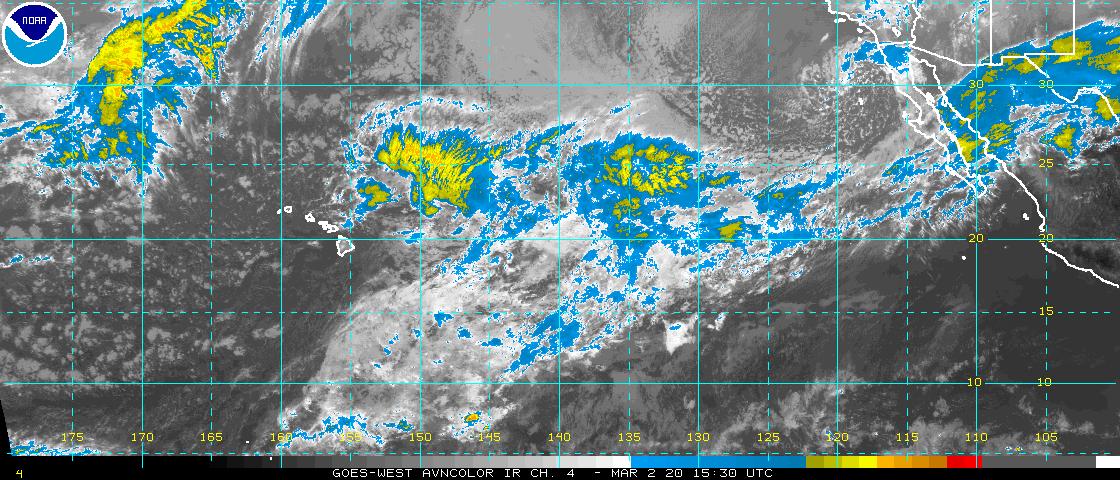
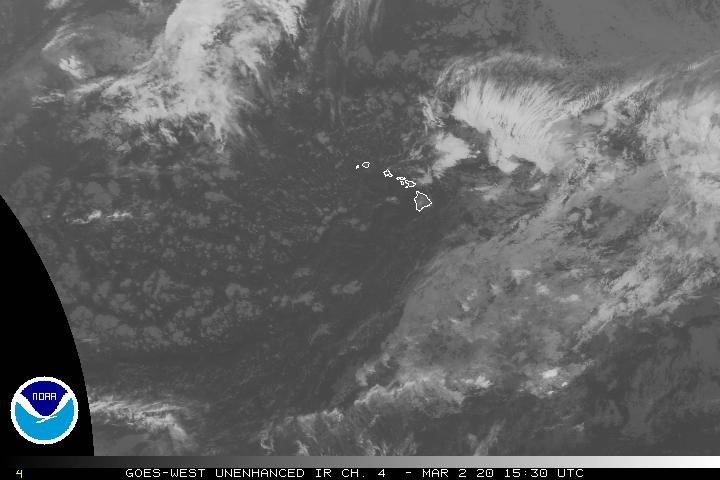
Satellite and Radar Images: To view the cloud conditions we have here in Hawaii, please use the following satellite links, starting off with this Infrared Satellite Image of the islands to see all the clouds around the state during the day and night. This next image is one that gives close images of the islands only during the daytime hours, and is referred to as a Close-up visible image. This next image shows a larger view of the Pacific…giving perspective to the wider ranging cloud patterns in the Pacific Ocean. Finally, here’s a Looping IR satellite image, making viewable the clouds around the islands 24 hours a day. To help you keep track of where any showers may be around the islands, here’s the latest animated radar image.
Hawaii’s Mountains – Here’s a link to the live webcam on the summit of near 14,000 foot Mauna Kea on the Big Island of Hawaii. The tallest peak on the island of Maui is the Haleakala Crater, which is near 10,000 feet in elevation. These two webcams are available during the daylight hours here in the islands…and when there’s a big moon rising just after sunset for an hour or two! Plus, during the nights and early mornings you will be able to see stars, and the sunrise too…depending upon weather conditions.
Tropical Cyclone activity in the eastern and central Pacific – Here’s the latest weather information coming out of the National Hurricane Center, covering the eastern north Pacific. You can find the latest tropical cyclone information for the central north Pacific (where Hawaii is located) by clicking on this link to the Central Pacific Hurricane Center. Here’s a tracking map covering both the eastern and central Pacific Ocean. A satellite image, which shows the entire ocean area between Hawaii and the Mexican coast…can be found here.
Aloha Paragraphs

Extra large surf…north and west shores Tuesday!
Cool north to northeast breezes are riding in behind a dissipating cold front…near Maui and Oahu. This band of clouds pushed through most of the state Monday, dropped some generally light showers as it passed overhead. It has slowed down, and more or less stalled in the central part of the state. This satellite image shows what’s left of the cold front, which is most active along the windward sides…at least in terms of clouds and light showers. There are still some clouds around the Big Island too, which will keep a few showers falling around that southernmost island as well. Here’s a looping radar image, so we can keep track of what few showers…which are left in association with the dissipating frontal boundary.
As the front washes out over the central islands into Tuesday, light north to northeast breezes will continue blowing. Weather will be favorably inclined in the wake of the cold front for several days. A second weak cold front will approach during the second half of the work week, with the light trade winds then…giving way to light and variable winds briefly. This second cold front is expected to stall before arriving, so that all we’ll likely notice will be lighter breezes…until the weekend. A third cold front is expected to approach then, turning our winds to the southeast ahead of its arrival. As we know, southeast winds can carry volcanic haze (vog), from the vents on the Big Island, to other parts of the state…which is likely to happen then.
An unusually large swell train of waves will cause dangerously large waves to continue pounding the north and west facing shores…lasting into mid-week. These waves will be breaking along our north and west facing shores, and may be as large and dynamic as any we’ve seen for many years. The east sides will likely see some wrap from these extra large waves, so those beaches will be locally much larger than normal as well. The south shores too, will generally be small, but some areas may see unusually large waves breaking as well. These waves will be very dangerous, although will be very exciting to witness at the same time. I recommend staying well away from the ocean where these waves are breaking, but if you have a chance…they would be very exciting to see! This high surf event is being compared to the wave conditions that occurred all the way back in December of 1969!
It’s early Monday evening here on Maui, as I begin writing this last section of today’s narrative. As noted above, a weak cold front traveled down the island chain today, as shown in the satellite link in the first paragraph above. As the radar images in that paragraph also show, there’s hardly any showers still falling as we move into Monday night. This weather feature will be rather minor, at least compared to the extra large northwest swells that will be breaking along our north and west facing beaches, and outer reefs for the next couple of days. If you plan on checking the waves out, you will have time to do that…although they will be at their largest during these first couple of days of the week. Again, be very careful, and don’t get down near the ocean where these waves are occurring. ~~~ The cold front brought clouds to the central islands today, after clearing Kauai earlier. The showers have been very minor indeed. Looking ahead, it appears that generally dry weather will prevail through most of the rest of this week. Actually, the computer models point out considerably less than the normal amount of precipitation just about everywhere here in the state, into the weekend. The next chance for a cold front’s showers will potentially arrive this coming Sunday evening into early next week. So, I’m expecting really nice weather conditions, that is as soon as we can get rid of the most recent cold front’s residual moisture. ~~~ I’m getting ready to take the drive back upcountry to Kula, and looking out the window here in Kihei before I leave, I see lots of drizzly clouds out there…which I’m sure is even a bit wetter on the north shores, and the upcountry windward sides. I hope you have a great Monday night, and that you will join me here again early Tuesday morning, when I’ll have your next weather narrative from paradise waiting. Aloha for now…Glenn.
Interesting: Man-made U.S. greenhouse gas emissions fell last year as record oil prices and a weak economy reduced demand for fossil fuels, the U.S. Energy Information Administration said on Thursday. Output of the gases scientists blame for warming the planet fell 2.2 percent in 2008 from the prior year to 7,053 million tons of carbon dioxide (CO2) equivalent, the EIA said.
Emissions of energy-related carbon dioxide decreased by 2.9 percent in 2008, having risen at an average annual rate of 1.0 percent per year from 1990 to 2007. Since 1990, U.S. greenhouse gas emissions, which include carbon dioxide, methane and nitrous oxide, have increased at an average annual rate of 0.7 percent, the agency said.
Interesting2: Hawaii may be paradise for vacationers, but for geologists it has long been a puzzle. Plate tectonic theory readily explains the existence of volcanoes at boundaries where plates split apart or collide, but mid-plate volcanoes such as those that built the Hawaiian island chain have been harder to fit into the theory.
A classic explanation, proposed nearly 40 years ago, has been that magma is supplied to the volcanoes from upwellings of hot rock, called mantle "plumes," that originate deep in the Earth’s mantle. Evidence for these deep structures has been sketchy, however.
Now, a sophisticated array of seismometers deployed on the sea floor around Hawaii has provided the first high-resolution seismic images of a mantle plume extending to depths of at least 932 miles.
This unprecedented glimpse of the roots of the Hawaiian "hot spot" is the product of an ambitious project known as PLUME, for Plume-Lithosphere Undersea Melt Experiment, which collected and analyzed two years of data from sea floor and land-based seismometers.
"One of the reasons it has taken so long to create these kinds of images is because many of the major hot spots are located in the middle of the oceans, where it has been difficult to put seismic instruments," says study co-author Sean Solomon, director of the Carnegie Institution’s Department of Terrestrial Magnetism.
"The Hawaiian region is also distant from most of the earthquake zones that are the sources of the seismic waves that are used to create the images. Hawaii has been the archetype of a volcanic hotspot, and yet the deep structure of Hawaii has remained poorly resolved. For this study we were able to take advantage of a new generation of long-lived broad band seismic instruments that could be set out on the seafloor for periods of a year at a time."
The PLUME seismic images show a seismic anomaly beneath the island of Hawaii, the chain’s largest and most volcanically active island. Critics of the plume model have argued that the magma in hot spot volcanoes comes from relatively shallow depths in the upper mantle (less than 660 kilometers), not deep plumes, but the anomaly observed by the PLUME researchers extends to at least 1,500 kilometers.
Rock within the anomaly is also calculated to be significantly hotter than its surroundings, as predicted by the plume model. "This has really been an eye-opener," says Solomon. "It shows us that the anomalies do extend well into the lower mantle of the Earth." Erik Hauri, also of Carnegie’s Department of Terrestrial Magnetism, led the geochemical component of the research.
"We had suspected from geochemistry that the center of the plume would be beneath the main island, and that turns out to be about where the hot spot is centered," he says. "We also predicted that its width would be comparable to the size of island of Hawaii and that also turned out to be true.
But those predictions were merely theoretical. Now, for the first time, we can really see the plume conduit." Has the question of hot spots and mantle plumes been settled at last? "We believe that we have very strong evidence that Hawaii is underlain by a plume that extends at least to 1,500 kilometers depth," says Solomon.
"It may well extend deeper, we can’t say on the basis of our data, but that is addressable with global datasets, now that our data have been analyzed. So it’s a very strong vote in favor of the plume model."
Interesting3: In the US, Ford is still behind the 5 major foreign auto makers in fuel efficiency, surpassing only GM and Chrysler. Yet Ford of Europe already achieves dazzling mileage that we Americans can only dream of.
Imagine a gas-fueled car that gets 62 miles to the gallon: "With start-stop, regenerative brakes and an Eco Mode system, the new Focus gets 62 MPG (U.S.) on the European scale and emits just 99 grams of CO2 per kilometer" Available in Europe next Spring.
What is even more startling about this achievement by European Ford is that this mileage is achieved with just good old-fashioned tweaks on the traditional ICE gas car. There is no major technological breakthrough. Why doesn’t Ford make cars like that here?
Interesting4: The rising level of atmospheric carbon dioxide may be fueling more than climate change. It could also be making some trees grow like crazy. That is the finding of a new study of natural stands of quaking aspen, one of North America’s most important and widespread deciduous trees.
The study, by scientists from the University of Wisconsin-Madison and the University of Minnesota at Morris (UMM) and published December 4 in the journal Global Change Biology, shows that elevated levels of atmospheric carbon dioxide during the past 50 years have boosted aspen growth rates by an astonishing 50 percent.
"Trees are already responding to a relatively nominal increase in atmospheric carbon dioxide over the past 50 years," says Rick Lindroth, a UW-Madison professor of ecology and an expert on plant responses to climate change. Lindroth, UW-Madison colleague Don Waller, and professors Christopher Cole and Jon Anderson of UMM conducted the new study.
The study’s findings are important as the world’s forests, which cover about 30 percent of the Earth’s land surface, play an important role in regulating climate and sequestering greenhouses gases. The forests of the Northern Hemisphere, in particular, act as sinks for carbon dioxide, helping to offset the increase in levels of the greenhouse gas, widely viewed as a threat to global climate stability.
What’s more, according to the study’s authors, the accelerated growth rates of aspen could have widespread unknown ecological consequences. Aspen is a dominant tree in mountainous and northern forested regions of North America, including 42 million acres of Canadian forest and up to 6.5 million acres in Wisconsin and Minnesota.
Aspen and their poplar cousins are considered "foundation species," meaning they exert a strong influence on the plant and animal communities and dynamics of the forest ecosystems where they reside. "We can’t forecast ecological change. It’s a complicated business," explains Waller, a UW-Madison professor of botany.
"For all we know, this could have very serious effects on slower growing plants and their ability to persist." Carbon dioxide, scientists know, is food for plants, which extract it from the air and through the process of photosynthesis convert it to sugar, plant food.
Interesting5: A heat wave in Australia, which has given the country the hottest temperatures of the year, has also caused an unusual pest to invade a town in the Outback. Around 6,000 wild camels have entered the small community of Docker River in the Northern Territory.
The extreme drought affecting the area has led the camels to the town of 350 people to seek water, damaging water mains, pipes and even air conditioners attached to houses, according to Earth Week.
The Australian Broadcasting Corp. reports that many of the town’s residents have been forced to stay indoors. The government in Northern Territory plans to draw the camels out of the town using helicopters.
The animals will then be shot and left to decompose in the desert. This decision has sparked controversy with animal-rights groups. The Australian government’s Bureau of Meteorology reported a serious to severe rainfall deficiency across much or Northern Territory from July to November 2009.
AFP also reports that scores of decomposing camels that have died of thirst in the Outback are contaminating water sources. Camels are not native to Australia. They were brought to the country in the late 19th century to assist with transportation across the Outback.
When railroads and roads replaced the need for them, the camels were let free, leading to an explosion in population. An estimated one million camels currently live in Australia, and officials say these non-indigenous animals cause damage to the ecosystem, as reported by Earth Week.
Interesting6: If you think there’s less smog this year, you are probably right. Thanks in large part to cooler temperatures and more rain, the number of dirty-air days for smog nationwide has dropped by almost half in 2009 compared to last year, according to a survey by the non-profit Clean Air Watch. The survey by Clean Air Watch volunteers is the first comprehensive snapshot of smog in the United States in 2009.
It found that the national health standard for smog, technically ozone, was breached more than 2,600 times through August 31 at monitoring stations in 37 states and the District of Columbia. During the same period last year, there were more than 5,000 such events, known in the jargon of the bureaucracy as "exceedences."
There were several key factors in the smog drop, according to Frank O’Donnell, president of Clean Air Watch: cooler, wetter weather, less use of coal-burning electric power plants to run air conditioners, the general decline in the economy, and the continuing turnover of cars and trucks to new models that meet tougher clean-air requirements.
"Despite the improvement, we can’t afford to drop our efforts to reduce smog-forming pollution," O’Donnell said. "We can’t count on rain to wash the pollution away. Scientists warn that global warming could make it harder to achieve clean-air standards in the future. And, obviously, a sick economy is not the right cure for dirty air."
 Email Glenn James: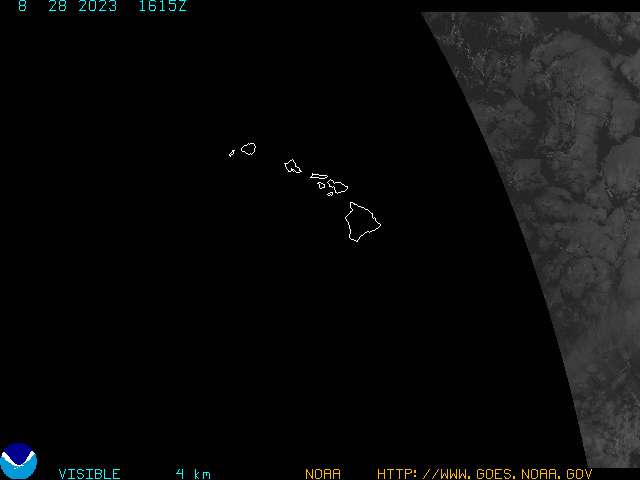

Mark Says:
Hi Glenn,
Any chance you can you look into the crystal ball for the
mid Dec. – late Dec. forecasting models for HI?~~~Hi Mark, we would have to used climatology for that far into the future. In which case, we would likely see fair weather punctuated by showery cold fronts at times. Aloha, Glenn
Suzie Says:
Hi Glenn,
when you list the wave height for the surf reports are you measuring the surf from the face of the wave or the back?~~~Hi Suzie, good question. There are actually two sets of measurements, the so called Hawaiian style, and the newer way, established by the NWS. It depends on where you are reading the numbers on my website. On the surf page I still use the Hawaiian style, while the narrative page I use the NWS numbers…as most folks who read on that page are more familiar with that way of measuring them. I hope this helps. Aloha, Glenn