December 22-23, 2010
Air Temperatures – The following maximum temperatures were recorded across the state of Hawaii Wednesday afternoon:
Lihue airport, Kauai – 77
Honolulu airport, Oahu – 80
Kaneohe, Oahu – 80
Molokai airport – 80
Kahului airport, Maui – 81
Kona airport – 84
Hilo airport, Hawaii – 77
Air Temperatures ranged between these warmest and coolest spots near sea level – and on the highest mountain tops…as of 5pm Wednesday evening:
Port Allen, Kauai – 84F
Kaneohe, Oahu – 74
Haleakala Crater – 46 (near 10,000 feet on Maui)
Mauna Kea summit – 36 (near 14,000 feet on the Big Island)
Precipitation Totals – The following numbers represent the largest precipitation totals (inches) during the last 24 hours on each of the major islands, as of late Wednesday afternoon:
1.00 Hanapepe, Kauai
0.75 Schofield South, Oahu
0.10 Molokai
0.00 Lanai
0.13 Kahoolawe
2.08 Oheo Gulch, Maui
2.80 Glenwood, Big Island
Marine Winds – Here’s the latest (automatically updated) weather map showing a 1021 millibar high pressure cell far to our northeast. At the same time, we find a weakening cold front paralleling the windward sides of our islands, and a weak trough of low pressure near Hawaii. Our winds will be light or a bit stronger from the east to southeast Thursday and Friday.
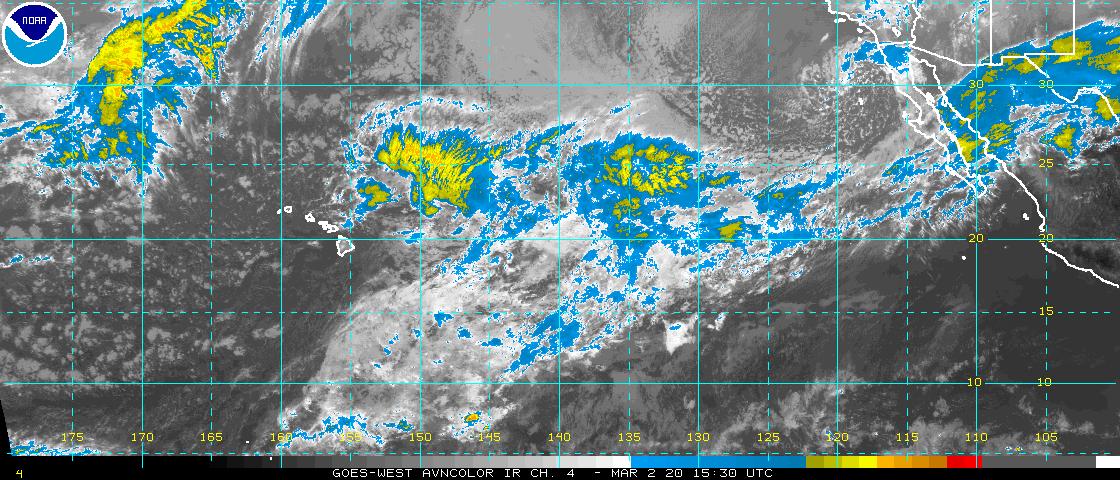
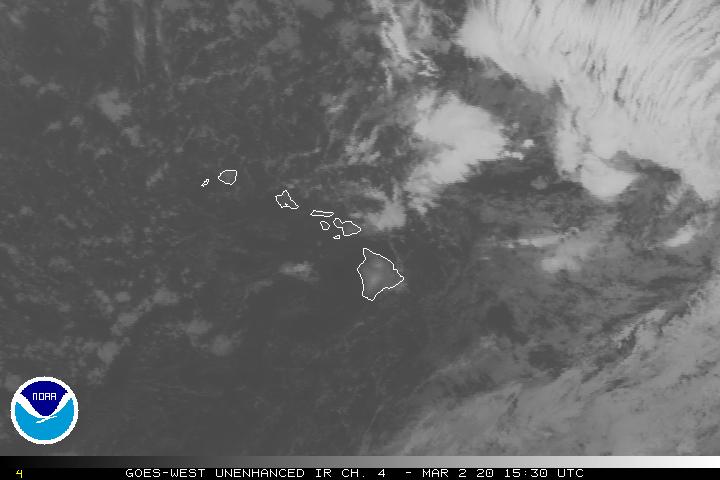
Satellite and Radar Images: To view the cloud conditions we have here in Hawaii, please use the following satellite links, starting off with this Infrared Satellite Image of the islands to see all the clouds around during the day and night. This next image is one that gives close images of the islands only during the daytime hours, and is referred to as a Close-up visible image. This next image shows a larger view of the Pacific…giving perspective to the wider ranging cloud patterns in the Pacific Ocean. Finally, here's a Looping IR satellite image, making viewable the clouds around the islands 24 hours a day. To help you keep track of where any showers may be around the islands, here’s the latest animated radar image.
Hawaii’s Mountains – Here’s a link to the live web cam on the summit of near 14,000 foot Mauna Kea on the Big Island of Hawaii. The tallest peak on the island of Maui is the Haleakala Crater, which is near 10,000 feet in elevation. These two web cams are available during the daylight hours here in the islands…and when there’s a big moon rising just after sunset for an hour or two! Plus, during the nights and early mornings you will be able to see stars, and the sunrise too…depending upon weather conditions.
Tropical Cyclone activity in the eastern and central Pacific – Here’s the latest weather information coming out of the National Hurricane Center, covering the eastern north Pacific. You can find the latest tropical cyclone information for the central north Pacific (where Hawaii is located) by clicking on this link to the Central Pacific Hurricane Center. Here’s a tracking map covering both the eastern and central Pacific Ocean. A satellite image, which shows the entire ocean area between Hawaii and the Mexican coast…can be found here. Of course, as we know, our hurricane season won't end until November 31st here in the central Pacific.
Aloha Paragraphs

Localized rain – flash flood watch except Kauai
Winds will be generally light through Thursday, returning trade winds briefly Friday, then south to southeast winds on Christmas Day. This weather map shows a 1021 millibar high pressure system located to the northeast, moving east. At the same time, we also have a dissipating cold front located just to our northeast…along with a weak trough of low pressure near the islands Wednesday night too. The placement of these high and low pressure features will keep our winds generally blowing from the southeast direction for the time being. Wind speeds will remain on the light side, although there will be locally stronger gusts here and there. A short stint of trade winds will return Friday, before shifting to the southerly Kona direction on Christmas Day.
Winds remain generally light…the following numbers represent the strongest breezes early Wednesday evening:
07 mph Port Allen, Kauai
08 Waianae, Oahu
07 Molokai
09 Kahoolawe
06 Lipoa, Maui
05 Lanai Airport
20 Kawaihae, Big Island
The threat of rainfall over the islands continues, resulting in the continued flash flood watch over the area from Oahu down to the Big Island…through late Wednesday night. This large view satellite image shows a trough of low pressure well to our west, with an old cold front paralleling the windward sides…over the offshore waters. Looking at this next satellite picture, showed that clouds built up over and around the mountains again today…although may once again tonight dissipate. The air mass remains shower prone however, so that localized rain could fall in places over the islands. Checking out this looping radar image we see light to moderately heavy showers still in our vicinity, with a few leftover heavy downpours locally too. The threat of heavy showers will prevail, as a dissipating cold front remains in our vicinity through Thursday. We'll find off and on showery weather locally…although conditions should gradually improve some some degree. The daytime heating of the islands will help prompt afternoon showers over the islands perhaps again Thursday.
The overlying atmosphere remains moist and shower prone. Checking the radar loop above shows some precipitation falling over the nearby ocean area. Just about anywhere in the state could still find some showers falling into Thursday. Meanwhile, we could see a new cold front approaching the state this weekend, prompting the chance of more showery weather by early next week. Looking way out there, out to seven days from today, some of the computer models are showing yet another cold front moving our way, increasing the chance of heavy rain again then. We’ll have to take a wait and see attitude that far out into the future of course.
Here in Kula, Maui at 640pm, the air temperature is a relatively warm 65.8F degrees. As I was driving home from Kihei, the skies began to clear rather quickly after sunset. I expect that many areas in the state will find stars twinkling in our local skies overnight. The one exception was around the Big Island, where a flood advisory for localized heavy showers, with thunderstorms was active. Likely by Friday into the weekend we should see some improvement. This suggests that Thursday morning may begin without many clouds around too. Kula had a good shower at some point today, as everything was wet when I got home several minutes ago. I'm going to go down and have dinner soon, and then probably talk on my cell phone for awhile. I'm sipping on a Sierra Nevada Celebration Ale this evening, which is tasty. I'll catch up with you again early Thursday morning, the last day of work in Kihei for me this week. I hope you have a great Wednesday night until then! Aloha for now…Glenn.
Interesting: 250 million years ago there was a world wide extinction event where 96% of all marine species were exterminated. Most of this event is unknown. Only one in every ten species survived, and these formed the basis for the recovery of life in the subsequent time period, called the Triassic.
A new fossil site — at Luoping in Yunnan Province — provides a new window on that recovery, and indicates that it took about 10 million years for a fully-functioning new ecosystem to develop. During that time window, the new ecosystem evolved and changed until it stabilized.
Marine invertebrates suffered the greatest losses during the Permian extinction. In the intensively-sampled south China sections at the Permian boundary, for instance, 280 out of 329 marine invertebrate genera disappear within the final 2 sedimentary zones containing conodonts from the Permian.
The Permian had great diversity in insect and other invertebrate species, including the largest insects ever to have existed. The end-Permian is the only known mass extinction of insects, with eight or nine insect orders becoming extinct and ten more greatly reduced in diversity.
The spectacular haul of 20,000 fossils from a hillside in southwestern China represents the first discovery of a complete ecosystem which bounced back after life was nearly wiped off the face of the planet 252m years ago. The small town of Luoping in China lies in the relatively underdeveloped eastern part of Yunnan province.
Luoping is dominated by karst features with small basins among mountain ranges. This area was a sea in Permian times. "The Luoping site dates from the Middle Triassic and contains one of the most diverse marine fossil records in the world," said Professor Benton.
"We can tell that we’re looking at a fully recovered ecosystem because of the diversity of predators, most notably fish and reptiles. It’s a much greater diversity than what we see in the Early Triassic — and it’s close to pre-extinction levels."
By studying the fossils, Benton and his colleagues at the Chengdu Institute of Geology and Mineral Resources and the University of Western Australia, hope to piece together how life can come back from the brink.
"The recovery from mass extinction touches on current concerns about biodiversity and conservation. Why do certain species go extinct? Which species come back? How do you rebuild an ecosystem and how long does it take?" said Benton.
Reinforcing this conclusion is the complexity of the food web, with the bottom of the food chains dominated by species typical of later Triassic marine faunas — such as crustaceans, fishes and bivalves — and different from preceding ones.
Just as important is the debut of new predators — such as the long-snouted bony fish Saurichthys, the ichthyosaur Mixosaurus, the sauropterygian Nothosaurus and the prolacertiform Dinocephalosaurus. "The fossils at Luoping have told us a lot about the recovery and development of marine ecosystems after the end-Permian mass extinction," said Professor Benton.
"There’s still more to be discovered there, and we hope to get an even better picture of how life reasserted itself after the most catastrophic global event in the history of our planet."
Interesting2: On the typical American roadway, it is not uncommon to see large advertising billboards. These types of billboards have been around for a long time, but are slowly being replaced with new flashy electronic billboards. According to a new report, digital billboards consume large amounts of energy and create a variety of electronic waste.
Digital billboards use thousands of tiny light emitting diodes (LED) bulbs which can be manipulated, so the image can be changed. The effect is a brighter sign which attracts the gaze of motorists and passengers, adding to our ever-growing distractions on the road.
For billboard owners, they can be great for business, allowing their space to be sold to multiple advertisers at any one time. Besides contributing to light pollution and being a visual annoyance to some, digital billboards also use massive amounts of energy.
According the study by Gregory Young, an architectural designer and urban planner in the Philadelphia area, each billboard consumes 30 times as much energy as the typical American household.
Even though LED bulbs are extremely efficient, the signs deploy so many that their energy use is high. Typical billboards have only one or two large lights to illuminate them at night, but require no energy during the day.
Digital billboards need power for all hours of the day and therefore require cooling systems which use even more energy. Some of these new billboards are enormous, measuring 20'x60' (6m x 18m), and can deploy over 10,000 LED bulbs.
Young’s report states that the largest digital billboards consume a staggering 323,773 kilowatts hours per year, compared to the typical household uses about 11,000 kilowatt hours per year.
The cost of this amount of energy equates to a bill of over $44,000 per year (given the current kWh rate in the Philadelphia metro area). Another major problem is the enormous amounts of electronic waste produced from spent LED bulbs. LED bulbs have a lifespan of 100,000 hours (11 years) and are recyclable.
However, with rapid technological advancements, today's LED bulbs will be obsolete. Also, there is often no mandate to reuse the bulbs, and very little monitoring exists. Wastes produced from typical billboards (paper, vinyl sheets) actually have a higher volume, but do not have the potentially toxic byproducts.
Nevertheless, digital billboards are expected to increase in numbers around the country as prices for large LED screens fall. The Outdoor Advertising Association of America projects the annual increase of large digital billboards to be several hundred per year. The rise of digital billboards will also bring about a rise in environmental, energy, and safety concerns.
Interesting3: Campaigners urge health secretary Andrew Lansley to act to reduce air pollution, as government medical experts warn of its 'significant' health burden. Long-term exposure to particulate pollution, largely from road traffic, is shortening the lives of as many as 200,000 every year, according to a government advisory committee.
The UK has repeatedly failed to meet EU air pollution targets over the decades with more than 20 towns and cities found to be emitting pollution at twice the WHO limits. Of particular concern are dusts, sulphates and nitrates from road traffic and other sources, known as particulate matter.
These small particles can be carcinogenic and are able to pass through the lungs into the bloodstream, causing inflammation and other more serious conditions. Twice as many people today suffer from lung disease and asthmatic conditions caused by air pollution than did 20 years ago.
Studying data from 2008, the independent Committee on the Medical Effects of Air Pollutants (COMEAP) estimated that completely removing particulate pollution would have added six months to the life expectancy of every new birth in the UK that year.
Interesting4: Every hour, an enormous quantity and variety of human-made chemicals, having reached the end of their useful lifespan, flood into wastewater treatment plants. These large-scale processing facilities, however, are designed only to remove nutrients, turbidity and oxygen-depleting human waste, and not the multitude of chemicals put to residential, institutional, commercial and industrial use.
So what happens to these chemicals, some of which may be toxic to humans and the environment? Do they get destroyed during wastewater treatment or do they wind up in the environment with unknown consequences?
New research by Rolf Halden and colleagues at the Biodesign Institute at Arizona State University seeks to address such questions. The group's results, reported recently in the Journal of Environmental Monitoring, suggest that a number of high production volume (HPV) chemicals — that is, those used in the U.S. at rates exceeding 1 million pounds per year, are likely to become sequestered in post-treatment sludge and from there, enter the environment when these so-called biosolids are deposited on land.
As Halden notes, over 4000 chemicals in common usage in the U.S. qualify as HPV chemicals, the vast majority of which have never been evaluated in terms of exotoxicity (their potential to adversely affect ecosystems), or for the risks they may pose to humans.
"With each of these compounds, we are engaged in an experiment conducted on a nationwide scale," says Halden; "Odds are, some of these chemicals will turn out to be bad players and will pose problems for ecosystems, public health or both."
Unfortunately, it is neither technically nor economically feasible to perform the kind of detailed analyses necessary to declare this vast swirl of chemicals safe for humans or environmentally benign following wastewater treatment. Instead, Halden's efforts are aimed at narrowing the field of potentially troublesome chemicals, by defining traits likely to cause some chemicals to persist in the environment.
To do this, the group applied a new empirical model for estimating the fraction of mass loading of chemicals in raw sewage expected to endure in digested sludge. Chemicals which become sequestered in digested sewage sludge are a potential cause for concern in part because the treated sludge is often subsequently applied to land, including land designated for agricultural use.
Halden's group screened some 207 HPV chemicals, using a model that predicted that two thirds of these compounds are likely to accumulate in digested sludge to greater than fifty percent of their initial mass loading in raw sewage. Eleven of these chemicals were flagged as compounds of special concern and deemed potential hazards to human and environmental health.
Three principal criteria dictated the selection of these problem chemicals: (a) their propensity to accumulate and persist in sludge in large amounts (b) structural characteristics suggestive of environmental persistence on land following biosolids recycling, and (c) unfavorable ecotoxicity threshold values, whether these have been experimentally determined or were forecasted with computer models.
As Halden explains, certain classes of chemicals possess physical characteristics that make them likelier to resist breakdown during wastewater treatment. Of particular concern are hydrophobic organic chemicals. As their name implies, such chemicals are 'afraid' of water and preferentially attach themselves to particulate matter, thereby becoming part of the primary and secondary sludge.
This characteristic trait limits the availability of hydrophobic chemicals to aerobic and anaerobic microorganisms during sewage treatment and sludge digestion. Rather than being broken down, such chemicals can become enriched in municipal biosolids by several orders of magnitude.
Through this process, substances in heavy usage, like HPV chemicals, can accumulate as pollutants in municipal sludge to parts per million (ppm) concentrations. "It's like vacuum cleaning your home," says Halden. "When the carpet is clean, the vacuum bag holds a concentrated burden of dirt.
By anology, the generation of biosolids enriched in non-biodegradable pollutants are the price you pay when purifying domestic sewage for water reuse." In order to better gauge which chemicals may go on to present human health and environmental risks following sequestration in sludge, the group conducted a computer or in silico analysis.
The method provides a streamlined and economically attractive means of isolating those chemicals deserving more in-depth field analysis. The group applied a new empirical model able to predict the fraction of total mass of a hydrophobic chemical likely to persist in biosolids after wastewater treatment.
Another advantage of the new model, applied by Halden and Assistant Professor Randhir Deo from the University of Guam, is simplicity. The model only requires two input values in order to estimate a chemical's environmental persistence.
The chemicals to be screened were taken from the High Production Volume Information System database maintained by the EPA to monitor the environmental fate of chemicals produced in amounts exceeding 1 million pounds per year.
The empirical model was developed and tweaked to produce the best agreement between the mathematical framework based on a given chemical's physical properties and actual measurements derived from large sewage treatment plants.
The physical characteristic found to play the largest role in a chemical's persistence in sludge was its sorption potential — the tendency of molecules of the chemical to adhere to the surface of other molecules. In the case of the HPV chemicals under consideration, high sorption values among hydrophobic chemicals caused them to stick to other particles and be sequestered from the degradative processes used to treat wastewater.
The bulk of the chemicals included in the HPV study were used for industrial purposes and included antidegradants, antioxidants, metal chelators, intermediates, by-products, catalysts, flame retardants, phenylating agents, plasticizers, heat storage and transfer agents, lubricants, solvents, anticorrosive agents, and others.
The study also identified five mass-produced chemicals used as flavors and fragrances that were predicted to persist in sludge in fifty percent or greater amounts of their initial mass loading in raw sewage. Once chemicals likely to persist in sludge were identified, estimates of their toxicity were examined.
Those with high persistence levels and high environmental toxicity made the enemies list of chemicals posing the greatest potential hazard. Prominent among the toxic chemicals were the so-called organohalogen compounds, seven of which were found to accumulate in substantial quantity in treated sludge and displayed half-lives in soil estimated to range from 120 to 360 days.
Perhaps of greatest concern are halogenated chemicals known as organobromines — popular ingredients in a range of flame retardant products, which have subsequently been identified in bird tissues,in egg pools of herring gulls,and in dust samples. Halden insists that better monitoring of just such chemicals is essential for understanding their trajectory and mitigating risks to human health and the environment.
Interesting5: Hydrologists may have a new way to study historical water conditions. By synthesizing present-day data with historical records they may be able to recreate broad hydrologic trends on a regional basis for periods from which scant data is available. Lack of reliable historical data can impede hydrologists' understanding of the current state of waterways and their ability to make predictions about the future.
That was the case for the rivers of the northeastern United States between 1600 and 1800, a period that runs from just before the first European settlers arrived to the onset of the Industrial Age.
"The historic perspective is important because humans have developed a particular approach to water that may not be sustainable," says Dr. Charles Vörösmarty, presidential professor of civil engineering in The Grove School of Engineering at The City College of New York.
"(People) often impact a system and then spend lots of money to fix it. By studying how systems evolved, we may be able to look at success stories of the past and avoid problems emerging today and in other parts of the world."
Professor Vörösmarty was principal investigator for the study, which was produced by an interdisciplinary team of researchers from 15 institutions. It was one of just two funded under the National Science Foundation's Continental Hydrological Processes Program, and is a major component of a multi century-scale study of waterways in an area stretching from Maine to Chesapeake Bay.
"The reconstruction makes it possible to discern broad hydrologic trends," said Christopher L. Pastore, a University of New Hampshire historian and corresponding author for the report, which was published this month in "Environmental Science & Technology."
"We're laying the groundwork for understanding the big picture: how Americans interacted with and changed their water resources over the broad sweep of time." Graduate students attending a summer institute at Massachusetts Institute of Technology developed the conceptual model and recommendations.
They identified four principal drivers of hydrological change: water engineering, land-cover change, climate change and human decision-making. The latter was overarching because it affects the other three. The model identified a baseline environment for the year 1600 and then worked forward. Europeans' impact on the waterways was felt soon after they arrived, Professor Vörösmarty noted.
For example, demand for beaver pelts reduced their population, and the dams the beavers had built collapsed because they were no longer being maintained. The signature of these changes was mapped on a regional scale and found to be substantial.
 Email Glenn James: