December 18-19, 2010
Air Temperatures – The following maximum temperatures were recorded across the state of Hawaii Saturday afternoon:
Lihue airport, Kauai – 82
Honolulu airport, Oahu – missing
Kaneohe, Oahu – 81
Molokai airport – 80
Kahului airport, Maui – 82
Kona airport – 83
Hilo airport, Hawaii – 81
Air Temperatures ranged between these warmest and coolest spots near sea level – and on the highest mountain tops…as of 4pm Saturday afternoon:
Kailua-kona – 80F
Kapalua, Maui – 75
Haleakala Crater – 52 (near 10,000 feet on Maui)
Mauna Kea summit – 39 (near 14,000 feet on the Big Island)
Precipitation Totals – The following numbers represent the largest precipitation totals (inches) during the last 24 hours on each of the major islands, as of Saturday afternoon:
0.02 Puu Opae, Kauai
0.00 Oahu
0.00 Molokai
0.00 Lanai
0.00 Kahoolawe
0.00 Maui
0.00 Big Island
Marine Winds – Here’s the latest (automatically updated) weather map showing weak 1020 millibar high pressure system located far to the east of the state. Our winds will be light or a bit stronger from the south to southwest Sunday and Monday.
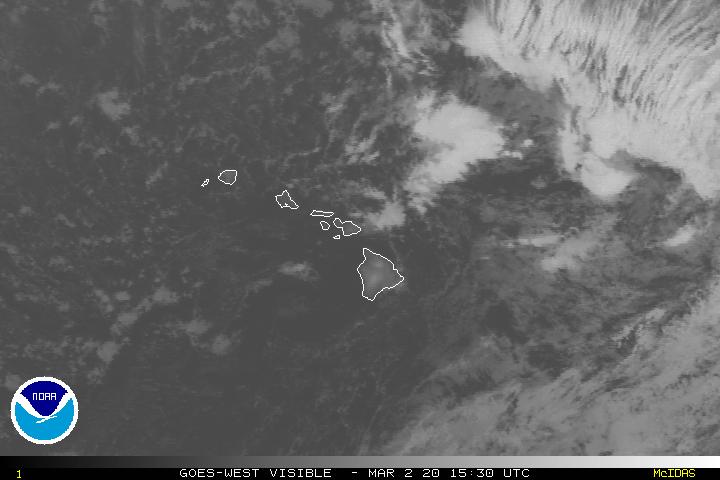
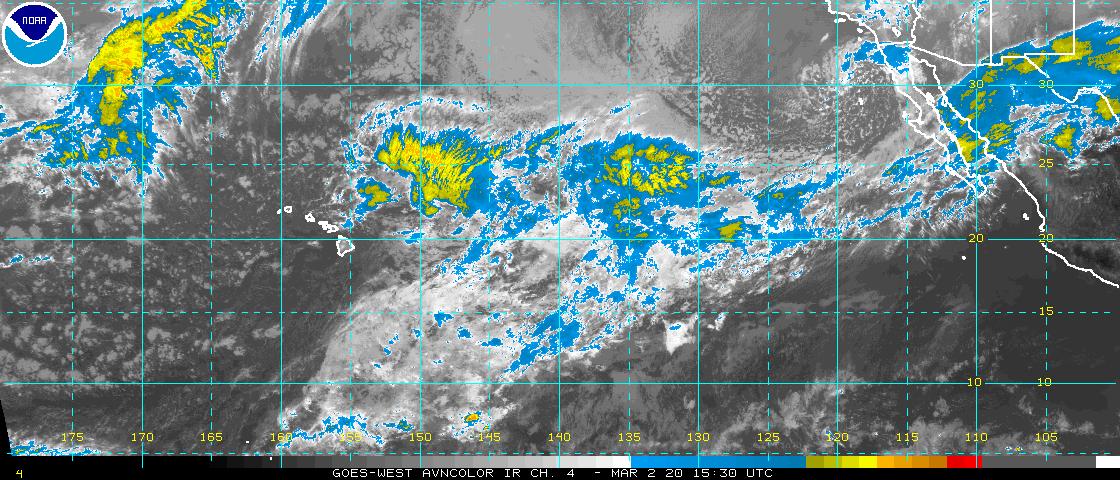
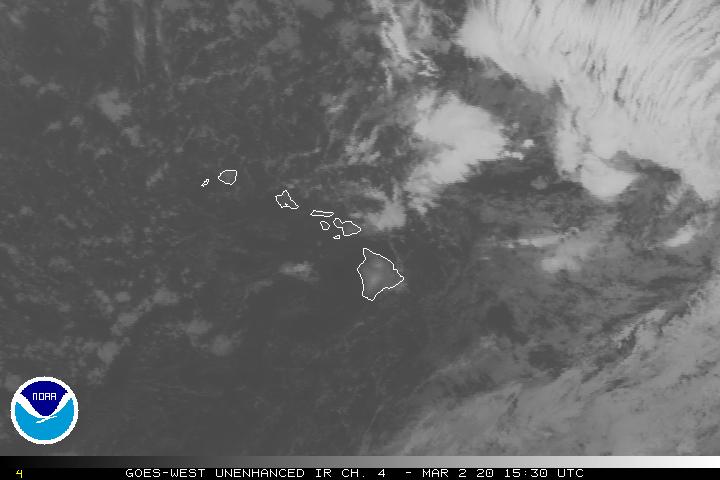
Satellite and Radar Images: To view the cloud conditions we have here in Hawaii, please use the following satellite links, starting off with this Infrared Satellite Image of the islands to see all the clouds around during the day and night. This next image is one that gives close images of the islands only during the daytime hours, and is referred to as a Close-up visible image. This next image shows a larger view of the Pacific…giving perspective to the wider ranging cloud patterns in the Pacific Ocean. Finally, here's a Looping IR satellite image, making viewable the clouds around the islands 24 hours a day. To help you keep track of where any showers may be around the islands, here’s the latest animated radar image.
Hawaii’s Mountains – Here’s a link to the live web cam on the summit of near 14,000 foot Mauna Kea on the Big Island of Hawaii. The tallest peak on the island of Maui is the Haleakala Crater, which is near 10,000 feet in elevation. These two web cams are available during the daylight hours here in the islands…and when there’s a big moon rising just after sunset for an hour or two! Plus, during the nights and early mornings you will be able to see stars, and the sunrise too…depending upon weather conditions.
Tropical Cyclone activity in the eastern and central Pacific – Here’s the latest weather information coming out of the National Hurricane Center, covering the eastern north Pacific. You can find the latest tropical cyclone information for the central north Pacific (where Hawaii is located) by clicking on this link to the Central Pacific Hurricane Center. Here’s a tracking map covering both the eastern and central Pacific Ocean. A satellite image, which shows the entire ocean area between Hawaii and the Mexican coast…can be found here. Of course, as we know, our hurricane season won't end until November 31st here in the central Pacific.
Aloha Paragraphs
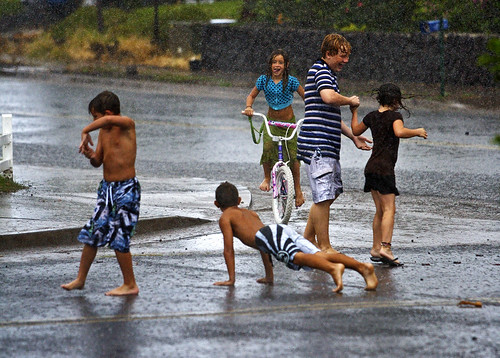
Increasing clouds leading to rain
Winds will be generally light…from the south and southwest this weekend. This weather map shows a weak 1020 millibar high pressure system located far to the east of the islands Saturday evening. The resultant light winds will keep some volcanic haze around, having come up from the vents on the Big Island. Winds will remain on the light side into the new week ahead, gradually becoming north to northeast around Tuesday…gradually giving way to trade winds by mid-week…lasting for several days.
Winds will be generally light from the south to southwest…the following numbers represent the strongest breezes early Saturday evening:
07 mph Lihue, Kauai
20 Waianae, Oahu
06 Molokai
10 Kahoolawe
08 Lipoa, Maui
09 Lanai Airport
17 South Point, Big Island
Wet conditions will arrive later Saturday on Kauai and Oahu, extending down to the rest of the state into Sunday…lasting into Monday at least. This large view satellite image continues to show a large mass of rich moisture edging over the Hawaiian Islands. Just a bit further west, near the International Dateline, we see a counterclockwise rotating low pressure system. Looking at this next satellite picture, which provides a closer look at our islands, we can see this threatening area of clouds and showers, has moved over the state Saturday night. Checking out this looping radar image we see moderately heavy showers forming close to or over Niihau and Kauai, and to the south of Oahu.
Friday evening I went to see a new film, called The Tourist (2010), starring Angelina Jolie, and Johnny Depp…among others. I'd been looking forward to seeing this film, as I like both of these two actors. The synopsis: two strangers find themselves unwittingly thrust into a deadly game of cat and mouse. The critics are being tough on this film, giving it only a C- grade. The viewers are being a bit more generous, giving a B grade. I go along with the B grade, actually a good solid B for that matter. I was thoroughly entertained by this film, and could recommend it…especially to those who like both of these major actors. Here's a trailer, just in case you want to give a peek.
Here in Kula, Maui at around 5pm, skies have become cloudy…and remain volcanically hazy too. As noted above, we have some definite changes coming our way soon, certainly in contrast to what we've been seeing the last several days…which has been very dry weather. We've seen a gradual increase in clouds during the day Saturday, with rain very close to Kauai at the time of this writing. This precipitation will spread across the entire state tonight into Sunday. There's a chance that this thick layer of tropical moisture may have a few embedded heavy showers too, or even a random thunderstorm. There's still some uncertainty about how long this wet weather will last, although at this point it looks destined to remain over our area at least through Tuesday, if not into Wednesday. We may begin to see some breaking up of this inclement weather pattern by mid-week, as the trade winds gradually come back into our area. ~~~ I'll be keeping a close eye on this developing wet weather event, and may come back online before Sunday morning, if conditions warrant further updates. Please plan on driving very carefully when the rains arrive, as there could be some localized flooding. Aloha for now…Glenn.
Extra: Parts of the state of Hawaii had an earthquake Saturday morning! 3.8 on the richter scale…near Kahoolawe Island just offshore from south Maui.
Interesting: For a few hours on the night of Dec. 20 to Dec. 21, the attention of tens of millions of people will be drawn skyward, where the mottled, coppery globe of our moon will hang completely immersed in the long, tapering cone of shadow cast out into space by our Earth. If the weather is clear, favorably placed sky watchers will have a view of one of nature's most beautiful spectacles: a total eclipse of the moon.
Unlike a total eclipse of the sun, which is only visible to those in the path of totality, eclipses of the moon can usually be observed from one's own backyard. The passage of the moon through the Earth's shadow is equally visible from all places within the hemisphere where the moon is above the horizon.
The total phase of the upcoming event will be visible across all of North and South America, as well as the northern and western part of Europe, and a small part of northeast Asia, including Korea and much of Japan.
Totality will also be visible in its entirety from the North Island of New Zealand and Hawaii — a potential viewing audience of about 1.5 billion people. This will be the first opportunity from any place on earth to see the moon undergo a total eclipse in 34 months.
This star chart shows where in the sky the upcoming lunar eclipse will appear. And check this NASA lunar eclipse chart to see how visible the eclipse will be from different regions around the world.
Stages of the eclipse
There is nothing complicated about viewing this celestial spectacle. Unlike an eclipse of the sun, which necessitates special viewing precautions in order to avoid eye damage, an eclipse of the moon is perfectly safe to watch. All you'll need to watch are your eyes, but binoculars or a telescope will give a much nicer view.
The eclipse will actually begin when the moon enters the faint outer portion, or penumbra, of the Earth's shadow a little over an hour before it begins moving into the umbra. The penumbra, however, is all but invisible to the eye until the moon becomes deeply immersed in it.
Sharp-eyed viewers may get their first glimpse of the penumbra as a faint smudge on the left part of the moon's disk at or around 6:15 UT (on Dec. 21) which corresponds to 1:15 a.m. Eastern Time or 10:15 p.m. Pacific Time (on Dec. 20).
The most noticeable part of this eclipse will come when the moon begins to enter the Earth's dark inner shadow (called the umbra). A small scallop of darkness will begin to appear on the moon's left edge at 6:33 UT (on Dec. 21) corresponding to 1:33 a.m. EST or 10:33 p.m. PST (on Dec. 20).
The moon is expected to take 3 hours and 28 minutes to pass completely through the umbra. The total phase of the eclipse will last 72 minutes beginning at 7:41 UT (on Dec. 21), corresponding to 2:41 a.m. EST or 11:41 p.m. PST (on Dec. 20).
At the moment of mid-totality (8:17 UT/3:17 a.m. EST/12:17 a.m. PST), the moon will stand directly overhead from a point in the North Pacific Ocean about 800 miles west of La Paz, Mexico.
The moon will pass entirely out of the Earth's umbra at 10:01 UT/5:01 a.m. EST/2:01 a.m. PST and the last evidence of the penumbra should vanish about 15 or 20 minutes later.
Color and brightness in question
During totality, although the moon will be entirely immersed in the Earth's shadow, it likely will not disappear from sight. Rather, it should appear to turn a coppery red color, a change caused by the Earth's atmosphere bending or refracting sunlight into the shadow.
Since the Earth's shadow is cone-shaped and extends out into space for about 844,000 miles, sunlight will be strained through a sort of "double sunset," all around the rim of the Earth, into its shadow and then onto the moon.
However, because of the recent eruptions of the Eyjafjallajökull volcano last spring and the Merapi volcano in Indonesia in October, one and possibly even two clouds of ash and dust might be floating high above the Earth.
As a result, the moon may appear darker than usual during this eclipse; during totality, parts of the moon might even become black and invisible.
A careful description of the colors seen on the totally eclipsed moon and their changes is valuable. The hues depend on the optical equipment used, usually appearing more vivid with the naked eye than in telescopes. The French astronomer Andre-Louis Danjon introduced the following five-point scale of lunar luminosity ("L") to classify eclipses:
L = 0: Very dark eclipse, moon almost invisible, especially in mid-totality.
L = 1: Dark eclipse, gray or brownish coloration, details distinguishable only with difficulty.
L = 2: Deep red or rust-colored eclipse, with a very dark central part in the shadow, and outer edge of the umbra relatively bright.
L = 3: Brick red eclipse, usually with a bright or yellow rim to the shadow.
L = 4: Very bright copper-red or orange eclipse, with a bluish very bright shadow rim.
Examine the moon at mid-totality and also near the beginning and end of totality to get an impression of both the inner and outer umbra. In noting an L observation, state the time and optical means (naked eye, binoculars or telescope) that is used.
At mid-totality, from rural locations far from city lights, the darkness of the sky is impressive. Faint stars and the Milky Way will appear, and the surrounding landscape will take on a somber hue. As totality ends, the eastern edge of the moon begins to emerge from the umbra, and the sequence of events repeats in reverse order until the spectacle is over.
Fringe effects
Interestingly, from most of New Zealand, a slice of northeast Australia, Papua, New Guinea, southwest Japan and Korea, the moon will rise during totality on the evening of Dec. 21. Because of low altitude and bright evening twilight, observers in these locations may not see much of the moon at all until it begins to emerge from out of the Earth's shadow.
Conversely, much of the United Kingdom and parts of western and northern Europe will see the moon set during totality on the morning of Dec. 21. Because of low altitude and bright morning twilight, observers in these locations may not see much of the moon at all after it slips completely into the Earth's shadow.
Past and future
The last total lunar eclipse occurred on Feb. 20 to Feb. 21, 2008 and was visible from most of the Americas, as well as Europe, much of Africa and western Asia. In 2011, there will be two total lunar eclipses. The first, on June 15, will be visible primarily from the Eastern Hemisphere and will have an unusually long duration of totality lasting one hour and 40 minutes.
Another total lunar eclipse will occur on Dec. 10 and will be visible over the western half of North America before moonset. For the next total lunar eclipse that will be visible across all of North America, we must wait until April 14 to April 15, 2014.
 Email Glenn James: