Weather Details and Aloha Paragraphs
Posted by GlennSeptember 5-6 2006
Air Temperatures – The following maximum temperatures were recorded across Hawaii Tuesday:
Lihue, Kauai – 84F
Honolulu, Oahu – 89
Kaneohe, Oahu – 85
Kahului, Maui – 88
Hilo, Hawaii – 84
Kailua-Kona, Hawaii – 87
Temperatures early Wednesday morning ranged between these warmest and coolest spots near sea level at the 4 a.m. hour:
KAILUA-KONA, OAHU – 78
MOLOKAI AIRPORT – 61
Precipitation Totals – The following numbers represent the largest precipitation totals (inches) during the last 24 hours (as of Wednesday morning) on each of the major islands:
1.02 MOUNT WAIALEALE, KAUAI
0.35 HAKIPUU MAUKA, OAHU
0.03 MOLOKAI
0.00 LANAI
0.00 KAHOOLAWE
0.19 WEST WAILUAIKI, MAUI
0.13 WAIAHA, BIG ISLAND
Weather Chart – Here’s the latest (automatically updated) weather map…showing a 1028 millibar high pressure center located far to the NE of our islands. This pressure configuration will provide moderately strong trade winds blowing across our area…gusty during the afternoon hours. Here’s a Weather Map Symbol page for clarification about what all those weather symbols mean on the map.
Hawaii’s Mountains – Here’s a link to the live webcam on the summit of near 14,000 foot Mauna Kea on the Big Island of Hawaii. The tallest peak on the island of Maui is the Haleakala Crater, which is near 10,000 feet in elevation. These two webcams are available during the daylight hours here in the islands…and when there’s a big moon rising just after sunset for an hour or two! Plus, during the nights and early mornings you will be able to see stars, and the sunrise too…depending upon cloud conditions.
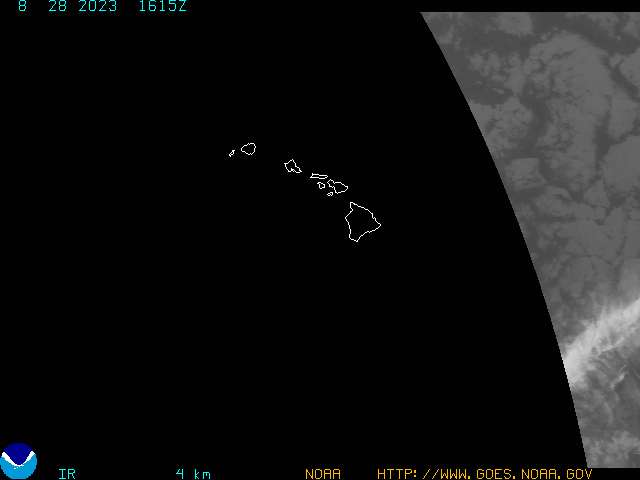
Satellite Images – To view the cloud conditions we have here in Hawaii, please use the following satellite links, starting off with the Infrared Satellite Image of the islands to see all the clouds around the state during the day and night. This next image is one that gives close images of the islands only during the daytime hours, and is referred to as a Close-up visible image. This next image shows a larger view of the Pacific…giving perspective to the wider ranging cloud patterns in the Pacific Ocean…out from the islands. To help you keep track of where any showers may be around the islands, here’s the latest animated radar image.
Tropical Cyclone Activity – The eastern Pacific hurricane season runs from May 15 through November 30…while the central Pacific (where Hawaii is) runs from June 1 through November 30. The latest storm information for the eastern Pacific can be found by clicking here. A storm tracking map for both the central and eastern areas can be found by clicking here . For the central Pacific, the latest storm information can be found by clicking here.
Aloha Paragraphs

Hawaii’s Green Sea Turtle
Photo Credit: flikr.com
The lighter than usual trade winds will continue today, then pick up again on Wednesday. We see areas of high pressure located far to the NE of the islands Tuesday. These trade wind producing high pressure systems are providing only light trade winds now…due to the interrupting presence of an upper level trough of low pressure nearby. These balmy trade winds will rebound again Wednesday, remaining active through the rest of this week.
These lighter than normal trade winds will allow afternoon cloud buildups again today. The leeward sides will remain dry, except along the Kona slopes of the Big Island, and the upcountry areas on Maui perhaps too…where we may find a few afternoon or evening showers falling locally. As the trade winds gain some strength by mid-week, we’ll see some increase in showers along the windward sides for a day or two.
The tropical Pacific Oceans have mellowed-out some after a spurt of activity last week. There are no more cyclones in the western Pacific, and we’ve lost former hurricane John, which pounded the Mexican coast last week. Yesterday’s weakening tropical depression Kristy, decided to strengthen again today, now upgraded back to a tropical storm. This long lasting storm is spinning the waters of the eastern Pacific, gradually moving westward towards our central Pacific.
It’s early Tuesday evening here in Kula, Maui, as I start writing this sunset commentary. I found the beach relatively empty early this afternoon during my lunch break from work. There was a brisk north breeze blowing, but not strong enough to chase anyone off this sandy beach I didn’t think. The air was warm, and the ocean was certainly warm enough for a delightful swim too. There should be larger waves Wednesday, as I expect a new south swell to be "gracing" our leeward beaches then. Speaking of waves, the first substantial NW swell (the winter time direction) of this late summer period is expected to jack the waves up late this coming Sunday or by early next Monday morning. This is all good news for the local surfing community. I don’t surf the big winter waves myself, although I love the summer waves that come up from the southern hemisphere. The sunset this evening was just wonderful, and the higher clouds are just now starting to shine, so I’d better scoot out there again to bear witness to the occasion. I hope you have a great Tuesday night! I’ll be back around early Wednesday morning with your next narrative from paradise. Aloha for now…Glenn.
I want to highlight another of the great advertisers on my website today, this time it’s Beach Guide. "Welcome to the Maui Beach Guide! Whether you’re planning a trip to Maui or are already here on the island, we created this guide just for you: the Maui Beach Guide is your complete, unbiased guide to every single beach on Maui."
 Email Glenn James: