











December 2-3, 2009
Air Temperatures – The following maximum temperatures were recorded across the state of Hawaii Wednesday afternoon:
Lihue, Kauai – 78
Honolulu, Oahu – 83
Kaneohe, Oahu – 79
Kaunakakai, Molokai – 80
Kahului, Maui – 80
Hilo, Hawaii – 80
Kailua-kona – 84
Air Temperatures ranged between these warmest and coolest spots near sea level around the state – and on the highest mountains…at 5pm Wednesday evening:
Port Allen, Kauai – 82F
Lihue, Kauai – 74
Haleakala Crater – 52 (near 10,000 feet on Maui)
Mauna Kea summit – 41 (near 14,000 feet on the Big Island)
Precipitation Totals – The following numbers represent the largest precipitation totals (inches) during the last 24 hours on each of the major islands, as of Wednesday afternoon:
0.02 Anahola, Kauai
0.02 Waimanalol, Oahu
0.00 Molokai
0.00 Lanai
0.00 Kahoolawe
0.01 Oheo Gulch, Maui
0.76 Mountain View, Big Island
Marine Winds – Here’s the latest (automatically updated) weather map showing a cold front moving down through the islands. Winds will be south to southwest Thursday, with lighter north to northeast winds Friday.
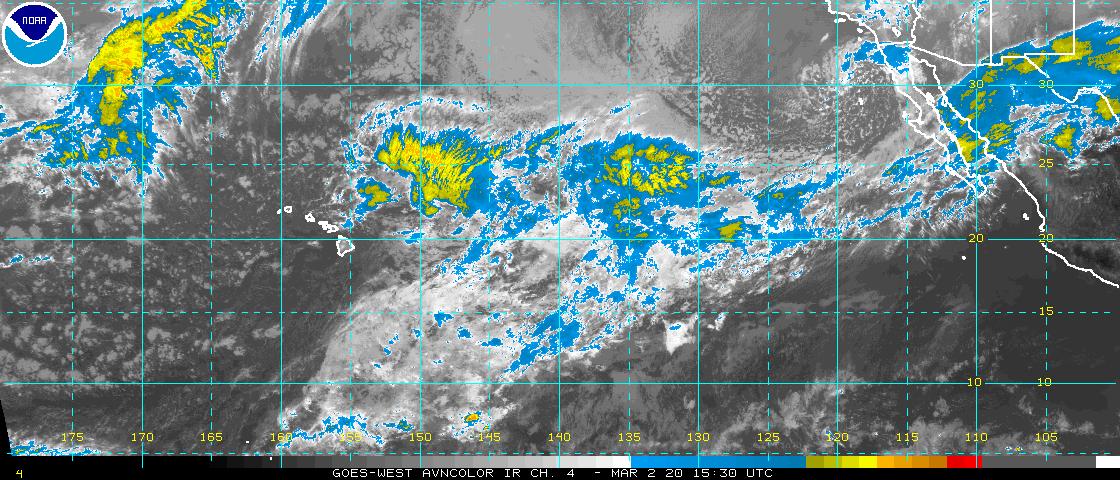
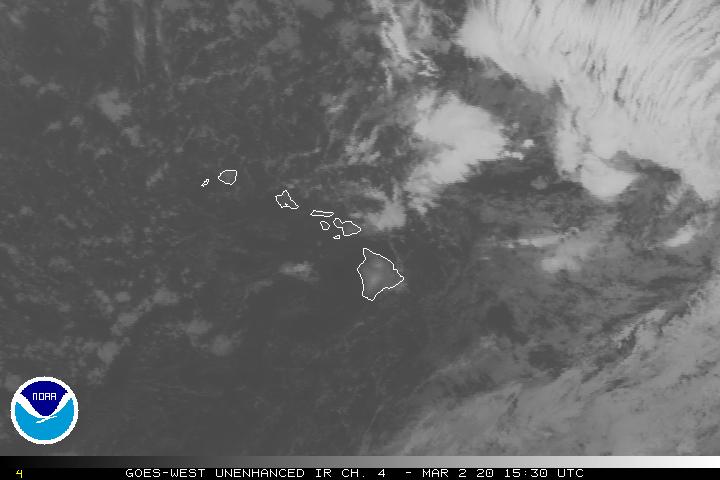
Satellite and Radar Images: To view the cloud conditions we have here in Hawaii, please use the following satellite links, starting off with this Infrared Satellite Image of the islands to see all the clouds around the state during the day and night. This next image is one that gives close images of the islands only during the daytime hours, and is referred to as a Close-up visible image. This next image shows a larger view of the Pacific…giving perspective to the wider ranging cloud patterns in the Pacific Ocean. Finally, here’s a Looping IR satellite image, making viewable the clouds around the islands 24 hours a day. To help you keep track of where any showers may be around the islands, here’s the latest animated radar image.
Hawaii’s Mountains – Here’s a link to the live webcam on the summit of near 14,000 foot Mauna Kea on the Big Island of Hawaii. The tallest peak on the island of Maui is the Haleakala Crater, which is near 10,000 feet in elevation. These two webcams are available during the daylight hours here in the islands…and when there’s a big moon rising just after sunset for an hour or two! Plus, during the nights and early mornings you will be able to see stars, and the sunrise too…depending upon weather conditions.
Tropical Cyclone activity in the eastern and central Pacific – Here’s the latest weather information coming out of the National Hurricane Center, covering the eastern north Pacific. You can find the latest tropical cyclone information for the central north Pacific (where Hawaii is located) by clicking on this link to the Central Pacific Hurricane Center. Here’s a tracking map covering both the eastern and central Pacific Ocean. A satellite image, which shows the entire ocean area between Hawaii and the Mexican coast…can be found here.
Aloha Paragraphs

Approaching cold front…with showers
The islands were almost totally clear Wednesday, with just a few clouds stacking up around the mountains on Maui and the
Winds are considerably lighter than they have been over the last several days, with a drift up from the southeast Wednesday…with a bit of volcanic haze around Maui. This latest weather map shows a couple of very weak high pressure systems to the northeast of the islands. A ridge stretches back to the southwest, to over the central part of the chain. As the cold front pushes south and southeast, the ridge will migrate to the south and southeast of the
The cold front will bring precipitation into the state, Kauai will be first in line for these showers…reaching
Our weather will clear up, at least on Kauai and
The parent low pressure systems for these cold fronts, will be deep storms in the north Pacific…which will send us large northwest swells. We’ll see these winter-like swells arriving every 2-3 days, with high surf advisories, or even warnings going up each time. The next couple of these swells will qualify as large, although we will have to wait until next Monday…for an extra large swell train of waves to arrive. The storm that will generate this giant swell, will have hurricane force winds revolving around its center. These swells will be something to photograph, but most of us will need to stay out of the ocean on the north and west facing beaches while they’re breaking. These high surf episodes are common as we move towards our upcoming winter season.
It’s early Wednesday evening here on Maui, as I begin writing this last section of today’s narrative. Wednesday was a great day here in the islands! Skies were generally clear, with just those few clouds surrounding the mountains. Shower activity was at a bare minimum in most areas. As noted in the paragraphs above, Thursday will find the season’s first cold front moving down through the island chain. Gusty Kona winds will blow ahead of the front, with northwest to north, then northeast breezes filling in behind the front. This is all pretty exciting, although I can only speak for myself. I hope that you will enjoy this experience as well. ~~~ I’m just about ready to get out on the road now, for the drive back upcountry to Kula. I’ll be back early Thursday morning to see where the front is then, and to prepare your next new weather narrative from paradise. Don’t forget to keep that extra blanket on your bed, as it will be chilly Thursday morning. The just past full moon will keep island skies well lit too. I hope you have a great Wednesday night until we meet again! Aloha for now…Glenn.
Interesting: For many people "rural" is synonymous with low incomes, limited economic opportunity, and poor schools. However, a recent study found that much of rural America is actually prosperous, particularly in the Midwest and Plains. Researchers just had to look at things differently to see the prosperity.
The study — announced today and based on date from the year 2000 — analyzed unemployment rates, poverty rates, high school drop-out rates, and housing conditions to identify prospering communities. The result: One in five rural counties in the United States is prosperous, doing better than the nation as a whole on all these measures.
The study did not define community success in terms of the traditional measures of growth in population, employment and income, according to Andrew Isserman, an economist at the University of Illinois at Urbana-Champaign and author of the paper.
Instead, it focused on outcomes: Do communities keep their kids in school? Are their unemployment and poverty rates low? Are housing conditions good and the folks healthy? "When we started our research, people wondered whether we would find any prosperous rural communities at all using those criteria.
But more than 300 of the nation’s rural counties did better than the nation," Isserman said. Counties in America’s Heartland — Illinois, Indiana, and Iowa and parts of six adjacent states — came out on top with half the rural counties prospering. In the Southeast and Southwest, fewer than one in twenty rural counties prosper.
Prosperous rural counties have more off-farm jobs, more educated populations, and less income inequality than other rural counties. The prosperous rural counties in 2000 averaged 2 percent population growth over the previous decade.
The worst-off counties, which met no prosperity criteria, averaged five times the growth at 11 percent, yet had much lower incomes. "This finding supports our view that growth and prosperity are different dimensions, and much can be learned from studying rural prosperity," Isserman said.
Interesting2: Two inventions have shaped our modern world more than any other: the engine and the computer. Where the engine captured and extended the human capacity to do physical work, the computer did the same for the capacity of the human brain to think, organize and control. This power has now pervaded not just homes and offices but also tens of thousands of products where it once didn’t seem to fit, thanks to a small and beautiful device called the microprocessor.
Early computers were huge machines constructed from heterogeneous technologies and were very costly and wasteful of energy. Fifty years ago, a computer was an end in itself – it was inconceivable to put a computer inside, say, a toy or an electric toothbrush. Semiconductor technology changed all that.
Semiconductors made it possible to shrink computing components down to previously unimaginable sizes, enabling the invention of the microprocessor. This extended the idea of what a computer could be and provided a conceptual framework for delivering the immense power of computing technology into practical components that could be manufactured in volume, and therefore at low cost.
The microprocessor led naturally to the microcontroller, an entire computer on a single integrated circuit: very small, inexpensive and energy efficient. Today there is no industry and no human endeavor that hasn’t been touched by microprocessors or microcontrollers.
Microprocessors and semiconductor technology are co-evolving, one feeding the other in a cycle of growth limited only by the "food" supply – the ability to make ever smaller transistors. This process is not only delivering ever smaller, faster and cheaper microprocessors, but also adding capabilities such as sensors and motors.
We can now routinely make digital video and still cameras smaller than a grain of rice, optics included, costing less than a dollar. As time goes on, we will be able to mass-produce ever more complex and complete systems.
Interesting3: Eighty-five million barrels. That’s how much oil we consume every day. It’s a staggering amount – enough to fill over 5400 Olympic swimming pools – and demand is expected to keep on rising, despite the impending supply crunch. The International Energy Agency forecasts that by 2030 it will rise to about 105 million barrels per day with a commensurate increase in production, although whistle-blowers recently told The Guardian newspaper in London that insiders at the IEA believe the agency vastly over-estimates our chances of plugging that gap.
The agency officially denies this. Wherever the truth lies, it is widely expected that by 2030 we will have passed the peak of conventional oil production – the moment that output from conventional oil reserves goes into terminal decline. A report from the UK Energy Research Centre (UKERC) published in August said there was a "significant risk" it would happen before 2020.
And that means we will soon be staring down the barrel of the ultimate oil crisis. Some governments and corporations are waking up to the idea and beginning to develop alternatives to keep the world’s transport systems moving when cheap oil runs out. These include biofuels, more energy-efficient – or electric – cars, and hydrogen. But none of these is likely to make up the global shortfall in time.
The pressure is on to keep the black stuff flowing and so the next two decades will see an unprecedented effort to exploit increasingly exotic and unconventional sources of oil. They include tar sands (a mixture of sand or clay and a viscous, black, sticky petroleum deposit called bitumen), oil shale (a sedimentary rock containing kerogen, a precursor to petroleum) and synthetic liquid fuels made from coal or gas.
Purely in terms of geological abundance, these sources look more than sufficient to meet global demand. According to the IEA, taken together, they raise the remaining global oil resource to about 9 trillion barrels – almost nine times the amount of oil humanity has consumed to date. The trouble is that the name "non-conventional oil" hides several dirty little secrets and a whole host of huge challenges.
Conventional oil refers to liquid hydrocarbons trapped in deep, highly pressurized reservoirs, which means that when the wells are drilled, the oil usually gushes to the surface of its own accord. Non-conventional oils are not so forthcoming, and need large amounts of energy, water and money to coax them from the ground and turn them into anything useful, like diesel or jet fuel.
As a result, non-conventional oil production to date has been slow to expand – with current output of just 1.5 million barrels per day. Not only that, because they take so much energy to produce, they are responsible for higher carbon emissions per barrel than conventional oil.
Interesting4: Enjoy serving shrimp, oysters or crabs during your holiday meals? Then you should pay heed to the big climate-change meeting opening next Monday in Copenhagen. What nations decide there could determine if our ocean will continue providing tasty shellfish — or instead become part of a perilous chemistry experiment that could ravage valuable fisheries and coral reefs.
The problem, strange as it may seem, is that the ocean is doing a wonderful job of slowing down global warming. Every day, it removes nearly 30 million metric tons of carbon dioxide — the main warming gas — from the atmosphere. That’s nearly twice what U.S. power plants, cars and factories spew daily into the sky.
So we owe the ocean a big thanks for putting a brake on climate change and giving us time to find solutions. Unfortunately, that help comes at a steep price. When carbon dioxide in the air mixes with seawater, a chemical reaction creates a compound called carbonic acid. In the ocean, however, “acidification” is bad news for shellfish and corals.
That’s because as acidification increases — and it is increasing rapidly — the process locks up the carbonate molecules these creatures need to build their shells and stony skeletons. So far, climate negotiators have paid scant attention to ocean acidification. That needs to change in Copenhagen. Already, scientists say the oceans are 30 percent more acidic than they were just 250 years ago.
That’s a disturbingly rapid shift, perhaps 100 times faster than anything Earth has had during the last 200,000 years. And if we don’t act soon to curb emissions, acidity could double by the end of the century, making our seas more acidic than they’ve been in 20 million years. Scientists are just beginning to fully understand the consequences of this massive chemistry experiment.
Studies, for instance, suggest that adult fish and shellfish might survive more acidic waters but their eggs and larvae may not. So, over time, these organisms would become “dead species walking” — seemingly fine but reproductively doomed. Other research predicts that some ocean waters could become acidic enough to dissolve the shells of the tiny creatures that form the critical base of the marine food chain.
These “pteropods” are a favorite food of pink salmon, and help sustain giant whales. One of the first victims of acidification, however, will be the world’s hard corals. Tiny coral polyps build their monumental, dazzling reefs by manufacturing tons of limestone. But the corals won’t be able to keep up their masonry if acidification continues.
In fact, several studies have concluded that if emissions aren’t curbed, virtually all warm-water reefs could stop growing and start crumbling to rubble by the middle to end of this century. Among the potential U.S. casualties: reefs off Hawaii, Florida and the Gulf Coast that serve as backbones for some of the planet’s richest habitats.
And if the reefs go, so could iconic species that are part of America’s cultural — and culinary — heritage, such as snapper, grouper and spiny lobster. Such losses would have enormous social and economic consequences. Reefs support tourism and global fisheries worth billions of dollars annually, and more than 100 million people rely on them for their food and livelihood.
Interesting5: California officials said on Tuesday that drought and environmental restrictions have forced them to cut planned water deliveries to irrigation districts and cities statewide to just 5 percent of their contracted allotments. Although the state Water Resources Department typically ends up supplying more water than first projected for an upcoming year, its 5 percent initial allocation for 2010 marks the smallest on record since the agency began delivering water in 1967.
Drastic cutbacks in irrigation supplies this year alone from both state and federal water projects have idled some 23,000 farm workers and 300,000 acres of cropland in California, according to researchers at the University of California at Davis. Water shortages also have forced California cities large and small to raise rates they charge and to ration supplies. The state water allocation initially set for this year was 15 percent of the amount users are entitled to receive under their contracts.
That figure was later raised to 40 percent, still well below the 68 percent averaged over the past decade. While a return to wetter weather in the months ahead could quickly ease the crunch, the initial 2010 allotment was greeted with alarm up and down a state already beset with chronic budget problems and jobless levels above the national average.
"On the heels of three years of drought and ongoing regulatory restrictions, we are now bracing for yet another year of painfully limited water supplies," said Laura King Moon, assistant general manager for the State Water Contractors.
Interesting6: Days before the Copenhagen conference on climate change kicks off, a major study by a group of 100 international scientists has said that sea levels are likely to rise by as much as more than 4 feet by the end of this century. That’s twice as much as previously predicted in IPCC’s fourth assessment report of 2007. The report released by the Scientific Committee on Antarctic Research (SCAR) is the first comprehensive review of the impact of global warming on Antarctica.
The IPCC’s 2007 report had projected that sea-levels could rise by 18cm to 59cm by 2099. Subsequent studies of glacial melts in Greenland and Antarctica had raised fears that sea rise could be much higher than that. “We can see the west Antarctic glaciers are shrinking at a rate fast enough to contribute to a sea level rise of 1.4 m by 2100, but it will be no more than that,” SCAR executive director Colin Summerhayes told reporters at a media briefing in London.
If these projections come true, most areas in low-lying island nations like the Maldives would go under the sea. Based on earlier studies, the UN’s environmental panel has already warned that sea levels would be high enough to make the Maldives uninhabitable by 2100. The new study also significantly enhances the threat to the Indian coast — and cities like Mumbai, Chennai and the low-lying Kolkata.
“Anybody who lives in coastal cities needs to be slightly worried by projections of 1 meter or more,” Summerhayes said. Since 1870, global sea level has risen by about 20cm at an average rate of 1.7 mm/year. But in recent decades, the rate has risen sharply to 2.5mm/year, according to the latest figures. The rise in sea level is mainly a result of thermal expansion of the ocean due to global warming as well as increased water inflows from melting glaciers and ice caps.
The reports says that central Antarctica, that has so far been protected from warming due to a hole in the ozone layer, will also see the full effects of greenhouse gas increases as the ozone hole heals. The scientists found that there has been significant thinning of the west Antarctic ice sheet and 90% of glaciers across the Antarctic peninsula had retreated over recent decades.
But the bulk of the Antarctic ice sheet has shown little change over recent decades. However, the report says, historically, small-scale climate variability has caused rapid ice loss, shifts in ocean and atmospheric circulation in the continent. This shows Antarctica is highly sensitive to even minor climate changes. It says studies of sediments under recently lost ice shelves suggest ice shelf loss in some regions is unprecedented during this time scale.
 Email Glenn James: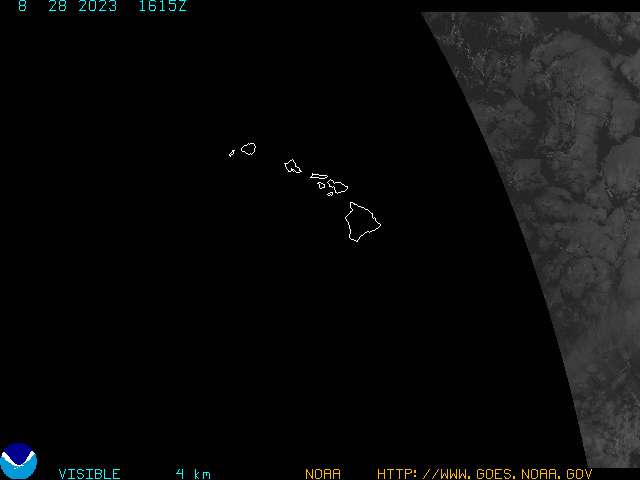


Rick Ridgeway Says:
News flash, global warming is a hoax, and always has been. Didn’t you hear about the email leak?~~~Hi Rick, I wouldn’t too sure, or at least I’m not…but time will tell won’t it? Thanks for chiming in on this debate. Aloha, Glenn