November 30-December 1, 2009
Air Temperatures – The following maximum temperatures were recorded across the state of Hawaii Monday afternoon:
Lihue, Kauai – 76
Honolulu, Oahu – 79
Kaneohe, Oahu – 76
Kaunakakai, Molokai – 79
Kahului, Maui – 80
Hilo, Hawaii – 79
Kailua-kona – 84
Air Temperatures ranged between these warmest and coolest spots near sea level around the state – and on the highest mountains…at 4pm Monday afternoon:
Kailua-kona – 84F
Hilo, Hawaii – 71
Haleakala Crater – 45 (near 10,000 feet on Maui)
Mauna Kea summit – 32 (near 14,000 feet on the Big Island)
Precipitation Totals – The following numbers represent the largest precipitation totals (inches) during the last 24 hours on each of the major islands, as of Monday afternoon:
0.69 Mount Waialaele, Kauai
0.68 South Fork Kaukonahua, Oahu
0.90 Molokai
0.01 Lanai
0.00 Kahoolawe
3.99 Puu Kukui, Maui
2.01 Honokaa, Big Island
Marine Winds – Here’s the latest (automatically updated) weather map showing a 1025 millibar high pressure system far to the northwest of the islands…moving eastward towards Hawaii. Winds will be locally strong and gusty into Tuesday, then lighter.
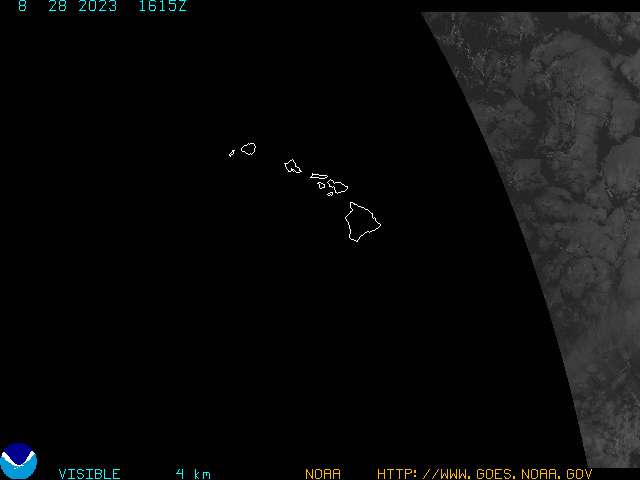
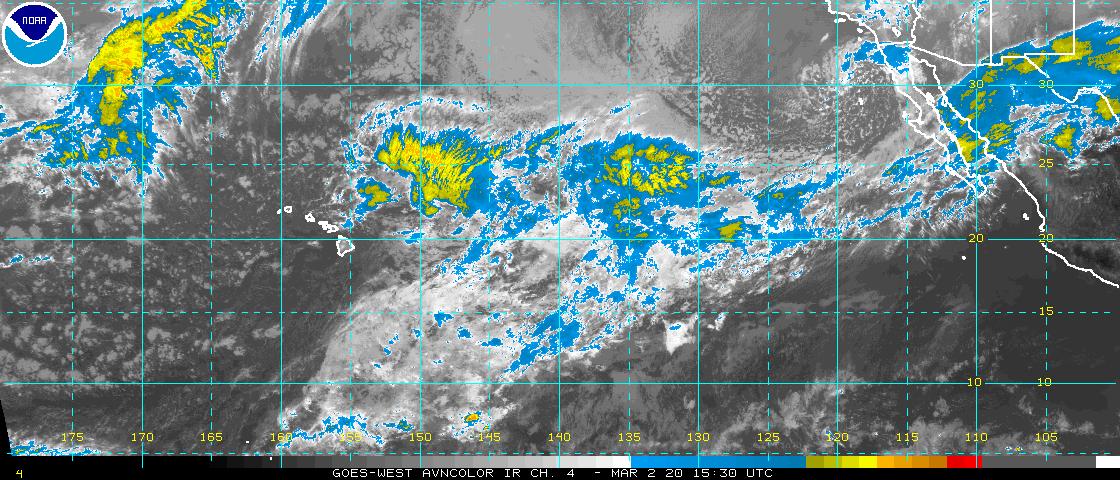
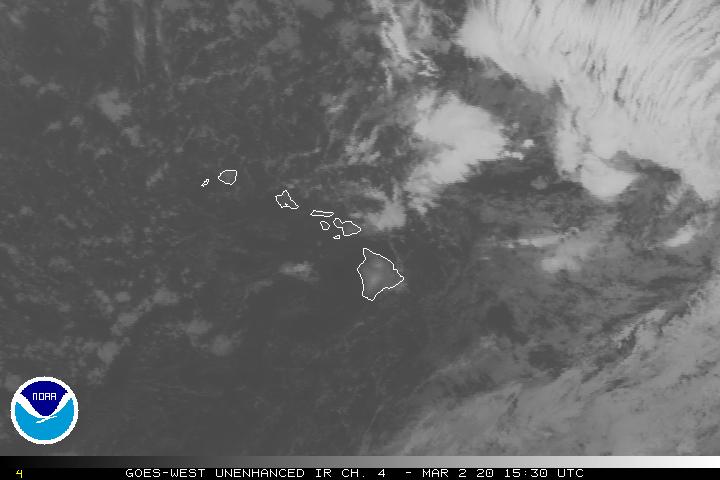
Satellite and Radar Images: To view the cloud conditions we have here in Hawaii, please use the following satellite links, starting off with this Infrared Satellite Image of the islands to see all the clouds around the state during the day and night. This next image is one that gives close images of the islands only during the daytime hours, and is referred to as a Close-up visible image. This next image shows a larger view of the Pacific…giving perspective to the wider ranging cloud patterns in the Pacific Ocean. Finally, here’s a Looping IR satellite image, making viewable the clouds around the islands 24 hours a day. To help you keep track of where any showers may be around the islands, here’s the latest animated radar image.
Hawaii’s Mountains – Here’s a link to the live webcam on the summit of near 14,000 foot Mauna Kea on the Big Island of Hawaii. The tallest peak on the island of Maui is the Haleakala Crater, which is near 10,000 feet in elevation. These two webcams are available during the daylight hours here in the islands…and when there’s a big moon rising just after sunset for an hour or two! Plus, during the nights and early mornings you will be able to see stars, and the sunrise too…depending upon weather conditions.
Tropical Cyclone activity in the eastern and central Pacific – Here’s the latest weather information coming out of the National Hurricane Center, covering the eastern north Pacific. You can find the latest tropical cyclone information for the central north Pacific (where Hawaii is located) by clicking on this link to the Central Pacific Hurricane Center. Here’s a tracking map covering both the eastern and central Pacific Ocean. A satellite image, which shows the entire ocean area between Hawaii and the Mexican coast…can be found here.
Aloha Paragraphs

Gradually lighter trade winds
The trade winds will remain active, at least in most areas, through Tuesday…then big noticeably lighter by mid-week. The small craft advisory will contine over most of Hawaii’s marine zones Monday night. The computer models suggest that the trade winds will diminish on Wednesday…with lighter and variable breezes then. The approach of a cold front will turn our winds southeast, then south and southwest…from the Kona direction, by Thursday. A second cold front will potentially turn our winds again to the south and southwest by Sunday again. If a third cold front doesn’t try to move our way thereafter…we will likely see a surge of cool north winds in the wake of that final frontal boundary next Tuesday.
Cold air associated with an upper level low pressure system…recently made our atmosphere unstable. This upper level disturbance enhanced incoming showers…carried our way on the blustery trade winds. This cold air aloft caused some locally heavy showers…along with a couple of thunderstorms around the Big Island. Drier air is moving into our area from the west now, which has put us back into an unusually dry trade wind weather pattern into Tuesday. Lets use this satellite image to keep an eye on the clouds around now…and use this looping radar image to see where just a few showers might be for the time being.
Looking further ahead, and as described above, we have more excitement up ahead. Drier weather is upon us now, with fairly normal weather conditions on tap through Tuesday. Wednesday’s winds will turn considerably lighter than they are now, with some afternoon interior clouds perhaps dropping a few light showers. Then, as we move into Thursday, our winds will become Kona in direction (south and southwest), as an active Pacific cold front moves in our direction from the northwest. It will bring some rain to our islands this Friday…with another cold front precipitation event later Sunday or next Monday.
It’s early Monday evening here on Maui, as I begin writing this last section of today’s narrative. As you can see, if you had a chance to read down through the paragraphs above, we’re looking at several days of nice weather ahead. The trade winds will remain around through Tuesday, but then soften into what we call light and variable breezes by mid-week. We haven’t seen Kona winds in quite some time, so it will be a pleasure to welcome them back into our area starting Thursday. ~~~ This evening, I’m about ready to take the drive over to Haiku for the viewing of a film. This is at a friend of mine’s house, where he apparently has a large screen. He and another friend of mine, have teamed up to present a film tonight called Wings of Desire. These films are shown after some libations and a little food, followed by discussion of the films. I won’t be able to stay for that, but will take in the film before high-tailing it back upcountry to Kula afterwards. I’ll let you know what I thought of the film early Tuesday morning. I’ll embed that commentary in the next new weather narrative from Paradise. I hope you have a great Monday night until then! Aloha for now…Glenn.
Interesting: Popular thinking about how to improve food systems for the better often misses the point, according to the results of a three-year global study of salmon production systems. Rather than pushing for organic or land-based production, or worrying about simple metrics such as "food miles," the study finds that the world can achieve greater environmental benefits by focusing on improvements to key aspects of production and distribution.
For example, what farmed salmon are fed, how wild salmon are caught and the choice to buy frozen over fresh matters more than organic vs. conventional or wild vs. farmed when considering global scale environmental impacts such as climate change, ozone depletion, loss of critical habitat, and ocean acidification.
The study is the world’s first comprehensive global-scale look at a major food commodity from a full life cycle perspective, and the researchers examined everything — how salmon are caught in the wild, what they’re fed when farmed, how they’re transported, how they’re consumed, and how all of this contributes to both environmental degradation and socioeconomic benefits.
Interesting2: There is one month left in 2009, which leaves you plenty of time to take advantage of the green tax incentives available to consumers. While some of these tax credits or deductions have been available for several years, many were created as part of the American Recovery and Reinvestment Act.
A common theme among green-related Recovery Act programs is the importance of weatherization projects. When homeowners can create a more energy efficient property, they save money on energy bills as well as reduce their greenhouse gas emissions. Energy-saving and weatherization products must be installed on an existing, primary residence.
Although 2009 is coming to a close, these tax credits are valid for projects completed through December 31, 2010. If you’re in the market for a new vehicle, purchasing a hybrid or clean diesel vehicle may help you save thousands on your taxes. Unfortunately, the most popular hybrid, the Toyota Prius, is no longer eligible for a tax credit.
Tax credits for hybrids are phased out after an automaker has sold 60,000 eligible units. However, there are still three automakers that sell tax credit-eligible hybrid vehicles: Ford, General Motors, and Nissan. Due to the popularity of the Ford Escape Hybrid, Ford is already in the tax credit phase out process.
If you purchased an eligible Ford hybrid prior to April 1, 2009, you may be eligible to take the full credit amount. Ford hybrids purchased between April 1, 2009 and September 30, 2009 are eligible for a 50% credit and eligible Ford hybrids purchased prior to March 31, 2010 will be eligible for a 25% credit.
Interesting3: Companies need to move towards using greener chemicals because the principal drivers demanding such change — science, regulation, and business-to-business environmentally preferable purchasing programs — are surging and will intensify. Product toxicity reduction should be a core element of business strategy because it can reduce reputational and litigation liabilities, help companies avoid "toxic lockout" of their products from the marketplace, and drive innovation.
It can drive sales in the marketplace for environmentally preferable products, lower overhead costs when products subject to government hazardous waste laws are eliminated, and contribute to enhanced employee safety and productivity. Toxicity reduction and elimination can also yield other forms of cost savings, generally determined on a case by case basis.
In the course of this three-part series, we aim to help you figure out how to reduce your company’s toxic footprint by reducing and eliminating the "worst of the worst" toxic chemicals and promoting use of "best of the best" green ones.
Interesting4: New analysis of a 13,000-year-old Mars meteorite, retrieved from Antarctica, has rekindled the debate about whether the ancient rock holds signs of past microbial Martian life. The study is reminiscent of initial research, published in 1996, suggesting that very, very tiny — nanometer-sized — iron sulfide and iron oxide grains in the meteorite had biological origins, and that tiny, worm-shaped objects in the rock, known as ALH84001, could be the fossilized remains of Martian microbes.
The research was widely panned, and the NASA team making claims for life on Mars subsequently retreated. Now a team of experts at the NASA Johnson Space Center, including the lead astro-biologist in the 1996 study, David McKay, have looked at the rock again using a new analysis technique, called ion beam milling.
They conclude that there is enough evidence to rule out at least one geological process as the one that formed the nano-crystal iron grains. That leaves something that was once living — biology — as a possible cause.
Interesting5: Intervals of regional warmth and cold in the past are linked to the El Niño phenomenon and the so-called "North Atlantic Oscillation" in the Northern hemisphere’s jet stream, according to a team of climate scientists. These linkages may be important in assessing the regional effects of future climate change. "Studying the past can potentially inform our understanding of what the future may hold," said Michael Mann, Professor of meteorology, Penn State.
Mann stresses that an understanding of how past natural changes have influenced phenomena such as El Niño, can perhaps help to resolve current disparities between state-of the-art climate models regarding how human-caused climate change may impact this key climate pattern.
Mann and his team used a network of diverse climate proxies such as tree ring samples, ice cores, coral and sediments to reconstruct spatial patterns of ocean and land surface temperature over the past 1500 years. They found that the patterns of temperature change show dynamic connections to natural phenomena such as El Niño.
They report their findings in the Nov. 27 issue of Science. Mann and his colleagues reproduced the relatively cool interval from the 1400s to the 1800s known as the "Little Ice Age" and the relatively mild conditions of the 900s to 1300s sometimes termed the "Medieval Warm Period." "However, these terms can be misleading," said Mann.
"Though the medieval period appears modestly warmer globally in comparison with the later centuries of the Little Ice Age, some key regions were in fact colder. For this reason, we prefer to use ‘Medieval Climate Anomaly’ to underscore that, while there were significant climate anomalies at the time, they were highly variable from region to region."
The researchers found that 1,000 years ago, regions such as southern Greenland may have been as warm as today. However, a very large area covering much of the tropical Pacific was unusually cold at the same time, suggesting the cold La Niña phase of the El Niño phenomenon. This regional cooling offset relative warmth in other locations, helping to explain previous observations that the globe and Northern hemisphere on average were not as warm as they are today.
Interesting6: In the film The Day After Tomorrow, the world enters the icy grip of a new glacial period within the space of just a few weeks. Now new research shows that this scenario may not be so far from the truth after all. William Patterson, from the University of Saskatchewan in Canada, and his colleagues have shown that switching off the North Atlantic circulation can force the Northern hemisphere into a mini ‘ice age’ in a matter of months. Previous work has indicated that this process would take tens of years.
Around 12,800 years ago the northern hemisphere was hit by a mini ice-age, known by scientists as the Younger Dryas, and nicknamed the ‘Big Freeze’, which lasted around 1300 years. Geological evidence shows that the Big Freeze was brought about by a sudden influx of freshwater, when the glacial Lake Agassiz in North America burst its banks and poured into the North Atlantic and Arctic Oceans.
This vast pulse, a greater volume than all of North America’s Great Lakes combined, diluted the North Atlantic conveyor belt and brought it to a halt. Without the warming influence of this ocean circulation temperatures across the Northern hemisphere plummeted, ice sheets grew and human civilisation fell apart. Previous evidence from Greenland ice cores has indicated that this sudden change in climate occurred over the space of a decade or so.
Now new data shows that the change was amazingly abrupt, taking place over the course of a few months, or a year or two at most. Patterson and his colleagues have created the highest resolution record of the ‘Big Freeze’ event to date, from a mud core taken from an ancient lake, Lough Monreach, in Ireland. Using a scalpel layers were sliced from the core, just 0.5mm thick, representing a time period of one to three months.
 Email Glenn James: