











November 27-28, 2009
Air Temperatures – The following maximum temperatures were recorded across the state of Hawaii Friday afternoon:
Lihue, Kauai – 79
Honolulu, Oahu – 84
Kaneohe, Oahu – 80
Kaunakakai, Molokai – 81
Kahului, Maui – 81
Hilo, Hawaii – 76
Kailua-kona – 84
Air Temperatures ranged between these warmest and coolest spots near sea level around the state – and on the highest mountains…at 5pm Friday evening:
Barking Sands, Kauai – 82F
Hilo, Hawaii – 71
Haleakala Crater – 43 (near 10,000 feet on Maui)
Mauna Kea summit – 32 (near 14,000 feet on the Big Island)
Precipitation Totals – The following numbers represent the largest precipitation totals (inches) during the last 24 hours on each of the major islands, as of Friday afternoon:
0.65 Mount Waialaele, Kauai
0.98 Wilson Tunnel, Oahu
0.04 Molokai
0.00 Lanai
0.00 Kahoolawe
4.93 West Wailuaiki, Maui
4.65 Pahoa, Big Island
Marine Winds – Here’s the latest (automatically updated) weather map showing a 1037 millibar high pressure system far to the northeast of the islands. Winds will be moderately strong Saturday…locally stronger and gusty. Sunday’s winds should pick up a notch.
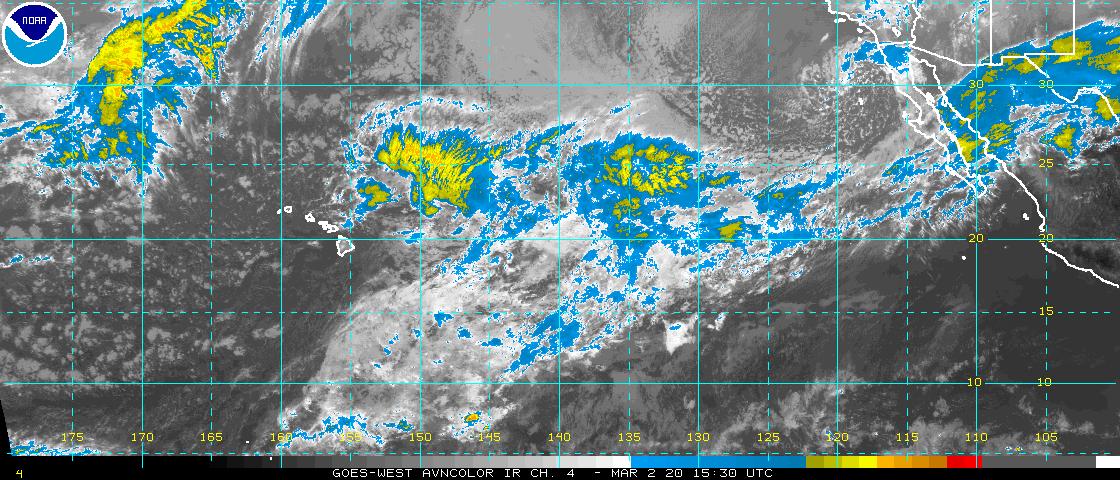
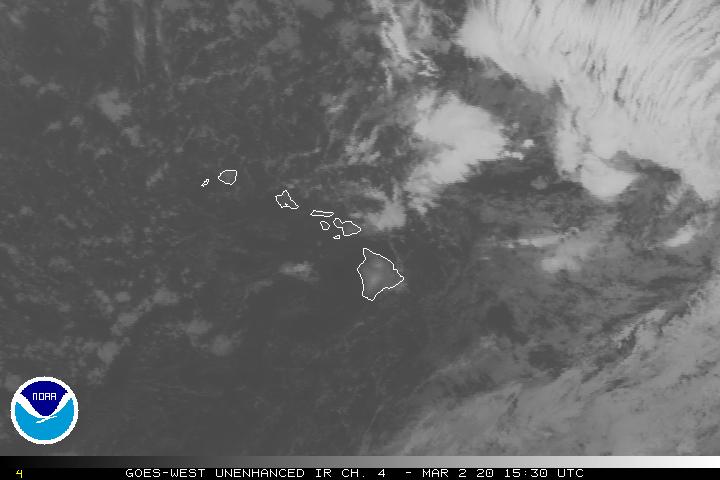
Satellite and Radar Images: To view the cloud conditions we have here in Hawaii, please use the following satellite links, starting off with this Infrared Satellite Image of the islands to see all the clouds around the state during the day and night. This next image is one that gives close images of the islands only during the daytime hours, and is referred to as a Close-up visible image. This next image shows a larger view of the Pacific…giving perspective to the wider ranging cloud patterns in the Pacific Ocean. Finally, here’s a Looping IR satellite image, making viewable the clouds around the islands 24 hours a day. To help you keep track of where any showers may be around the islands, here’s the latest animated radar image.
Hawaii’s Mountains – Here’s a link to the live webcam on the summit of near 14,000 foot Mauna Kea on the Big Island of Hawaii. The tallest peak on the island of Maui is the Haleakala Crater, which is near 10,000 feet in elevation. These two webcams are available during the daylight hours here in the islands…and when there’s a big moon rising just after sunset for an hour or two! Plus, during the nights and early mornings you will be able to see stars, and the sunrise too…depending upon weather conditions.
Tropical Cyclone activity in the eastern and central Pacific – Here’s the latest weather information coming out of the National Hurricane Center, covering the eastern north Pacific. You can find the latest tropical cyclone information for the central north Pacific (where Hawaii is located) by clicking on this link to the Central Pacific Hurricane Center. Here’s a tracking map covering both the eastern and central Pacific Ocean. A satellite image, which shows the entire ocean area between Hawaii and the Mexican coast…can be found here.
Aloha Paragraphs

Gorgeous Hawaiian sunset
Still strong and gusty trade winds, although falling off just a touch Sunday…picking up again Sunday. The small craft advisory has been pared back a little in the marine zones Friday evening. This current weather map shows a strong 1037 millibar high pressure system to the northeast of the islands. An approaching cold front this weekend, will cause our winds to slow down just a little Saturday…increasing again Sunday and Monday. The computer models suggest that the trade winds will diminish once again by mid-week. A second, more robust cold front may turn our winds south and southwest, from the Kona direction by next weekend.
As the trade winds continue, there’s always that prospect for more windward showers. The computer models are now strongly suggesting that Sunday looks like it could turn unsettled again. The approaching cold front may draw some moisture up into the state from the southeast later in the weekend, lasting for several days. At the same time, an upper level disturbance will be enhance these showers…and even cause some localized thunderstorms. As next weekend’s cold front gets into our area, we would see increasing showers again then. Here’s the latest satellite image, showing showers being carried in our direction on the trade winds…especially around Maui and the Big Island at the time of this writing.
It’s Friday evening here on Maui, with still quite a few clouds still hanging around. The windward sides have remained on the wet side, with off and on passing showers falling…although that seems to be coming to an end temporarily now. The leeward sides had a pretty good day, which will definitely stretch through Saturday. There’s still a little uncertainty as to what the second half of the weekend will look like. The models are drawing up a wet weather picture, with unstable conditions, and possible localized heavy showers falling here and there by Sunday. This prospect will need to be monitored closely, as flash flooding isn’t totally out of the question. ~~~ I’m going to see a new film at the Maui Arts and Cultural Center in Wailuku. It’s called Up In The Air (2009), starring George Clooney, Vera Farminga, Anna Kendrick, Jason Bateman. The brief synopsis of this film: "A smart and poignant romantic comedy that is one of those rare mainstream Hollywood pictures that addresses contemporary issues gracefully. Anchored by a strong performance from George Clooney, director Jason Reitman’s most mature film balances laughs and pathos with its story of downsized workers and love’s redemptive power." Here’s a trailer of this new film, I think you will enjoy seeing it. I’ll of course give you ~~~ I’ll be back online with a movie review Saturday morning, I hope you have a great Friday night! Aloha for now…Glenn.
Interesting: The number of people with diabetes in the United States is expected to double over the next 25 years, a new study predicts. That would bring the total by 2034 to about 44.1 million people with the disease, up from 23.7 million today. At the same time, the cost of treating people with diabetes will triple, the study also warns, rising from an estimated $113 billion in 2009 to $336 billion in 2034.
One factor driving the soaring costs: the number of people living with diabetes for lengthy periods, the researchers said. Over time, the cost of caring for someone with diabetes tends to rise along with their risk for developing complications, such as end-stage renal disease, which requires dialysis.
"We believe our model provides a more precise estimate of what the population size will look like and what it will cost the country and government programs like Medicare," said study author Dr. Elbert Huang, an assistant professor of medicine at the University of Chicago. Prior forecasts, including the ones currently used by the federal government’s budget analysts, have underestimated the burden, the researchers said.
A 1991 study, for example, predicted that 11.6 million people would have diabetes in 2030. In 2009, there were already more than twice that many living with diabetes. "In a similar way, we may be underestimating what’s happening, which is actually very disturbing," Huang said.
Among Medicare beneficiaries, the number with diabetes is expected to rise from 8.2 million to 14.6 million in 2034, with an accompanying rise in spending from $45 billion to $171 billion. "That essentially means that in 2034, half of all direct spending on diabetes care will be coming from the Medicare population," Huang said.
The study is published in the December issue of Diabetes Care. The high cost of chronic disease is one of the most pressing issues facing the United States as legislators grapple with financial strains on Medicare and the larger issue of health-care reform, the researchers say.
Interesting2: The kelp forests off southern California are considered to be some of the most diverse and productive ecosystems on the planet, yet a new study indicates that today’s kelp beds are less extensive and lush than those in the recent past. The kelp forest tripled in size from the peak of glaciation 20,000 years ago to about 7,500 years ago, then shrank by up to 70 percent to present day levels, according to the study by Rick Grosberg, professor in the Department of Evolution and Ecology and the Center for Population Biology at UC Davis, with Michael Graham of the Moss Landing Marine Laboratory and Brian Kinlan at UC Santa Barbara.
Kelp forests around offshore islands peaked around 13,500 years ago as rising sea levels created new habitat and then declined to present day levels. The kelp along the mainland coast peaked around 5,000 years later. This transition from an extensive island-based kelp system to a mainland-dominated system coincided with conspicuous events in the archaeological record of the maritime people in the region, suggesting that climate-driven shifts in kelp ecosystems impacted human populations that used those resources. Understanding the past history of a population is crucial to understanding its genetics in the present, Grosberg said.
Interesting3: Hammerhead sharks are some of the Ocean’s most distinctive residents. "Everyone wants to understand why they have this strange head shape," says Michelle McComb from Florida Atlantic University. One possible reason is the shark’s vision.
"Perhaps their visual field has been enhanced by their weird head shape," says McComb, giving the sharks excellent stereovision and depth perception. However, according to McComb, there were two schools of thought on this theory. In 1942, G.
Walls speculated that the sharks couldn’t possibly have binocular vision because their eyes were stuck out on the sides of their heads. However, in 1984, Leonard Campagno suggested that the sharks would have excellent depth perception because their eyes are so widely separated.
"In fact one of the things they say on TV shows is that hammerheads have better vision than other sharks," says McComb, "but no one had ever tested this." Teaming up with Stephen Kajiura and Timothy Tricas, the trio decided to find out how wide a hammerhead’s field of view is and whether they could have binocular vision and publish their results on November 27 2009 in the Journal of Experimental Biology.
Hammerheads come in all shapes and sizes so McComb and Kajiura, opted to work with species with heads ranging from the narrowest to the widest. Fishing for juvenile scalloped hammerheads off Hawaii and bonnethead sharks in the waters around Florida, the team successfully landed the fish and quickly transported them back to local labs to test the fish’s eyesight.
Interesting4: The world’s oceans are absorbing less carbon dioxide (CO2), a Yale geophysicist has found after pooling data taken over the past 50 years. With the oceans currently absorbing over 40 percent of the CO2 emitted by human activity, this could quicken the pace of climate change, according to the study, which appears in the November 25 issue of Geophysical Research Letters.
Jeffrey Park, professor of geology and geophysics and director of the Yale Institute for Biospheric Studies, used data collected from atmospheric observing stations in Hawaii, Alaska and Antarctica to study the relationship between fluctuations in global temperatures and the global abundance of atmospheric CO2 on interannual (one to 10 years) time scales.
A similar study from 20 years ago found a five-month lag between interannual temperature changes and the resulting changes in CO2 levels. Park has now found that this lag has increased from five to at least 15 months. "No one had updated the analysis from 20 years ago," Park said.
"I expected to find some change in the lag time, but the shift was surprisingly large. This is a big change." With a longer lag time, atmospheric CO2 can no longer adjust fully to cyclical temperature fluctuations before the next cycle begins, suggesting that the oceans have lost some of their ability to absorb CO2 from the atmosphere.
Weaker CO2 absorption could be caused by a change in ocean circulation or just an overall increase in the surface temperature. "Think of the oceans like soda," Park said. "Warm cola holds less fizz," Park said. "The same thing happens as the oceans warm up."
Interesting5: An analysis of quality of cardiac care following the public release of data on measures of care at hospitals in Ontario, Canada, did not result in significant system wide improvement in hospitals’ performance on most quality of care indicators, according to a new study. "Public release of hospital performance data is increasingly being mandated by policy makers with the goal of improving the quality of care.
Advocates of report cards believe that publicly releasing performance data on hospitals will stimulate hospitals and clinicians to engage in quality improvement activities and increase the accountability and transparency of the health care system.
Critics argue that publicly released report cards may contain data that are misleading or inaccurate and may unfairly harm the reputations of hospitals and clinicians," the authors write.
"Although there has been considerable debate, few empirical data exist to determine whether publicly released report cards on hospital performance improve the overall quality of care provided."
Interesting6: A flotilla of icebergs originating in Antarctica has been detected over open seas south of New Zealand. The icebergs, straying well outside the normal range for such Antarctic Ice, were located in remote, little-traveled waters, and thus were not a major shipping hazard. Nor were they a significant threat to New Zealand.
According to the AP, the nearest was said by authorities to lie 160 miles southeast of Stewart Island, southern New Zealand, based on satellite imagery on Tuesday. Its size was roughly 100 yards by 200 yards. A bigger berg standing 50 yards above the waterline and spanning 500 yards in length, lurked near Macquarie Island.
Macquarie is located midway between Antarctica and New Zealand at the southwestern corner of the South Pacific Ocean. The ultimate origin for this icy flotilla may have stemmed from a massive break-up of the Ross Ice Shelf back in 2000.
Another raft of icebergs linked to this break up of shelf ice drifted toward southern New Zealand during 2006. These never reached New Zealand, as they either broke up or were swept away to open seas by ocean currents.
Interesting7: Islands don’t move much, but they can still make waves. In fact they sometimes make dramatic waves … in the clouds. In a new satellite image, the South Sandwich island chain triggers a series of airborne waves. The V-shaped waves fan out to the east, visible as white clouds over the dark ocean water.
The islands disturb the smooth flow of air, creating waves that ripple through the atmosphere downwind of the obstacles, NASA explained in a statement. The moist, cloudy air over the ocean (meteorologists call this the marine layer) is often capped by a layer of dry air.
When the wave ripples through the atmosphere downwind of the islands, clouds form (or persist) at the crests of the waves because air cools as it rises, and water vapor condenses into cloud droplets.
|
In the wave troughs, some of the dry air from above sinks into marine layer, replacing the cloudy air. In addition, as air sinks, it warms, causing clouds to evaporate. The rugged islands, in the southern Atlantic Ocean, are of volcanic origin — Bristol and Montagu have been active during recorded history.
 Email Glenn James: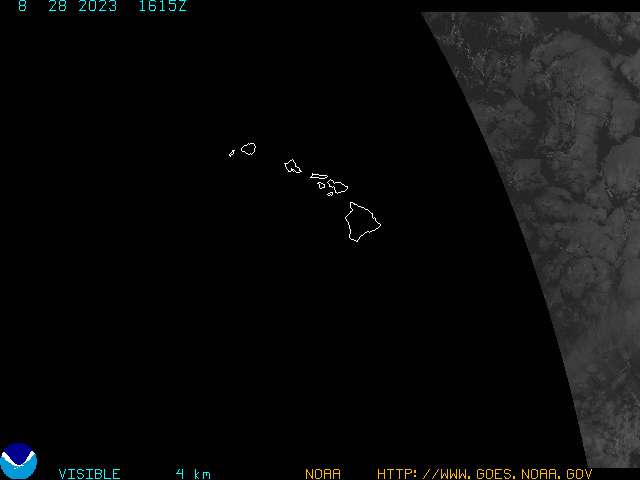


Eliza Says:
Aloha Glenn – Wow, that was some rainstorm last night. And today it is like the sprinkler is set on an “high” with extremely variable timer. LOL
Want to express Mahalo nui for all you do here for us.
~ Eliza~~~Hi Eliza, I don’t do all that much, just point out a few things about our lovely weather…rainy as it sometimes! Although, thanks, and I know what you mean. As my good friend Sharon, who lives in Haiku too is saying today: wet, wet, wet! Aloha, Glenn