December 7-8, 2010
Air Temperatures – The following maximum temperatures were recorded across the state of Hawaii Tuesday afternoon:
Lihue airport, Kauai – 77
Honolulu airport, Oahu – 80
Kaneohe, Oahu – 78
Molokai airport – 79
Kahului airport, Maui – 82
Kona airport – 81
Hilo airport, Hawaii – 79
Air Temperatures ranged between these warmest and coolest spots near sea level – and on the highest mountain tops…as of 5pm Tuesday evening:
Port Allen, Kauai – 81F
Hilo, Hawaii – 74
Haleakala Crater – 52 (near 10,000 feet on Maui)
Mauna Kea summit – 39 (near 14,000 feet on the Big Island)
Precipitation Totals – The following numbers represent the largest precipitation totals (inches) during the last 24 hours on each of the major islands, as of Tuesday afternoon:
0.15 Omao, Kauai
0.01 Mililani, Oahu
0.00 Molokai
0.00 Lanai
0.00 Kahoolawe
0.00 Maui
0.02 Saddle Quarry, Big Island
Marine Winds – Here’s the latest (automatically updated) weather map showing a high pressure ridge over the Hawaiian Islands…moving southward. Our winds will be light from the southwest through southeast Wednesday, increasing in strength Thursday.
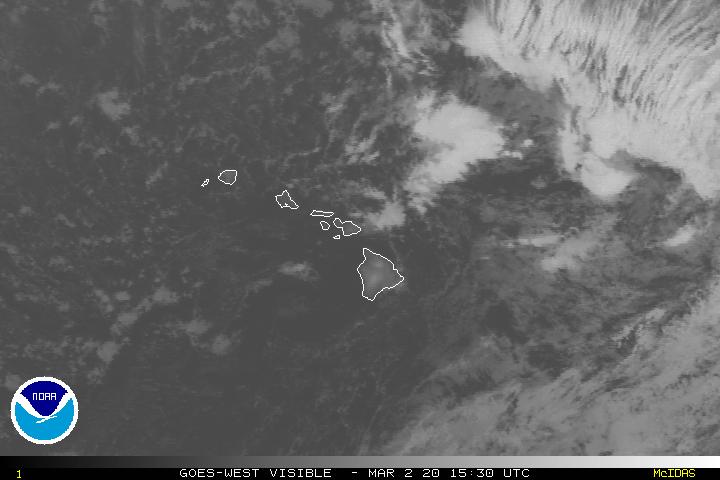
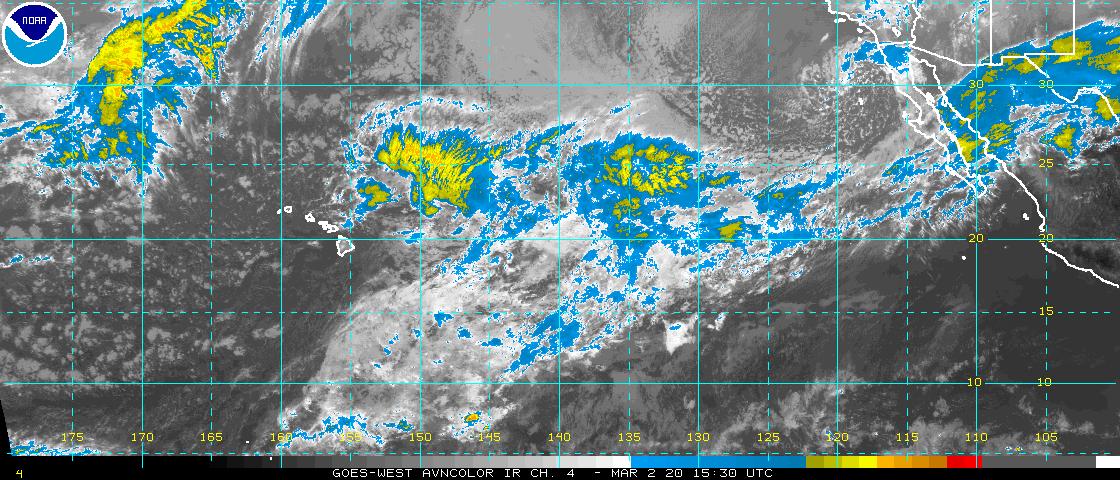
Satellite and Radar Images: To view the cloud conditions we have here in Hawaii, please use the following satellite links, starting off with this Infrared Satellite Image of the islands to see all the clouds around during the day and night. This next image is one that gives close images of the islands only during the daytime hours, and is referred to as a Close-up visible image. This next image shows a larger view of the Pacific…giving perspective to the wider ranging cloud patterns in the Pacific Ocean. Finally, here's a Looping IR satellite image, making viewable the clouds around the islands 24 hours a day. To help you keep track of where any showers may be around the islands, here’s the latest animated radar image.
Hawaii’s Mountains – Here’s a link to the live web cam on the summit of near 14,000 foot Mauna Kea on the Big Island of Hawaii. The tallest peak on the island of Maui is the Haleakala Crater, which is near 10,000 feet in elevation. These two web cams are available during the daylight hours here in the islands…and when there’s a big moon rising just after sunset for an hour or two! Plus, during the nights and early mornings you will be able to see stars, and the sunrise too…depending upon weather conditions.
Tropical Cyclone activity in the eastern and central Pacific – Here’s the latest weather information coming out of the National Hurricane Center, covering the eastern north Pacific. You can find the latest tropical cyclone information for the central north Pacific (where Hawaii is located) by clicking on this link to the Central Pacific Hurricane Center. Here’s a tracking map covering both the eastern and central Pacific Ocean. A satellite image, which shows the entire ocean area between Hawaii and the Mexican coast…can be found here. Of course, as we know, our hurricane season won't end until November 31st here in the central Pacific.
Aloha Paragraphs

Rising north swell Wednesday…high surf advisory
Light breezes, trending towards the south and southeast during this first half of the week…will give way to stronger south to southwest Kona winds starting Thursday into Friday. This weather map shows a 1026 millibar high pressure system far to our east-northeast, with its associated ridge having dropped down over our islands Tuesday night. The placement of this ridge over the state will keep our local winds on the light side through most of Wednesday. Meanwhile, a cold front is approaching the state from the north. This front will stall before arriving, although get close enough to Kauai that it will push the ridge down towards the Big Island in the process. We will see an increase in volcanic haze (vog) over some parts of the state into Wednesday. Winds are expected to become stronger and gusty from the south and southwest Kona directions during the second half of this work week. These Kona winds will likely become strong enough to trigger small craft wind advisories, perhaps even a wind advisory in one or two of those windiest locations. The trade winds are expected to arrive back in our Hawaiian Island weather picture later Sunday or by early next week…lasting briefly, or at least until the next cold front pushes the ridge down over us again.
Winds around the state remain light through Wednesday…the following numbers represent the strongest gusts early Tuesday evening:
08 mph Lihue, Kauai
13 Waianae, Oahu
07 Molokai
13 Kahoolawe
13 Hana, Maui
06 Lanai Airport
08 Hilo, Big Island
There will be very few showers around, as our overlying atmosphere is very dry and stable…at the moment As we move past the middle of the week, conditions will become much more changeable. This will become especially true as we grade into Thursday and Friday. The cold front, now not far to our north…will come close enough to Kauai Wednesday, to bring some possible showers to Niihau and Kauai. This frontal boundary, or a second cold front, will sweep in our direction later in the week, prompting stronger and gusty Kona winds. This front will bring rainfall with it, some of which will be heavy…with thunderstorms possible then too. This type of rainfall pattern can easily result in flash flooding. The NWS in Honolulu hasn’t issued a Hydrologic Outlook Statement however, which when this comes out…signifies that they feel at least 50% assured that flooding rainfall will occur in the state. This typically comes out 2-4 days ahead of what’s likely to be fairly major rainfall event.
In sum: a dry and stable air mass overlies the Aloha state now, which will keep good weather around for the next day or a little more. As we move past the middle of the week however, things will become less settled. This will become especially true as we get into Thursday and Friday. The details of this change in our weather will need to be fine tuned as we go forward, although all signs continue to point towards windy and rainy weather beginning Thursday, with the end point looking like late Friday. Despite the fact that the frontal cloud band will pass down through the state perhaps Friday, its remnant moisture may be blown back along our windward sides…by the returning trade winds into the early part of next week. Here’s a large size IR satellite image, showing the dynamic parent low pressure system far to our northeast, with its classic wound-up comma shaped cold front to our north.
It's Tuesday evening as I begin writing this last section of today's narrative update. The weather here in the islands will remained quite nice again today, with just those afternoon clouds over and around the mountains. These clouds didn't produce more than a few drops of rain, as the air is still so dry and stable. The light winds, and dry air however has caused cool early morning temperatures early this morning…even at sea level locations. The air mass will remain dry, especially for the area around Oahu, Maui and the Big Island. This will lead to another mostly clear night tonight just about everywhere…which will bring more chilly temperatures right down to sea level on Wednesday morning. As the Kona winds pick up later in the week, the chill will ease up quite a bit.
~~~ Here in Kihei, Maui, at around 530pm, the weather was mostly clear, with just a few leftover afternoon clouds on the slopes of the Haleakala Crater. The volcanic haze has finally begun to collect over Maui, and perhaps over other parts of the state too. I expect this vog to become thicker on Wednesday. If I was you, and you've felt chilly the last three mornings, be sure to keep that extra blanket on your bed tonight…as it will be very cool in the morning. ~~~ Oh yeah, almost forgot, be careful if you are heading to the beach Wednesday, especially on the north shores, as the surf is going to be big…high surf advisory level rough surf. The winds are going to be going offshore too, which will carry all kinds of spray off the backs of the incoming waves, which will be beautiful to watch…from a safe vantage point on the beach! ~~~ Two more things, gosh so much to keep track of: watch for the crescent moon this evening after sunset, and finally and I mean finally, we may get the first snow of the season atop the summits on the Big Island over the next 2-3 days! I'll catch up with you in the morning Wednesday, and until then, I hope you have a great Tuesday night! Aloha for now…Glenn.
Interesting: The population of endangered mountain gorillas has increased significantly in the last 30 years, say researchers. A census carried out in the Virunga Massif – where most of the world's mountain gorillas live – revealed 480 individuals living in 36 groups. Conservationists say that, 30 years ago, only 250 gorillas survived in this same area.
Along with the 302 mountain gorillas from a census in Bwindi in 2006, the world population is now more than 780. The Virunga Massif includes three contiguous national parks: Parc National des Virunga in the Democratic Republic of Congo, Volcanoes National Park in Rwanda and Mgahinga Gorilla National Park in Uganda. The only other location where mountain gorillas exist is Bwindi Impenetrable National Park in Uganda.
A 2003 census estimated the population in Virunga at 380 individuals – so the current figure suggests that the population has increased by just over 25% in the last seven years. Conservationists say the increase is thanks to that a collaborative "trans-boundary" effort by organizations in the Democratic Republic of Congo, Rwanda and Uganda to protect the gorillas and their habitat.
But, according to the African Wildlife Foundation and International Gorilla Conservation Program (IGCP), the animals are still very much under threat. A joint statement from the two organizations reported that a recent five-day patrol in the Virunga Massif discovered and destroyed 200 poachers' snares.
Interesting2: Every year, people line up to get flu vaccines at pharmacies and doctor's offices because the flu develops new strains, requiring the vaccines to be updated. What if there was a single flu vaccine you could take to last for decades against any flu virus strain?
Such a thing would make yearly trips to get vaccinated obsolete and save tons of money in medical costs. Scientists at the National Institute of Allergy and Infectious Diseases (NIAID) believe this is possible. A universal flu vaccine is possible because of our greater understanding of the flu virus.
Currently, the seasonal flu vaccine causes reactions in the body that mimic the natural flu virus. This prompts the creation of antibodies which would defend against any real exposure to the virus. But the antibodies created from vaccination are only directed at the head portion of the lollipopped-shaped flu virus.
The virus head changes from year to year, making it unrecognizable to the antibodies. Therefore, a new vaccination is required every year. According to the study's authors, Anthony S. Fauci M.D., NIAID director, and Gary J. Nabel, M.D., Ph.D., director of the NIAID Vaccine Research Center, a universal flu vaccine would have to prompt an immune response not common in nature.
The antibodies would have to be directed at a part of the virus other than the often-changing head. For example, it could attack the stem of the virus, which is common among different strains. During experiments, this type of vaccination has proved effective when administered to animals.
The authors outline how a universal flu vaccine may proceed through the testing and licensing stages. The 16 known flu virus subtypes could be sorted into 3 groups based on the likelihood of spreading disease in human populations. The group with the most potential for damage would be aimed at first. A first-generation flu vaccine would be produced for this group, then so on for all groups.
There is a question of how a universal flu vaccine may affect the evolution of viruses. The vaccine may be so effective that it may eliminate the flu much like polio. Or it may cause drastic mutations that could create a supervirus immune to our antibodies.
Perhaps the only way to know for sure is to make the universal flu vaccine a reality and see what happens. Ten European countries, including Norway, have agreed to develop an offshore electricity grid at the North Sea, in a bold move that promoters say will give Europe the possibility of tapping into an even bigger source of energy than the Middle East's oil capacity.
Ministers from all the ten 'North Seas Countries' signed of a 'Memorandum of Understanding' on December 3 to develop an offshore electricity grid seen as a major step forward for a single European market for electricity.
Interesting3: The oceans are acidifying at probably the fastest rate for 65 million years — with unknown implications for the three billion people who depend on fish for protein, a report released at the 2010 UN Climate Change Conference (COP 16), in Mexico has said. Rising CO2 emissions, a quarter of which eventually dissolve in the oceans to produce carbonic acid, have caused a 30 per cent drop in ocean pH values, reflecting an increase in ocean acidity, according to the report, produced by the UN Environment Program (UNEP).
"If we go on at the same rate we will have a 120 per cent increase in acidity by the end of the century," said Carol Turley, the report's lead author and knowledge exchange coordinator at the UK Ocean Acidification Research Program. The report reviewed scientific literature and found that the effects of acidification on the food chain are still unclear, and more research is needed.
But it outlined many potential threats. Acidification can reduce the growth and affect the development of smaller fish. For example, it can impair orientation and sense of smell in young clownfish, making them more vulnerable to predators.
Interesting4: The USA is on track for its quietest wildfire year since 1998, and firefighter deaths are the lowest on record, according to the National Interagency Fire Center. "Right now, we're at 3.3 million acres burned," says Rick Ochoa, fire weather program manager of the fire center in Boise. Seven firefighters lost their lives fighting blazes so far this year, says Randy Eardley, deputy chief of external affairs at the fire center.
That is the fewest deaths since records for firefighter deaths began in 1987, and far below the 10-year average of 20 deaths per year. The annual average of acres burned January through November from 2000 to 2009 is 6.8 million. By contrast, more than 9 million acres burned in 2006 and again in 2007.
Ochoa says persistently cool, wet weather in the normally arid and fire-plagued West throughout the late spring and summer were the primary factors for the drop in acres burned. "The West never really dried out or warmed up," Ochoa adds. The South was also wetter than average: "We had an El Niño earlier this year, which typically produces a wet pattern over the southern tier of states," he says.
The El Niño and the La Niña climate patterns — warming and cooling of tropical Pacific Ocean waters — strongly affect weather conditions in the USA. During a La Niña pattern, conditions are dry across southern states. More than a third of wildfires this year were human-caused, either accidentally or deliberately. Ochoa says 63% of the acres burned were due to lightning and 37% were human-caused.
"In general, about 75% of the western fires are historically caused by lightning," he says. The transition from an El Niño to a La Niña this past summer, along with ongoing drought, will increase the likelihood for wildfires across the southern USA through the winter and into the spring, Ochoa says. "Because we have that strong La Niña , it should be dry from eastern New Mexico to Texas to Florida," he notes.
Wildfires are most common through the winter in the southern Plains, and in March in Florida. The dryness is already causing problems in Texas and Oklahoma, according to the most recent U.S. Drought Monitor, a weekly government publication. It said: "Some impacts on crops, grasslands, and livestock upkeep have been reported, and burn bans have been mandated in a number of counties in this region."
Georgia and Florida have also been extremely dry recently. According to the drought monitor, 90% of Georgia and 69% of Florida is in drought. Over the past 90 days, parts of northeastern and east-central Florida have received about one foot less than their average rainfall.
 Email Glenn James: