November 25-26, 2009
Happy Thanksgiving!
Air Temperatures – The following maximum temperatures were recorded across the state of Hawaii Wednesday afternoon:
Lihue, Kauai – 79
Honolulu, Oahu – 83
Kaneohe, Oahu – 79
Kaunakakai, Molokai – 84
Kahului, Maui – 80
Hilo, Hawaii – 79
Kailua-kona – 84
Air Temperatures ranged between these warmest and coolest spots near sea level around the state – and on the highest mountains…at 5pm Wednesday evening:
Barking Sands, Kauai – 81F
Molokai airport – 73
Haleakala Crater – missing (near 10,000 feet on Maui)
Mauna Kea summit – 34 (near 14,000 feet on the Big Island)
Precipitation Totals – The following numbers represent the largest precipitation totals (inches) during the last 24 hours on each of the major islands, as of Wednesday afternoon:
0.23 Mount Waialaele, Kauai
0.36 Wilson Tunnel, Oahu
0.02 Molokai
0.00 Lanai
0.02 Kahoolawe
0.18 Ulupalakua, Maui
0.23 Mountain View, Big Island
Marine Winds – Here’s the latest (automatically updated) weather map showing a 1033 millibar high pressure system far to the north of the islands…moving eastward. Winds will be locally strong and gusty Thursday and Friday.
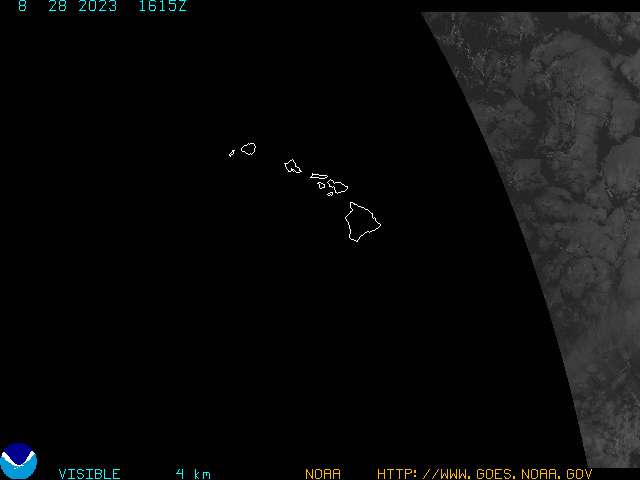
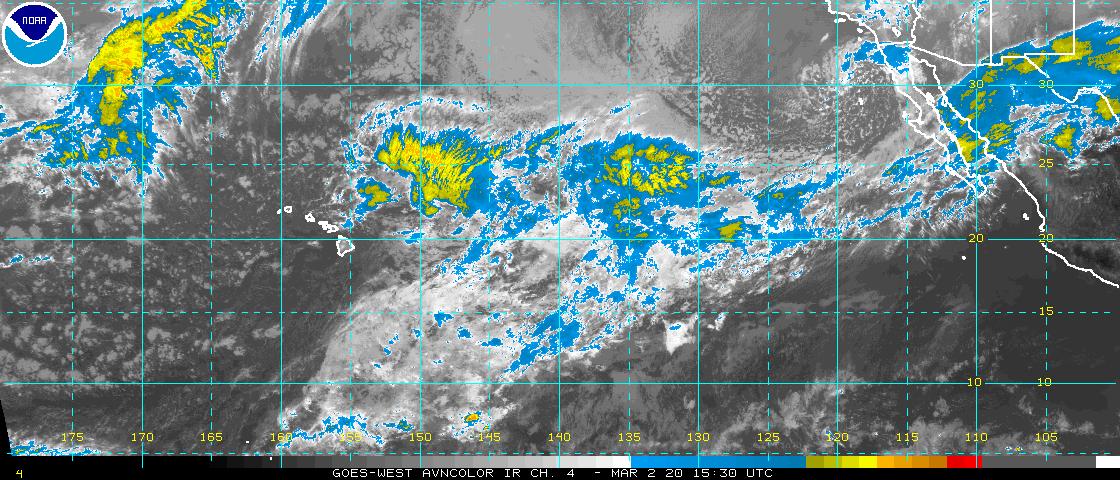
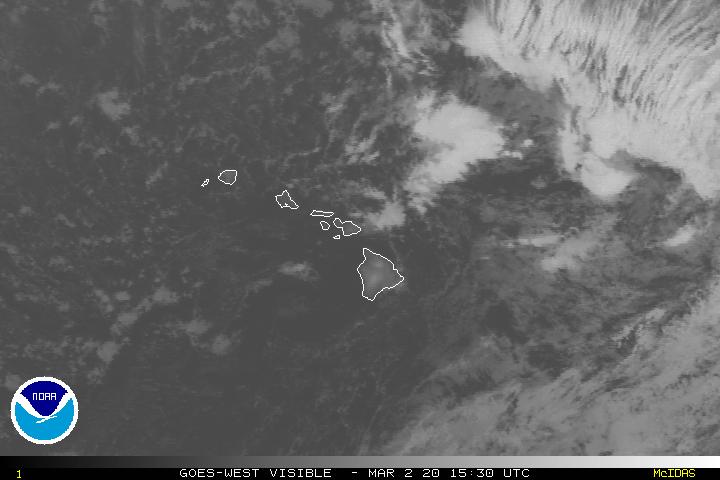
Satellite and Radar Images: To view the cloud conditions we have here in Hawaii, please use the following satellite links, starting off with this Infrared Satellite Image of the islands to see all the clouds around the state during the day and night. This next image is one that gives close images of the islands only during the daytime hours, and is referred to as a Close-up visible image. This next image shows a larger view of the Pacific…giving perspective to the wider ranging cloud patterns in the Pacific Ocean. Finally, here’s a Looping IR satellite image, making viewable the clouds around the islands 24 hours a day. To help you keep track of where any showers may be around the islands, here’s the latest animated radar image.
Hawaii’s Mountains – Here’s a link to the live webcam on the summit of near 14,000 foot Mauna Kea on the Big Island of Hawaii. The tallest peak on the island of Maui is the Haleakala Crater, which is near 10,000 feet in elevation. These two webcams are available during the daylight hours here in the islands…and when there’s a big moon rising just after sunset for an hour or two! Plus, during the nights and early mornings you will be able to see stars, and the sunrise too…depending upon weather conditions.
Tropical Cyclone activity in the eastern and central Pacific – Here’s the latest weather information coming out of the National Hurricane Center, covering the eastern north Pacific. You can find the latest tropical cyclone information for the central north Pacific (where Hawaii is located) by clicking on this link to the Central Pacific Hurricane Center. Here’s a tracking map covering both the eastern and central Pacific Ocean. A satellite image, which shows the entire ocean area between Hawaii and the Mexican coast…can be found here.
Aloha Paragraphs

Large waves remain active…north and west shores
The trade winds will remain active through the rest of this week into next…some fairly minor fluctuation in speed at times. The small craft advisory is active in all of the marine zones across the entire state Wednesday night. This current weather map shows a 1033 millibar high pressure system to the north of the islands, moving eastward. At this point, there is no end in sight for this late autumn trade wind episode. As usual, the night and early morning hours will see the lightest wind conditions, with winds picking up again during the later morning hours…through the late afternoon time frame.
The emphasis for showers will remain along the windward showers Thursday into Friday…with even a few flying over to the leeward sides on the smaller islands. As noted, the computer models have been suggesting, that we would see some modest increase in showers along our north and east facing windward coasts and slopes today into Friday. As is often the case under such a trade wind weather pattern, the most generous showers would likely fall during the night and early morning hours. This satellite image shows those approaching windward biased showers…along with areas of high cirrus clouds, which will carry across our islands at times.
Caution should be used when going near the ocean along our north and west shores…as large waves will be breaking Thursday…lowering into Friday. This surf is large enough, that the NWS forecast office in Honolulu has a high surf warning along those beaches at the time of this writing. The computer wave models show more storms in the north Pacific, which will bring additional large NW swells to us over the next week. Meanwhile, a small craft advisory remains in force for both the large northwest swell, and the strong trade winds now too. The south side beaches will be near flat in contrast, and will offer more user friendly swimming conditions. I might add that only experienced water persons should be getting out into the ocean on those north facing beaches.
It’s early Wednesday evening here in Kihei, Maui, as I begin writing this last section of today’s narrative. Wednesday saw considerably more clouds than originally expected, with some showers too. As this looping radar image shows, there are some generous showers traveling along in the trade wind flow now. Each of the islands will take their turn in getting somewhat wet, although as noted above, the lion’s share of these showers will end up along the windward coasts and slopes. The smaller islands, and especially Oahu, will see some of these showers being carried over the mountains…into the leeward sides. ~~~ This evening I’m going to see a new film, one which last weekend, when it opened at theatres, broke records. It’s not your typical film by any means, and is called Twilight Saga: The New Moon (2009)…starring Kristen Stewart, Robert Pattinson and Taylor Lautner among others. The briefest synopsis: "Bella Swan delves deeper into the mysteries of the supernatural world she yearns to become part of, only to find herself in greater peril than ever before." I didn’t see the first of this series, so this synopsis doesn’t mean a lot to me, and may not to you either. Just in case you’re interested though, here’s the trailer for this "out there" film. This film obviously isn’t for everyone, although lots and lots folks are seeing it anyway. ~~~ I’ll be back Thanksgiving morning with you next new weather narrative, I hope you have a great Wednesday night until then! Aloha for now…Glenn.
Interesting: General Motors has been inundated in recent years with nothing but bad news. After filing for bankruptcy and receiving a controversial government bailout, the ailing car maker is trying to revolutionize the auto industry and breathe life back into its deflated sails with the introduction of the Chevy Volt. Considered to be an "extended-range electric vehicle" or E-REV, the Volt is set to go on sale late next year and is unlike today’s hybrids. A lithium-ion battery powers the Volt for the first 40 miles of a trip and then the gas engine kicks in to create more electricity to keep the car rolling.
If recharged every 40 miles, the Volt’s owner may never need to go to the pump again. The Volt is slated to receive a 230 mpg rating (through a bit of creative math), which is impressive, but we wanted to know how it stacks up against the current hybrid front runner, the Toyota Prius. First off, let’s take a look at Chevy Volt’s stats.
The Volt does 0-60 in 8 seconds and runs on electricity for the first 40 miles, then the gas engine kicks in and recharges the battery. Once the batteries are depleted and the generator kicks in, the car has an additional 260 miles of driving range.
If the Volt is driven farther than 40 miles without recharging, it will get roughly 40 mpg while running on the generator. The wheels, however, are always driven by the electric system. The Volt has to be plugged in and takes 6.5 hours to charge using a standard 100 volt home outlet.
Interesting2: U.S. researchers have demonstrated a technology that uses the sun’s heat to convert carbon dioxide and water into the building blocks of traditional fuels, a reverse combustion process that may emerge as a practical alternative to sequestration of CO2 emissions from power plants. The prototype "Sunshine to Petrol" system, developed by Sandia National Laboratories in New Mexico, uses concentrated solar energy to trigger a thermo-chemical reaction in an iron-rich composite located inside a two-sided cylindrical chamber.
The iron oxide is designed to lose an oxygen molecule when exposed to 1,500 degree C heat, and then retrieve an oxygen molecule when it is cooled down, essentially converting an incoming supply of CO2 into an outgoing stream of carbon monoxide.
Interesting3: It’s that time of year again… no, not when turduckens appear on dinner tables nationwide and it becomes somehow acceptable to call the marshmallow a vegetable. It’s time for the 2009 edition of "Freeing the Grid," an annual report card to states on their net metering and interconnection standards.
Together, these two key policies empower energy customers (that’s you) to go solar and reduce your utility bills. Although there is still plenty of room for improvement, this year’s report shows solid progress across most states—an indicator that these once-obscure policies are becoming accepted best practices.
Oregon was this year’s star pupil. Meanwhile, there were still a number of states that didn’t even show up to class. Want to see if your state made the grade? Download 2009’s Freeing the Grid here from the report’s lead author, Network for New Energy Choices. They may sound wonky, but net metering and interconnection standards are the backbone of a strong rooftop solar market.
Interesting4: Food waste contributes to excess consumption of freshwater and fossil fuels which, along with methane and carbon dioxide emissions from decomposing food, impacts global climate change. In a new paper published in the open-access, peer-reviewed journal PLoS One, Kevin Hall and colleagues at the National Institute of Diabetes and Digestive and Kidney Diseases calculate the energy content of nationwide food waste from the difference between the US food supply and the food eaten by the population.
The latter was estimated using a validated mathematical model of human metabolism relating body weight to the amount of food eaten. The researchers found that US per capita food waste has progressively increased by about 50% since 1974 reaching more than 1400 Calories per person per day or 150 trillion Calories per year.
Previous calculations are likely to have underestimated food waste by as much as 25% in recent years. This calculated progressive increase of food waste suggests that the US obesity epidemic may have been the result of a "push effect" of increased food availability and marketing with Americans being unable to match their food intake with the increased supply of cheap, readily available food.
Hall and colleagues suggest that addressing the oversupply of food energy in the US could help curb to the obesity epidemic as well as reduce food waste, which would have profound consequences for the environment and natural resources. For example, food waste is now estimated to account for more than one quarter of the total freshwater consumption and more than 300 million barrels of oil per year representing about 4% of the total US oil consumption.
Interesting5: President Barack Obama will go to Copenhagen next month to participate in a long-anticipated, high-stakes global climate summit, a White House official said. The president will attend the summit on Dec. 9 before heading to Oslo to accept the Nobel Peace Prize, the official told NBC News. Obama’s attendance had been in question until now.
The conference had originally been intended to produce a new global climate change treaty on limiting emissions of greenhouse gases that would replace the 1997 Kyoto Protocol. However, hopes for a legally binding agreement have dimmed lately, with leaders saying the summit is more likely to produce a template for future action to cut emissions blamed for global warming.
Interesting6: Tackling climate change by reducing carbon dioxide and other greenhouse emissions will have major direct health benefits in addition to reducing the risk of climate change, especially in low-income countries, according to a series of six papers appearing on, Nov. 25 in the British journal The Lancet. The studies, three of them coauthored by Kirk R. Smith, professor of global environmental health and one coauthored by Michael Jerrett, associate professor of environmental health sciences, both at University of California, Berkeley, use case studies to demonstrate the co-benefits of tackling climate change in four sectors: electricity generation, household energy use, transportation, and food and agriculture.
"Policymakers need to know that if they exert their efforts in certain directions, they can obtain important public health benefits as well as climate benefits," said Smith, who was the principal investigator in the United States for the overall research effort. "Climate change threatens us all, but its impact will likely be greatest on the poorest communities in every country. Thus, it has been called the most regressive tax in human history. Carefully choosing how we reduce greenhouse gas emissions will have the added benefit of reducing global health inequities."
 Email Glenn James: