November 24-25, 2009
Air Temperatures – The following maximum temperatures were recorded across the state of Hawaii Tuesday afternoon:
Lihue, Kauai – 80
Honolulu, Oahu – 85
Kaneohe, Oahu – 80
Kaunakakai, Molokai – 83
Kahului, Maui – 84
Hilo, Hawaii – 81
Kailua-kona – 84
Air Temperatures ranged between these warmest and coolest spots near sea level around the state – and on the highest mountains…at 4pm Tuesday afternoon:
Honolulu, Oahu – 82F
Lihue, Kauai – 77
Haleakala Crater – 50 (near 10,000 feet on Maui)
Mauna Kea summit – 41 (near 14,000 feet on the Big Island)
Precipitation Totals – The following numbers represent the largest precipitation totals (inches) during the last 24 hours on each of the major islands, as of Tuesday afternoon:
0.18 Mount Waialaele, Kauai
0.02 Waimanalo, Oahu
0.00 Molokai
0.00 Lanai
0.00 Kahoolawe
0.06 West Wailuaiki, Maui
0.40 Mountain View, Big Island
Marine Winds – Here’s the latest (automatically updated) weather map showing a 1025 millibar high pressure system far to the northeast of the islands…along with a 1028 millibar high to the far northwest. A ridge of high pressure will be connecting these high pressure cells soon. Winds will be moderately strong, although locally stronger and gusty from the trade wind direction Wednesday into Friday.
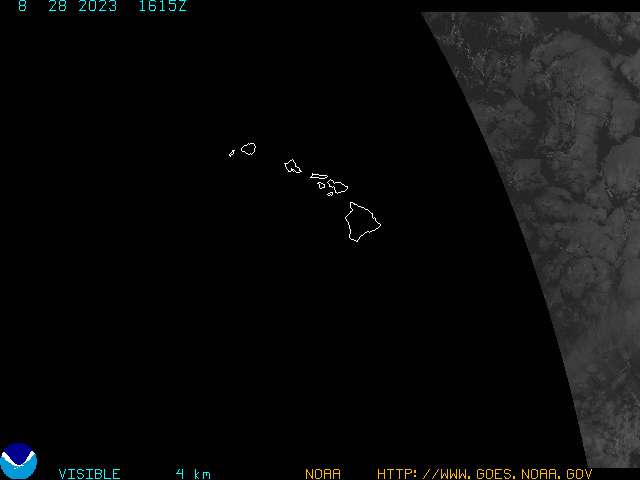
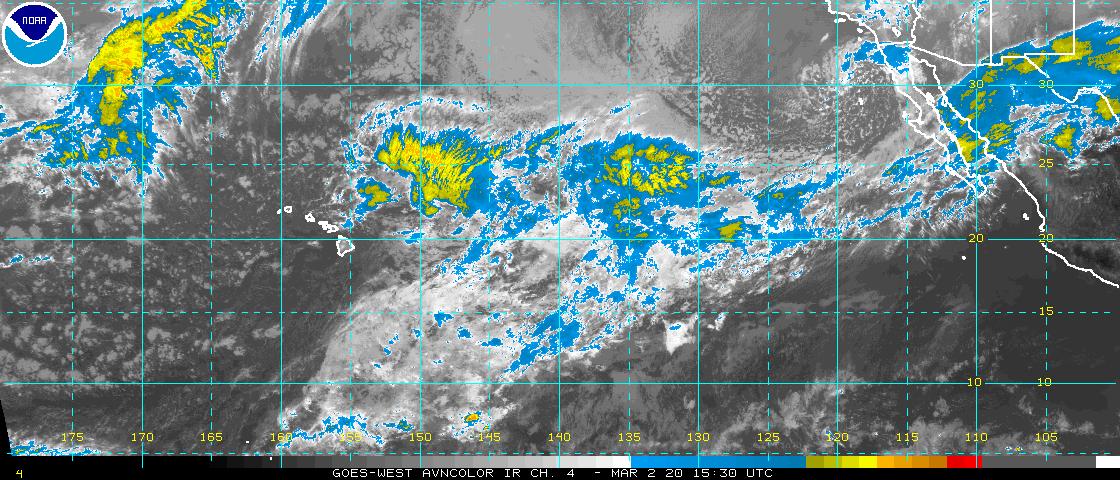
Satellite and Radar Images: To view the cloud conditions we have here in Hawaii, please use the following satellite links, starting off with this Infrared Satellite Image of the islands to see all the clouds around the state during the day and night. This next image is one that gives close images of the islands only during the daytime hours, and is referred to as a Close-up visible image. This next image shows a larger view of the Pacific…giving perspective to the wider ranging cloud patterns in the Pacific Ocean. Finally, here’s a Looping IR satellite image, making viewable the clouds around the islands 24 hours a day. To help you keep track of where any showers may be around the islands, here’s the latest animated radar image.
Hawaii’s Mountains – Here’s a link to the live webcam on the summit of near 14,000 foot Mauna Kea on the Big Island of Hawaii. The tallest peak on the island of Maui is the Haleakala Crater, which is near 10,000 feet in elevation. These two webcams are available during the daylight hours here in the islands…and when there’s a big moon rising just after sunset for an hour or two! Plus, during the nights and early mornings you will be able to see stars, and the sunrise too…depending upon weather conditions.
Tropical Cyclone activity in the eastern and central Pacific – Here’s the latest weather information coming out of the National Hurricane Center, covering the eastern north Pacific. You can find the latest tropical cyclone information for the central north Pacific (where Hawaii is located) by clicking on this link to the Central Pacific Hurricane Center. Here’s a tracking map covering both the eastern and central Pacific Ocean. A satellite image, which shows the entire ocean area between Hawaii and the Mexican coast…can be found here.
Aloha Paragraphs

Extra large waves in Hawaii soon…north and west shores
Slightly lighter trade winds blew Tuesday, which will give way to stronger winds Wednesday through Friday. These trade winds, once they get back up to speed, will be blustery. We’re seeing small craft advisory flags going back up through most of the marine zones across the entire state now. The winds will likely be at their peak Thursday into Friday, in those most windy locations. This current weather map shows two 1026 high pressure systems, one to the far northeast…and other straddling the International Dateline to the northwest. As this weather chart shows, there’s an elongated ridge of high pressure connecting the two, except where a cold front breaks through to the north of our islands. This is why our local trade winds have softened a little yesterday and today.
Rainfall will remain in the normal to somewhat below normal category for the time being. The windward sides are where the most generous precipitation will occur at lower elevations. The computer models have been suggesting, since last week actually, that we could see some modest increase in showers along our north and east facing windward coasts and slopes at Thursday into Friday. As is often the case under such a typical trade wind weather pattern, the most generous showers would likely fall during the night and early morning hours. The gusty trade winds might be strong enough to coax a few showers into the leeward sides at times too.
The big news will soon be the large to very large northwest swell, which will pump the surf up starting tonight…lasting into Thursday. The surf is going to be large enough, that the NWS forecast office in Honolulu has already issued a high surf warning along our north and west facing beaches! This much higher than normal surf, will last into Thursday at least…gradually lowering in height thereafter. The computer wave models show more storms in the north Pacific, which will bring additional large NW to NNW swells to us over the next week. Meanwhile, a small craft advisory has been issued for both the large northwest swell, and the increasingly strong trade winds that will be in play by Wednesday as well. Only the most experienced watermen and women should be out in these kinds of rough ocean conditions.
It’s early Tuesday evening here in Kihei, Maui, as I begin writing this last section of today’s narrative. Tuesday was a great day in terms of weather, with hardly any clouds in our local skies! The trade winds were blowing, but not as strongly as what we’ll see over the next several days. The weather just up ahead will be quite nice in general, with a couple of exceptions. The first item is the very large surf in our marine environment, which will be dangerous along our north and west facing beaches. The second is the increasingly strong trade winds that will be filling into our Hawaiian Island weather picture soon as well. ~~~ After work today I’ll be driving over to Wailuku. I’ve been invited to go on Manao Radio, a local station here on Maui, for an hour long interview. The disc jockey’s name who invited me is JJ Paladino. This interview happens between 630 and 730pm (HST), on the 91.5 FM station. It can be listened to on manaoradio.com if you have any interest. As I understand it, we’ll be talking about weather and stuff, and I’ll have a chance to play some of the music I like. ~~~ Looking out the window here in Kihei, before I leave for the drive to Wailuku, it’s almost totally clear. There’s a few clouds around, but it’s much less cloudy than usual for this time of day. I’ll catch up with you early Wednesday morning, when I’ll be back with your next new weather narrative, yes from paradise! Aloha for now…Glenn.
Interesting: A new study provides "incontrovertible evidence" that the volcanic super-eruption of Toba on the island of Sumatra about 73,000 years ago deforested much of central India, some 3,000 miles from the epicenter, researchers report. The volcano ejected an estimated 800 cubic kilometers of ash into the atmosphere, leaving a crater (now the world’s largest volcanic lake) that is 100 kilometers long and 35 kilometers wide.
Ash from the event has been found in India, the Indian Ocean, the Bay of Bengal and the South China Sea. The bright ash reflected sunlight off the landscape, and volcanic sulfur aerosols impeded solar radiation for six years, initiating an "Instant Ice Age" that — according to evidence in ice cores taken in Greenland — lasted about 1,800 years.
During this instant ice age, temperatures dropped by as much as 16 degrees centigrade (28 degrees Fahrenheit), said University of Illinois anthropology professor Stanley Ambrose, a principal investigator on the new study with professor Martin A.J. Williams, of the University of Adelaide. Williams, who discovered a layer of Toba ash in central India in 1980, led the research.
The climactic effects of Toba have been a source of controversy for years, as is its impact on human populations. In 1998, Ambrose proposed in the Journal of Human Evolution that the effects of the Toba eruption and the Ice Age that followed could explain the apparent bottleneck in human populations that geneticists believe occurred between 50,000 and 100,000 years ago. The lack of genetic diversity among humans alive today suggests that during this time period humans came very close to becoming extinct.
Interesting2: The oceans are by far the largest carbon sink in the world. Some 93 percent of carbon dioxide is stored in algae, vegetation, and coral under the sea. But oceans are not able to absorb all of the carbon dioxide released from the burning of fossil fuels. In fact, a recent study suggests that the oceans have absorbed a smaller proportion of fossil-fuel emissions, nearly 10 percent less, since 2000.
The study, published in the current issue of Nature, is the first to quantify the perceived trend that oceans are becoming less efficient carbon sinks. The study team, led by Columbia University oceanographer Samar Khatiwala, measured the amount of human-caused carbon dioxide emissions pumped into the oceans since 1765.
Industrial carbon dioxide emissions have increased dramatically since the 1950s, and oceans have until recently been able to absorb the greater amounts of emissions. Sometime after 2000, however, the rise in emissions and the oceans’ carbon uptake decoupled. Oceans continue to absorb more carbon, but the pace appears to have slowed. The reason is based in part on simple chemistry.
Increased concentrations of carbon dioxide have turned waters more acidic, especially nearer to the poles. While carbon dioxide dissolves more readily in cold, dense seawater, these waters are less capable of sequestering the gas as the ocean becomes more acidic. The study revealed that the Southern Ocean, near Antarctica, absorbs about 40 percent of the carbon in oceans.
Interesting3: After wind, sun, currents and tides, a company is preparing to make clean electricity by harnessing another natural phenomenon, the energy-unleashing encounter of freshwater and seawater. Taking a step further in the planet’s hunt for clean power, Norway is to unveil today the world’s first prototype of an osmotic power plant on the banks of the Oslo fjord.
The project is small-scale but could prove the great potential of osmotic energy. "It is a form of renewable energy which, unlike solar or wind power, produces a predictable and stable amount of energy regardless of the weather," explained Stein Erik Skilhagen, in charge of the project at state-owned Statkraft, which specializes in renewable energies.
Osmotic energy is based on the principle that nature is constantly seeking balance, and plays on the different concentration levels of liquids. When freshwater and seawater meet on either side of a membrane — a thin layer that retains salt but lets water pass — freshwater is drawn towards the seawater side. The flow puts pressure on the seawater side, and that pressure can be used to drive a turbine, producing electricity.
Interesting4: A report published by Report Buyer entitled "Ethical Food and Beverage, Personal Care and Household Products in the U.S." states that despite the economic downturn of 2008-2009, ethical grocery products are continuing to make headway in the market, especially when contrasted with the relatively flat market for conventional groceries. Indeed, by many accounts, consumer demand is steadily increasing for products that fulfill eco-friendly, natural, organic, local, humane, and fair trade criteria.
Major marketers and retailers are increasingly tapping into this trend by offering more ethical products, upping their corporate responsibility efforts through energy-efficient "green" facilities and sustainable business practices, and increasing their associated cause-related marketing efforts.
Underpinning market advancement is ongoing strong consumer demand for products perceived to be healthier and safer. According to the 348 page report, approximately one-fourth of U.S. adult shoppers frequently buy certified organic food or beverage products, and one-third are usually willing to pay more for organic foods-even in the midst of economic recession.
Interesting5: Today, the U.S. Environmental Protection Agency issued a final rule to help reduce water pollution from construction sites. This rule, which takes effect in February 2010 and will be phased in over four years, should significantly improve the quality of water nationwide. Construction activities like clearing, excavating and grading significantly disturb soil and sediment.
If that soil is not managed properly it can be easily washed off of the construction site during storms and pollute nearby water bodies. The new Effluent Guidelines for Discharges from the Construction and Development Industry require construction site owners and operators that disturb one or more acres of land to use best management practices to ensure that soil disturbed during construction activity does not pollute nearby water bodies.
Additionally, owners and operators of sites that impact 10 or more acres of land at one time will be required to monitor discharges and ensure they comply with specific limits on discharges to minimize the impact on nearby water bodies. This is the first time that EPA has imposed national monitoring requirements and enforceable numeric limitations on construction site storm water discharges.
Soil and sediment runoff is one of the leading causes of water quality problems nationwide. Soil runoff from construction has also reduced the depth of small streams, lakes and reservoirs, leading to the need for dredging. It is anticipated that the regulation will reduce the amount of sediment discharged from construction sites by about 4 billion pounds each year once fully implemented.
Interesting6: Alcohol-based hand sanitizers, found in schools, hospitals, day-care centers, health clubs and grocery stores, can be a great substitute for hand washing if soap and water aren’t available, as long as they contain more than 60 percent ethyl alcohol or isopropanol or a combination of the two. And though they can kill bacteria, they differ from products labeled "antibacterial," which require water. Available in a squeeze bottle or pump, sanitizer gel is alcohol-based and doesn’t need to be rinsed off. Just a dime-sized dollop to dry hands kills micro-organisms by stripping away the outer layer of the oil on the skin.
After you’ve used it, the bacteria don’t regrow as fast, which keeps "residual micro-flora that reside in deeper layers of skin from coming to the surface," according to the Colorado State University Cooperative Extension. But hand sanitizers still don’t remove dirt; you need soap, water and friction for that.
The setting and what’s already on your hands also is important, because soil, food and other substances make the gels less effective. Health-care workers, for example, can use waterless hand sanitizers in place of soap and water because the employees routinely clean their hands several times an hour, and sanitizers encourage compliance, according to the U.S. Centers for Disease Control and Prevention.
Interesting7: Antibacterial soap, which contains the chemicals triclosan or triclocarban, must be used with water and is marketed as having the ability to kill bacteria. But it’s no more effective than non-antibacterial soap and doesn’t prevent colds or flu, which are caused by viruses, not bacteria. Unless you’re in a hospital environment, using products with triclosan, a biocide that can destroy biological structures at random, is overkill, like using a jackhammer to kill an ant.
Moreover, triclosan, which mimics the thyroid hormone and is bioaccumulating in the environment, is present in 60 percent of U.S. waterways investigated. Unfortunately, it’s nearly impossible to find liquid soap without triclosan.
It’s also added to toothpaste, deodorant, dog shampoo, cutting boards, clothing, toys and other antibacterial products. The best way around this is to "just rub your hands with plain water," said Sylvia Garcia-Houchins, manager of infection control at the University of Chicago. The key is the scrubbing action.
Interesting8: Rising water temperatures are kicking up more powerful winds on Lake Superior, with consequences for currents, biological cycles, pollution and more on the world’s largest freshwater lake…and its smaller brethren. Since 1985, surface water temperatures measured by lake buoys have climbed 1.2 degrees per decade, about 15 percent faster than the air above the lake and twice as fast as warming over nearby land.
"The lake’s thermal budget is very sensitive to the amount of ice cover over the winter," says Ankur Desai, atmospheric and oceanic sciences professor at the University of Wisconsin-Madison. "There is less ice on Lake Superior during the winter, and consequently the water absorbs more heat." A wide temperature differential between water and air makes for a more stable atmosphere with calmer winds over the relatively cold water.
However, as warming water closes the gap, as in Lake Superior’s case, the atmosphere gets more turbulent. "You get more powerful winds," Desai says. "We’ve seen a 5 percent increase per decade in average wind speed since 1985." Those findings will be published Nov. 15 in the journal Nature Geoscience.
Interesting9: A new detailed map of Mars shows what was likely a vast ocean in the north and valleys around the equator, suggesting that the planet once had a humid, rainy climate, according to research. The computer-generated map, based on topographic data from NASA satellites, also showed that the network of valleys on the red planet was at least twice as extensive as previously estimated.
"The relatively high values over extended regions indicate the valleys originated by means of precipitation-fed runoff erosion – the same process that is responsible for formation of the bulk of valleys on our planet," geography professor at Northern Illinois University, Wei Luo, said. "A single ocean in the northern hemisphere would explain why there is a southern limit to the presence of valley networks.
"The southernmost regions of Mars, located farthest from the water reservoir, would get little rainfall and would develop no valleys. This would also explain why the valleys become shallower as you go from north to south, which is the case." Prof Luo said rain would be mostly restricted to the area over the ocean and to the land surfaces in nearby, as indicated by the belt-like pattern of valley dissection seen in the new map.
The report appears in the Journal of Geophysical Research. Since NASA’s Mariner 9 space probe discovered the ancient Martian valley networks in 1971, debate has raged over whether the valleys resulted from water erosion – meaning that there was humidity and rainfall – or through groundwater sapping erosion, which can happen in cold and dry conditions.
 Email Glenn James: