











November 30-December 1, 2010
Air Temperatures – The following maximum temperatures were recorded across the state of Hawaii Tuesday afternoon:
Lihue airport, Kauai – 79
Honolulu airport, Oahu – 86
Kaneohe, Oahu – missing
Molokai airport – 83
Kahului airport, Maui – 84
Kona airport – 84
Hilo airport, Hawaii – 82
Air Temperatures ranged between these warmest and coolest spots near sea level – and on the highest mountain tops…as of 5pm Tuesday evening:
Port Allen, Kauai – 82F
Hana, Maui – 73
Haleakala Crater – 45 (near 10,000 feet on Maui)
Mauna Kea summit – 34 (near 14,000 feet on the Big Island)
Precipitation Totals – The following numbers represent the largest precipitation totals (inches) during the last 24 hours on each of the major islands, as of Tuesday afternoon:
0.45 Mount Waialeale, Kauai
0.14 Moanalua RG, Oahu
0.02 Molokai
0.00 Lanai
0.00 Kahoolawe
0.72 West Wailuaiki, Maui
1.12 Laupahoehoe, Big Island
Marine Winds – Here’s the latest (automatically updated) weather map showing high pressure systems to the north-northwest and far to the northeast of the Hawaiian Islands. At the same time, we find a trough of low pressure just to the northeast of the state. Our winds will become quickly stronger into Thursday.
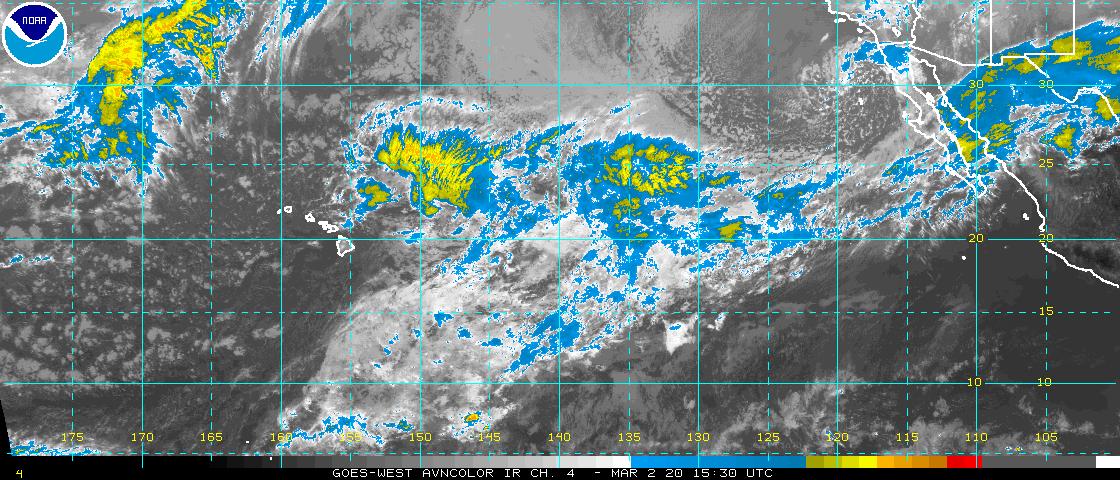
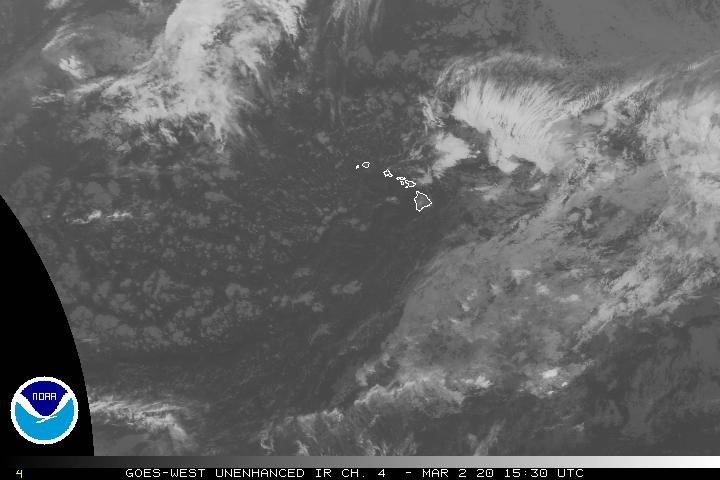
Satellite and Radar Images: To view the cloud conditions we have here in Hawaii, please use the following satellite links, starting off with this Infrared Satellite Image of the islands to see all the clouds around during the day and night. This next image is one that gives close images of the islands only during the daytime hours, and is referred to as a Close-up visible image. This next image shows a larger view of the Pacific…giving perspective to the wider ranging cloud patterns in the Pacific Ocean. Finally, here's a Looping IR satellite image, making viewable the clouds around the islands 24 hours a day. To help you keep track of where any showers may be around the islands, here’s the latest animated radar image.
Hawaii’s Mountains – Here’s a link to the live web cam on the summit of near 14,000 foot Mauna Kea on the Big Island of Hawaii. The tallest peak on the island of Maui is the Haleakala Crater, which is near 10,000 feet in elevation. These two web cams are available during the daylight hours here in the islands…and when there’s a big moon rising just after sunset for an hour or two! Plus, during the nights and early mornings you will be able to see stars, and the sunrise too…depending upon weather conditions.
Tropical Cyclone activity in the eastern and central Pacific – Here’s the latest weather information coming out of the National Hurricane Center, covering the eastern north Pacific. You can find the latest tropical cyclone information for the central north Pacific (where Hawaii is located) by clicking on this link to the Central Pacific Hurricane Center. Here’s a tracking map covering both the eastern and central Pacific Ocean. A satellite image, which shows the entire ocean area between Hawaii and the Mexican coast…can be found here. Of course, as we know, our hurricane season won't end until November 31st here in the central Pacific.
Aloha Paragraphs

High cirrus clouds in Hawaii, with increasing trades…
along with an uptick in windward showers too
We've reached the end of our recent light wind regime, with the trade winds already beginning to find a toe-hold…which will do nothing but increase going forward. This weather map shows two high pressure systems, located far to the northeast, and far north-northwest of Hawaii Tuesday night. The long and short of this will be a steady strengthening of our local trade winds Wednesday into the weekend. These trade winds have triggered a small craft wind advisory across those windiest waters around Maui and the Big Island, starting Wednesday. It is quite likely that this advisory may spread through the rest of the marine environment by Friday into Saturday. The game plan still calls for a reduction in these blustery winds by the first couple of days of next week.
Winds around have increased steadily during the day…the following numbers representing the strongest gusts early Tuesday evening:
27 mph Port Allen, Kauai
25 Oahu Forest NWR, Oahu
31 Molokai
31 Kahoolawe
29 Maalaea, Maui
08 Lanai Airport
22 Kealakomo, Big Island
As the trade winds have bounced back earlier than expected today, and as a result we'll see showery clouds being drawn our way…along the windward sides of the islands. Here's a satellite image, showing a vast amount of the high cirrus clouds, streaming in from the west…associated with a trough of low pressure out that way. If we shift our gaze to a larger satellite view, we can see just how extensive this high stuff is…and that there are some thick streaks in this mix. High clouds don’t bring precipitation, although certainly bring colorful sunrise and sunsets to our islands! These icy clouds, which form up at 20,000 feet and above, will continue to spread our way over the next couple of days. Besides the colorful beginnings and endings of the days, they do a good job of filtering and dimming our Hawaiian sunshine as well…which our visitors don’t like all that though!
Looking a bit further ahead, we’re in line for an increase in showers…which will last through the next several days. The first intrusion, if you will, for showers, will be an area of moisture arriving tonight into Wednesday. Then, later on Thursday, and old cold front will be carried our way…on the blustery trades. Just about the time that this moisture arrives Thursday into Friday, we’ll have cold air shifting overhead aloft. This in turn will make our showers more generous than they would otherwise be…perhaps even going so far as to say ~ heavy for several days. The latest thinking is that there is even the chance of a random thunderstorm to occur here and there with time. Those heavier showers will likely ease up by the weekend, although the windward sides may remain a bit on the damp side then. Here’s the looping radar image, so we can keep track of where the current showers are falling around the state.
It's Tuesday evening as I begin writing this last section of today's narrative update. The weather, as noted above, has turned out to be more windy than expected. Weather, especially during the autumn, winter, and spring is like this. Here in the islands, especially during the summer months, hardly a change happens for what seems like weeks at a time. That's all behind us now, as we slip deeper into the late autumn zone…edging right up on the winter season ahead. Hold onto your hats folks, as just up ahead we have what looks like some interesting weather in store. I'll have your next installment of this weather narrative from paradise comin' atcha early Wednesday morning. I hope you have a great Tuesday night until then! Aloha for now…Glenn.
Interesting: Peat, or turf, is an accumulation of partially decayed vegetation matter. Peat forms in wetland bogs, moors, and peat swamp forests. Peat is harvested as an important source of fuel in certain parts of the world. Peat has a high carbon content and can burn under low moisture conditions. Once ignited by the presence of a heat source, it smolders.
These smoldering fires can burn undetected for very long periods of time (months, years and even centuries) propagating in a creeping fashion through the underground peat layer. The rate of global warming could lead to a rapid release of carbon from these peat lands that would then further accelerate global warming.
Two recent studies published by the Mathematics Research Institute at the University of Exeter highlight the risk that this 'compost bomb' instability could pose, and calculate the conditions under which it could occur. Peat fires are emerging as a global threat with significant economic, social and ecological impacts.
Recent burning of peat bogs in Indonesia, with their large and deep growths containing more than 50 billion tons of carbon, has contributed to increases in world carbon dioxide levels. Peat deposits in Southeast Asia could be destroyed by 2040.
In 1997, it is estimated that peat and forest fires in Indonesia released between 0.81 and 2.57 Gt of carbon; equivalent to 13-40 percent of the amount released by global fossil fuel burning, and greater than the carbon uptake of the world's biosphere.
These fires may be partially responsible for the increase in carbon dioxide levels since 1998. Underground peat fires are fairly common and world-wide. In 2008 there was an underground peat fire in North Carolina triggered by a lightning strike and aided by a prolonged drought.
In Australia (Victoria province) there has been a peat fire raging for 13 years. In 2010 Russia is suffering from a prolonged peat fire. A peat fire, like any fire, requires fuel (peat), air, and ignition. The first Exeter paper by Catherine Luke and Professor Peter Cox describes one of the basic potential ignition sources.
When soil microbes decompose organic matter they release heat — this is why compost heaps are often warmer than the air around them. The compost bomb instability is a runaway feedback that occurs when the heat is generated by microbes more quickly than it can escape to the atmosphere.
This in turn requires that the active decomposing soil layer is thermally-insulated from the atmosphere. Catherine Luke explains: "The compost bomb instability is most likely to occur in drying organic soils covered by an insulating lichen or moss layer."
The second paper led by Dr Sebastian Wieczorek and Professor Peter Ashwin, also of the University of Exeter, proves there is a dangerous rate of global warming beyond which the compost bomb instability (i.e. ignition or spontaneous combustion occurs) occurs.
Spontaneous combustion occurs when materials self-heat to a temperature high enough to cause them to ignite. Typically, composting materials ignite at temperatures between 150 and 200°C. As the temperature rises, the speed of temperature increase also rises.
For example, heat is generated about 16 times faster at 100°C than at 60°C because the reaction rate approximately doubles with each 10°C rise in temperature. The Exeter team is now modeling the potential impact of the compost bomb instability on future climate change, including the potential link to the Russian peat land fires. It is also working to identify other rate-dependent tipping points.
Interesting2: A widespread farming catastrophe could hit Africa if global temperatures rose by four degrees Celsius or more, according to a study that calls for urgent planning for a much warmer future and investment in technology to avert disaster. In most of southern Africa the growing season could shrink by as much as a fifth, according to scientists at the International Livestock Research Institute (ILRI) in Kenya, who carried out simulation studies based on existing climate change models.
The 'four degrees plus' scenario is increasingly being contemplated as negotiations, which began again in Cancún, Mexico, today (29 November—10 December), have stalled on measures aimed at limiting the global temperature rise to two degrees.
Drastic changes to farming will be needed under such a scenario, said Carlos Seré, director-general of ILRI. "The general feeling is that the world is not going to move quickly enough on [confining global warming to] two degrees," he told SciDev.Net: "We are not getting traction.
"The common thinking has been that there will be enough variability in farming today to allow us to cope, but the reality is that in a four degree world the range of options is very narrow." According to the models, the growing season may increase modestly in eastern Africa.
But cropping seasons are likely to decline more quickly everywhere in the region except central Africa. Much of southern Africa's rain-fed agriculture could fail every other season by the 2090s, says the study.
Interesting3: NASA's Cassini spacecraft has detected a very tenuous atmosphere known as an exosphere, infused with oxygen and carbon dioxide around Saturn's icy moon Rhea. This is the first time a spacecraft has directly captured molecules of an oxygen atmosphere — albeit a very thin one — at a world other than Earth. The oxygen appears to arise when Saturn's magnetic field rotates over Rhea.
Energetic particles trapped in the planet's magnetic field pepper the moon's water-ice surface. They cause chemical reactions that decompose the surface and release oxygen. The source of the carbon dioxide is less certain. Oxygen at Rhea's surface is estimated to be about 5 trillion times less dense than what we have at Earth.
But the new results show that surface decomposition could contribute abundant molecules of oxygen, leading to surface densities roughly 100 times greater than the exospheres of either Earth's moon or Mercury. The formation of oxygen and carbon dioxide could possibly drive complex chemistry on the surfaces of many icy bodies in the universe.
"The new results suggest that active, complex chemistry involving oxygen may be quite common throughout the solar system and even our universe," said lead author Ben Teolis, a Cassini team scientist based at Southwest Research Institute in San Antonio. "Such chemistry could be a prerequisite for life.
All evidence from Cassini indicates that Rhea is too cold and devoid of the liquid water necessary for life as we know it." Releasing oxygen through surface irradiation could help generate conditions favorable for life at an icy body other than Rhea that has liquid water under the surface, Teolis said.
If the oxygen and carbon dioxide from the surface could somehow get transported down to a sub-surface ocean, that would provide a much more hospitable environment for more complex compounds and life to form. Scientists are keen to investigate whether life on icy moons with an ocean is possible, though they have not yet detected it.
The tenuous atmosphere with oxygen and carbon dioxide makes Rhea, Saturn's second largest moon, unique in the Saturnian system. Titan has a thick nitrogen-methane atmosphere, but very little carbon dioxide and oxygen.
"Rhea is turning out to be much more interesting than we had imagined," said Linda Spilker, Cassini project scientist at NASA's Jet Propulsion Laboratory, Pasadena, Calif. "The Cassini finding highlights the rich diversity of Saturn's moons and gives us clues on how they formed and evolved."
 Email Glenn James: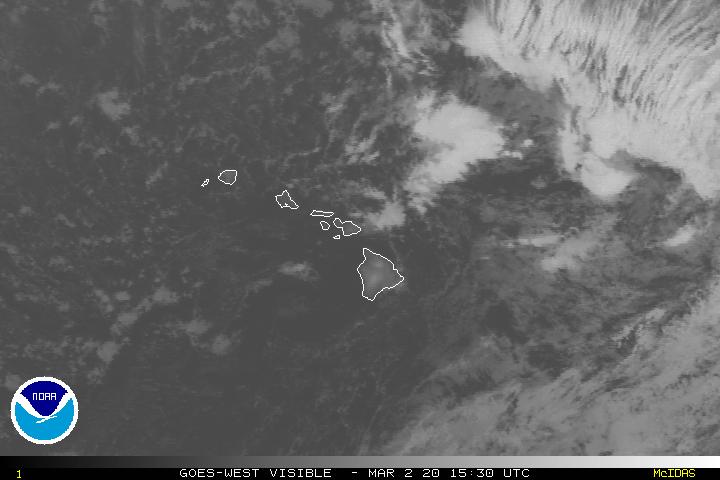



Rich Stevens Says:
Hey Glenn-It's 6:15 am–Wanted to mention an extreme rain cell that ;passed thru here, just after 4 am today. East side, Hawai'i Island, Hawaiian Paradise Park near Kea'au. We are one-half mile from the shoreline. Definitely the heaviest downpour we've experienced this winter. A good ten minutes of some real loud stuff….By the way, enjoyed your dispatches from Nor Cal, the Sonoma Coast, et al. Lived around there many years. Keep up the great work……………………..Aloha, Rich~~~Hi Richard, that sounds like a very heavy duty downpour! I’m expecting more of that kind of thing later Thursday into Friday, keep an eye out. As for northern California, yes…I love that area too! By the way, thanks for your on the spot weather report, always appreciate receiving them. Aloha, Glenn