Weather Details and Aloha Paragraphs
Posted by GlennAugust 12-13 2006
Air Temperatures – The following maximum temperatures were recorded across Hawaii Saturday:
Lihue, Kauai – 82F
Honolulu, Oahu – 87
Kaneohe, Oahu – 85
Kahului, Maui – 87
Hilo, Hawaii – 83
Kailua-Kona, Hawaii – 86
Temperatures early Sunday morning ranged between these warmest and coolest spots near sea level at the 4 a.m. hour:
KAILUA-KONA – 78
HILO AIRPORT – 68
Precipitation Totals – The following numbers represent the largest precipitation totals (inches) during the last 24 hours (as of Sunday morning) on each of the major islands:
0.29 MOUNT WAIALEALE, KAUAI
0.59 SOUTH FORK KAUKONAHUA, OAHU
0.13 MOLOKAI
0.00 LANAI
0.00 KAHOOLAWE
0.28 WEST WAILUAIKI, MAUI
0.28 MOUNTAIN VIEW, BIG ISLAND
Weather Chart – Here’s the latest (automatically updated) weather map…showing high pressure systemS located far to the north of our islands. At the same time we have troughing of low pressure affecting the state now. The net result will be for lighter winds through Monday in general. Here’s a Weather Map Symbol page for clarification about what all those weather symbols mean on the map.
Hawaii’s Mountains – Here’s a link to the live webcam on the summit of near 14,000 foot Mauna Kea on the Big Island of Hawaii. The tallest peak on the island of Maui is the Haleakala Crater, which is near 10,000 feet in elevation. These two webcams are available during the daylight hours here in the islands…and when there’s a big moon rising just after sunset for an hour or two! Plus, during the nights and early mornings you will be able to see stars, and the sunrise too…depending upon cloud conditions.
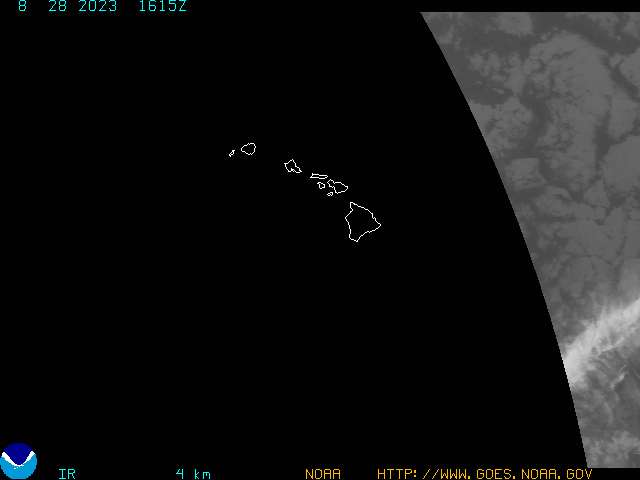
Satellite Images – To view the cloud conditions we have here in Hawaii, please use the following satellite links, starting off with the Infrared Satellite Image of the islands to see all the clouds around the state during the day and night. This next image is one that gives close images of the islands only during the daytime hours, and is referred to as a Close-up visible image. This next image shows a larger view of the Pacific…giving perspective to the wider ranging cloud patterns in the Pacific Ocean…out from the islands. To help you keep track of where any showers may be around the islands, here’s the latest animated radar image.
Tropical Cyclone Activity – The eastern Pacific hurricane season runs from May 15 through November 30…while the central Pacific (where Hawaii is) runs from June 1 through November 30. The latest storm information for the eastern Pacific can be found by clicking here. A storm tracking map for both the central and eastern areas can be found by clicking here . For the central Pacific, the latest storm information can be found by clicking here.
Aloha Paragraphs

Schooling fish from a snorkelers point of view
Photo Credit: flikr.com
The trade winds will keep blowing at moderate to fresh levels Saturday, then start to ease back a little starting Sunday. The source of these locally blustery trade winds is an usually strong high pressure system, at least for this time of year…located far to the NNE of our islands. The latest computer forecast models are now showing a trough of low pressure moving through the islands after the weekend. This will help to soften the trade wind speeds, remaining lighter than they have been lately through Tuesday, then rebounding around the middle of next week.
These trade winds will carry some showers to the windward coasts, and perhaps the Kona slopes. The overlying atmosphere has become a little more shower prone now. As the trough gets closer, the one described in the paragraph above, we may see an increase in showers locally Monday into Tuesday coming up. The leeward sides may see some showers being blown over from the windward sides locally too. The Kona coast will see some afternoon or evening showers in the upcountry as well.
It’s early Saturday morning here in Kula, Maui, as I begin this last paragraph of today’s narrative. When I got off work last evening, several friends and I took the drive up the mountain, and had a nice skateboarding session. One of the members of this group set up a tripod, and was shotting us with a high quality video camera. When we first got there, the fog was further up the slopes, so we got some decent footage. Although it didn’t take long before the fog swept in, and shut down that operation. We made a few more runs though, and then sat in a circle talking story, mostly centered around surfing, skateboarding, and snow boarding. We all had somewhat similar backgrounds, being sport buffs, so it was fun to rap together while sipping on a cold microbrewery Oregon ale. We got hungry at some point, when we realized it was totally dark. Then we took the drive down to an Italian restaurant in Makawao for dinner. It was a fun little adventure! I don’t have any major plans today, although am getting together with a friend for dinner late in the day, and then have a kayaking excursion planned for early Sunday morning near La Perouse Bay. Aloha for now…Glenn.
By the way department: The Perseid meteor shower peaks this weekend. The best night to go out is Saturday night, August 12/13. The first hour of the night will be dark and a small number of Perseids will streak long tracks when they fall into Earth’s atmosphere at a grazing angle. Later in the night, the Moon will light up the sky; it’s just a few days past full Moon this weekend. The Perseid rate will increase because the meteors fall in at a steeper angle; the meteors are short and swift then. While moonlight (and street lights) will wash out faint meteors, you will still have the opportunity in clear weather to see the many bright meteors from this classic, late-summer meteor shower.
 Email Glenn James: