











November 24-25, 2010
Air Temperatures – The following maximum temperatures were recorded across the state of Hawaii Wednesday afternoon:
Lihue airport, Kauai – 80
Honolulu airport, Oahu – 86
Kaneohe, Oahu – 81
Molokai airport – 83
Kahului airport, Maui – 83
Kona airport – 83
Hilo airport, Hawaii – 80
Air Temperatures ranged between these warmest and coolest spots near sea level – and on the highest mountain tops…as of 5pm Wednesday evening:
Barking Sands, Kauai – 82F
Hilo, Hawaii – 75
Haleakala Crater – 45 (near 10,000 feet on Maui)
Mauna Kea summit – 32 (near 14,000 feet on the Big Island)
Precipitation Totals – The following numbers represent the largest precipitation totals (inches) during the last 24 hours on each of the major islands, as of Wednesday afternoon:
0.66 Mount Waialeale, Kauai
0.25 Oahu Forest NWR, Oahu
0.09 Molokai
0.00 Lanai
0.01 Kahoolawe
0.71 West Wailuaiki, Maui
0.58 Waiakea Uka, Big Island
Marine Winds – Here’s the latest (automatically updated) weather map showing a large 1032 millibar high pressure system far to our northeast of the Hawaiian Islands. Our trade winds will strengthen into Friday.
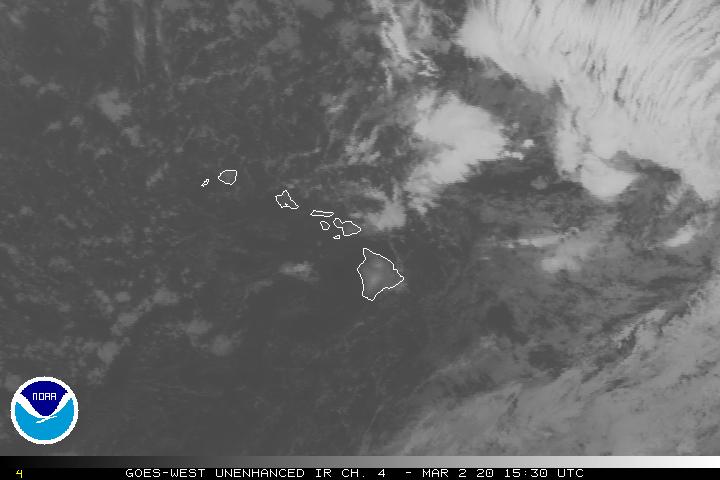
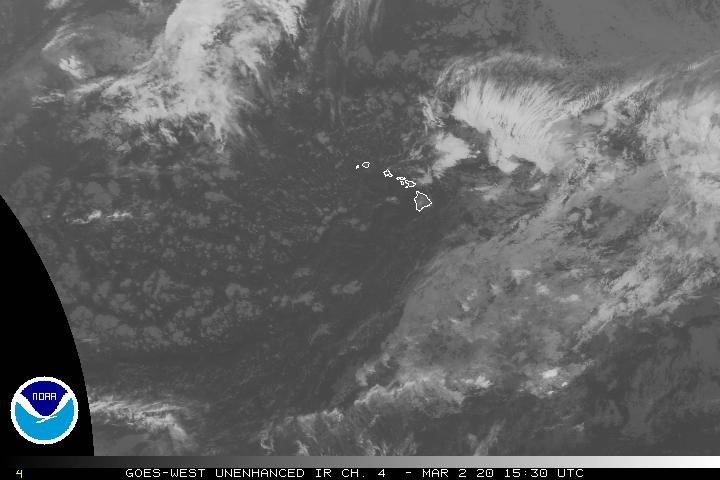
Satellite and Radar Images: To view the cloud conditions we have here in Hawaii, please use the following satellite links, starting off with this Infrared Satellite Image of the islands to see all the clouds around during the day and night. This next image is one that gives close images of the islands only during the daytime hours, and is referred to as a Close-up visible image. This next image shows a larger view of the Pacific…giving perspective to the wider ranging cloud patterns in the Pacific Ocean. Finally, here's a Looping IR satellite image, making viewable the clouds around the islands 24 hours a day. To help you keep track of where any showers may be around the islands, here’s the latest animated radar image.
Hawaii’s Mountains – Here’s a link to the live webcam on the summit of near 14,000 foot Mauna Kea on the Big Island of Hawaii. The tallest peak on the island of Maui is the Haleakala Crater, which is near 10,000 feet in elevation. These two webcams are available during the daylight hours here in the islands…and when there’s a big moon rising just after sunset for an hour or two! Plus, during the nights and early mornings you will be able to see stars, and the sunrise too…depending upon weather conditions.
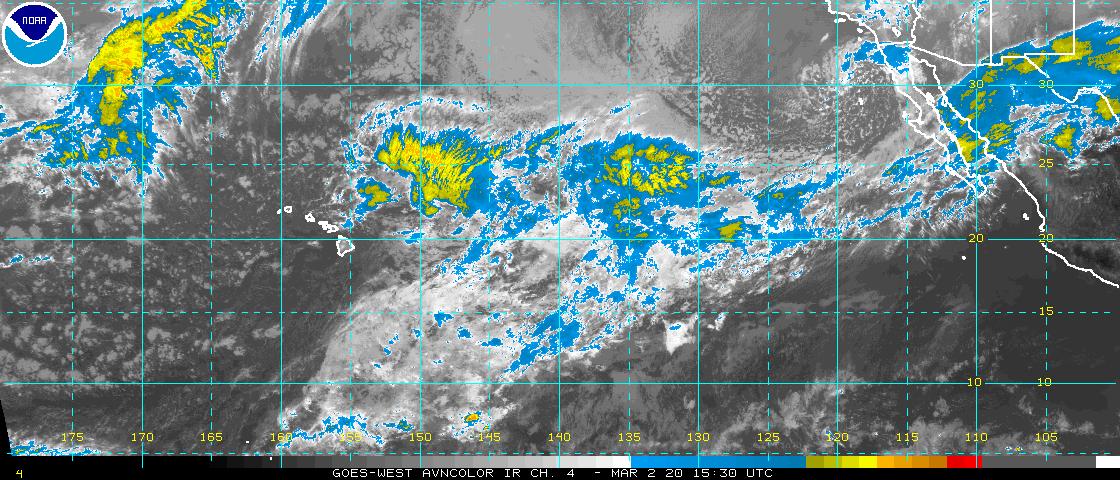
Tropical Cyclone activity in the eastern and central Pacific – Here’s the latest weather information coming out of the National Hurricane Center, covering the eastern north Pacific. You can find the latest tropical cyclone information for the central north Pacific (where Hawaii is located) by clicking on this link to the Central Pacific Hurricane Center. Here’s a tracking map covering both the eastern and central Pacific Ocean. A satellite image, which shows the entire ocean area between Hawaii and the Mexican coast…can be found here. Of course, as we know, our hurricane season won't end until November 31st here in the central Pacific.
Aloha Paragraphs

Stronger trade winds…along with windward showers
Happy Thanksgiving
The increase in trade wind speeds will prevail through the end of the work week…easing up gradually as we move into the upcoming weekend. This weather map shows a large 1032 millibar high pressure system located to the northeast of Hawaii Wednesday night. The NWS forecast office in Honolulu has expanded the small craft wind advisory, from just around Maui and the Big Island…up through most of the rest of the Hawaiian Islands through Friday. At the same time, we find a high wind watch in force over the tall mountain peaks on Maui and the Big Island.
Winds around the state are picking up…with the following numbers representing the strongest gusts early Wednesday evening:
24 mph Port Allen, Kauai
28 Waianae Valley, Oahu
27 Molokai
35 Kahoolawe
39 Maalaea Bay, Maui
17 Lanai Airport
30 PTA Keamuku, Big Island
The strengthening trade winds will carry clouds our way, which will keep the windward sides moist at times Wednesday into the night…then drying out some later on the Thanksgiving holiday. Here's a satellite image, showing generally clear skies, although with clouds and showers starting to approach Maui and the Big Island…with more taking aim on Oahu and Kauai tonight. If we shift our gaze to a larger satellite view, we can see those whiter and brighter clouds, the high and middle level ones, located well offshore in most directions.
It's Wednesday evening as I begin writing this last section of today's narrative update. The winds are picking up right on schedule, and we have increased showers on the way too. Let's check with this looping radar image, so we can see where the showers are falling at the moment. As noted above, the Big Island and Maui are finding the most showers, which will eventually spread to the other islands tonight. The leeward sides may find a few stray showers being carried over that way, by the gusty trade winds. ~~~ Looking a bit further ahead, the computer models continue to suggest that our winds will become softer later this weekend, right on into early next week. Those same models are trying to paint a wetter picture as early as this coming Sunday, into the first couple of days of next week too. We'll have to see about all this over the next day or two. ~~~ I'll be back on Thanksgiving morning, with your next new weather narrative, I hope you have a great Wednesday night until then! Happy Thanksgiving! Aloha for now…Glenn.
Interesting: Pterodactyl are not giant birds and indeed if they were, they might not even be able to fly based on standard theories of flight. Some have proposed that they vaulted and then glided on the winds. These ancient reptiles that flew over the heads of dinosaurs — were at their best in gentle tropical breezes, soaring over hillsides and coastlines or floating over land and sea on thermally driven air currents, according to new research from the University of Bristol.
Pterodactyls) were too slow and flexible to use the stormy winds and waves of the southern ocean like the albatrosses of today states the research by Colin Palmer, an engineer turned paleontology PhD student in Bristol’s School of Earth Sciences. The anatomy of pterosaurs (pterodactyls) was highly modified from their reptilian ancestors for the demands of flight.
Pterosaur bones were hollow and air filled, like the bones of birds. They had a keeled breastbone that was developed for the attachment of flight muscles and an enlarged brain that shows specialized features associated with flight. Their slow flight and the variable geometry of their wings also enabled pterosaurs to land very gently, reducing the chance of breaking their paper- thin bones.
This helps to explain how they were able to become the largest flying animals ever known. Some had wing spans over 30 feet and were far larger than other known flying creatures Currently the bird with the largest wingspan is the albatross. Their wingspan reaches 11 feet. Albatrosses travel huge distances with two techniques used by many long-winged seabirds, dynamic soaring and slope soaring.
Dynamic soaring involves repeatedly rising into wind and descending downwind thus gaining energy from the vertical wind gradient. Slope soaring uses the rising air on the windward side of large waves. Using his 40 years of experience in the engineering industry, Colin Palmer constructed models of pterosaur wing sections from thin, curved sheets of epoxy resin/carbon fiber composite and tested them in a wind tunnel.
These tests quantified the two-dimensional characteristics of pterosaur wings for the first time, showing that such creatures were significantly less aerodynamically efficient and were capable of flying at lower speeds than previously thought. Colin Palmer said: “Pterosaur wings were adapted to a low-speed flight regime that minimizes sink rate.
This regime is unsuited to marine style dynamic soaring adopted by many seabirds which requires high flight speed coupled with high aerodynamic efficiency, but is well suited to thermal/slope soaring. The low sink rate would have allowed pterosaurs to use the relatively weak thermal lift found over the sea.
"Since the bones of pterosaurs were thin-walled and thus highly susceptible to impact damage, the low-speed landing capability would have made an important contribution to avoiding injury and so helped to enable pterosaurs to attain much larger sizes than extant birds.
The trade-off would have been an extreme vulnerability to strong winds and turbulence, both in flight and on the ground, like that experienced by modern-day paragliders."
Interesting2: A nutritious blue-green algae, known as spirulina, has been added to school meals in Jordan to combat chronic malnutrition and anaemia among children. Almost one in ten Jordanian children suffer from chronic malnutrition, or long-term protein or energy deficiency, while a third are anaemic, according to a survey by the Jordanian Department of Statistics (DOS) made public in March.
The Intergovernmental Institution for the use of Micro-algae Spirulina against Malnutrition (IIMSAM), which has observer status with the UN Economic and Social Council, says spirulina is rich in protein and vitamin B, and contains beta-carotene that can overcome eye problems caused by Vitamin A deficiency.
A tablespoon a day can eliminate iron anaemia, the most common mineral deficiency. According to IIMSAM, a pilot feeding program in two Kenyan schools from April 2009 to April 2010 helped cure 1,350 pupils suffering from malnutrition.
The World Food Program estimates that 22 per cent of children under the age of five in Kenya are malnourished, significantly higher than the 15 per cent level which the World Health Organization uses as a threshold to describe an emergency situation.
Naseer S. Homoud, director of IIMSAM's Middle East Office, said spirulina has a role in fighting malnourishment, especially in children, and referred to "its low cost of farming as it can be grown even on infertile land and without a large water supply."
Interesting3: Will polar bears survive in a warmer world? UCLA life scientists present new evidence that their numbers are likely to dwindle. As polar bears lose habitat due to global warming, these biologists say, they will be forced southward in search of alternative sources of food, where they will increasingly come into competition with grizzly bears.
To test how this competition might unfold, the UCLA biologists constructed three-dimensional computer models of the skulls of polar bears and grizzly bears — a subspecies of brown bears — and simulated the process of biting. The models enabled them to compare the two species in terms of how hard they can bite and how strong their skulls are.
"What we found was striking," said Graham Slater, a National Science Foundation-funded UCLA postdoctoral scholar in ecology and evolutionary biology and lead author of the research. "The polar bear and brown bear can bite equally hard, but the polar bear's skull is a much weaker structure."
The implication is that polar bears are likely to lose out in competition for food to grizzlies as warmer temperatures bring them into the same environments, because grizzlies' stronger skulls are better suited to a plant-rich diet, said Slater and Blaire Van Valkenburgh, UCLA professor of ecology and evolutionary biology and senior author of the research.
"The result for polar bears may be lower weight, smaller and fewer litters, less reproductive success, fewer that would survive to adulthood, and dwindling populations," Van Valkenburgh said. "Then you can get into an extinction vortex, where a small population becomes even smaller in a downward spiral to extinction.
"To people who say polar bears can just change their diet, we are saying they will change their diet — they will have to — but it probably will not be sufficient for them, especially if they are co-existing with grizzly bears. Their skull is relatively weak and not suited to adapting its diet.
We did not expect to find what we found." "This is one additional piece of evidence that things look pretty bleak for the polar bear if current trends continue," Slater said. The research, federally funded by the National Science Foundation, was published this month in the online journal PLoS ONE, a publication of the Public Library of Science.
Polar bears are a "marvelous example of rapid adaptation to an extreme environment," Slater said. "The fact that we can lose them equally as rapidly as a result of human-mediated climate change is rather striking. Polar bears are very well suited to do what they do, but they are highly specialized and not well suited to doing much else."
It could take quite some time for polar bears to go extinct, Van Valkenburgh said, but they are likely to become much more rare than today. Polar bears are losing habitat as a result of global warming and the associated loss of arctic sea ice, which they use to hunt for seals, Van Valkenburgh and Slater said.
But could they survive on an alternative food source? "Our results suggest that this is not too likely," Slater said. "The polar bear's skull is a relatively weak structure that is not suited to diets consisting of a lot of plant material like that of the brown bear. As climate change continues, polar bears will be forced to move south in search of resources, while brown bears move north as their climate becomes more mild.
When these two species meet, as they have already begun to, it seems that brown bears will easily out-compete polar bears. Our findings should serve as a warning that polar bears may not be flexible enough to survive if current trends continue. "Chewing a lot of vegetables takes quite a lot of force to grind up," Slater said.
"Grizzly bears are well suited to eating these kinds of food, but the polar bear is not well suited for it. The grizzly has a much more efficient skull for eating these kinds of foods." In Canada, grizzly bears are moving north and are already in polar bear territory, Van Valkenburgh and Slater said.
The life scientists — whose co-authors include UCLA undergraduates Leeann Louis and Paul Yang and graduate student Borja Figueirido from Spain's Universidad de Malaga, Campus Universitario de Teatinos — studied two adult male skulls from museums, one of a polar bear from Canada, the other of a grizzly from Alaska. They built 3-D computer models of the skulls and then analyzed their biomechanics.
"We can apply muscle forces to the skull to simulate biting, and we can measure how hard the animal could bite. We can measure stress and strain in the skull as well," Slater said. "We found that while the stresses in the grizzly bear skull are relatively low, the same bites in the polar bear produce much more stress.
Combined with other evidence from Blaire's laboratory, this tells us that the smaller teeth of polar bears are less suited to diets that consist of plants, grass, vegetation and berries." "Polar bears would not be able to break up the food as well in their mouths and would not digest it as well," Van Valkenburgh said.
In the timeline of evolution, polar bears evolved from the brown bear very recently, and the two are very closely related, Van Valkenburgh and Slater said. Genetic studies indicate that the split between polar bears and brown bears occurred only 500,000 to 800,000 years ago — the most recent split between any of the eight bear species.
Despite the recentness of the split between these two species, their skulls and teeth are extremely different, probably as a result of where they live (arctic versus temperate regions) and the differences in their diets. Grizzly bears have very large molar teeth, while polar bears have teeth that are much smaller.
Polar bears eat seal blubber, which is soft and does not require much chewing, while brown bears consume many plants. The biologists investigated the rate at which skull shape has evolved in the bear family.
They found that the rate of evolution in the branch of the bear family tree leading to the polar bear was twice as fast as the rates in other branches of the tree; it appears that skull shape evolved extremely rapidly in polar bears.
Polar bears probably evolved very rapidly in response to glacial climates during the ice ages, Slater said. "You don't see many bears that look like polar bears, and the difference in skull shape evolved very rapidly," Slater said.
 Email Glenn James: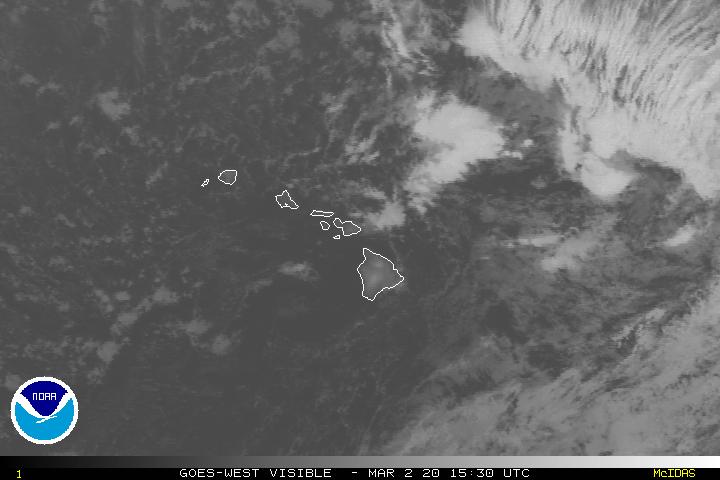


Dan Hunt Says:
Glenn : Have a safe and Happy Thanksgiving. Dan~~~ Hi Dan, good to hear from you, and the same good wishes to you my friend. Aloha, Glenn
petermac Says:
Aloha Glenn- another question about the precip seeing radar loop. From time to time thare are these anomolies showing a momentary streak which quickly shifts to a another location, then disappears altogether. Do you know what these are? Have you seen them? I just now saw some on the loop.
Mahalo for awesome info!!~~~Hi Peter, I’ve seen those streaks at times too, never knew what they were. The next time I talk to the NWS forecast office in Honolulu I’ll ask the radar desk what they are. Good question. Aloha, Glenn