











October 19-20, 2010
Air Temperatures – The following maximum temperatures were recorded across the state of Hawaii Tuesday afternoon:
Lihue airport, Kauai – 84
Honolulu airport, Oahu – 84
Kaneohe MCAS, Oahu – 84
Molokai airport – 83
Kahului airport, Maui – 85
Ke-ahole airport (Kona) – 86
Hilo airport, Hawaii – 80
Air Temperatures ranged between these warmest and coolest spots near sea level – and on the highest mountain tops…as of 5pm Tuesday evening:
Port Allen, Kauai – 84F
Hilo, Hawaii – 72
Haleakala Crater – 46 (near 10,000 feet on Maui)
Mauna Kea summit – 39 (near 14,000 feet on the Big Island)
Precipitation Totals – The following numbers represent the largest precipitation totals (inches) during the last 24 hours on each of the major islands, as of Tuesday afternoon:
0.21 Lihue, Kauai
3.80 Manoa Valley, Oahu
0.00 Molokai
0.00 Lanai
0.00 Kahoolawe
0.41 West Wailuaiki, Maui
0.82 Pali 2, Big Island
Marine Winds – Here’s the latest (automatically updated) weather map showing high pressure systems to the northwest, and north-northeast of our islands. At the same time, a cold front is pushing a ridge down closer to the islands. Our local winds will fill in during the day Wednesday…into Thursday.
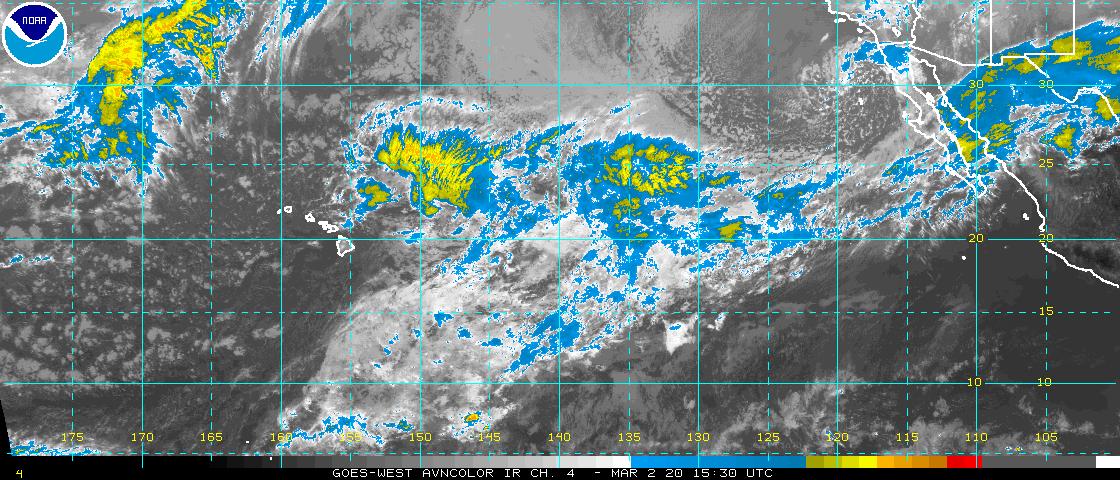
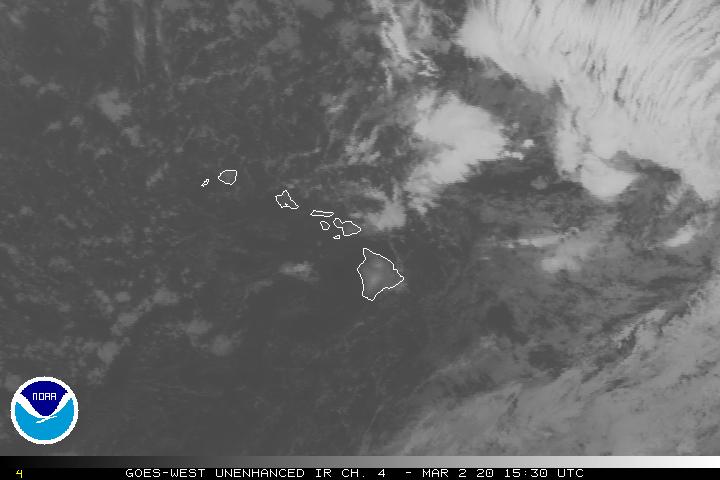
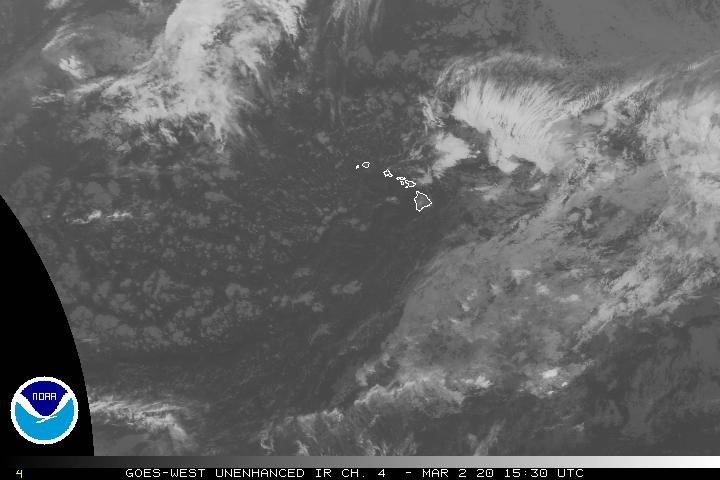
Satellite and Radar Images: To view the cloud conditions we have here in Hawaii, please use the following satellite links, starting off with this Infrared Satellite Image of the islands to see all the clouds around during the day and night. This next image is one that gives close images of the islands only during the daytime hours, and is referred to as a Close-up visible image. This next image shows a larger view of the Pacific…giving perspective to the wider ranging cloud patterns in the Pacific Ocean. Finally, here's a Looping IR satellite image, making viewable the clouds around the islands 24 hours a day. To help you keep track of where any showers may be around the islands, here’s the latest animated radar image.
Hawaii’s Mountains – Here’s a link to the live webcam on the summit of near 14,000 foot Mauna Kea on the Big Island of Hawaii. The tallest peak on the island of Maui is the Haleakala Crater, which is near 10,000 feet in elevation. These two webcams are available during the daylight hours here in the islands…and when there’s a big moon rising just after sunset for an hour or two! Plus, during the nights and early mornings you will be able to see stars, and the sunrise too…depending upon weather conditions.
Tropical Cyclone activity in the eastern and central Pacific – Here’s the latest weather information coming out of the National Hurricane Center, covering the eastern north Pacific. You can find the latest tropical cyclone information for the central north Pacific (where Hawaii is located) by clicking on this link to the Central Pacific Hurricane Center. Here’s a tracking map covering both the eastern and central Pacific Ocean. A satellite image, which shows the entire ocean area between Hawaii and the Mexican coast…can be found here. Of course, as we know, our hurricane season won't end until November 31st here in the central Pacific.
Aloha Paragraphs
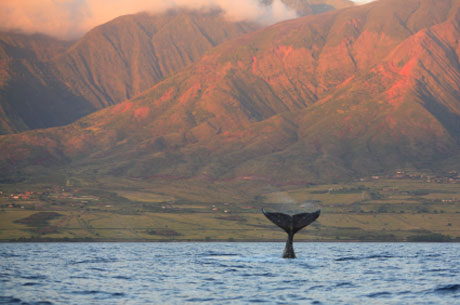
It won't be long now
Our local winds will remain quite light through mid-week…although locally gusty in places. This weather map shows a high pressure system to northeast Tuesday night…along with an approaching cold front to our northwest. As we move into Wednesday and Thursday…our trade winds will fill back into the islands, lasting through the rest of the week. These trade winds will blow generally in the light to moderately strong category…perhaps turning more east or even east-southeast later this coming weekend, into early next week.
The atmosphere turned unstable today, which prompted some locally heavy showers here and there. As we can see from glancing at this satellite image, there are rather numerous cumulus clouds in our vicinity…especially over and around Maui and the Big Island. At the same time we see areas of high cirrus clouds to our southeast. Glancing further to the east, there’s an area of deeper clouds…using this larger view of the central Pacific. The models are suggesting that later this week, perhaps by the weekend into early next week, we could see the chance of more localized generous showers.
It's Tuesday evening as I begin writing this last section of today's narrative update. As pointed out above, we had a rather unexpected turn of events today in our weather, with lots of heavy showers erupting…especially on Maui and the Big Island. Oahu got some showers too, although Kauai missed most of the action altogether. It appears that as darkness falls, that the showers will back off way off, with clearing skies expected…taking us into Wednesday morning. It was a dynamic day, with everything but thunderstorms showing up, in terms of clouds and rainfall locally! ~~~ I'll be back early Wednesday morning with your last new weather narrative before I take off on vacation Thursday. Looking out the window here in Kihei, before taking the drive back upcountry to Kula, there's partly cloudy conditions in most directions. I see a vivid rainbow looking over towards the windward side, towards Makawao and Paia. Here's a looping radar image to see those showers at the time of this writing. I'll catch up with you early Wednesday, have a good one until then! Aloha for now…Glenn.
Interesting: Typhoon Megi, having racked the northern Philippines with flooding rain and destructive winds, will steer northward enough to spare northern Vietnam and Hainan Island, China, any further flooding rain. As of Tuesday, rainfall over several days was as high as 3 feet at Vinh, Vietnam, and 15 inches at Qionghai, Hainan Dao (Island), China. In northern Vietnam, a bus was swept off a flooded roadway leading to at least 20 deaths.
Officials have stated that the flooding death toll was at least 50. The island province of Hainan, China, meanwhile, suffered a second bout of serious flooding in October. At Qionghai, eastern Hainan, 4 feet of rain fell within the first eight days of October, and much of the island suffered severe flooding.
This latest bout of rain, which was triggered by a broad tropical weather system unrelated to Megi or any other named storm, sparked renewed flooding and evacuations as of Monday, and it boosted rainfall for the month thus far to nearly 65 inches at Qionghai.
Needless to say, a blow from the likes of Typhoon Megi could prove disastrous for these rain-soaked areas. However, it now can be said that a direct hit from Megi upon northern Vietnam or even Hainan Island is highly unlikely. Rather, a track towards southeastern China, maybe Hong Kong, is indicated. Ultimate landfall, likely in Guangdong, southern China, would happen late in the week about Friday, EDT.
Interesting2: The United States and many other heavily populated countries face a growing threat of severe and prolonged drought in coming decades, according to a new study by National Center for Atmospheric Research (NCAR) scientist Aiguo Dai. The detailed analysis concludes that warming temperatures associated with climate change will likely create increasingly dry conditions across much of the globe in the next 30 years, possibly reaching a scale in some regions by the end of the century that has rarely, if ever, been observed in modern times.
Using an ensemble of 22 computer climate models and a comprehensive index of drought conditions, as well as analyses of previously published studies, the paper finds most of the Western Hemisphere, along with large parts of Eurasia, Africa, and Australia, may be at threat of extreme drought this century.
In contrast, higher-latitude regions from Alaska to Scandinavia are likely to become more moist. Dai cautioned that the findings are based on the best current projections of greenhouse gas emissions. What actually happens in coming decades will depend on many factors, including actual future emissions of greenhouse gases as well as natural climate cycles such as El Niño.
The new findings appear as part of a longer review article in Wiley Interdisciplinary Reviews: Climate Change. The study was supported by the National Science Foundation, NCAR's sponsor. "We are facing the possibility of widespread drought in the coming decades, but this has yet to be fully recognized by both the public and the climate change research community," Dai says. "If the projections in this study come even close to being realized, the consequences for society worldwide will be enormous."
While regional climate projections are less certain than those for the globe as a whole, Dai's study indicates that most of the western two-thirds of the United States will be significantly drier by the 2030s. Large parts of the nation may face an increasing risk of extreme drought during the century.
Other countries and continents that could face significant drying include:
• Much of Latin America, including large sections of Mexico and Brazil
• Regions bordering the Mediterranean Sea, which could become especially dry
• Large parts of Southwest Asia
• Most of Africa and Australia, with particularly dry conditions in regions of Africa
• Southeast Asia, including parts of China and neighboring countries
The study also finds that drought risk can be expected to decrease this century across much of Northern Europe, Russia, Canada, and Alaska, as well as some areas in the Southern Hemisphere. However, the globe's land areas should be drier overall.
"The increased wetness over the northern, sparsely populated high latitudes can't match the drying over the more densely populated temperate and tropical areas," Dai says. A climate change expert not associated with the study, Richard Seager of Columbia University's Lamont Doherty Earth Observatory, adds:
"As Dai emphasizes here, vast swaths of the subtropics and the midlatitude continents face a future with drier soils and less surface water as a result of reducing rainfall and increasing evaporation driven by a warming atmosphere. The term 'global warming' does not do justice to the climatic changes the world will experience in coming decades. Some of the worst disruptions we face will involve water, not just temperature."
A portrait of worsening drought
Previous climate studies have indicated that global warming will probably alter precipitation patterns as the subtropics expand. The 2007 assessment by the Intergovernmental Panel on Climate Change (IPCC) concluded that subtropical areas will likely have precipitation declines, with high-latitude areas getting more precipitation.
In addition, previous studies by Dai have indicated that climate change may already be having a drying effect on parts of the world. In a much-cited 2004 study, he and colleagues found that the percentage of Earth's land area stricken by serious drought more than doubled from the 1970s to the early 2000s. Last year, he headed up a research team that found that some of the world's major rivers are losing water.
In his new study, Dai turned from rain and snow amounts to drought itself, and posed a basic question: how will climate change affect future droughts? If rainfall runs short by a given amount, it may or may not produce drought conditions, depending on how warm it is, how quickly the moisture evaporates, and other factors.
Droughts are complex events that can be associated with significantly reduced precipitation, dry soils that fail to sustain crops, and reduced levels in reservoirs and other bodies of water that can imperil drinking supplies. A common measure called the Palmer Drought Severity Index classifies the strength of a drought by tracking precipitation and evaporation over time and comparing them to the usual variability one would expect at a given location.
Dai turned to results from the 22 computer models used by the IPCC in its 2007 report to gather projections about temperature, precipitation, humidity, wind speed, and Earth's radiative balance, based on current projections of greenhouse gas emissions. He then fed the information into the Palmer model to calculate the PDSI index.
A reading of +0.5 to -0.5 on the index indicates normal conditions, while a reading at or below -4 indicates extreme drought. The most index ranges from +10 to -10 for current climate conditions, although readings below -6 are exceedingly rare, even during short periods of time in small areas.
By the 2030's, the results indicated that some regions in the United States and overseas could experience particularly severe conditions, with average decadal readings potentially dropping to -4 to -6 in much of the central and western United States as well as several regions overseas, and -8 or lower in parts of the Mediterranean. By the end of the century, many populated areas, including parts of the United States, could face readings in the range of -8 to -10, and much of the Mediterranean could fall to -15 to -20.
Such readings would be almost unprecedented. Dai cautions that global climate models remain inconsistent in capturing precipitation changes and other atmospheric factors, especially at the regional scale. However, the 2007 IPCC models were in stronger agreement on high- and low-latitude precipitation than those used in previous reports, says Dai.
There are also uncertainties in how well the Palmer index captures the range of conditions that future climate may produce. The index could be overestimating drought intensity in the more extreme cases, says Dai. On the other hand, the index may be underestimating the loss of soil moisture should rain and snow fall in shorter, heavier bursts and run off more quickly.
Such precipitation trends have already been diagnosed in the United States and several other areas over recent years, says Dai. "The fact that the current drought index may not work for the 21st century climate is itself a troubling sign," Dai says.
Interesting3: Argentina enacted a new law that protects the country's glaciers, in a global context where climate change threatens the large bodies of ice and there are risks of different polluting activities. The law, enacted on September 30, aims to preserve the glaciers as "strategic reserves of water for human consumption, for agriculture and as suppliers of water to recharge basins, for the protection of biodiversity; as a source of scientific and tourist attraction." The legislation also establishes the creation of the "National Inventory of Glaciers". It will be updated every five years, and verify the changes on the surfaces of glaciers and periglacial.
The "periglacial environment" is the high mountain area, with frozen soil, that acts as regulator of water resources. Researchers at the Argentine Institute of Snow Research, Glaciology and Environmental Sciences will have the task to disclose necessary information to control and monitor all glaciers and periglacial areas that act as water reserves.
The law states and prohibits the release, dispersal or disposal of substances or contaminants, chemicals or waste of any kind or size in glaciers and periglacial environments. It also prohibited the exploration and explotacion of mines. Furthermore, it required an environmental impact assessment of all planned activities which are not prohibited.
"The new Act Glaciers may be an important tool in protecting drinking water sources located in the higher sectors of the Andean Cordillera," told Jorge Rabassa to SciDev.Net, Rabassa is a researcher at the National Council of Science and Technology and Professor head of the National University of Patagonia San Juan Bosco in Ushuaia. In the periglacial environment are the major water resources in the high mountains that supply throughout the year various river basins, especially during the summer.
 Email Glenn James: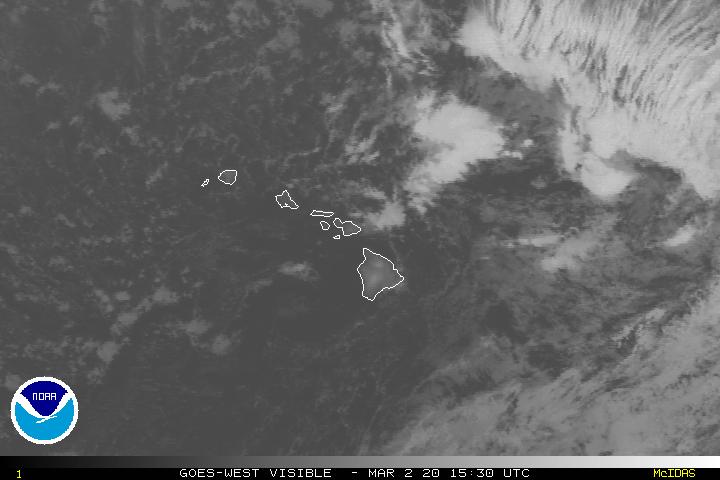


Myrtle Says:
Hi Glenn — We hope you have a good time in California. Before you leave, please check on the automated Maui forecasts. The ones for the isle of Maui seem to be displaying the wrong days. Safe travels! Myrtle and clan~~~Thanks for the nice send off Myrtle and clan too. I know the forecasts are off in some places, I’ll try and look into that before I leave…some work and some don’t.