











October 18-19, 2009
Air Temperatures – The following maximum temperatures were recorded across the state of Hawaii Sunday afternoon:
Lihue, Kauai – 83
Honolulu, Oahu – 89
Kaneohe, Oahu – 84
Kaunakakai, Molokai – 88
Kahului, Maui – 89
Hilo, Hawaii – 87
Kailua-kona – 88
Air Temperatures ranged between these warmest and coolest spots near sea level around the state – and on the highest mountains…at 4 p.m. Sunday afternoon:
Port Allen, Kauai – 88F
Kaneohe, Oahu – 81
Haleakala Crater – 59 (near 10,000 feet on Maui)
Mauna Kea summit – 41 (near 14,000 feet on the Big Island)
Precipitation Totals – The following numbers represent the largest precipitation totals (inches) during the last 24 hours on each of the major islands, as of Sunday afternoon:
0.31 Mount Waialeale, Kauai
0.30 Oahu Forest NWR, Oahu
0.12 Molokai
0.02 Lanai
0.00 Kahoolawe
1.04 West Wailuaiki, Maui
0.17 Pahoa, Big Island
Marine Winds – Here’s the latest (automatically updated) weather map showing a high pressure systems located generally to the northeast of the islands. These highs and ridges will keep the trade winds active Sunday and Monday…locally strong and gusty.
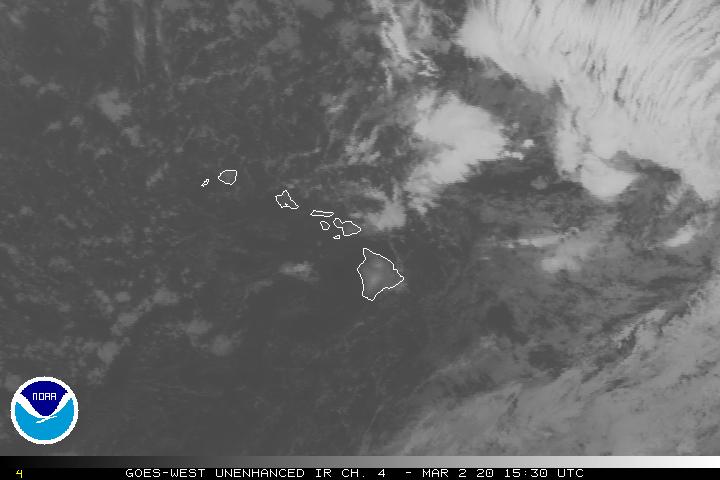
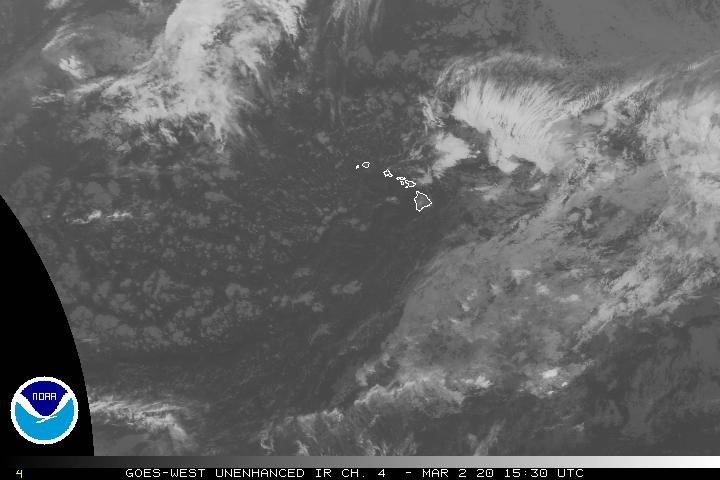
Satellite and Radar Images: To view the cloud conditions we have here in Hawaii, please use the following satellite links, starting off with this Infrared Satellite Image of the islands to see all the clouds around the state during the day and night. This next image is one that gives close images of the islands only during the daytime hours, and is referred to as a Close-up visible image. This next image shows a larger view of the Pacific…giving perspective to the wider ranging cloud patterns in the Pacific Ocean. Finally, here’s a Looping IR satellite image, making viewable the clouds around the islands 24 hours a day. To help you keep track of where any showers may be around the islands, here’s the latest animated radar image.
Hawaii’s Mountains – Here’s a link to the live webcam on the summit of near 14,000 foot Mauna Kea on the Big Island of Hawaii. The tallest peak on the island of Maui is the Haleakala Crater, which is near 10,000 feet in elevation. These two webcams are available during the daylight hours here in the islands…and when there’s a big moon rising just after sunset for an hour or two! Plus, during the nights and early mornings you will be able to see stars, and the sunrise too…depending upon weather conditions.
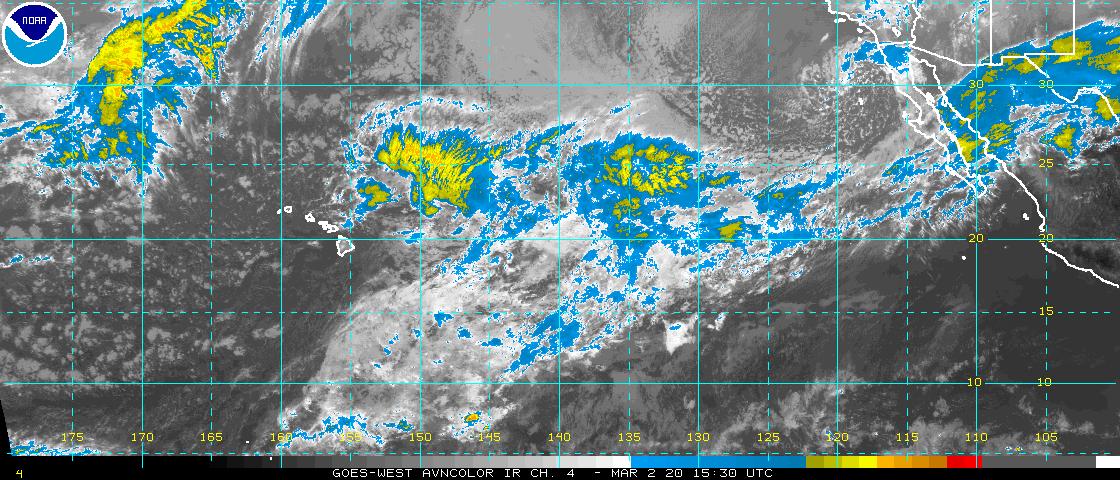
Tropical Cyclone activity in the eastern and central Pacific – Here’s the latest weather information coming out of the National Hurricane Center, covering the eastern north Pacific. You can find the latest tropical cyclone information for the central north Pacific (where Hawaii is located) by clicking on this link to the Central Pacific Hurricane Center. Here’s a tracking map covering both the eastern and central Pacific Ocean. A satellite image, which shows the entire ocean area between Hawaii and the Mexican coast…can be found here.
Aloha Paragraphs
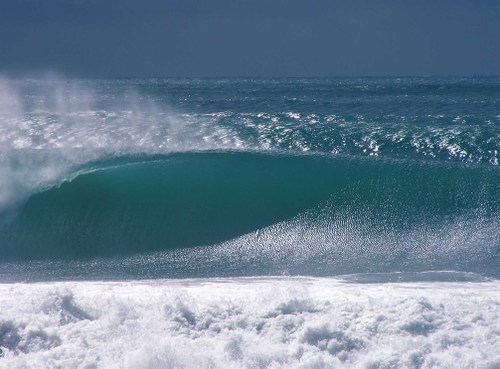
South shore waves…high surf advisory
The trade winds will continue into the first couple of days of the new work week ahead…locally on the blustery side for the time being. The NWS office in Honolulu has extended the small craft wind advisory to all the major channels across the island chain now…in addition to a few of those locally windier coastal areas around Maui and the Big Island. The winds may gradually take on a more southeast orientation as we get towards Tuesday, last for several days. A new tropical depression, called 3C has developed to the south of the state of Hawaii, strengthening over the next couple of days. This feature, along with an approaching cold front to our northwest, will cause our winds to weaken, and turn more southeast. This may carry some volcanic haze up from the Big Island over the other islands for a couple of days by mid-week. The trade winds are expected to return towards the end of the new work week ahead.
The overlying atmosphere remains quite dry and stable for the time being…with likely just a few windward biased showers at times. The trade wind flow will continue into Monday, bringing fairly normal weather conditions to the Aloha state. Satellite imagery shows that there are just scattered moisture pockets upstream, with nothing unusual in that regard now. The leeward sides should remain generally nice, with lots of sunshine beaming down during the days. The northern fringe of the new tropical depression 3C, moving by to our southwest, may bring an increase in clouds and showers later Tuesday into Wednesday or Thursday.
It’s that time of the year again, when I’ll be taking my annual vacation to the mainland…once again to California. I’ll be leaving tomorrow afternoon, and be gone for about three weeks. I’ll be visiting my good friends, and also spending some quality time with my family in Long Beach as well. This will be a time when I renew my batteries, and spend time away from my weather schedule here in the islands. I’ll have more to say about this going forward, but just wanted to give you a heads up ahead of time. I’ll leave this paragraph here, so that those who drop by every few days, will know of my plans, and won’t be surprised. By the way, you will be able to continue getting the latest weather forecasts for each of the islands, by going to the left hand margin of any of the pages on this website, and clicking on the island you want to know about.
It’s early Sunday evening here in Kula, Maui, as I begin writing the last section of today’s narrative update. As noted above, we’ve seen a lovely day Sunday, with gorgeous trade wind weather prevailing. This satellite image shows the tropical depression about 600 miles south of our islands. As noted above, this area will likely strengthen into a tropical storm…and even into a hurricane well to the west of Hawaii with time. I’ll keep this looping satellite image here, so we can keep track of this tropical vortex to our south. Here’s the latest track map for this new tropical depression 3C…the islands are hidden under the box in the right hand corner by the way. ~~~ As Sunday winds down, after being quite sunny in most areas, the big news continues in the marine environment, where a significant south swell is bringing breaking waves to the south and west shores. The other feature of note, is the gusty trade winds that are whipping up the surface of our surrounding ocean as well. Then, of course, we have that tropical vortex down to our south at the moment too. Speaking of storms, we also find a super typhoon in the western Pacific, taking aim on the northern part of Luzon Island, in the Philippines. Last but not least, we have a major hurricane in the eastern Pacific, likely to impact the southern part of the Baja peninsula soon. So, we have active tropical cyclone activity here in the Pacific, while the Atlantic remains calm. ~~~ This will be my last narrative update until my vacation begins tomorrow. I’ll come back in the morning and prepare this website for my departure. You will be able to get all the current weather forecasts for all the islands however, by going to the left hand margin of any page, and click on the area that you would like to find out about. I’ll have more information about my vacation plans here in the morning, and then when possible, I’ll sent notes about where I am, and what I’m up to along the way. I hope you have a good Sunday night! Aloha for now…Glenn.
Interesting: Another potential "super typhoon" is threatening to make landfall in areas in Luzon. Luzon was among the worst areas to be hit by two devastating storms in the last three weeks. It was storm 22W, but now it has been given the international name of Lupit.
The storm will be named Ramil once it enters Philippine territory. It would be the 18th storm to enter the country this year.
PAGASA’s weather satellite spotted the storm at 1,350 kilometers east of Visayas, packing center winds of 65 kilometers per hour and gusts of up to 80 kph. As of 2 a.m. Friday morning, it located approximately 945 nautical miles of Luzon in the Philippines. It has tracked west-northwestward at 15 knots over the past six hours.
The government have forewarned residents already devastated by storms Ondoy (international code name Ketsana) and Pepeng (Parma) to be prepared "for an intense storm – typhoon." The new storm, which was first spotted over the Marianas Islands, threatens to hit Luzon areas as its residents scrambles to recover from the twin storms that devastated thousands of hectares of residential and agricultural areas for the last three weeks.
As of 2 a.m. Friday, the National Disaster Coordinating Council said a total of 392 people have been confirmed killed by landslides and floods caused by Pepeng’s or Parma’s heavy rains. Ondoy’s death toll was pegged at 341, bringing the total of deaths from the two storms to 733. This information is according to ABS/CBM news team in Asia. The number of missing people from after the two storms is estimated at 89. The twin storms also damaged at least $20 billion worth of crops and infrastructure.
Interesting2: Philanthropist and businessman George Soros announced this week that he would be the next in a line of wealthy front-runners to fund initiatives in clean technology. Soros is the founder of hedge fund Soros Fund Management LLC, and has been known for making monetary contributions to other charitable efforts that effect the well-being of society, such as health care and education; now he’s shifting his focus to play a part in reducing the impact of climate change.
Soros will establish the Climate Policy Initiative, an organization that will work with the US, China, India, Brazil and Europe and ensure that public interests are represented as new issues that affect climate change are established.
According to Thomas Holler, who will lead the initiative, "It will be part advisory service, part policy developer and part watchdog," Soros’ major role in the Climate Policy Initiative will be through his contribution of $10 million for year for the next 10 years.
Soros has also pledged to invest $1 billion in clean energy technology, contributing to the estimated $1 trillion needed to keep the globe’s temperatures in check; ensuring that they don’t rise beyond 2 degrees Celsius per year as a result of global warming.
Interesting3: Contrary to what was previously assumed, being overweight is not increasing the overall death rate in the German population. Matthias Lenz of the Faculty of Mathematics, Computer Science, and Natural Sciences of the University of Hamburg and his co-authors present these and other results in the current issue of Deutsches Ärtzeblatt International.
Most Germans are overweight, with a body mass index (BMI) between 25 and 29.9 kg/m2. About 20% are obese (BMI of 30 or over), with age- and gender-related differences. The authors systematically evaluated 42 studies of the relationships between weight, life expectancy, and disease.
The Süddeutsche Zeitung published an advance notice of the report, which shows that overweight does not increase death rates, although obesity does increase them by 20%. As people grow older, obesity makes less and less difference. For coronary heart disease, overweight increases risk by about 20% and obesity increases it by about 50%.
On the other hand, a larger BMI is associated with a lower risk of bone and hip fracture. In relation to cancer, the overall death rate among extremely obese men (BMI above 40) is no higher than among those of normal weight.
Men who are overweight even have a 7% lower death rate. No significant association was found in women. According to the authors’ analysis, overall mortality is unchanged by overweight, but increased by 20% by obesity, while extreme obesity raises it by up to 200%.
Interesting4: According to climate change experts, our planet has a fever — melting glaciers are just one stark sign of the radical changes we can expect. But global warming’s effects on farming and water resources is still a mystery. A new Tel Aviv University invention, a real-time "Optical Soil Dipstick" (OSD), may help solve the mystery and provide a new diagnostic tool for assessing the health of our planet.
According to Prof. Eyal Ben-Dor of TAU’s Department of Geography, his soil dipstick will help scientists, urban planners and farmers understand the changing health of the soil, as well as its agricultural potential and other associated concerns. "I was always attracted to drug development and diagnostics, which spurred the development of this OSD device," he says.
"It’s like a diagnostic device that measures soil health. Through a small hole in the surface of the earth, we can assess what lies beneath it." As climate change alters our planet radically, Prof. Ben-Dor explains, this dipstick could instantly tell geographers what parts of the U.S. are best — or worst — for farming.
For authorities in California, it is already providing proof that organic farms are chemical-free, and it could be used as a whistle-blower to catch environmental industrial polluters. The efficacy of the OSD was recently reported in the Soil Science Society of America Journal.
Interesting5: People are more likely to wash their hands when they have been shamed into it, according to a study by the London School of Hygiene & Tropical Medicine. The study, published in the American Journal of Public Health, looked at responses to electronic hygiene messages displayed in UK service station toilets.
A million people die every year from diarrheal disease and respiratory infection. Hand washing with soap is the cheapest and best way of controlling these diseases. It also prevents the spread of flu, and hospital-acquired infections such as Clostridium difficile.
However, "it’s difficult to know what kind of message is most effective at changing this everyday behavior, so it’s important to experimentally test what works best in a real setting. That way you can save money and make sure your program will be effective prior to rolling out any public health campaign at great expense," says Robert Aunger, leader of the study.
A quarter of a million people were counted using the toilets and their use of soap was monitored by on-line sensors. Only 32% of men washed their hands with soap whilst women were twice as good, with 64% washing their hands.
A variety of messages, ranging from ‘Water doesn’t kill germs, soap does’ to ‘Don’t be a dirty soap dodger’, were flashed onto LED screens at the entrance of the toilets and the effects of the messages on behavior were measured.
‘Is the person next to you washing with soap?’ was best overall, showing how people respond to whether they thought others were watching. There were intriguing differences in behavior by gender, with women responding to reminders, while men tended to react best to messages that invoked disgust, for example ‘soap it off or eat it later’.
Interesting6: Drinking water from plastic bottles made with the toxic chemical bisphenol A (BPA) increases urinary levels of the chemical by nearly 70 percent, according to a study conducted by researchers from Harvard University and the Centers for Disease Control and Prevention. BPA, an industrial chemical that makes plastics hard and transparent, is widely used in plastic drinking bottles, infant bottles and other consumer products, and also in resins that line cans of food and infant formula.
The chemical has been shown to disrupt the hormonal system, potentially leading to reproductive defects as well as brain damage, cardiovascular disease, cancer, obesity and diabetes. The study, conducted on 77 student volunteers, was published in the journal Environmental Health Perspectives.
Interesting7: NOAA’s Fisheries Service announced yesterday that two of three populations totaling more than 200,000 spotted seals in and near Alaska are not currently in danger of extinction or likely to become endangered in the foreseeable future. The announcement follows an 18-month status review. However, NOAA is proposing to list a third smaller population of 3,300 seals off China and Russia as threatened.
"The northern two spotted seal populations exceed 200,000 individuals. We do not predict the expected fluctuations in sea ice will affect them enough to warrant listing at this time," said Doug Mecum, acting administrator for NOAA’s Fisheries Service Alaska region. Spotted seals have three distinct populations.
The 100,000-strong Bering Sea population segment lives near Kamchatka and in the Gulf of Anadyr in Russia and in the eastern Bering Sea in United States waters. Another distinct population segment of roughly 100,000 seals has breeding populations in both the Sea of Japan and the Sea of Okhotsk.
The southern-most population of about 3,300 seals is centered in Liaodong Bay, China and Peter the Great Bay, Russia.The Center for Biological Diversity, an environmental organization, petitioned to have spotted seals listed under the Endangered Species Act in 2007, expressing concern for the species’ habitat from climate warming and loss of sea ice.
Interesting8: Coffee accounts for 80% of all Fair Trade certified products sold in the US, and with 40 million pounds of Fair Trade coffee purchases in 2009, Starbucks is by far the largest buyer of Fair Trade coffee on the planet. Starbucks’ commitment to Fair Trade is commendable, and in fact seems exceptional, in a world where the vast majority of companies engage in less-than-ethical business practices.
TransFair USA, the only third-party Fair Trade certifier in the US, calls the relationship between the non-profit and Starbucks "deeply transformational" to thousands of farmers and their communities. Fair Trade ensures that farmers around the world receive a reasonable price for their products, which in turn helps producers to invest in their communities, pay for their children’s education, and become better stewards of the land.
Not only are coffee growers getting a better price, coffee drinkers are getting a better cup of coffee. Today some of the highest quality coffees available are Fair Trade certified. In honor of Fair Trade Month, TransFair USA CEO, Paul Rice, and Starbucks Senior Vice President of Coffee & Tea, Dub Hay, met on Monday to discuss the virtues of Fair Trade and how the relationship between the non-profit and the world’s most well known coffee slinger has grown in recent years. The discussion was broadcast live over the Internet, fielding questions submitted via Twitter, Facebook, and live chat.
 Email Glenn James:

cloud Says:
Hi Glenn,
have a great trip…look forward to hearing about your adventures and good times when you return. Boy, do I miss those fall flavors and oak-lined hillsides in Calif — hope you get to walk among some redwoods and streams around Mt. Tamalpais and beyond. we sure want to hear about great food/wine, too! stay in touch — send photos if you can. Take care, cloud. ~~~ Hi Cloud, thanks for your vacation well wishes, I’m so excited! I will send back stories of what I’m doing while away, as I find the time and a computer to use. Be well yourself, Aloha, Glenn
Jack Weber Says:
Glenn, have a safe and renewing trip. I’ll miss your weatherings. Hope you pop in every so often and tell us what’s up. Cheers, Jack ~~~ Hi Jack, thanks for your vacation well wishes, I appreciate your note. I will drop in occasionally, to say hi. Be well my friend. Aloha, Glenn
Kathy L Says:
Safe travels! Hope you soak up your friend and family time and come back with batteries recharged. Everybody needs a break.
Aloha ~~~ Hi Kathy, thanks very much, I’ll do exactly what you suggest! Aloha, Glenn
Bob Berglund Says:
Glenn,
Hope you have an enjoyable visit over here on the mainland and get to hit some high country while you are vacationing. I just got back from a two day road trip to attend a friends retirement in SouthWest Washington and the trees are turning their fall reds and yellows against a backdrop of evergreen, spectacular! We will all look forward to your travel updates or review when you return. Safe travels.
Bob ~~~ Hi Bob, good to hear from you again! Thanks for your travel well wishes, I plan to have a great time, resting, relaxing, and having fun with my family and friends. I’ll do some posting of my adventures as I have a chance. Those fall colors sound wonderful, can’t wait to see them myself. Be well my friend, Aloha, Glenn
Sandra J Says:
Hi Glenn: Hope you have a wonderful vacation with loads of time to spend with family and friends, and exciting experiences to tell us about. We will miss you, but look forward to your return when you are refreshed. Happy Holiday!! Sandra ~~~ Hi Sandra, thanks very much for your well wishes, I plan on relaxing and having fun at the same time. I’ll be adding notes about what I’m doing when I find the time and a computer. Aloha, Glenn