











October 6-7, 2010
Air Temperatures – The following maximum temperatures were recorded across the state of Hawaii Wednesday afternoon:
Lihue airport, Kauai – 86
Honolulu airport, Oahu – 89
Kaneohe MCAS, Oahu – 84
Molokai airport – 87
Kahului airport, Maui – 90
Ke-ahole airport (Kona) – 85
Hilo airport, Hawaii – 84
Air Temperatures ranged between these warmest and coolest spots near sea level – and on the highest mountain tops…as of 5pm Wednesday evening:
Port Allen, Kauai – 86
Hilo, Hawaii – 79
Haleakala Crater – 54 (near 10,000 feet on Maui)
Mauna Kea summit – 43 (near 14,000 feet on the Big Island)
Precipitation Totals – The following numbers represent the largest precipitation totals (inches) during the last 24 hours on each of the major islands, as of Wednesday afternoon:
1.31 Mount Waialeale, Kauai
0.26 Oahu Forest NWR, Oahu
0.00 Molokai
0.00 Lanai
0.00 Kahoolawe
0.06 West Wailuaiki, Maui
0.72 Mountain View, Big Island
Marine Winds – Here’s the latest (automatically updated) weather map showing a 1024 millibar high pressure system far to the northeast of our islands, moving eastward…away from the islands. Our local trade winds will slow down Thursday and Friday.
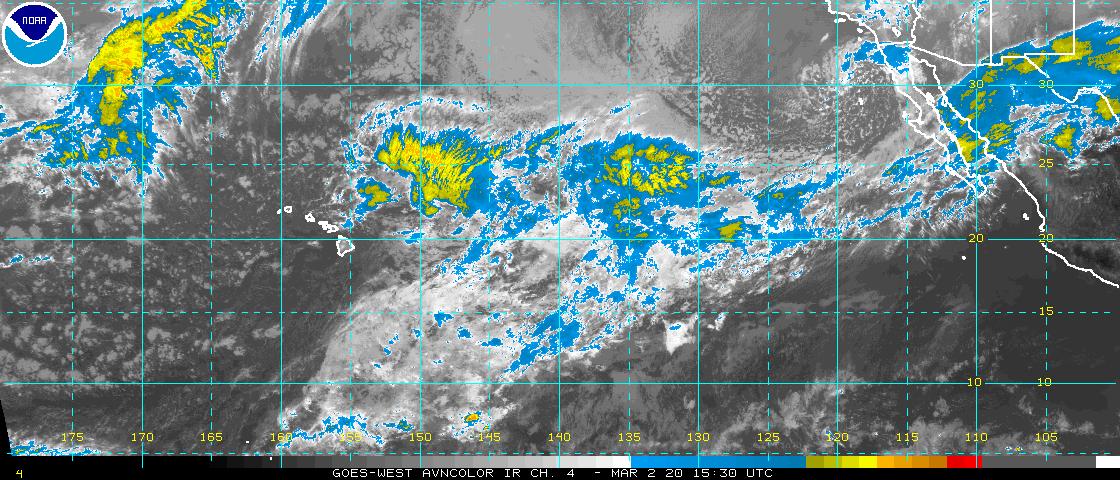
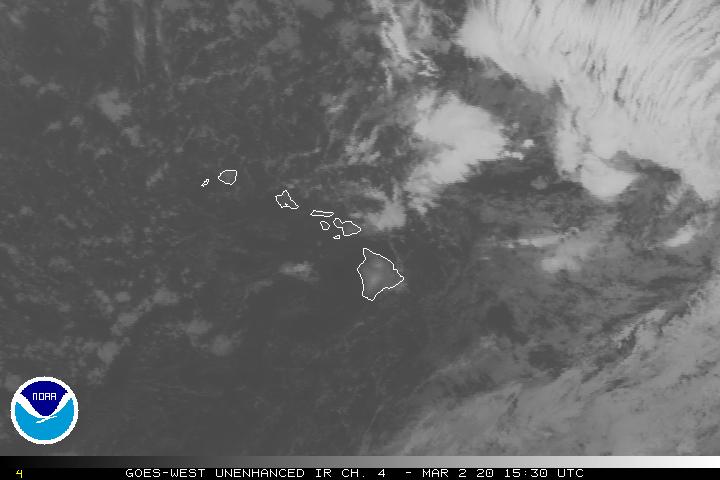
Satellite and Radar Images: To view the cloud conditions we have here in Hawaii, please use the following satellite links, starting off with this Infrared Satellite Image of the islands to see all the clouds around during the day and night. This next image is one that gives close images of the islands only during the daytime hours, and is referred to as a Close-up visible image. This next image shows a larger view of the Pacific…giving perspective to the wider ranging cloud patterns in the Pacific Ocean. Finally, here’s a Looping IR satellite image, making viewable the clouds around the islands 24 hours a day. To help you keep track of where any showers may be around the islands, here’s the latest animated radar image.
Hawaii’s Mountains – Here’s a link to the live webcam on the summit of near 14,000 foot Mauna Kea on the Big Island of Hawaii. The tallest peak on the island of Maui is the Haleakala Crater, which is near 10,000 feet in elevation. These two webcams are available during the daylight hours here in the islands…and when there’s a big moon rising just after sunset for an hour or two! Plus, during the nights and early mornings you will be able to see stars, and the sunrise too…depending upon weather conditions.
Tropical Cyclone activity in the eastern and central Pacific – Here’s the latest weather information coming out of the National Hurricane Center, covering the eastern north Pacific. You can find the latest tropical cyclone information for the central north Pacific (where Hawaii is located) by clicking on this link to the Central Pacific Hurricane Center. Here’s a tracking map covering both the eastern and central Pacific Ocean. A satellite image, which shows the entire ocean area between Hawaii and the Mexican coast…can be found here. Of course, as we know, our hurricane season won’t end until November 31st here in the central Pacific.
Aloha Paragraphs

Hammerhead shark…so interesting!
The trade winds will drop down into lighter realms Thursday and Friday…then rebound this weekend into early next week. The computer models continue to suggest that we’ll see the trade winds becoming lighter over the next few days, as our trade wind producing ridge of high pressure gets pushed down closer to the islands. This will happen as low pressure systems, and their associated cold fronts further to the north, extend their influence southward. This weather map shows a weaker 1024 millibar high pressure system to our northeast, moving away towards the east…supporting this lighter trade wind flow.
The locally wet weather we saw the last couple of days has given way to drier weather now, with a spread of just a few showers along the windward sides…and afternoon showers along the leeward slopes Thursday and Friday. We can’t count out the usual showers here and there, although precipitation won’t be much of an issue for the time being. This means that our beaches will have favorable weather conditions, with just about all outdoor activities being available. As we can see from checking this IR satellite image, there are very few clouds in our vicinity Wednesday night. As there are so few clouds, we can confirm, with this looping radar image, that very few showers are falling either. As the trade winds pick up this weekend, into early next week, we’ll see at least some increase in our windward biased showers. The computer models are suggesting that we could see an upper level low pressure system, with its cold air aloft…enhancing these windward showers later this weekend into early next week.
It’s Wednesday evening as I begin writing this last section of today’s narrative update. The weather here in the islands will be going through some changes the next two days, as our local trade winds tumble to some degree. These trades won’t disappear altogether, but will become lighter in most areas. This expected light wind weather pattern will shift our precipitation, what little there is, away from the windward sides, or at least take most of it…up into the leeward slopes during the afternoons through Friday. As the trade winds return this weekend, along with an upper level trough of low pressure, showers will likely increase over the windward sides later Saturday into next Monday or Tuesday. All things considered though, there’s really no problem in our weather outlook well into the future for most places. ~~~ Looking out the windows here in Kihei, before I leave for the drive back upcountry, its mostly sunny here on Maui, except for those usual clouds over and around the mountains. I’ll catch up with you again early Thursday morning, when I’ll have your next new weather narrative available. I hope you have a good Wednesday night until then! Aloha for now…Glenn.
Extra: The Kiss of Life…youtube video of Sade singing
Interesting: An area of deep-sea coral reefs has just been discovered off the coast of Israel, the first such reef to be found in what is generally considered a region with sparse sea life. The exploration vessel Nautilus, operated by a team of experts from the University of Haifa in Israel, discovered the deep-sea corals. The area stretches over a few miles, roughly 2,297 feet under the ocean surface and some 19 to 26 miles off the coast of Tel Aviv. "We did not expect, know or even imagine that we would come across these reefs and certainly not such large ones.
It’s like finding a flourishing oasis in the middle of the desert," said Yizhaq Makovsky, who directed the University of Haifa control center for the project. The discovery of these coral reefs has broad scientific importance. They can help researchers to better understand the mechanisms of survival in the environmental conditions of the deep sea, as well as to determine how these conditions correlate with the effect of global changes over time.
Interesting2: Sleep is sleep. Diet is diet. Then again cutting back on sleep reduces the benefits of dieting, according to a study published October 5, 2010, in the Annals of Internal Medicine. When dieters in the study got a full night’s sleep, they lost the same amount of weight as when they slept less. When dieters got adequate sleep, however, more than half of the weight they lost was fat. When they cut back on their sleep, only one-fourth of their weight loss came from fat.
Dieters also felt hungrier with a lack of sleep. When sleep was restricted, dieters produced higher levels of ghrelin, a hormone that triggers hunger and reduces energy expenditure. "If your goal is to lose fat, skipping sleep is like poking sticks in your bicycle wheels," said study director Plamen Penev, MD, PhD, assistant professor of medicine at the University of Chicago. "Cutting back on sleep, a behavior that is ubiquitous in modern society, appears to compromise efforts to lose fat through dieting.
In our study it reduced fat loss by 55 percent." The study, performed at the University of Chicago’s General Clinical Resource Center, followed 10 overweight but healthy volunteers aged 35 to 49 with a body mass index ranging from 25, considered overweight, to 32, considered obese. Participants were placed on an individualized, balanced diet, with calories restricted to 90 percent of what each person needed to maintain his or her weight without exercise.
Each participant was studied twice: once for 14 days in the laboratory with an 8.5-hour period set aside for sleep, and once for 14 days with only 5.5 hours for sleep. They spent their waking hours engaged in home- or office-like work or leisure activities. Normal sleep is a variable depending on age and time period during the 24 hour day. Babies might sleep up to 18 hours in a day. Adults may only need 7 to 8 hours on average. During the two-week, 8.5-hours-in-bed phase, volunteers slept an average of 7 hours and 25 minutes each night. In the 5.5-hour phase, they slept 5 hours and 14 minutes, or more than two hours less.
The number of calories they consumed, about 1,450 per day, was kept the same. The volunteers lost an average of 6.6 pounds during each 14-day session. During weeks with adequate sleep, they lost 3.1 pounds of fat and 3.3 pounds of fat-free body mass, mostly protein. During the short-sleep weeks, participants lost an average of 1.3 pounds of fat and 5.3 pounds of fat-free mass. Getting adequate sleep also helped control the dieters’ hunger. Average levels of ghrelin did not change when dieters spent 8.5 hours in bed.
When they spent 5.5 hours in bed, their ghrelin levels rose over two weeks from 75 ng/L to 84 ng/L. Ghrelin is a hormone produced mainly by cells lining the human stomach and epsilon cells of the pancreas that stimulates hunger. Ghrelin levels increase before meals and decrease after meals. It is considered the counterpart of the hormone leptin, produced by adipose tissue, which induces satiation when present at higher levels Higher ghrelin levels have been shown to "reduce energy expenditure, stimulate hunger and food intake, promote retention of fat, and increase hepatic glucose production to support the availability of fuel to glucose dependent tissues," the authors note.
"In our experiment, sleep restriction was accompanied by a similar pattern of increased hunger and, ” reduced oxidation of fat." The tightly controlled circumstances of this study may actually have masked some of sleep’s benefit for dieters, suggested Penev. Study subjects did not have access to extra calories. This may have helped dieters" to stick with their lower-calorie meal plans despite increased hunger in the presence of sleep restriction," he said.
The message for people trying to lose weight is clear, Penev said. "For the first time, we have evidence that the amount of sleep makes a big difference on the results of dietary interventions. One should not ignore the way they sleep when going on a diet. Obtaining adequate sleep may enhance the beneficial effects of a diet. Not getting enough sleep could defeat the desired effects."
Interesting3: Soaring international production of livestock could release enough carbon into the atmosphere by 2050 to single-handedly exceed ‘safe’ levels of climate change, says a study. Scientists combined figures for livestock production in 2000 with Food and Agriculture Organization projections for population growth and meat consumption by 2050. They found that the livestock sector’s emissions alone could send temperatures above the 2 degrees Celsius rise commonly said to be the threshold above which climate change could be destabilizing.
They also make a more conservative estimate: that the sector will contribute enough greenhouse gas emissions to take up 70 per cent of the ‘safe’ 2 degree temperature rise. Nathan Pelletier and Peter Tyedmers, researchers at Dalhousie University, Canada — whose work was published in Proceedings of the National Academy of Sciences yesterday (4 October) — called on governments to prioritize the reining in of the livestock sector, adding that "mobilizing the necessary political will to implement such policies is a daunting but necessary prospect".
The authors’ calculations took account of predicted efficiency gains in meat production, and said that such practices should be "vigorously pursued". They also recommended a shift in production away from ruminants, such as cattle and sheep, to poultry and to well-managed fisheries and aquaculture. They also suggested "across the board" reduction in per capita consumption of livestock products, something they say may be "particularly feasible and advantageous in developed countries".
Interesting4: A new species of dinosaur discovered in Arizona suggests dinosaurs did not spread throughout the world by overpowering other species, but by taking advantage of a natural catastrophe that wiped out their competitors. Tim Rowe, professor of paleontology at The University of Texas at Austin’s Jackson School of Geosciences, led the effort to describe the new dinosaur along with co-authors Hans-Dieter Sues, curator of vertebrate paleontology at the National Museum of Natural History in Washington, DC and Robert R. Reisz, professor and chair of biology at the University of Toronto.
The description appears in the online edition of the journal Proceedings of the Royal Society B on Oct. 6. Sarahsaurus, which lived about 190 million years ago during the Early Jurassic Period, was 14 feet long and weighed about 250 pounds. Sarahsaurus was a sauropodomorph, a small but closely related ancestor to sauropods, the largest land animals in history. Conventional wisdom says that soon after dinosaurs originated in what is now South America, they rapidly spread out to conquer every corner of the world, so smart and powerful they overwhelmed all the animals in their path.
Sarahsaurus challenges that view. One of the five great mass extinction events in Earth’s history happened at the end of the Triassic Period 200 million years ago, wiping out many of the potential competitors to dinosaurs. Evidence from Sarahsaurus and two other early sauropodomorphs suggests that each migrated into North America in separate waves long after the extinction and that no such dinosaurs migrated there before the extinction. "We used to think of dinosaurs as fierce creatures that outcompeted everyone else," said Rowe.
"Now we’re starting to see that’s not really the case. They were humbler, more opportunistic creatures. They didn’t invade the neighborhood. They waited for the residents to leave and when no one was watching, they moved in." Sarahsaurus had physical traits usually associated with gigantic animals. For example, its thigh bones were long and straight like pillars, yet were not much larger than a human’s thigh bones.
Sarahsaurus shows that sauropodmorphs started out small and later evolved to a very large size. "And so it’s starting to look like some of our ideas about how size and evolution work are probably in need of revision," said Rowe, "and that some of the features we thought were tied to gigantism and the physics and mechanics of the bones may not be right." Rowe is also intrigued by the new dinosaur’s hands. "We’ve never found anything like this in western North America," he said.
"Its hand is smaller than my hand, but if you line the base of the thumbs up, this small hand is much more powerfully built than my hand and it has these big claws. It’s a very strange animal. It’s doing something with its hands that involved great strength and power, but we don’t know what." Sarahsaurus is named in honor of Sarah (Mrs. Ernest) Butler, an Austin philanthropist and long time supporter of the arts and sciences.
Butler chaired a fundraising committee for the Dino Pit, an interactive exhibit Rowe helped create at the Austin Nature and Science Center that encourages children to dig up their own fossil replicas. The Dino Pit had been talked about for 20 years, but fundraising efforts stalled until Butler became chair. "I told her if she really raised a million dollars to build the Dino Pit, I’d name a dinosaur after her," he said. A team of researchers and students led by Rowe discovered Sarahsaurus on a field trip in Arizona in 1997.
To reach publication, the team had to obtain excavation permits, excavate the site over three years, remove each fossil fragment from surrounding rock, measure and analyze each piece, and CT scan pieces to study internal structures. "It took me 13 years, but I’m delighted by the great success of the Dino Pit, which hundreds of thousands of kids have now visited. And also that we had the luck to make a find of suitable importance to carry Sarah’s name."
Interesting5: Iowa State University’s Christopher Williams was just trying to see if adding bio-oil to asphalt would improve the hot- and cold-weather performance of pavements. What he found was a possible green replacement for asphalt derived from petroleum. That finding will move from Williams’ laboratory at the Institute for Transportation’s Asphalt Materials and Pavements Program at Iowa State to a demonstration project this fall. The project will pave part of a Des Moines bicycle trail with an asphalt mixture containing what is now known as Bioasphalt.
If the demonstration and other tests go well, "This would be great stuff for the state of Iowa," said Williams, an associate professor of civil, construction and environmental engineering. He said that’s for a lot of reasons: Asphalt mixtures derived from plants and trees could replace petroleum-based mixes. That could create a new market for Iowa crop residues. It could be a business opportunity for Iowans. And it saves energy and money because Bioasphalt can be mixed and paved at lower temperatures than conventional asphalt. Bio-oil is created by a thermochemical process called fast pyrolysis.
Corn stalks, wood wastes or other types of biomass are quickly heated without oxygen. The process produces a liquid bio-oil that can be used to manufacture fuels, chemicals and asphalt plus a solid product called biochar that can be used to enrich soils and remove greenhouses gases from the atmosphere. Robert C. Brown — an Anson Marston Distinguished Professor of Engineering, the Gary and Donna Hoover Chair in Mechanical Engineering and the Iowa Farm Bureau director of Iowa State’s Bioeconomy Institute — has led research and development of fast pyrolysis technologies at Iowa State.
Three of his former graduate students — Jared Brown, Cody Ellens and Anthony Pollard, all December 2009 graduates — have established a startup company, Avello Bioenergy Inc., that specializes in pyrolysis technology that improves, collects and separates bio-oil into various liquid fractions. Williams used bio-oil fractions provided by Brown’s fast pyrolysis facility at Iowa State’s BioCentury Research Farm to study and develop Bioasphalt. That research was supported by the Iowa Energy Center and the Iowa Department of Transportation.
Avello has licensed the Bioasphalt technology from the Iowa State University Research Foundation Inc. and has produced oak-based bio-oil fractions for the bike trail project using funding from the Iowa Department of Economic Development. Williams said the project will include a mix of 5 percent Bioasphalt. Jeb Brewer, the city engineer for the City of Des Moines, said the Bioasphalt will be part of phase two of the Waveland Trail on the city’s northwest side. The 10-foot-wide trail will run along the west side of Glendale Cemetery from University Avenue to Franklin Avenue. Brewer said the demonstration project is a good fit for the city.
"We have a fairly active program for finding ways to conserve energy and be more sustainable," he said. "We’re interested in seeing how this works out and whether it can be part of our toolbox to create more sustainable projects." Contractors involved in the Bioasphalt demonstration project are Elder Corp. of Des Moines, Bituminous Materials and Supplies of Des Moines and Grimes Asphalt and Paving Corp. of Grimes with the Asphalt Paving Association of Iowa supporting the project.
Iowa State’s Williams said a successful demonstration would lead to more pavement tests containing higher and higher percentages of Bioasphalt. "This demonstration project is a great opportunity," he said. "We’re introducing a green technology into a green environment in Des Moines. And it’s a technology that’s been developed here in Iowa."
 Email Glenn James: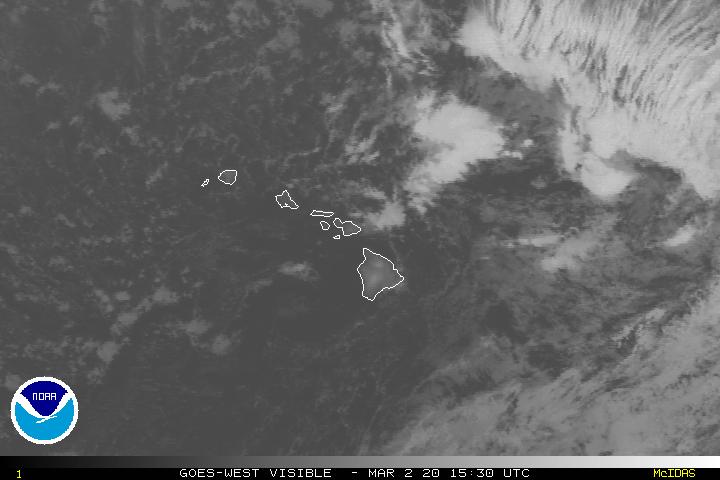


Becki Says:
Aloha Glenn,
I will be visiting Kihei next week and staying for 10 days. What is the longer range forecast looking like? We have an outdoor wedding to attend at the end of next week in Lahaina. Hopefully no showers.~~~Hi Becky, I don’t see any showers arriving from this vantage point, although your time frame is bit beyond any forecasts that I can make. Please keep checking back in, preferably early next week. Aloha, Glenn