











September 29-30, 2010
Air Temperatures – The following maximum temperatures were recorded across the state of Hawaii Wednesday afternoon:
Lihue airport, Kauai – 84
Honolulu airport, Oahu – 83
Kaneohe MCAS, Oahu – 85
Molokai airport – 84
Kahului airport, Maui – 86
Ke-ahole airport (Kona) – 83
Hilo airport, Hawaii – 84
Air Temperatures ranged between these warmest and coolest spots near sea level – and on the highest mountain tops…as of 5pm Wednesday evening:
Barking Sands, Kauai – 83
Honolulu, Oahu – 78
Haleakala Crater – 48 (near 10,000 feet on Maui)
Mauna Kea summit – 41 (near 14,000 feet on the Big Island)
Precipitation Totals – The following numbers represent the largest precipitation totals (inches) during the last 24 hours on each of the major islands, as of Wednesday afternoon:
0.84 Kapahi, Kauai
0.12 Wheeler Field, Oahu
0.02 Molokai
0.00 Lanai
0.00 Kahoolawe
0.00 Maui
0.14 Honaunau, Big Island
Marine Winds – Here’s the latest (automatically updated) weather map showing a high pressure system far to the northeast of our islands. At the same time, we find a frontal cloud band just to the north of the state. Our local winds will remain light Thursday into Friday.
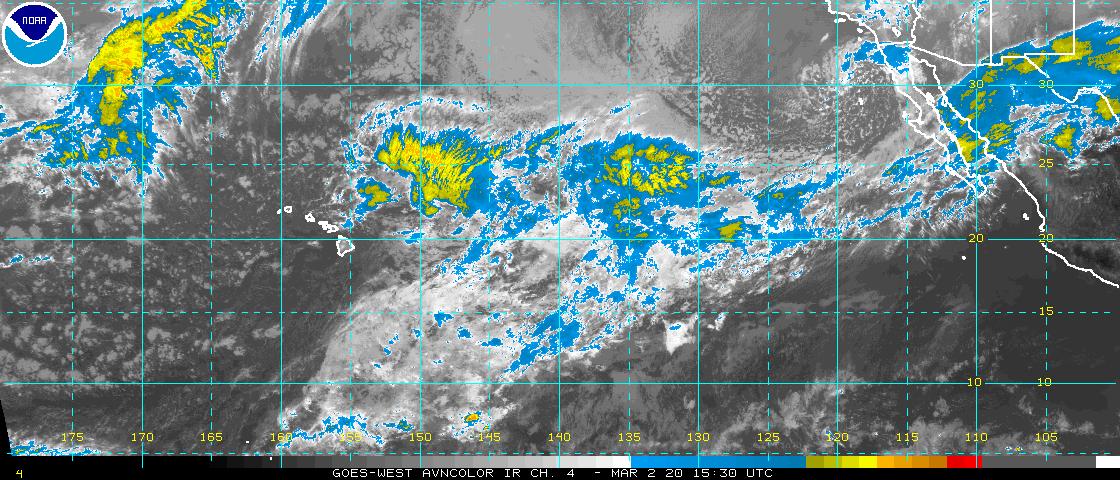
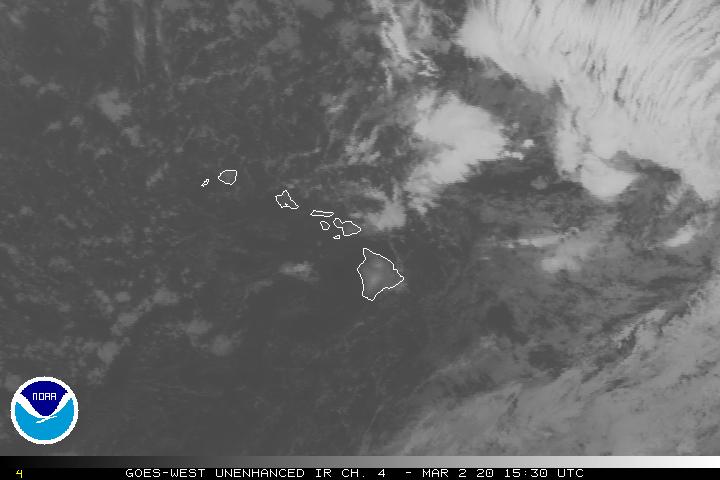
Satellite and Radar Images: To view the cloud conditions we have here in Hawaii, please use the following satellite links, starting off with this Infrared Satellite Image of the islands to see all the clouds around during the day and night. This next image is one that gives close images of the islands only during the daytime hours, and is referred to as a Close-up visible image. This next image shows a larger view of the Pacific…giving perspective to the wider ranging cloud patterns in the Pacific Ocean. Finally, here’s a Looping IR satellite image, making viewable the clouds around the islands 24 hours a day. To help you keep track of where any showers may be around the islands, here’s the latest animated radar image.
Hawaii’s Mountains – Here’s a link to the live webcam on the summit of near 14,000 foot Mauna Kea on the Big Island of Hawaii. The tallest peak on the island of Maui is the Haleakala Crater, which is near 10,000 feet in elevation. These two webcams are available during the daylight hours here in the islands…and when there’s a big moon rising just after sunset for an hour or two! Plus, during the nights and early mornings you will be able to see stars, and the sunrise too…depending upon weather conditions.
Tropical Cyclone activity in the eastern and central Pacific – Here’s the latest weather information coming out of the National Hurricane Center, covering the eastern north Pacific. You can find the latest tropical cyclone information for the central north Pacific (where Hawaii is located) by clicking on this link to the Central Pacific Hurricane Center. Here’s a tracking map covering both the eastern and central Pacific Ocean. A satellite image, which shows the entire ocean area between Hawaii and the Mexican coast…can be found here. Of course, as we know, our hurricane season won’t end until November 31st here in the central Pacific.
Aloha Paragraphs

Surfing is good in the islands…thanks to the light winds
Our local winds will remain light and variable in direction…becoming trade winds later Friday into the weekend. The reason our trade winds are lacking now, and that we’ve moved into a light wind regime…is due to a dissipating cold front, just to the north of the state. This cold front had arrived over Kauai and Oahu, dropping some showers there. The cold front then quickly started falling apart during the day Wednesday however, so that the frontal clouds remained offshore to our north during the day. There will continue to be a convective weather pattern over us, with the light winds, leaving us in a light wind condition. As we move into Friday and the weekend, we should see the trade winds strengthening, becoming light to moderately strong…continuing on into early next week.
The cold front continues to dissipate over Kauai and offshore from the other islands from Oahu down to Maui. This cold front hasn’t done much precipitating over the islands, outside of a fairly impressive .84" at the Kapahi rain gauge on Kauai. Here’s a satellite image of this cold front, showing what’s left of it over the ocean to our north. As the winds pick up a little, they will help to carry some of the leftover showery clouds back along the windward sides of the islands tonight into Friday. Here’s a looping radar image to keep trade of those showers that will be moving in tonight. The overlying atmosphere remains rather dry and stable however, so that whatever showers that manage to fall, will be on the light side. We should end up some of more those afternoon convective cloud buildups along the leeward slopes…with perhaps even an isolated light shower, at least while the winds are so light in our area.
It’s Wednesday evening as I begin writing this last section of today’s narrative update. The aforementioned early season cold front tried to do a better job of bringing us some late September showers, but in the end…couldn’t quite pull it off. The island of Kauai, being further north did pick up some showers, although not as much as we had originally hoped for. Oahu got a couple of showers, although Maui and the Big Island remained mostly high and dry. There’s still a good chance that some of this moisture will make it down further into the state tonight through the next couple of days…mostly along the windward north and northeast sides of the smaller islands. As we move into the weekend, an upper level low pressure system will move overhead, and promote addition showers along our windward sides. ~~~ I’m heading back upcountry to Kula, from down here in Kihei now. It’s cloudy up there, although I didn’t see any showers falling this afternoon, like there were the last couple of days. Actually, now that I’m home, there have been some showers, and looking at that radar image in the paragraph above, it appears that we’ll find some additional showers arriving in places tonight. I’ll catch up with you again early Thursday morning, when I get back online to prepare the next new weather narrative from paradise. I hope you have a great Wednesday night until then! Aloha for now…Glenn.
Interesting: Ultra-thin solar cells can absorb sunlight more efficiently than the thicker, more expensive-to-make silicon cells used today, because light behaves differently at scales around a nanometer (a billionth of a meter), say Stanford engineers. They calculate that by properly configuring the thicknesses of several thin layers of films, an organic polymer thin film could absorb as much as 10 times more energy from sunlight than was thought possible.
In the smooth, white, bunny-suited clean-room world of silicon wafers and solar cells, it turns out that a little roughness may go a long way, perhaps all the way to making solar power an affordable energy source, say Stanford engineers. Their research shows that light ricocheting around inside the polymer film of a solar cell behaves differently when the film is ultra thin.
A film that’s nanoscale-thin and has been roughed up a bit can absorb more than 10 times the energy predicted by conventional theory. The key to overcoming the theoretical limit lies in keeping sunlight in the grip of the solar cell long enough to squeeze the maximum amount of energy from it, using a technique called "light trapping.
"It’s the same as if you were using hamsters running on little wheels to generate your electricity — you’d want each hamster to log as many miles as possible before it jumped off and ran away. "The longer a photon of light is in the solar cell, the better chance the photon can get absorbed," said Shanhui Fan, associate professor of electrical engineering.
The efficiency with which a given material absorbs sunlight is critically important in determining the overall efficiency of solar energy conversion. Fan is senior author of a paper describing the work published online this week by Proceedings of the National Academy of Sciences.
Graphic shows a schematic diagram of a thin film organic solar cell showing the top layer, a patterned, roughened scattering layer, in green. The organic thin film layer, shown in red, is where light is trapped and electrical current is generated. The film is sandwiched between two layers that help keep light contained within the thin film. Credit: Stanford University.
Interesting2: Scotland should produce enough renewable electricity to meet all its power demand by 2025, First Minister Alex Salmond said Tuesday. "Scotland has unrivalled green energy resources and our new national target to generate 80 percent of electricity needs from renewables by 2020 will be exceeded by delivering current plans for wind, wave and tidal generation," Salmond said.
"I’m confident that by 2025 we will produce at least 100 percent of our electricity needs from renewables alone, and together with other sources it will enable us to become a net exporter of clean, green energy," he said a statement ahead of a renewable energy investment conference.
Last week, Scotland raised its 2020 renewable electricity target from 50 to 80 percent of total demand, much of which is expected to be met by offshore wind despite costs soaring over the last few years.
The sparsely-populated part of northern Britain is expected to export much of the low-carbon electricity produced by its existing onshore wind farms and planned offshore projects south to England, which has lagged behind most of Europe in green energy growth.
Interesting3: The Panoramic Survey Telescope & Rapid Response System (Pan-STARRS) PS1 telescope has discovered an asteroid that will come within 4 million miles of Earth in mid-October. The object is about 150 feet in diameter and was discovered in images acquired on September 16, when it was about 20 million miles away. It is the first "potentially hazardous object" (PHO) to be discovered by the Pan-STARRS survey and has been given the designation "2010 ST3."
"Although this particular object won’t hit Earth in the immediate future, its discovery shows that Pan-STARRS is now the most sensitive system dedicated to discovering potentially dangerous asteroids," said Robert Jedicke, a University of Hawaii member of the PS1 Scientific Consortium, who is working on the asteroid data from the telescope. "This object was discovered when it was too far away to be detected by other asteroid surveys," Jedicke noted.
The Harvard-Smithsonian Center for Astrophysics is a major partner in the Consortium. Most of the largest PHOs have already been catalogued, but scientists suspect that there are many more under a mile across that have not yet been discovered. These could cause devastation on a regional scale if they ever hit our planet. Such impacts are estimated to occur once every few thousand years.
Timothy Spahr, director of the Minor Planet Center (MPC), said, "I congratulate the Pan-STARRS project on this discovery. It is proof that the PS1 telescope, with its Gigapixel Camera and its sophisticated computerized system for detecting moving objects, is capable of finding potentially dangerous objects that no one else has found."
The MPC, located in Cambridge, Mass., was established by the International Astronomical Union in 1947 to collect and disseminate positional measurements for asteroids and comets, to confirm their discoveries, and to give them preliminary designations.
Pan-STARRS expects to discover tens of thousands of new asteroids every year with sufficient precision to accurately calculate their orbits around the sun. Any sizable object that looks like it may come close to Earth within the next 50 years or so will be labeled "potentially hazardous" and carefully monitored.
NASA experts believe that, given several years warning, it should be possible to organize a space mission to deflect any asteroid that is discovered to be on a collision course with Earth. Pan-STARRS has broader goals as well. PS1 and its bigger brother, PS4, which will be operational later in this decade, are expected to discover a million or more asteroids in total, as well as more distant targets such as variable stars, supernovas, and mysterious bursts from galaxies across more than half the universe. PS1 became fully operational in June 2010.
 Email Glenn James: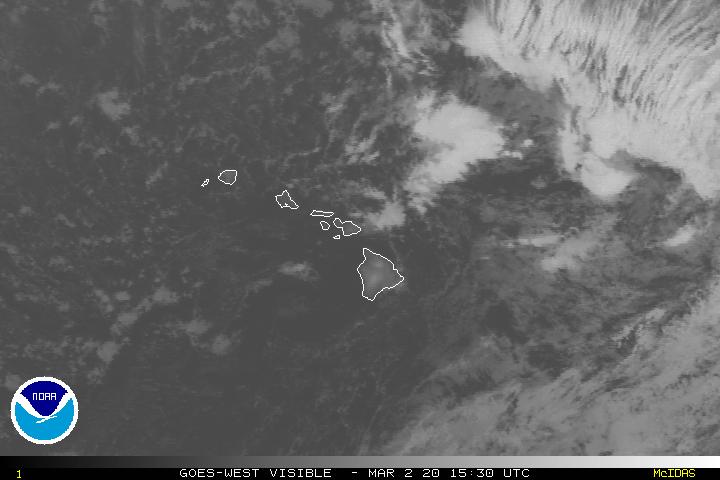

Frank Parrino Says:
Aloha Glenn.
Good News from Leeward Molokai….3:30 a.m. and I just read my rain gauge. 1/2 inch! We’ve had multiple misty, drippy episodes the last month or so but nothing measurable until last night. Hope all your readers get some of this wonderful water.~~~Good news Frank, thanks for the early morning report! Looking outside Thursday morning, before 5am, it’s totally clear, although my weather deck is still wet from some showers late Wednesday afternoon. Good to hear from you here on Molokai! Aloha, Glenn
Laura Says:
Greetings from Calgary Glenn!
Just wondering what you know about the effects of La Nina on Hawaiian (specifically Maui?) weather? We have had an unusually cool/wet summer here in Alberta and are now having summer like weather in near October. Weird or just La Nina? Heading your way next March so wondering if there is a long range winter forecast like we have here. Have a great day!
Laura Fortier~~~Hi Laura, things seem to be turned around up there, don’t they. It’s too early to know about how La Nina will influence the islands. My first impression was that it would make for more rain than usual this winter, although I’m starting to hear otherwise…so I will write about this on my narrative page soon, as soon as I become clear about which way it will go this winter. You will love being here on Maui either way! Aloha, Glenn
Liz Says:
Greetings on this chilly morning! Just checking in to say there’s not a single cloud to be seen – it’s clear as a bell all the way to the summit of Mauna Kea (which we can see from our backyard here in Pahoa). Very odd…~~~Totally clear ahead of this very slow moving cold front, I hope it can manage to get down you way! Aloha, Glenn