September 23-24, 2010
Air Temperatures – The following maximum temperatures were recorded across the state of Hawaii Thursday afternoon:
Lihue airport, Kauai – 85
Honolulu airport, Oahu – 88
Kaneohe MCAS, Oahu – 83
Molokai airport – 87
Kahului airport, Maui – 87
Ke-ahole airport (Kona) – 86
Hilo airport, Hawaii – 84
Air Temperatures ranged between these warmest and coolest spots near sea level – and on the highest mountain tops…as of 5pm Thursday evening:
Port Allen, Kauai – 86
Hilo, Hawaii – 80
Haleakala Crater – 55 (near 10,000 feet on Maui)
Mauna Kea summit – 46 (near 14,000 feet on the Big Island)
Precipitation Totals – The following numbers represent the largest precipitation totals (inches) during the last 24 hours on each of the major islands, as of Thursday afternoon:
0.15 Mount Waialeale, Kauai
0.40 Wilson Tunnel, Oahu
0.00 Molokai
0.00 Lanai
0.00 Kahoolawe
0.05 Hana airport, Maui
0.17 Glenwood, Big Island
Marine Winds – Here’s the latest (automatically updated) weather map showing high pressure systems to the northeast of our islands. Our local trade winds will remain light to moderately strong through Friday…starting to become lighter Saturday.
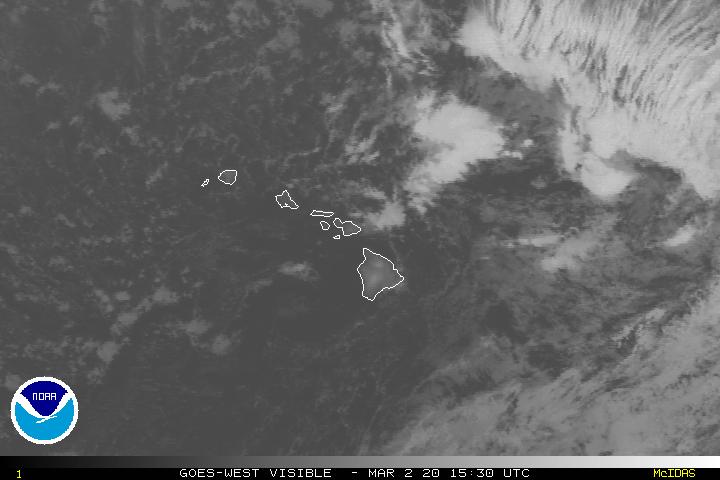
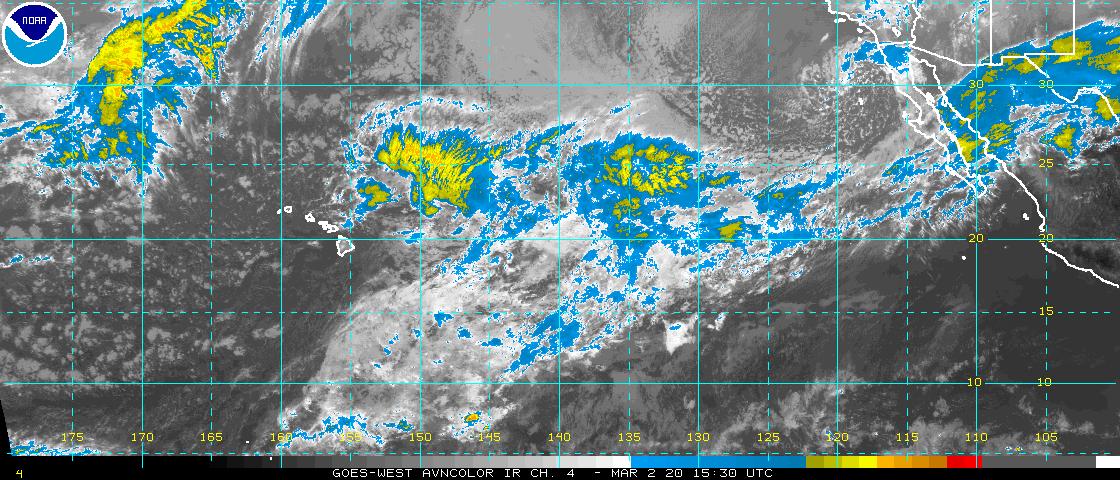
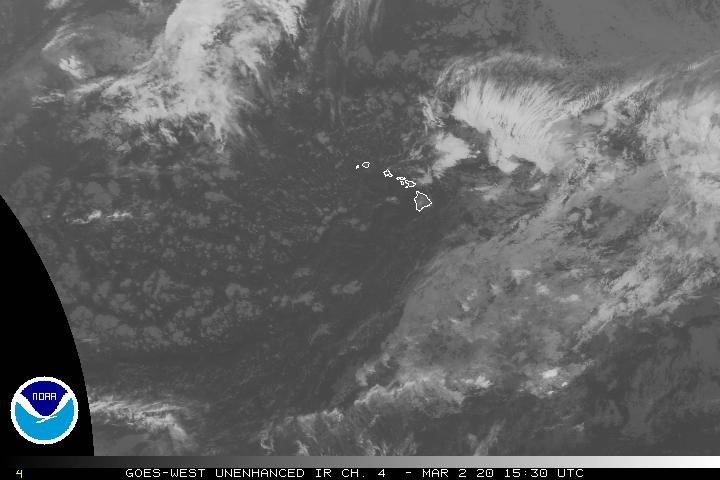
Satellite and Radar Images: To view the cloud conditions we have here in Hawaii, please use the following satellite links, starting off with this Infrared Satellite Image of the islands to see all the clouds around during the day and night. This next image is one that gives close images of the islands only during the daytime hours, and is referred to as a Close-up visible image. This next image shows a larger view of the Pacific…giving perspective to the wider ranging cloud patterns in the Pacific Ocean. Finally, here’s a Looping IR satellite image, making viewable the clouds around the islands 24 hours a day. To help you keep track of where any showers may be around the islands, here’s the latest animated radar image.
Hawaii’s Mountains – Here’s a link to the live webcam on the summit of near 14,000 foot Mauna Kea on the Big Island of Hawaii. The tallest peak on the island of Maui is the Haleakala Crater, which is near 10,000 feet in elevation. These two webcams are available during the daylight hours here in the islands…and when there’s a big moon rising just after sunset for an hour or two! Plus, during the nights and early mornings you will be able to see stars, and the sunrise too…depending upon weather conditions.
Tropical Cyclone activity in the eastern and central Pacific – Here’s the latest weather information coming out of the National Hurricane Center, covering the eastern north Pacific. You can find the latest tropical cyclone information for the central north Pacific (where Hawaii is located) by clicking on this link to the Central Pacific Hurricane Center. Here’s a tracking map covering both the eastern and central Pacific Ocean. A satellite image, which shows the entire ocean area between Hawaii and the Mexican coast…can be found here. Of course, as we know, our hurricane season won’t end until November 31st here in the central Pacific.
Aloha Paragraphs

Beautiful red ginger flower
Friday will see light to moderately strong trade winds blowing….locally a bit stronger during the day. The computer models continue to suggest that as we move into the upcoming weekend, especially by Sunday into the first half of next week…that our trade winds will be easing up quite a bit. This will happen as an early autumn low pressure system in the Gulf of Alaska pushes a cold front our way…with our trade wind producing ridge of high pressure moving down over our islands. At least one of the computer models shows a cold front arriving around next Wednesday or Thursday. This weather map shows high pressure systems positioned to the northeast of our islands Thursday night.
As our trade winds give way to lighter winds this weekend into next week, we’ll shift into a convective weather pattern…lasting until the trade winds fill back in behind the possible cold front mentioned above. As this happens, we’ll shift into a new weather situation, with daytime sea breezes, along with rather muggy conditions at sea level locations. Typically, under this type of weather regime, we find clear to partly cloudy mornings, with slightly cooler than normal temperatures too. As the sun heats the islands during the day, clouds will form over and around the mountains…leading to localized upcountry showers. There is a pretty good chance of some generous afternoon showers breaking out in the interior sections Sunday and Monday, as an upper low pressure system enhances that precipitation.
Meanwhile, glancing south and southwest of the islands, using this satellite picture, we see two areas of disturbed weather. This satellite image shows these areas circled in yellow, which currently have a low 0 and 10% chance of spinning up into a tropical depression as of Thursday evening. Here’s what the computer models are showing of the primary area, if it were to develop further. None of the models are showing this area moving up into our island chain, so that it doesn’t appear to be much of a problem. However, anytime we find tropical disturbances to our southwest, south or southeast, we need to keep an eye out for unexpected changes in direction. By the way, it looks like we’ll find some high cirrus clouds being blown up over our islands, which could prompt nice sunrise and sunset colors now!
It’s Thursday evening as I begin writing this last section of today’s narrative update. As pointed out above, our trade winds will remain the main driver in our Hawaiian Islands weather picture through Friday, and probably into Saturday. They will start to calm down some later Saturday, and then even more so by Sunday into early next week. As the trade winds fade away, we’ll slide into a convective weather pattern, with humid conditions during the days, and slightly cooler nights. There will be some afternoon upcountry showers happening by as early as Saturday, which may get more plentiful thereafter for a few days. The trade winds will begin to filter back into our area later next week. Some of the computer models are showing an early season cold front dropping down into our area around the middle of next week, that would be early, but not out of the question. ~~~ Here in Kihei, Maui before I take the drive back upcountry to Kula, its mostly clear to partly cloudy, with the trade wind breezes still kicking up some. It’s actually very nice outside, and I can hardly wait to get out there. I’ll be back early Friday morning with your next new weather narrative from paradise. I hope you have a great Thursday night, and don’t forget to at least take a glance at the just past full moon! Aloha for now…Glenn.
Interesting: Plants picked up to 150 years ago by Victorian collectors and held by the million in herbarium collections across the world could become a powerful — and much needed — new source of data for studying climate change, according to research published in the British Ecological Society’s Journal of Ecology. The scarcity of reliable long-term data on phenology — the study of natural climate-driven events such as the timing of trees coming into leaf or plants flowering each spring — has hindered scientists’ understanding of how species respond to climate change.
But new research by a team of ecologists from the University of East Anglia (UEA), the University of Kent, the University of Sussex and the Royal Botanic Gardens, Kew shows that plants pressed up to 150 years ago tell the same story about warmer springs resulting in earlier flowering as field-based observations of flowering made much more recently.
The team examined 77 specimens of the early spider orchid (Ophrys sphegodes) collected between 1848 and 1958 and held at the Royal Botanic Gardens, Kew and the Natural History Museum in London. Because each specimen contains details of when and where it was picked, the researchers were able to match this with Meteorological Office records to examine how mean spring temperatures affected the orchids’ flowering.
They then compared these data with field observations of peak flowering of the same orchid species in the Castle Hill National Nature Reserve, East Sussex from 1975 to 2006, and found that the response of flowering time to temperature was identical both in herbarium specimens and field data. In both the pressed plants and the field observations, the orchid flowered 6 days earlier for every 1C rise in mean spring temperature.
The results are first direct proof that pressed plants in herbarium collections can be used to study relationships between phenology and climate change when field-based data are not available, as is almost always the case. According to the study’s lead author, PhD student Karen Robbirt of UEA: "The results of our study are exciting because the flowering response to spring temperature was so strikingly close in the two independent sources of data.
This suggests that pressed plant collections may provide valuable additional information for climate-change studies." "We found that the flowering response to spring temperature has remained constant, despite the accelerated increase in temperatures since the 1970s. This gives us some confidence in our ability to predict the effects of further warming on flowering times."
The study opens up important new uses for the 2.5 billion plant and animal specimens held in natural history collections in museums and herbaria. Some specimens date back to the time of Linnaeus (who devised our system of naming plants and animals) 250 years ago. Co-author Professor Anthony Davy of UEA says: "There is an enormous wealth of untapped information locked within our museums and herbaria that can contribute to our ability to predict the effects of future climate change on many plant species.
Importantly it may well be possible to extend similar principles to museum collections of insects and animals." Phenology — or the timing of natural events — is an important means of studying the impact of climate change on plants and animals. "Recent climate change has undoubtedly affected the timing of development and seasonal events in many groups of organisms. Understanding the effects of recent climate change is a vital step towards predicting the consequences of future change.
But only by elucidating the responses of individual species will we be able to predict the potentially disruptive effects of accelerating climate change on species interactions," he says. Detecting phenological trends in relation to long-term climate change is not straightforward and relies on scarce long-term studies. "We need information collected over a long period to enable us confidently to identify trends that could be due to climate change. Unfortunately most field studies are relatively brief, so there are very few long-term field data available," Professor Davy explains
Interesting2: China leads the world in tonnage of fish caught annually as well as the amount of fish consumed, according to new findings. The research, conducted by the University of British Columbia in collaboration with the National Geographic Society and The Pew Charitable Trusts, ranks the top 20 nations that have the greatest impact on ocean ecosystems through catching or consuming marine wildlife. China’s top ranking results from its enormous population, despite its very low per capita footprint of fish catch and consumption.
Japan is high on the list too, a result of its rate of consumption (often by importation) of fish rather than its catch. The "top 20" lists of fish catch and consumption are published in the October issue of National Geographic magazine. The United States comes in third in both lists, due to its relatively large population and tendency to eat top predator fish such as Atlantic salmon. Peru ranks second in the world in catch though is not in the top 20 fish-consuming countries because Peruvians on the whole eat little seafood.
The data come from the SeafoodPrint study, led by Daniel Pauly of the University of British Columbia and National Geographic Ocean Fellow Enric Sala. In assessing the true impact nations have on the seas, the team needed to look not just at what a given nation caught but also at what the citizens of that nation ate. Standard methods of measuring nations’ impact on the sea are misleading because, as Pauly says, "every fish is different. A pound of tuna represents roughly a hundred times the footprint of a pound of sardines."
That’s because fish like tuna are apex predators — they feed at the very top of the food chain. The largest tuna eat enormous amounts of fish, including intermediate-level predators such as mackerel, which in turn feed on fish like anchovies, which prey on microscopic organisms. A large tuna must eat the equivalent of its body weight every 10 days to stay alive, so a single thousand-pound tuna might need to eat as many as 15,000 smaller fish in a year, the National Geographic article says.
Any large fish in the world — a Pacific swordfish, an Atlantic mako shark, an Alaska king salmon, a Chilean sea bass — is likely to depend on several levels of a food chain. The SeafoodPrint method provides a way to compare all types of fish caught, by creating a unit of measurement based on "primary production" — the microscopic organisms at the bottom of the marine food web — required to make a pound of a given type of fish. The research found that a bluefin tuna, for example, may require a thousand pounds or more of primary production.
"The SeafoodPrint allows us to directly compare a sardine fishery with a tuna fishery, because each is measured according to the primary production it represents," Pauly says. The new approach also allows the researchers to assess individual nations’ impacts on the seas, based not only on what was caught but also on what their citizens ate through imports. "A country can acquire primary production by fishing, or it can acquire it by trade," says Pauly, whose research is part of the Sea Around Us project of The Pew Charitable Trusts and the University of British Columbia.
Much of the world’s catch, especially from the high seas, is being purchased by wealthy nations for their people; poorer countries simply can’t afford to bid for high-value species, the article says. Citizens in poor nations also lose out if their governments enter into fishing or trade agreements with wealthier nations. In these cases, local fish are sold abroad and denied to local citizens — those who arguably have the greatest need to eat them and the greatest right to claim them.
Humanity’s demand for seafood has now driven fishing fleets into every virgin fishing ground in the world, the scientists say. A report by the World Bank and United Nations’ Food and Agriculture Organization suggests that even if the number of boats, hooks and nets now used were cut by half, the world would still end up catching too many fish to be sustainable for the future.
The scientists favor treaties among nations setting seafood-consumption targets as well as ocean havens to safeguard resources. "Barely one percent of the ocean is now protected, compared with 12 percent of the land," Sala says, "and only a fraction of that is fully protected."
Interesting3: BP’s leaking oil well in the Gulf of Mexico was conclusively sealed this week, but even now, questions remain about the amount of oil that actually came out of it. Initially after the April 20 explosion, officials claimed that the flow could not be measured. Then, as public pressure for information mounted, they looked for ways to measure it, and started producing estimates: at first, 1,000 barrels a day; then 5,000; then 12,000 to 19,000; then upward from there.
Now, in the first independent, peer-reviewed paper on the leak’s volume, scientists have affirmed heightened estimates of what is now acknowledged as the largest marine oil accident ever. Using a new technique to analyze underwater video of the well riser, they say it leaked some 56,000 to 68,000 barrels daily–maybe more–until the first effective cap was installed, on July 15.
Their estimate of the total oil escaped into the open ocean is some 4.4 million barrels–close to the most recent consensus of government advisors, whose methods have not been detailed publicly. The paper appears in this week’s early online edition of the journal Science. "We wanted to do an independent estimate because people had the sense that the numbers out there were not necessarily accurate," said lead author Timothy Crone, a marine geophysicist at Columbia University’s Lamont-Doherty Earth Observatory.
After BP and government officials downplayed the possibility or importance of measurements, a wide spectrum of scientists, environmental groups and legal experts pointed out that the information was needed to determine both short- and long-term responses, and monetary liability. The new study divides the flow rate into two periods: April 22 to June 3, when oil spurted from a jagged break in the riser; and after June 3, when the riser was cut, and oil temporarily spewed into the ocean unimpeded.
Crone and his coauthor, Lamont marine geophysicist Maya Tolstoy, used a visual analysis technique Crone recently developed called optical plume velocimetry. They say video from the earlier period indicated a flow of about 56,000 barrels a day (a barrel is 42 gallons). After the pipe was cut, they say, the rate went to about 68,000. After accounting for time elapsed, the authors subtracted 804,877 barrels collected by BP at the site, to come up with a total of 4.4 million barrels that escaped.
Given the study’s stated 20 percent margin of error plus or minus, this roughly agrees with the federal government’s Flow Rate Technical Group’s most recent comparable estimate of 4.1 million barrels (after subtracting the oil collected by BP). Attempts to get a handle on the size of the release have been fraught with high-profile problems. A week after the initial 1,000-barrel-a-day assertion, it became apparent that BP was collecting more than that, and far more beside was escaping.
On April 28, the National Oceanic and Atmospheric Administration hastily produced an estimate of 5,000 barrels, extrapolating this from the size of the surface plume. But scientists and journalists soon attacked this figure (for instance in a May 13 New York Times report). Crone became involved when National Public Radio asked him and other experts to come up with their own estimates; a May 14 NPR story based on their observations suggested that the rate was actually five or ten times higher.
On May 21, the Times published an op-ed piece by Crone and colleagues from three other institutions outlining the case that existing scientific techniques could be used to form a realistic picture. On May 27, the government raised the estimate again, to 12,000-19,000 barrels per day. A variety of techniques went into this and the later, even higher, official estimates, but the government and its advisors have released only limited information on their techniques — again, raising criticism from the scientific community .
This new study is the first to lay out the details of an analysis publicly in a report independently reviewed by other researchers. Crone started developing optical plume velocimetry in 2006, in order to study natural hydrothermal vents — volcanically driven cracks and holes in the seafloor that shoot out buoyant, superheated jets of mineral-laden water. A jet from a leaking oil pipe is similar.
The technique uses high-resolution video from underwater cameras to track the motion of turbulent billows and flows in the water, breaking down the movement pixel by pixel. Under a grant from the U.S. National Science Foundation, Crone tested it first in the lab, then at deep-sea vents in the eastern Pacific, and the Juan de Fuca ridge, off the U.S. Pacific northwest. He is currently developing a network of automatic cameras that will track vent activity on the Juan de Fuca.
"This is a great example of how basic research that doesn’t seem to have any immediate value suddenly gains huge immediacy for society," said Crone. The scientists say their study is just a start. Other researchers have been trying to get at the same question using separate visual and acoustic techniques. Crone and Tolstoy say their conclusions rest on just a few short clips of high-resolution video — almost all that has been released by BP and the government so far, and made available by members of Congress to the scientists.
(A live publicly accessible webcam showing the leak as it continued week after week had extremely low resolution, insufficient for analysis.) The researchers point out that the flows could have varied day to day. And, the analysis did not include video of several other leaks from smaller holes further up the pipe, which are thought to have grown with time; thus, the true figures may be larger, if anything, said Crone.
"We clearly acknowledge the limits of our technique; we’re unlikely to ever know the exact figure," he said. Tolstoy added: "This is not the last word. It is the first peer-reviewed word. But we think it’s a really good ballpark." The researchers said they hope they and others will be able to refine their estimates if the government and BP release more video and other information to independent researchers.
Ian MacDonald, a Florida State University oceanographer who has also studied the leak, but was not involved in the study, said: "This is a welcome paper in that it opens the door onto how the oil spill flow-rate estimates have been calculated. It provides a transparency of method and a foundation for peer review for what has until now been a confusing and uncertain process."
 Email Glenn James: