October 5-6, 2009
Air Temperatures – The following maximum temperatures were recorded across the state of Hawaii Monday afternoon:
Lihue, Kauai – 85
Honolulu, Oahu – 85
Kaneohe, Oahu – 83
Kahului, Maui – 90
Hilo, Hawaii – 85
Kailua-kona – 87
Air Temperatures ranged between these warmest and coolest spots near sea level around the state – and on the highest mountains…at 5 p.m. Monday evening:
Port Allen, Kauai – 88F
Lihue, Kauai – 77
Haleakala Crater – 48 (near 10,000 feet on Maui)
Mauna Kea summit – 36 (near 14,000 feet on the Big Island)
Precipitation Totals – The following numbers represent the largest precipitation totals (inches) during the last 24 hours on each of the major islands, as of Monday afternoon:
4.90 Wailua, Kauai
6.07 Poamoho 2, Oahu
0.22 Molokai
0.04 Lanai
0.00 Kahoolawe
0.65 Puu Kukui, Maui
0.66 Pahoa, Big Island
Marine Winds – Here’s the latest (automatically updated) weather map showing a 1032 millibar strong high pressure system far to the northeast of the islands…moving away towards the northeast. An approaching cold front is pushing this high’s ridge down over us now. Our local winds will remain light into Wednesday.
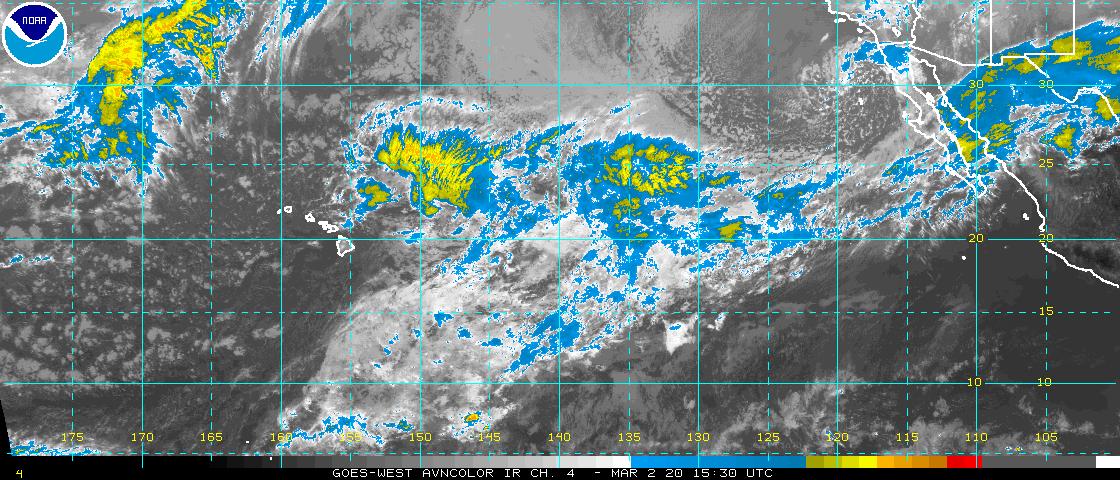
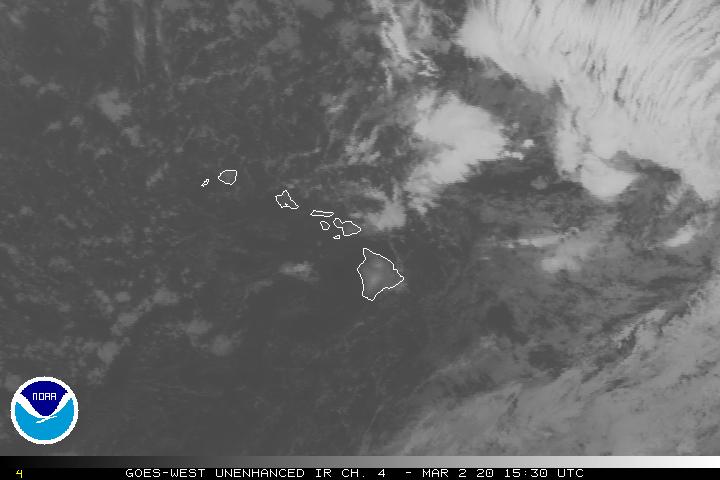
Satellite and Radar Images: To view the cloud conditions we have here in Hawaii, please use the following satellite links, starting off with this Infrared Satellite Image of the islands to see all the clouds around the state during the day and night. This next image is one that gives close images of the islands only during the daytime hours, and is referred to as a Close-up visible image. This next image shows a larger view of the Pacific…giving perspective to the wider ranging cloud patterns in the Pacific Ocean. Finally, here’s a Looping IR satellite image, making viewable the clouds around the islands 24 hours a day. To help you keep track of where any showers may be around the islands, here’s the latest animated radar image.
Hawaii’s Mountains – Here’s a link to the live webcam on the summit of near 14,000 foot Mauna Kea on the Big Island of Hawaii. The tallest peak on the island of Maui is the Haleakala Crater, which is near 10,000 feet in elevation. These two webcams are available during the daylight hours here in the islands…and when there’s a big moon rising just after sunset for an hour or two! Plus, during the nights and early mornings you will be able to see stars, and the sunrise too…depending upon weather conditions.
Tropical Cyclone activity in the eastern and central Pacific – Here’s the latest weather information coming out of the National Hurricane Center, covering the eastern north Pacific. You can find the latest tropical cyclone information for the central north Pacific (where Hawaii is located) by clicking on this link to the Central Pacific Hurricane Center. Here’s a tracking map covering both the eastern and central Pacific Ocean. A satellite image, which shows the entire ocean area between Hawaii and the Mexican coast…can be found here.
Aloha Paragraphs

The Hawaiian Islands
A period of light winds will prevail this week…with returning trade winds holding off until the upcoming weekend. Our trade wind producing high pressure system, now far to the northeast, continues to move further away. This weather map shows this 1031 millibar high pressure cell heading up towards the southern part of the
A cold front is pushing the departing high’s associated ridge down close to the islands, also taking part in the collapse of our recent trade wind flow. This weather map shows this cold front, draping down from a developing storm far to the north-northwest. Our overlying atmosphere will become sultry as this happens, especially near the coasts. We may see our environment become hazy or even voggy, until the trade winds manage to return as we get close to the weekend. The trade winds will do away with the muggy conditions, and whatever haze that may be around until then.
At the same time we have lighter winds, we will also have an unsettled air mass over us…as we begin this new work week. The instability that’s around now, due to the close proximity of a trough of low pressure, will keep the threat of locally heavy showers in the forecast, as well as a chance of flash flood producing thunderstorms. There were reports of flash flooding Sunday night into early Monday morning. The NWS forecast office in
Those wettest areas around the state during the last 24 hours, had precipitation totals ranging between 4.00 and 6.00 inches! This looping IR satellite image shows where the heaviest showers are located, that would be those clouds that are brightest and whitest. The most dynamic showers, and thunderstorms, were located to the north of Kauai and
It’s early Monday evening here in Kihei, as I begin writing this last section of today’s narrative update. As noted in the paragraphs above, the atmosphere remains shower prone, with the chance of more heavy rain, and even a few thunderstorms Monday night into Tuesday. During the day Monday, each of the islands had plenty of clouds stacked-up over them. I could see Molokai, Lanai, West Maui, and east Maui from where I was today, and each one of them had billowing cauliflower-like cumulus clouds growing from their summits. There were some heavy duty showers in places, with the most generous that I saw well established over the island of Oahu. ~~~ As sunset approaches, satellite imagery shows rain producing clouds to the southeast of the Big Island, to the north of Kauai and Oahu, and to the southwest of the islands from Kauai to Maui….as this satellite image points out. ~~~ I’m about ready to head back upcountry to Kula, I see partly cloudy conditions out the window here, although not all that showery looking at the moment. I’ll know more when I get outside, and can check things out during my drive. I’ll be back early Tuesday morning with your next new weather narrative. I hope you have a great Monday night until then! Aloha for now…Glenn.
Interesting: Sitting up straight in your chair isn’t just good for your posture – it also gives you more confidence in your own thoughts, according to a new study. Researchers found that people who were told to sit up straight were more likely to believe thoughts they wrote down while in that posture concerning whether they were qualified for a job.
On the other hand, those who were slumped over their desks were less likely to accept these written-down feelings about their own qualifications. The results show how our body posture can affect not only what others think about us, but also how we think about ourselves, said Richard Petty, co-author of the study and professor of psychology at Ohio State University.
"Most of us were taught that sitting up straight gives a good impression to other people," Petty said. "But it turns out that our posture can also affect how we think about ourselves. If you sit up straight, you end up convincing yourself by the posture you’re in."
Petty conducted the study with Pablo Briñol, a former postdoctoral fellow at Ohio State now at the Universidad Autónoma de Madrid in Spain, and Benjamin Wagner, a current graduate student at Ohio State. The research appears in the October 2009 issue of the European Journal of Social Psychology.
The study included 71 students at Ohio State. When they entered the lab for the experiment, the participants were told they would be taking part in two separate studies at the same time, one organized by the business school and one by the arts school.
They were told the arts study was examining factors contributing to people’s acting abilities, in this case, the ability to maintain a specific posture while engaging in other activities. They were seated at a computer terminal and instructed to either "sit up straight" and "push out [their] chest]" or "sit slouched forward" with their "face looking at [their] knees." While in one of these positions, students participated in the business study, which supposedly investigated factors contributing to job satisfaction and professional performance.
Interesting2: Most gardening books and common wisdom recommend adding fertilizers to soil regularly to help ensure that plants get the major nutrients they need. But Earl Boyd with Lyngso Garden Materials says that adding fertilizer amendments to soil can actually disrupt the balance of nutrients in the soil and destroy trace minerals. A healthy soil can help plants thrive and exchange nutrients.
Fertilizers won’t kill plants, but they won’t support healthy soils either, Boyd said. His company sells a range of composts, mulch, granite and other products for environmentally sustainable gardening, most of which is produced locally in the San Francisco Bay Area. "Soil fertility is a whole system," agreed Jason Diestel, of Diestel Turkey Ranch, which provides premium compost for Lyngso Garden Materials and other landscapers.
A good quality compost can improve the soil far more than other amendments by making it more porous, and balancing the nutrients so that plants can thrive over a longer time. In clay soils like those found around the San Francisco Bay area, adding compost can break up clay so that water can penetrate into the earth, while losing less moisture from run-off.
A healthy soil also allows beneficial insects, earthworms and other creatures to crawl around and work the soil, which opens it up and allows more air to flow through. In turn, this aeration allows the soil to hold more water. This means that people don’t need to water their lawns and gardens as often. Better water retention translates to improving energy efficiency around the house.
It can cool down the home, and help balance temperatures in the yard. This energy efficiency savings is one aspect of getting a home or building LEED-certified, but it’s beneficial even to consumers who don’t need to think about earning points with for LEED. Compost can also provide a time and money-saving benefit, by "healing" the soil over time so that fewer amendments are needed as the years go by, Diestel said.
In contrast, those who use fertilizers may end up needing to add the same amount or more over time as their soils are depleted of minerals. Boyd said the only amendment he recommends to most home gardeners is to add a good compost at the end of the year and a good mulch to help the soil retain moisture. Not all composts are the same, Diestel explained.
For example, city composts created from residents’ yard clippings generally contain large sticks and materials that are clearly not broken down all the way, meaning that the compost doesn’t have as many nutrients available to plants. Cities often don’t let their compost break down all the way, because they’re trying to process such a large volume of material produced by residents. Curbside collection can also get contaminated by junk that people throw in their yard waste containers, Diestel said.
Interesting3: In the wake of the world’s worst mass extinction 250 million years ago, life on Earth was nearly nonexistent. All across the supercontinent Pangea, once lush forests lay in ruins, the corpses of trees poking like matchsticks into the poisoned air. In their place fungus ruled the land, according to a new study. It feasted on defunct wood, spreading across the planet in an orgy of decay.
The finding offers evidence against an alternative theory that rampant algae fed off the dead forests and puts to rest an old idea that an asteroid impact may have had a hand in the massive destruction. "This [fungus] was a disaster species, something that perhaps enjoyed the extinction a little more than it should," Mark Sephton of Imperial College London in the United Kingdom said.
"It proliferated all over the globe." The finding has important implications for the Permian-Triassic extinction, which wiped out a large majority of life on the planet. If the fossils had turned out to be algae, it would’ve suggested a soggy, swampy world dominated by gradual changes in climate and the environment.
Interesting4: Old, "multiyear" ice — the glue that holds the polar ice cap together and forms the Arctic’s defense against encroaching warming — is slowly disintegrating, a process that is plain to see from the air. Thick ice floes used to be miles wide just over a decade ago, said Jim Overland, a sea-ice expert with the U.S. National Oceanic and Atmospheric Administration, who has been surveying the site since the 1990s.
Now the narrow floes — with bright-white tops and a blue underwater glow — are just meters (yards) wide, observed Overland as he studied the patterns from the window of a U.S. Coast Guard C-130 aircraft. The dense, high-quality ice is not coming back, Overland said. "That’s a one-way street," he said "We have the same amount of multiyear ice this year as last year, even though we have a little more ice overall."
Interesting5: A new analysis of climate risk, published by researchers at MIT and elsewhere, shows that even moderate carbon-reduction policies now can substantially lower the risk of future climate change. It also shows that quick, global emissions reductions would be required in order to provide a good chance of avoiding a temperature increase of more than 2 degrees Celsius above the pre-industrial level — a widely discussed target.
But without prompt action, they found, extreme changes could soon become much more difficult, if not impossible, to control. Ron Prinn, co-director of MIT’s Joint Program on the Science and Policy of Global Change and a co-author of the new study, says that "our results show we still have around a 50-50 chance of stabilizing the climate" at a level of no more than a few tenths above the 2 degree target.
However, that will require global emissions, which are now growing, to start downward almost immediately. That result could be achieved if the aggressive emissions targets in current U.S. climate bills were met, and matched by other wealthy countries, and if China and other large developing countries followed suit with only a decade or two delay.
That 2 degree C increase is a level that is considered likely to prevent some of the most catastrophic potential effects of climate change, such as major increases in global sea level and disruption of agriculture and natural ecosystems. "The nature of the problem is one of minimizing risk," explains Mort Webster, assistant professor of engineering systems, who was the lead author of the new report.
That’s why looking at the probabilities of various outcomes, rather than focusing on the average outcome in a given climate model, "is both more scientifically correct, and a more useful way to think about it." Too often, he says, the public discussion over climate change policies gets framed as a debate between the most extreme views on each side, as "the world is ending tomorrow, versus it’s all a myth," he says.
"Neither of those is scientifically correct or socially useful." "It’s a tradeoff between risks," he says. "There’s the risk of extreme climate change but there’s also a risk of higher costs. As scientists, we don’t choose what the right level of risk for society, but we show what the risks are either way."
The new study, published online by the Joint Program in September, builds on one released earlier this year that looked at the probabilities of various climate outcomes in the event that no emissions-control policies at all were implemented — and found high odds of extreme temperature increases that could devastate human societies. This one examined the difference that would be made to those odds, under four different versions of possible emissions-reduction policies.
Interesting6: Norway is the best place in the world to live while Niger is the least desirable, according to an annual report by the United Nations. The 182 countries were ranked according to the quality of life their citizens experienced. Criteria examined included life expectancy, literacy rates, school enrolment and country economies. However the UN human development index used data collected in 2007 – before the global economic crisis.
The UN Development Program said the index highlighted the grave disparities between rich and poor countries. Norway’s consistently high rating for desirable living standards, is, in large part, the result of the discovery of offshore oil and gas deposits in the late 1960s. Niger, however, is a drought-prone country which has sometimes struggled to feed its people.
Other countries to reach the top spots were Australia and Iceland. However, living standards in Iceland have changed since the data was collected, as it was one of the countries worst hit by the credit crunch. The 2008 crisis exposed the Icelandic economy’s dependence on the banking sector, leaving it particularly vulnerable to collapse.
The country’s three major banks were nationalized and Iceland had to seek international support in order to stay afloat. UN deputy director Eva Jespersen told the BBC News website that although the country’s now-reduced gross domestic product figure would "pull Iceland down" next year, its high life expectancy rates and commitment to education would "cushion the decline to some degree".
Afghanistan was regarded the second least desirable place to live, just below Sierra Leone in third from bottom place. The index shows that life expectancy in Niger was 50 years – approximately 30 years shorter than for those living in Norway. For every dollar earned per person in Niger, $85 was earned in Norway. However, the Democratic Republic of Congo has the poorest people, where the average income per person was $298 per year.
hina has become one of the most improved because of rising income levels and life expectancy rates. The United States is rated as the 13th most desirable place to live, while the UK takes the 21st spot. The index also showed that half the people in the poorest 24 nations were believed to be illiterate. The tiny principality of Liechtenstein has the highest GDP per capita at $85,383. Its population is about 35,000.
The report’s author, Jeni Klugman, said: "Many countries have experienced setbacks over recent decades, in the face of economic downturns, conflict-related crises and the HIV and Aids epidemic. "And this was even before the impact of the current global financial crisis was felt."
 Email Glenn James: